• Link to X
  • Link to Instagram
  • Link to Youtube
  • Link to Facebook
  • Link to WhatsApp
CALL: (503)526-3887 or EMAIL: info@raindropnw.com
RAINDROP ROOFING NW | PORTLAND, OR
  • Home
  • About Us
    • About Raindrop Roofing NW
    • Our Team
    • Areas We Serve
    • Who We Support
    • Our Commitment to a Greener Future
    • Careers
    • Blog
  • Residential Roofing
    • Services
      • New / Replacement Roofs
      • Repairs and Maintenance
      • Remodels and Additions
      • Balconies, Patios, and Flat Decks
      • Roof Inspections and Certifications
    • Financing
    • Roof Gallery
    • Roof Types and Products
    • Manufacturer-Certified Roofing Contractor
    • Owner Resources
  • Commercial Roofing
    • Services
      • New and Replacement Roofs
      • Estimates and Inspections
      • Warranties
      • Real Estate Partnerships
      • Roof Certifications
    • Commercial Gallery
    • Roof Types and Products
    • Featured Project
  • Reviews
  • Contact Us
  • Menu Menu
You are here: Home1 / Roofing

Why Local Independent Roofers Are My Favorite Over Corporate Chains

Roofing

Why Local Independent Roofers Outperform Corporate Chains — And Why It Matters for Your Home

Understanding why local independent roofers outperform corporate chains could be one of the most valuable things you do before signing a roofing contract. Here is a quick answer if you are short on time:

Why local independent roofers outperform corporate chains:

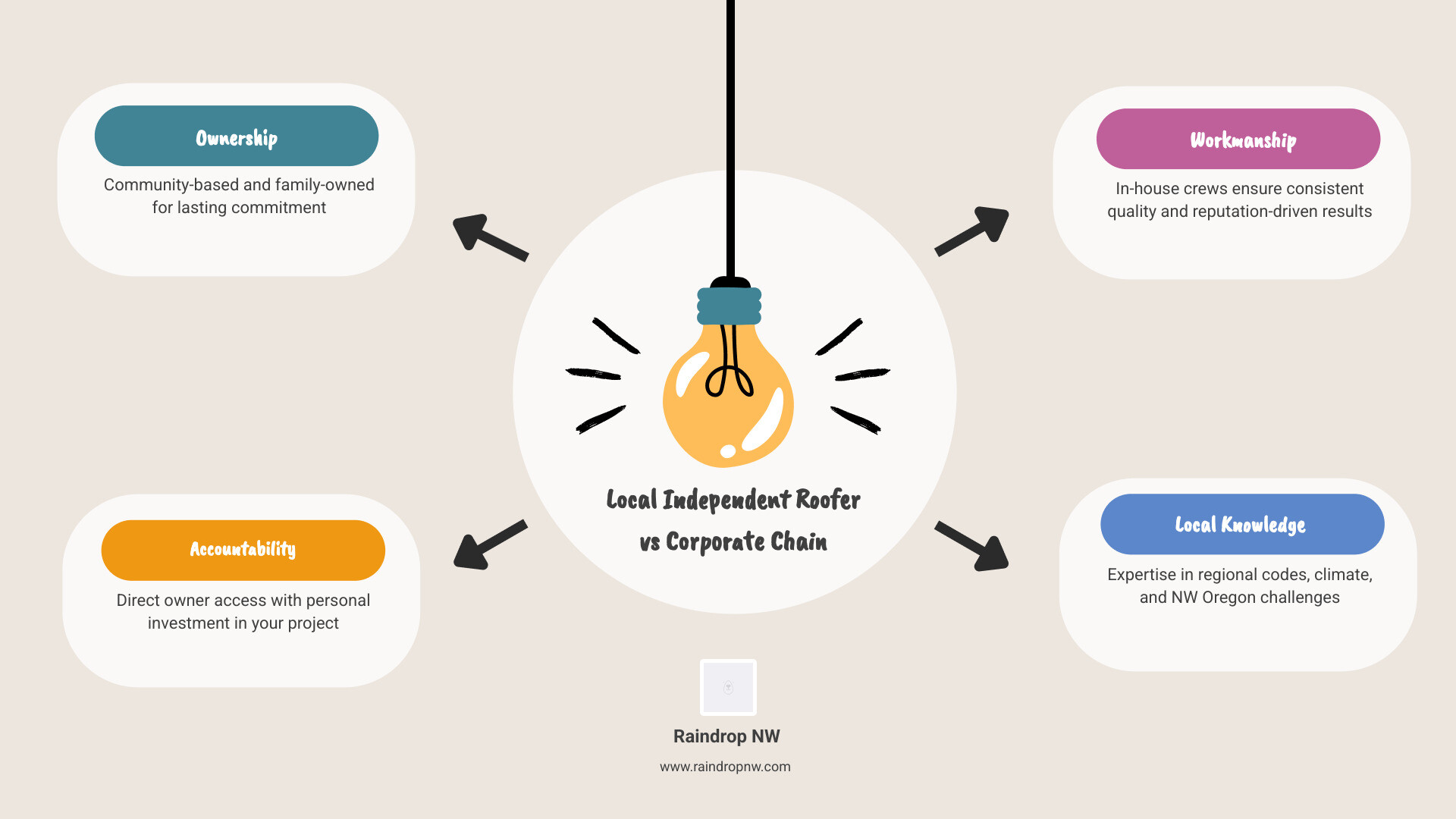
  • Direct accountability — The owner’s name and reputation are on the line with every job, not a distant corporate office
  • In-house crews — Local independents typically use their own trained workers, not rotating piece-rate subcontractors
  • Local knowledge — They understand Oregon building codes, permit processes, regional weather patterns, and neighborhood-specific conditions like moss growth and Douglas fir debris
  • More of your money goes to your roof — Without franchise royalties and corporate overhead draining the budget, more resources go toward quality materials and skilled labor
  • Warranty you can actually use — A locally owned company is far less likely to be sold, restructured, or dissolved before your warranty period ends
  • Faster emergency response — Local crews are already in your area and can respond quickly after a storm, without routing calls through a national dispatch center
  • Community investment — Hiring local keeps significantly more dollars circulating in the Beaverton and Portland-metro economy

Right now, private equity firms are acquiring U.S. roofing companies at a staggering pace — roughly one platform acquisition every 48 hours as of mid-2025. Many of these firms keep the original company name on the truck and the website, making it nearly impossible for homeowners to tell the difference between a truly local roofer and a corporate roll-up backed by out-of-state investors. For Oregon homeowners making a major investment in their home, that distinction is not just interesting — it is critical.

The roofing industry’s own data tells a clear story. Research shows that national chains typically charge significantly more than independent contractors for equivalent work, while subcontracting the actual installation to local crews — the same crews you could hire directly. Meanwhile, only about 14 cents of every dollar spent with a corporate roofing firm stays in the local economy, compared to roughly 68 cents when you hire a truly independent local contractor.

I am Torrey Yungeberg, owner of Raindrop Roofing NW, a family-owned roofing company rooted in Beaverton, Oregon, and I have seen why local independent roofers outperform corporate chains — from the quality of the work on the roof to the integrity of the warranty backing it. I will walk you through exactly what separates a genuinely local roofer from a corporate operation, and what to look for before you hire anyone to touch your home.
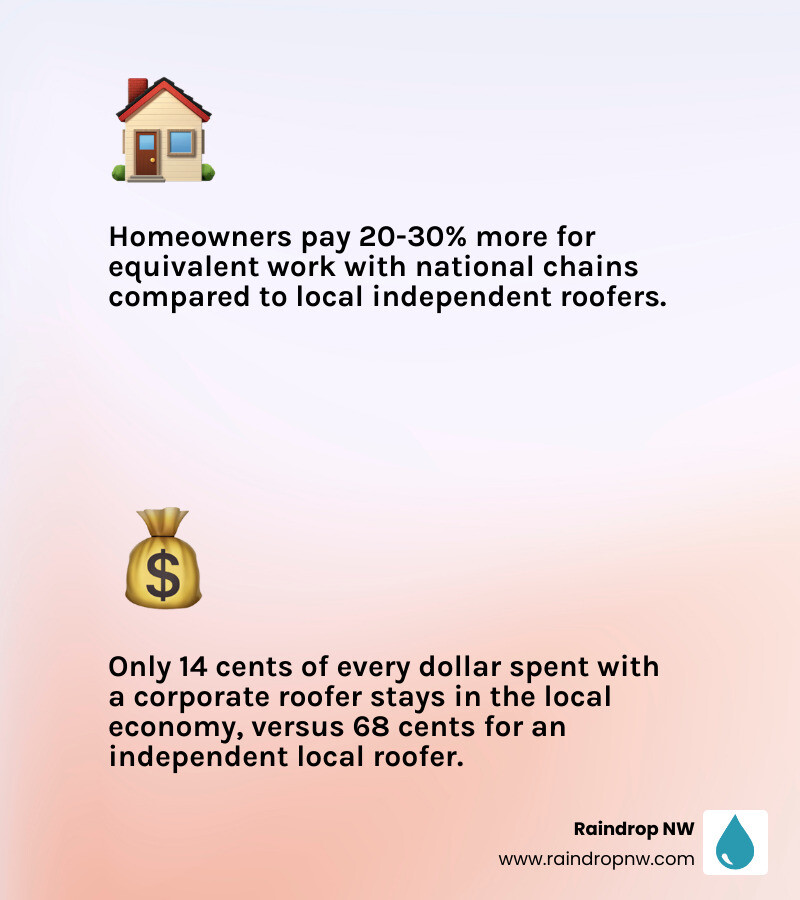
infographic comparing local independent roofers vs corporate chains on accountability, crew type, cost allocation, and

Why Local Independent Roofers Outperform Corporate Chains: The Operational Reality

local roofing crew working on a home in Beaverton

When you look at a glossy brochure from a national roofing franchise, it is easy to assume that their massive size translates into a better experience. However, the operational reality behind the scenes is often very different. The structural differences between how local independent roofers and corporate chains run their day-to-day businesses directly impact the safety, quality, and longevity of your roof.

To understand the core differences, it helps to look at a direct Local Independent Roofer vs Corporate Chain Comparison. Corporate chains are built on standardized playbooks designed to maximize profit margins for out-of-state investors. They rely on high-volume sales, aggressive marketing, and rapid turnover.

In contrast, the Benefits of Choosing a Truly Local Independent Roofer stem from a business model built on community trust, local referrals, and direct, hands-on management. When a company is locally owned and operated, the leadership is directly involved in the daily operations, ensuring that quality is never sacrificed for speed.

Understanding Why Local Independent Roofers Outperform Corporate Chains in Workmanship

The single most critical factor in how long your roof will last is the quality of the installation. Even the highest-grade architectural shingles will fail prematurely if they are installed incorrectly. This is where the gap between local independents and corporate chains becomes most apparent.

Most national roofing franchises operate on a subcontracting model. Because they manage multiple territories across different states, they do not maintain permanent, hourly-paid installation crews in every market. Instead, they hire local third-party subcontractors to do the actual physical labor. This means the crew on your roof might have no long-term connection to the company that sold you the job.

Furthermore, these subcontractors are almost always paid on a “piece-rate” basis — meaning they are paid a flat rate for every “square” (a 100-square-foot section) of roofing they install. This compensation model creates an inherent conflict of interest:

  • The speed incentive: Because the crew is paid by the job rather than by the hour, they are heavily incentivized to work as fast as possible. Speed becomes the ultimate goal, which often leads to critical details being rushed or skipped entirely.
  • The high-nailing problem: To move fast, installers using pneumatic nail guns may shoot nails too high on the shingle, missing the manufacturer’s designated nail line. “High-nailing” drastically reduces wind resistance and immediately voids the manufacturer’s wind warranty.
  • Ignoring hidden damage: When a piece-rate crew tears off an old roof and finds rotted plywood decking beneath it, stopping to replace the wood slows them down and cuts into their daily earnings. In a rushed corporate system, there is a strong temptation to simply roof over the rot, trapping moisture inside your attic.

Truly independent local roofers typically employ dedicated, hourly-paid in-house crews. Because our installers are paid hourly and managed directly by a local project supervisor, they are incentivized to take their time and do the job right. We emphasize meticulous craftsmanship over speed, ensuring that every flashing detail, underlayment layer, and shingle nail is installed to exact specifications. If you want to make sure your project is handled with this level of care, it is essential to learn How to Choose the Right Roofing Contractor who prioritizes internal quality control over volume.

Why Local Independent Roofers Outperform Corporate Chains in Long-Term Accountability

A roofing warranty is only as good as the company standing behind it. When you hire a national franchise, your warranty is often managed by a distant corporate office, which can make resolving future issues incredibly frustrating. If a leak occurs, you are forced to navigate automated phone trees, deal with out-of-state representatives, and wait for a regional coordinator to schedule a third-party inspection.

This issue has become even more pronounced with the recent boom in private equity roll-ups. When an investment firm buys a successful local roofing company, they often execute a standard five-year corporate lifecycle:

  1. Year 1: Maintain the local brand name and “family-owned” marketing facade to retain local goodwill, while quietly cutting operational costs.
  2. Year 2: Implement high-pressure sales scripts and commission-based quotas to drive up short-term revenue.
  3. Year 3: Expand profit margins by substituting premium materials with cheaper alternatives (often called “value engineering”) and squeezing labor rates.
  4. Year 4: Restructure the business or create corporate shell layers, making it incredibly difficult for past customers to seek warranty repairs.
  5. Year 5: Flip the consolidated “platform” to a larger conglomerate or another private equity firm, completely severing any remaining ties to the local community.

When a corporate roofer sells out or restructures, your workmanship warranty can easily disappear in the legal shuffle. Understanding How Independent Ownership Protects Your Warranty is vital for long-term peace of mind. Genuinely independent roofers do not have to worry about satisfying out-of-state shareholders or preparing the business for a corporate flip.

By Choosing a Roofing Company That Won’t Sell Out, you ensure that the same local team that installed your roof will be there to service it ten, fifteen, or twenty years down the road. Our reputation in Beaverton and the Portland metro area is our most valuable asset, and we protect it by honoring our promises directly.
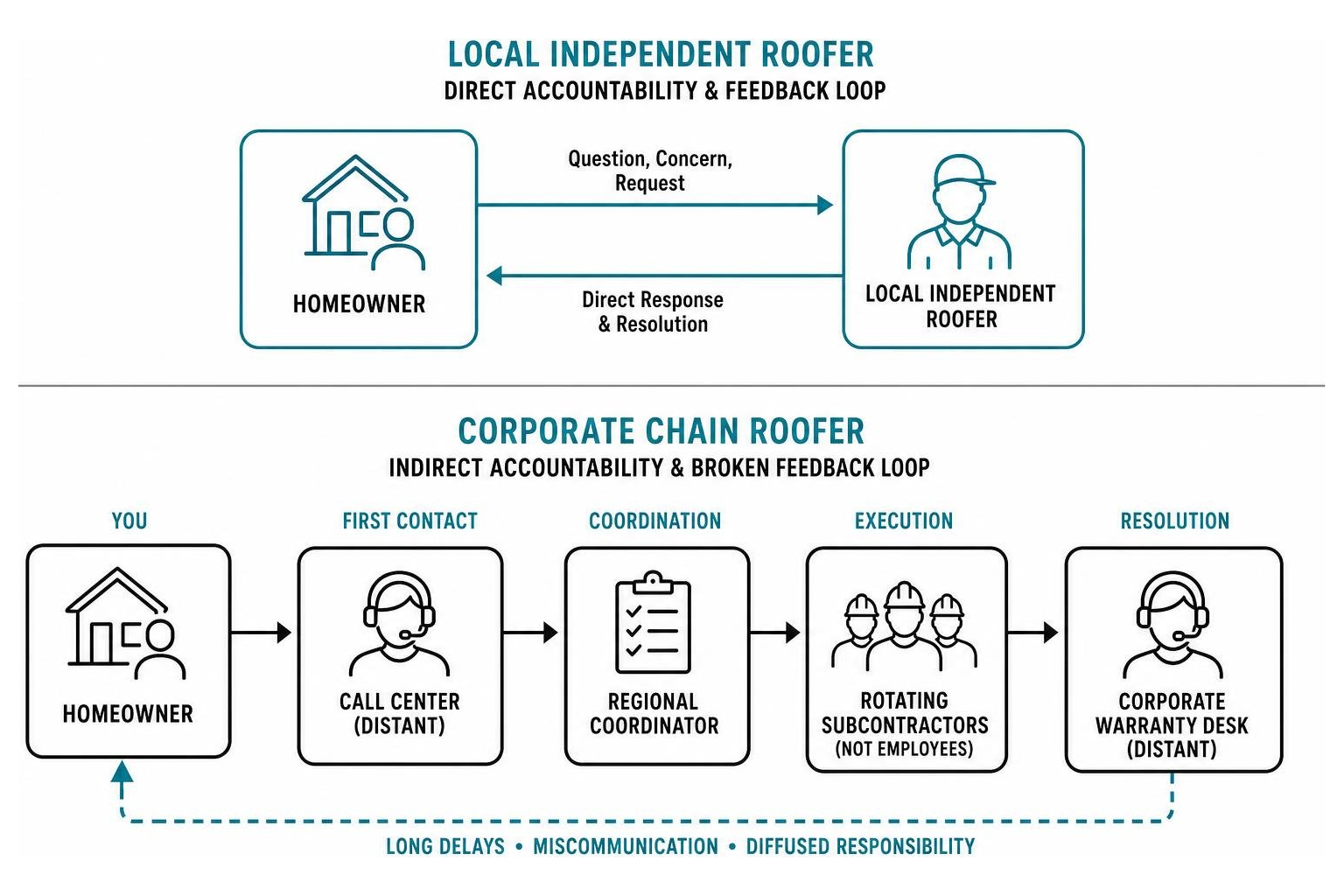
diagram showing the flow of accountability: local independent roofer has a direct feedback loop to the homeowner, while

The Financial Structure: Franchise Fees vs. Local Value

One of the most common questions homeowners ask is why national roofing chains typically charge 20% to 40% more than local independent contractors for the exact same work. The answer lies in the complex financial structure of corporate franchise systems.

When you sign a contract with a national franchise, a significant portion of your hard-earned money never actually touches your roof. Instead, it is siphoned off to cover corporate overhead and franchise-specific expenses:

  • Franchise Royalties: Franchisees must pay a permanent “brand tax” to their national corporate office, which typically ranges from 6% to 9% of their top-line gross revenue. This royalty fee must be paid on every single job, even self-generated word-of-mouth referrals.
  • National Advertising Funds: Franchise agreements usually require owners to contribute an additional 1% to 3% of their revenue to a national marketing fund to pay for expensive television commercials, digital campaigns, and corporate branding.
  • Corporate Debt Servicing: Many consolidated corporate roofing platforms are built using heavy leverage (borrowed money). Around 15% of every dollar spent with a PE-owned firm often goes directly toward servicing the high-interest debt used to acquire the business.
  • High Sales Commissions: Corporate sales representatives are frequently paid purely on commission, with strict monthly quotas. To hit their targets, they use high-pressure sales tactics and mark up contract prices to secure larger commission checks.

Because independent local roofers do not have to pay franchise royalties, national marketing fees, or corporate debt, we can allocate our resources much more efficiently. We pass those overhead savings directly to you by investing in superior materials and highly skilled, fairly compensated local installers.

Feature / Resource Allocation Truly Local Independent Roofer Corporate / Franchise Chain
Workmanship & Materials High (Approx. 60% of project budget) — Invested in premium shingles, synthetic underlayment, and skilled hourly labor Low (Approx. 40% of project budget) — Squeezed to maintain corporate profit margins
Sales & Marketing Costs Low (Approx. 5%) — Driven primarily by local word-of-mouth, community reputation, and organic search High (Approx. 20%) — Spent on aggressive lead-generation platforms, national ads, and sales commissions
Franchise Fees & Royalties 0% — No out-of-state corporate “brand tax” 6% to 9%+ — Mandated top-line royalty payments to corporate headquarters
Debt & Investor Dividends 0% — Self-sustained, locally owned business Approx. 15% — Allocated to private equity debt servicing and out-of-state investor returns
Local Wealth Retention High (Approx. 68%) — Money stays in the Beaverton and Portland metro area Low (Approx. 14%) — Most revenue is immediately siphoned out of state

Local Knowledge and Verifying Contractor Credentials in Beaverton

Pacific Northwest weather presents unique challenges that out-of-state corporate coordinators simply do not understand. In Beaverton, Portland, Hillsboro, and surrounding communities, our roofs must contend with continuous, heavy rainfall, high humidity, freeze-thaw cycles, and heavy shade from Douglas fir trees.

This environment requires micro-climate expertise. For example, a local independent roofer knows that:

  • Moss mitigation is non-negotiable: Continuous moisture combined with shade from Douglas firs creates the perfect breeding ground for moss, which lifts shingles and traps water. Local experts install specialized zinc or copper strips and recommend algae-resistant shingles designed specifically for our wet climate.
  • Debris management matters: Pine needles and heavy leaf debris from local trees can quickly clog gutters and valley flashing, causing water to back up under the shingles. We design custom flashing and gutter protection systems to handle these specific local conditions.
  • Building codes are highly localized: Building departments in Clackamas, Washington, and Multnomah counties have distinct permitting processes and local code interpretations. A regional coordinator in a distant corporate office lacks the personal relationships and experience required to navigate these local building departments efficiently, which often leads to failed inspections and project delays.

Regardless of whether you choose a local independent or a national chain, protecting your home means doing your homework. You should never take a contractor’s marketing claims at face value.

Before signing any contract, it is highly recommended to review the essential Questions to Ask Before Hiring a Roofer to ensure they have the proper operational setup to handle your project.

In Oregon, verifying a contractor’s credentials is straightforward. You can easily learn How to Verify a Roofer’s License and Insurance by visiting the Oregon Construction Contractors Board (CCB) website. Every legitimate roofer must have an active CCB license, which you can search using their business name or license number.

Checking the CCB registry allows you to confirm:

  1. Active License Status: Ensure their license is active and in good standing.
  2. Liability Insurance & Bond: Verify they carry active commercial general liability insurance (we recommend at least $1 million) and a current consumer bond.
  3. Workers’ Compensation: Ensure they have active workers’ compensation insurance to protect you from liability if an installer is injured on your property.
  4. Dispute History: The CCB website will display any past or pending consumer complaints filed against the business.

Understanding How Consistent Licensing Protects Past and Future Customers is a critical part of consumer safety. When corporate chains buy out local companies or restructure their corporate entities, they often change their CCB license numbers, effectively wiping away their public dispute history and leaving past customers with no clear legal recourse. A family-owned business that has maintained the exact same license number for decades demonstrates long-term stability and a clean track record.

Additionally, look for elite manufacturer certifications. Because of our long-term local presence, independent roofers often maintain deep, direct relationships with top manufacturers. Knowing How Manufacturer Certifications Indicate Quality helps you identify contractors who have been rigorously vetted by the shingle manufacturers themselves. These certifications allow us to offer robust, manufacturer-backed extended warranties that protect your investment even in the highly unlikely event that the local contractor eventually closes their doors.

Frequently Asked Questions About Choosing a Roofer

How do local roofers handle emergency repairs and storm damage?

When a severe windstorm hits the Portland metro area, local independent roofers can respond far faster than national corporate chains. Because our trucks, crews, and materials are already located right here in Beaverton, we can quickly dispatch teams to perform rapid mitigation, such as tarping damaged areas to prevent water from destroying your home’s interior drywall.

In contrast, national chains often route emergency calls through centralized out-of-state call centers, creating communication delays. Furthermore, during major weather events, out-of-state “storm chasers” often flood the local market to secure quick insurance payouts, only to disappear as soon as the storm passes, leaving homeowners with no local contact if the repairs fail.

Do independent roofers have access to premium materials?

Yes, absolutely. In fact, independent roofers often have better, more flexible relationships with local material suppliers and major manufacturers. Because we are not locked into rigid, corporate-mandated national vendor contracts, we can select the absolute best products for our unique Pacific Northwest climate—such as high-impact Class 4 shingles and advanced synthetic underlayment.

Our manufacturer-certified status ensures we have direct access to premium roofing systems and can offer the highest level of manufacturer-backed warranties.

How does supporting a local roofer benefit the Beaverton community?

When you hire a truly independent, family-owned local roofer, your money stays in the community. Studies show that local independent businesses retain approximately 68 cents of every dollar locally, compared to just 14 cents for corporate, PE-owned firms.

We buy our materials from local suppliers, pay competitive hourly wages to local installers, and pay local taxes that fund our schools, parks, and roads. Supporting a local business creates a cycle of economic growth that directly benefits your neighbors and the local economy, rather than siphoning wealth to out-of-state investment firms and corporate shareholders.

Conclusion

At the end of the day, your roof is your home’s primary line of defense against the elements. Entrusting it to a company that views your ZIP code as a corporate revenue target can lead to rushed workmanship, hidden costs, and frustrating customer service.

At Raindrop NW, we are proud to be a multi-generational, family-owned roofing company rooted right here in Beaverton, Oregon. We serve our neighbors throughout the Portland metro area with honest communication, certified craftsmanship, and direct, personal accountability. We live where we work, and we treat every roof we install as if it were protecting our own family.

If you are ready to experience the difference that a truly local, independent roofing company can make, we invite you to reach out to us today. Schedule a Free Inspection with Raindrop NW and let our family take care of yours.

https://www.raindropnw.com/wp-content/uploads/2026/07/pexels-photo-11467876.avif 627 940 SEO Stats https://www.raindropnw.com/wp-content/uploads/2024/05/logo-raindrop-space-300x92.png SEO Stats2026-07-27 07:40:362026-07-27 07:40:36Why Local Independent Roofers Are My Favorite Over Corporate Chains

An Essential Guide to Moss and Algae Prevention on Pacific Northwest Roofs

Roofing

Why Moss and Algae Prevention on Pacific Northwest Roofs Is One of the Most Important Things You Can Do for Your Home

Moss and algae prevention on Pacific Northwest roofs is something every homeowner in this region needs to take seriously — not someday, but now. If you live in the Portland metro area or anywhere in western Oregon, your roof is under near-constant biological attack. The rain, the shade, the cool temperatures, the towering Douglas firs — all of it creates a perfect incubator for moss and algae growth that simply doesn’t exist at the same intensity anywhere else in the country.

Here’s a quick summary of the most effective prevention steps for PNW homeowners:

  1. Install zinc or copper ridge strips to continuously release moss-inhibiting ions every time it rains.
  2. Trim overhanging tree branches to at least 4–6 feet of clearance from the roofline to reduce shade and debris.
  3. Clean gutters at least twice a year to prevent moisture backup and organic debris buildup.
  4. Remove roof debris annually using a leaf blower or soft brush to eliminate the organic material moss feeds on.
  5. Apply a moss treatment (zinc sulfate solution or a 50/50 bleach-and-water mix per ARMA guidelines) every 1–3 years depending on your tree coverage and sun exposure.
  6. Choose algae-resistant shingles with copper-infused granules if you’re replacing your roof.
  7. Schedule a professional roof inspection at least once a year to catch growth early before it causes real damage.

The stakes are real. A 30-year architectural shingle roof in the Pacific Northwest that receives no moss management will typically fail somewhere between 18 and 22 years — cutting off nearly a third of its expected lifespan. With consistent, proactive care, that same roof can reach or even exceed its full service life. That’s not a minor difference. That’s years of protection and thousands of dollars.

I’m Torrey Yungeberg, owner of Raindrop Roofing NW, a family-owned roofing company based in Boring, Oregon, and I’ve spent years helping Portland-area homeowners tackle the unique challenge of moss and algae prevention on Pacific Northwest roofs firsthand. In this guide, I’ll walk you through exactly what’s growing on your roof, why it’s so aggressive here, and what actually works to stop it.

Moss vs algae lifecycle on PNW roofs: growth stages, causes, and prevention methods infographic

Moss vs. Algae: Understanding the Threat to PNW Roofs

black algae streaks on asphalt shingles

Before we can dive into prevention, we have to know exactly what we are fighting. Many homeowners look up at their roofs, see dark stains or green clumps, and lump it all together as “gunk.” However, moss and algae are entirely different organisms. Treating them the same way is a recipe for wasted effort.

Gloeocapsa Magma (The Black Streak Culprit)

That dark, dirty-looking discoloration that makes your roof look decades older than it actually is? That isn’t dirt, soot, or mold. It is a hardy, ancient strain of cyanobacteria called Gloeocapsa magma, commonly referred to as blue-green algae.

Algae spores are airborne and travel easily from roof to roof throughout neighborhoods in Beaverton, Lake Oswego, and Tigard. Once they land on your shingles, they need three things to thrive: moisture, shade, and nutrients.

Our local climate provides the moisture and shade in abundance. As for the nutrients, modern asphalt shingles use limestone as a heavy filler material during manufacturing. To Gloeocapsa magma, your shingles are essentially an all-you-can-eat buffet. To protect itself from the sun’s harsh UV rays, this cyanobacteria develops a dark, pigmented sheath. This sheath acts as a natural sunscreen, which is why the algae manifests as ugly black streaks on your roof.

While algae is mostly an aesthetic issue, it can reduce your roof’s solar reflectivity, causing your home to absorb more heat during our increasingly warm Northwest summers. To understand how our local weather patterns accelerate these biological challenges, read more about How Portland Metro Climate Affects Your Roof.

Dicranoweisia Cirrata and Bryum Capillare (The True Moss Threats)

Unlike algae, moss is a non-vascular plant. It doesn’t have true roots, nor does it flowers or seeds. Instead, species like Dicranoweisia cirrata and Bryum capillare absorb water directly through their leaves. They anchor themselves to your shingles using tiny, hair-like structures called rhizoids.

These rhizoids burrow deep into the microscopic pores of your asphalt shingles, concrete tiles, or wood shakes. Once established, moss acts like a sponge, holding up to 20 times its own weight in water. This keeps your roofing materials in a state of constant saturation.

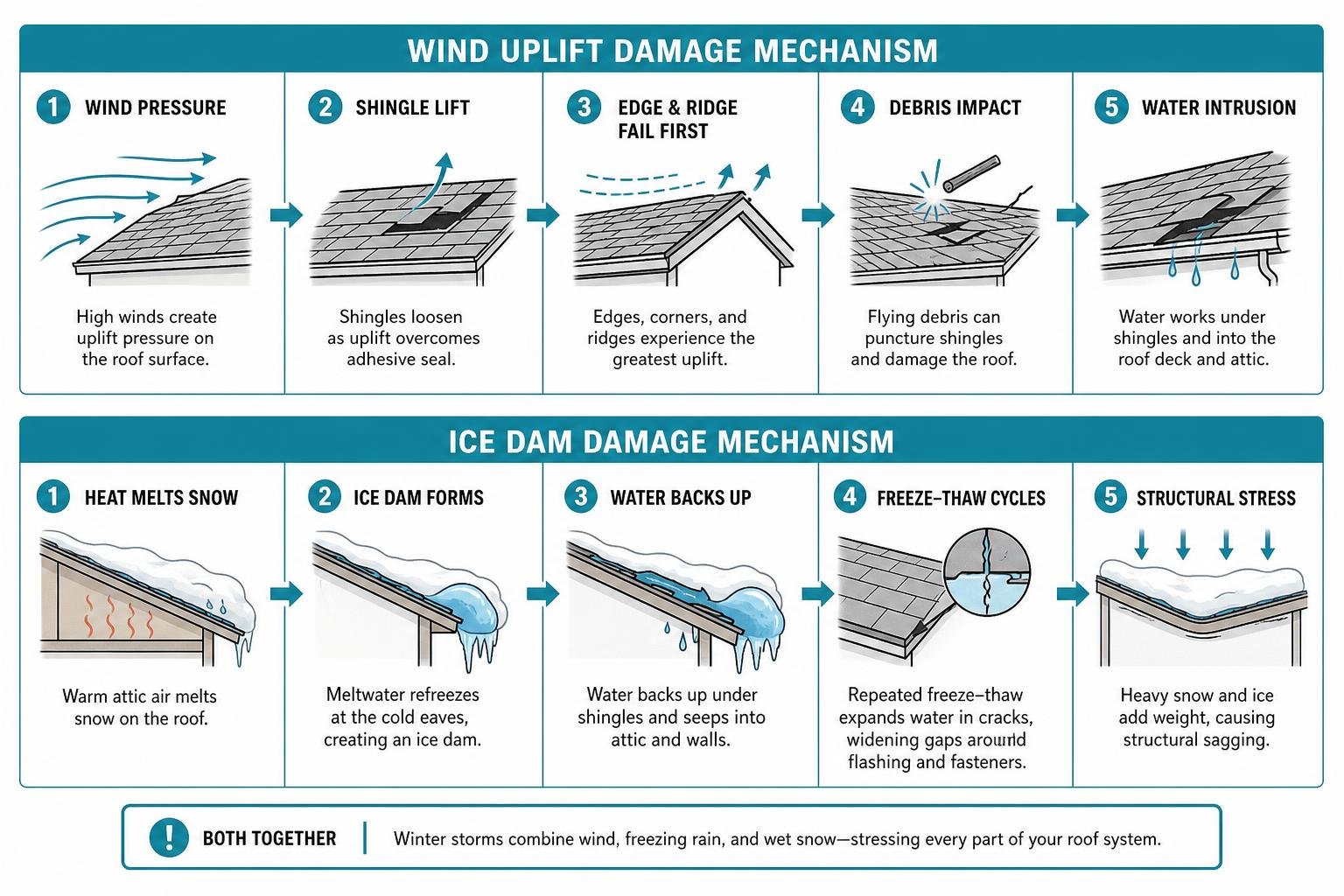
During the winter months, when temperatures in Gresham, Hillsboro, and Vancouver hover in the chilly 40s and 50s, this trapped water goes through freeze-thaw cycles. As the water expands, it physically forces the leading edges of your shingles to lift, curl, and warp. This creates direct pathways for water to seep underneath, rot the roof deck, and ruin your underlayment.

This constant exposure to moisture is why local roofs degrade so quickly without intervention. For an in-depth look at how our persistent rain impacts your home, check out How Persistent Rain and Humidity Stress Your Roof.

To help you tell these invaders apart, here is a quick comparison:

Characteristic Roof Algae (Gloeocapsa magma) Roof Moss (Dicranoweisia cirrata / Bryum capillare)
Appearance Dark green or black vertical streaks; looks like dirt or soot. Thick, green, carpet-like clumps or cushions.
Structure Microscopic single-celled cyanobacteria; no physical structure. Primitive, non-vascular plant with tiny leaves and holding rhizoids.
Primary Food Source Limestone filler inside modern asphalt shingles. Organic debris, dust, and moisture trapped on the roof.
Structural Damage Low (mainly cosmetic, though it reduces thermal efficiency). High (lifts shingles, traps moisture, causes wood rot and leaks).
Spread Method Airborne spores carried by wind and birds. Spores and physical fragments washed down by rain or wind.

Proactive Moss and Algae Prevention on Pacific Northwest Roofs

If you want to keep your roof healthy, you have to transition from reactive cleaning to proactive prevention. Waiting for a thick green carpet to form before taking action means you are already losing shingle granules and compromising your roof’s structure.

The secret to long-term moss and algae prevention on Pacific Northwest roofs lies in altering the physical environment of your roof so these organisms cannot take root in the first place. This approach is highly effective and saves you from the wear and tear of repeated, aggressive cleanings. For more practical strategies on maintaining a healthy roof, take a look at our guide on How to Extend the Life of Your Roof in Rainy Climates.

Ridge Strips and Chemical Barriers for Moss and Algae Prevention on Pacific Northwest Roofs

One of the most elegant, passive prevention methods available is the installation of zinc or copper ridge strips. These are thin rolls of galvanized metal installed directly along the peaks and ridges of your roof.

Every time it rains, water washes over these metal strips. This process slowly dissolves minute amounts of zinc or copper, releasing metallic ions that flow down the slope of your roof. These ions disrupt the cellular metabolism of moss and algae spores, preventing them from anchoring to your shingles.

You have likely seen this science in action on older homes around Oregon City or Camas. If a house has a galvanized metal chimney flashing or a plumbing vent, the shingles directly beneath that metal are clean, bright, and completely free of moss, while the rest of the roof is covered in green growth.

For the best results, we recommend combining a professional zinc sulfate spray treatment with physical ridge strips. The spray treatment provides immediate protection for 12 to 24 months, while the metal strips provide continuous, long-term defense for up to a decade or more.

Material Selection and Design for Moss and Algae Prevention on Pacific Northwest Roofs

If you are planning a roof replacement, you have a golden opportunity to design a system that naturally resists biological growth from day one.

  • Algae-Resistant Shingles: Many modern architectural shingles are manufactured with algae-resistant technology. These shingles incorporate copper-infused granules (such as 3M Copper Granules) directly into the asphalt mix. Over time, these granules slowly release copper ions, providing a built-in defense system that carries manufacturer warranties against algae staining for 10 to 25 years.
  • Standing Seam Metal Roofing: If you want a roof that is virtually immune to moss, standing seam metal is the gold standard. Moss struggles to find purchase on smooth, vertical metal panels, and the material dries out rapidly once the sun emerges.
  • Roof Pitch and Shade Management: Lower-pitch roofs hold water longer, creating a damp playground for spores. While you cannot easily change your roof’s pitch, you can control the shade. Trimming back overhanging branches from Douglas firs, maples, and oaks to create at least 4 to 6 feet of clearance allows sunlight to reach your shingles and helps them dry out faster.

Safe Removal Methods for Existing Moss and Algae

If your roof is already hosting a miniature forest, prevention strips won’t do much good. You need to remove the existing growth first. However, how you remove it is just as important as removing it at all.

The Golden Rule: Never, Ever Pressure Wash Your Shingles

If a contractor pulls up to your home in Beaverton or Tigard with a high-pressure power washer and points it at your asphalt roof, politely ask them to leave.

Pressure washing is the single fastest way to destroy an asphalt shingle roof. The high-pressure stream of water blasts away the protective ceramic granules that shield the underlying asphalt from UV damage. Losing these granules can age your roof by five to ten years in a single afternoon and will almost certainly void your manufacturer’s warranty. Furthermore, spraying water upward or sideways can force water directly under your shingles, saturating your plywood decking and causing immediate leaks.

The Safe, Professional Approach

The safest and most effective method for removing established moss involves a gentle, multi-step process:

  1. Debris Clearing: First, we clear away loose leaves, pine needles, and heavy organic debris using a leaf blower, directing the air down the slope of the roof so we don’t lift the shingles.
  2. Manual Brushing: For thick, established moss colonies, we use a soft-bristled brush to gently scrape away the bulk of the growth. We always work in a downward motion, following the natural flow of water, to prevent lifting or tearing the shingle tabs.
  3. Chemical Soft-Washing: Once the bulk moss is gone, we apply a targeted, low-pressure chemical treatment to kill the remaining microscopic rhizoids and spores.

If you want your roof to last as long as possible, check out our resource on How to Extend the Life of Your Roof.

Here are the most common and effective cleaning solutions used today:

  • Potassium Salts of Fatty Acids: These are biodegradable, soap-based products that are highly effective at breaking down moss without harming adjacent landscaping, pets, or local waterways.
  • Sodium Hypochlorite (Bleach) and Water (50:50 Mix): This is the cleaning method officially recommended by the Asphalt Roofing Manufacturers Association (ARMA). It is highly effective at killing both moss and algae. However, it requires careful handling, protective gear, and thorough rinsing to ensure the runoff doesn’t damage your garden or lawn.
  • Zinc Sulfate Solutions: Excellent for both killing light moss and preventing future growth, this solution bonds well to shingles and provides lasting protection.

Long-Term Maintenance and Professional Inspections

Maintaining a moss-free roof in the Pacific Northwest isn’t a one-and-done project. It requires a consistent, seasonal maintenance routine. Think of it like changing the oil in your car — a little proactive care now saves you from massive, expensive headaches down the road.

To help you keep track of your roof’s condition, read How Regular Inspections Catch Problems Early and learn How Often Should You Have Your Roof Inspected.

Debris Removal and Gutter Maintenance

Moss thrives on organic debris. When autumn leaves, pine needles, and twigs pile up in your roof valleys, behind your chimney, or along your gutters, they create damp, organic mats. These mats trap moisture against your shingles and provide the perfect soil-like environment for moss spores to germinate.

We recommend clearing your roof and cleaning your gutters at least twice a year — once in late spring to clear out maple seeds and blossoms, and once in late fall after the leaves have dropped. Using a leaf blower or a soft-bristled broom to keep these areas clean prevents water from backing up under your shingles. For a complete overview of regional roof care, explore The Ultimate Guide to Roof Care in Portland Oregon.

Attic Ventilation and Airflow

Many homeowners are surprised to learn that what happens inside their attic directly impacts moss growth outside on their roof.

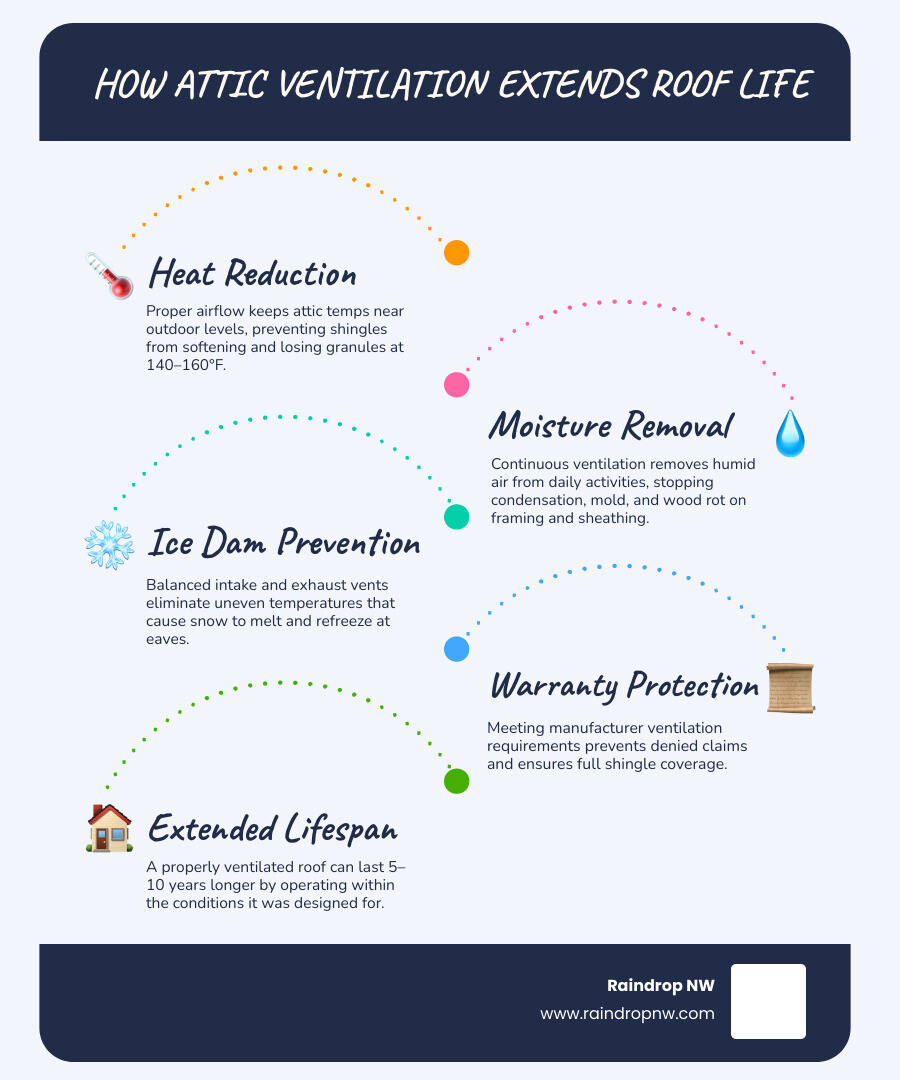
If your attic has poor ventilation, heat and moisture from your home get trapped underneath your roof deck. This warms the underside of your shingles, creating a warm, humid microclimate on your roof surface. This trapped moisture accelerates the growth of both algae and moss, especially on north-facing slopes that receive minimal direct sunlight.

Ensuring your intake vents (soffits) and exhaust vents (ridge vents) are clear and flowing freely reduces moisture buildup and keeps your roof deck cool and dry. To see how these systems work together to protect your home, read about How Ventilation Reduces Moisture Damage and How Proper Flashing Prevents Leaks.

Frequently Asked Questions

Can I use a pressure washer to clean moss off my roof?

Absolutely not. As tempting as it is to watch the moss peel away under high pressure, you are stripping away the protective ceramic granules that shield your shingles from the sun. Pressure washing can ruin asphalt shingles, shatter concrete tiles, tear cedar shakes, and force water directly under your roof deck. It will also void your manufacturer’s warranty. Stick to soft brushing and gentle chemical treatments instead.

How long does a professional moss treatment last?

A high-quality, professional moss treatment typically keeps your roof clear for 12 to 24 months. The exact lifespan depends on your home’s surrounding environment. If your roof is heavily shaded by mature Douglas firs or maples, you may need annual touch-ups. If your home gets plenty of direct sunlight, you can easily go two to three years between treatments.

Do zinc or copper strips really prevent moss growth?

Yes, they do, but they are designed for prevention, not removal. If you install them on a roof that is already covered in heavy moss, they won’t do much. However, if you install them on a clean or brand-new roof, the metal ions released during rainstorms will naturally inhibit new moss and algae spores from growing for up to ten years.

Conclusion

Living in the Pacific Northwest means embracing the rain, the trees, and the beautiful greenery. But it also means accepting the responsibility of protecting your home from the unique biological challenges of our climate.

At Raindrop Roofing NW, we are proud to be a truly local, family-owned roofing company serving Beaverton, Boring, Portland, and the surrounding communities. Unlike big, national corporations bought out by out-of-state investment firms, we live and work in this community. We understand the specific demands that Oregon weather places on your home, and we are committed to providing honest, high-quality service and long-term accountability.

Whether you need a gentle moss treatment, a preventive zinc strip installation, or a comprehensive evaluation of your roof’s health, our team is here to help. Schedule a professional roof inspection with Raindrop NW today, and let’s make sure your home stays safe, dry, and beautiful for years to come.

https://www.raindropnw.com/wp-content/uploads/2026/07/pexels-photo-28288027.avif 627 940 SEO Stats https://www.raindropnw.com/wp-content/uploads/2024/05/logo-raindrop-space-300x92.png SEO Stats2026-07-24 07:47:592026-07-24 07:47:59An Essential Guide to Moss and Algae Prevention on Pacific Northwest Roofs

The Definitive Guide to Choosing a Truly Local Roofing Contractor

Roofing

Why So Many Oregon Homeowners Are Rethinking Who They Hire for Their Roof

Choosing a truly local roofing contractor in Beaverton and the greater Portland metro has never felt more urgent — or more complicated. In recent years, roofing companies across the country have been quietly acquired by private equity firms and national chains, leaving homeowners with a contractor whose name says “local” but whose ownership, accountability, and warranty support are anything but. After a storm rolls through, the stakes get even higher. Door-knocking crews with out-of-state plates flood neighborhoods, offer fast quotes, then disappear before the ink on the warranty is dry.

Here’s a quick look at how to tell the difference between a truly local roofing contractor and one that just markets itself that way:

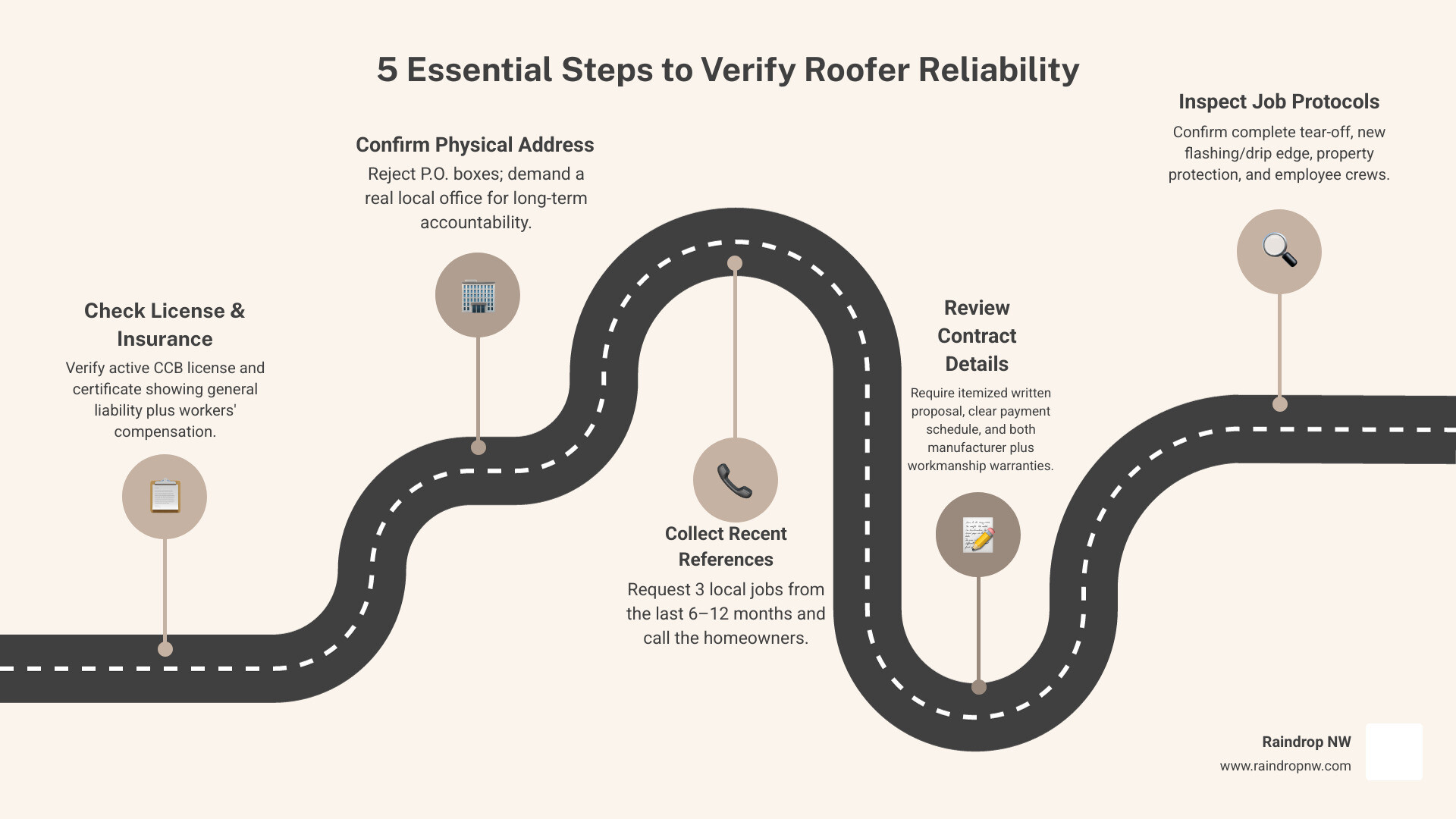
  1. They have a verifiable physical office in your community — not just a P.O. box or a shared coworking address.
  2. The owners live and work locally — they’re your neighbors, not regional managers reporting to a corporate headquarters.
  3. They hold a current Oregon business license and carry general liability and workers’ compensation insurance you can verify.
  4. They have a real track record in your area — references from homeowners in Beaverton, Portland, or surrounding communities.
  5. They understand local building codes and weather patterns — including Oregon’s wet winters, wind-driven rain, and moss-prone rooflines.
  6. Their warranties are enforceable — because they’ll still be in business next year, and the year after that.
  7. They’re involved in the community — through local trade associations, volunteer work, or neighborhood projects that go beyond a logo on a truck.

The uncomfortable truth is that many homeowners don’t discover a contractor wasn’t truly local until something goes wrong — a leak returns, a warranty claim goes unanswered, or the company’s phone number is suddenly disconnected. By then, the cost of that mistake falls entirely on you.

This guide walks you through exactly what to look for, what to ask, and what to watch out for when hiring a roofing contractor in the Portland metro area — so you can protect your home, your investment, and your peace of mind.

I’m Torrey Yungeberg, owner of Raindrop Roofing NW, a family-owned business rooted right here in Oregon, and choosing a truly local roofing contractor is something I’ve spent years helping homeowners understand — because I’ve seen what happens when that decision goes wrong. As Secretary of both the Oregon Chapter of National Women in Roofing and the Associated Roofing Contractors of Oregon and Southwest Washington, I bring not just field experience but a deep commitment to raising the standard of accountability in our industry.

infographic showing key benefits of hiring a local roofing contractor vs national chain infographic

Why Locality Matters: The Benefits of Choosing a Truly Local Roofing Contractor

When you invest in a new roof or a major repair, you are not just purchasing shingles and nails; you are purchasing a promise of long-term protection. This is where the difference between national corporate chains and independent local roofers becomes incredibly clear.

Keeping Your Dollars in the Pacific Northwest

When you hire a business that is genuinely rooted in our community, your investment has a powerful ripple effect. Research shows that local businesses return $0.68 of every dollar spent back into the local economy, compared to just $0.43 for national chains. Those dollars help fund our local schools, support neighborhood programs, and create stable, family-wage jobs right here in Beaverton, Tigard, Hillsboro, and Portland.

By contrast, national chains and private-equity-backed corporations funnel their profits out of Oregon to out-of-state headquarters or investor groups. They also tend to spend up to three times more on aggressive national marketing campaigns. Those massive advertising budgets do not improve the quality of your roof—but they do increase the overhead costs that are ultimately passed on to you.

Unmatched Response Times and Accountability

If a severe windstorm hits the Willamette Valley or an unexpected leak develops in the middle of a wet November night, you cannot afford to wait for a corporate call center to route your request. Homeowners who hire local contractors report 25% faster response times for repairs and warranty claims compared to national companies.

Because we work, live, and raise our families in the same neighborhoods we serve, our reputation is on the line with every single job. This community presence creates a level of personal accountability that a distant corporation simply cannot replicate. Over 70% of homeowners state they prefer hiring local contractors due to this superior accountability and community reputation. To learn more about how independent operations differ from corporate networks, read about the Benefits of Choosing a Truly Local Independent Roofer.

Climate-Specific Expertise

A roofing system that works perfectly in the dry heat of Arizona or the mild climate of Southern California will quickly fail under the constant moisture and seasonal freeze-thaw cycles of Western Oregon. Truly local contractors possess deep, knowledge of how regional weather patterns affect different materials. We know how to design ventilation systems that prevent attic moisture buildup during our damp winters, how to install robust ice and water barriers to protect valleys, and which materials resist the moss and algae growth common to shaded properties in Lake Oswego, West Linn, and Sherwood.

Long-Term Warranty Protection

A warranty is only as reliable as the company standing behind it. Local roofing companies are 40% more likely to honor long-term warranties because they remain in the community year after year. If an issue arises five or ten years down the road, you can walk right into our office or call a local number to get it resolved.

Feature Truly Local Independent Contractor National Chain / PE-Backed Firm
Primary Focus Quality craftsmanship & community reputation Volume, rapid growth, and profit margins
Economic Impact Returns $0.68 of every dollar to the local economy Returns only $0.43 of every dollar locally
Warranty Reliability 40% more likely to honor long-term warranties High risk of unfulfilled claims if local branch closes
Response Times 25% faster response for emergencies & repairs Delayed by out-of-state corporate scheduling
Marketing Overhead Low to moderate (relies heavily on local referrals) Up to 3x higher (costs passed to the homeowner)
Local Knowledge Expert in NW rain, moss prevention, and CCB codes Standardized national practices

How to Verify a Contractor’s Local Presence and Legitimacy

With so many companies using clever digital marketing to appear “local,” homeowners must take active steps to verify a contractor’s physical and legal presence before signing any agreement.

local roofing office in Beaverton Oregon

1. Verify a Physical Commercial Address

A legitimate local contractor will have a physical office, warehouse, or showroom in the area. Be wary of companies that list a P.O. Box, a UPS Store address, or a virtual coworking space as their primary location. Take a moment to search the address on Google Maps. Is it a real commercial building with company signage and service vehicles, or is it a residential home or a shared mailbox center?

2. Check the Oregon Construction Contractors Board (CCB) License

In Oregon, every professional residential and commercial roofing contractor must be licensed with the Construction Contractors Board (CCB). This is one of your strongest consumer protection tools.

  • Go to the Oregon CCB website and search the contractor’s business name or license number.
  • Confirm that the license status is “Active.”
  • Check the “LBL” (Licensed Business License) history. A truly local company will have a consistent, long-standing license history under the same name.
  • Verify that the company’s listed address on the CCB matches their marketing materials.

Reviewing a contractor’s licensing history can tell you a lot about their stability and business practices. For a detailed breakdown of why this matters, read How Consistent Licensing Protects Past and Future Customers.

3. Verify a Local Phone Number and Tax ID

A truly local contractor will have a local area code (such as 503 or 971) and a local business registry with the state of Oregon. If the only way to contact a company is through an 800-number or an online chat system managed by a third party, it is highly likely you are dealing with a national broker or a regional corporate entity rather than a local business owner.

Red Flags When Choosing a Truly Local Roofing Contractor

Vetting a contractor also means knowing what warning signs to watch out for. When choosing a truly local roofing contractor, keep an eye out for these common red flags:

  • The Post-Storm Influx (Storm Chasers): After a severe windstorm or hailstorm in the Portland metro area, out-of-state roofing companies often flood the market. They use temporary local addresses, hire untrained local subcontractors, and use high-pressure sales tactics to sign up as many homeowners as possible. Once the storm season passes, they pack up and move to the next state, leaving you with no way to enforce your workmanship warranty.
  • High-Pressure Sales Tactics: Avoid sales representatives who push you to sign a contract immediately, demand a large cash deposit on the spot, or claim that a special discount is only available if you sign today. A reputable local contractor will provide a detailed, written proposal and give you the time you need to review it.
  • Vague or Incomplete Proposals: A professional contract should never fit on a single, vague page. It must clearly outline the exact materials to be used (including brand and type), the scope of work (such as decking replacement, underlayment, flashing, and ventilation), the project timeline, cleanup practices, and payment terms.
  • Lack of Local References: If a contractor cannot provide a list of recently completed projects and references from homeowners in your immediate area—whether that is Beaverton, Tigard, Hillsboro, or Portland—they likely do not have deep roots in the community.

If you want to protect your investment and avoid common industry traps, take a look at our guide on how to Don’t Get Ripped Off: How to Find Top Rated Roof Replacement in Beaverton.

Key Credentials and Standards to Evaluate Before Hiring

To ensure your home is in safe hands, always request and verify the following credentials before any work begins on your property.

Active Liability and Workers’ Compensation Insurance

Roofing is inherently high-risk work that involves heights, heavy materials, and specialized power tools. If an uninsured worker is injured on your property, or if your home suffers structural water damage during a roof tear-off, you could be held financially liable.

  • General Liability Insurance: Protects your property from damage caused by the contractor’s work.
  • Workers’ Compensation Insurance: Covers medical expenses and lost wages for crew members if they are injured on the job.

Do not simply take a contractor’s word that they are insured. Request a copy of their Certificate of Insurance (COI) and call the insurance agency listed on the certificate to confirm that the policy is active and covers roofing operations. To understand how these credentials protect your property, see How to Choose the Right Roofing Contractor.

Manufacturer Certifications

The highest-quality roofing materials in the world can still fail if they are installed incorrectly. Leading manufacturers—such as GAF, Owens Corning, and CertainTeed—only grant certified status to a small percentage of contractors who meet strict standards for ongoing training, financial stability, and installation quality.

Hiring a certified contractor ensures your roof is installed according to strict manufacturer specifications, which also allows you to access extended, non-prorated manufacturer warranties that cover both materials and labor.

Essential Questions for Choosing a Truly Local Roofing Contractor

Before making your final hiring decision, schedule a consultation and ask these critical questions to gauge a contractor’s professionalism, quality control, and long-term commitment:

  1. Who will supervise my project on-site every day?
    • What to look for: A reputable contractor will assign a dedicated, English-speaking job site supervisor or project manager to monitor quality control, manage the crew, and answer your questions throughout the installation process.
  2. What steps will you take to protect my property and landscaping?
    • What to look for: The contractor should explain how they will protect your gutters, siding, windows, and landscaping using tarps, plywood, and specialized debris-containment systems, as well as how they will sweep your yard with magnetic nails sweeps after completion.
  3. What is covered under your workmanship warranty, and how long does it last?
    • What to look for: A manufacturer’s warranty only covers material defects. You need a written workmanship warranty from the contractor that covers installation errors. Ensure this warranty is clearly documented in your contract.
  4. Who owns your company, and where do they live?
    • What to look for: Ensure the business is independently owned by individuals who live and work in the local community, rather than being owned by an out-of-state investment firm or national conglomerate. For more context on why independent ownership matters for your warranty support, read Choosing a Roofing Company That Won’t Sell Out.

Frequently Asked Questions About Local Roofers

How do I verify if a roofing company is actually local to Beaverton?

To confirm a company is genuinely local, check their physical commercial address on Google Maps to ensure it is a real local office or warehouse rather than a virtual address or P.O. Box. Verify their business registry and active license status on the Oregon Construction Contractors Board (CCB) website, ensuring their listed address matches their local marketing. Finally, look for evidence of deep community roots, such as local sponsorships, membership in regional trade associations, and a long list of local references.

What is the difference between a manufacturer warranty and a workmanship warranty?

A manufacturer warranty covers defects in the physical roofing materials (such as shingles cracking or degrading prematurely), but it does not cover installation mistakes. A workmanship warranty is provided directly by your local contractor and covers installation-related issues (such as leaks caused by improper flashing, poor ventilation, or incorrect fastening). To get complete protection, you need both a strong manufacturer warranty and a written workmanship warranty from a stable, local contractor.

Why do storm-chasing roofing companies disappear after a major storm?

Storm-chasing companies operate on a high-volume, rapid-migration business model. They travel across the country following severe weather patterns, setting up temporary local operations to sign up as many insurance claims as possible. Because they rely on temporary, outsourced crews and prioritize speed over quality, their installations often suffer from major defects. Once local demand drops off, they close their temporary offices and move to the next storm zone, leaving homeowners with no local contact to address leaks or honor workmanship warranties.

Conclusion

Choosing a roofing contractor is one of the most significant investments you will make in your home’s structural integrity, safety, and long-term market value. While national chains and private-equity-backed firms may have massive marketing budgets, they simply cannot match the personal accountability, climate-specific expertise, and long-term community commitment of a truly local, independent contractor.

At Raindrop NW, we are proud to be a multi-generational, family-owned roofing company based right here in Beaverton, Oregon. We serve our neighbors throughout Portland, Tigard, Hillsboro, Lake Oswego, and the surrounding communities with a commitment to honest communication, certified craftsmanship, and reliable, long-term service. We live in the communities we serve, and we stand behind every roof we install.

If you are ready to experience the peace of mind that comes with working with a truly local, independent roofing partner, we invite you to reach out to our team today.

Schedule a Free Inspection with Raindrop NW

https://www.raindropnw.com/wp-content/uploads/2026/07/pexels-photo-34524694.avif 627 940 SEO Stats https://www.raindropnw.com/wp-content/uploads/2024/05/logo-raindrop-space-300x92.png SEO Stats2026-07-23 08:28:032026-07-23 08:28:03The Definitive Guide to Choosing a Truly Local Roofing Contractor

5 Red Flags When Hiring a Roofing Contractor

Roofing

Why Knowing the Red Flags When Hiring a Roofing Contractor Can Save You Thousands

Spotting the red flags when hiring a roofing contractor before you sign anything is one of the most important things you can do as a homeowner. Here are the most common warning signs to watch for:

  1. Unsolicited door-to-door solicitation — especially right after a storm
  2. Large upfront payment demands — legitimate contractors don’t ask for most of the money before work begins
  3. No proof of license or insurance — always verify Oregon CCB credentials independently
  4. High-pressure “sign today” tactics — reputable contractors give you time to decide
  5. Vague or missing written contract — no clear scope, materials, or warranty terms is a serious problem

Roofing is the most commonly reported home improvement scam category, accounting for 15% of all BBB complaints. The median loss from a home improvement scam is $1,700 — more than three times higher than the median loss across all scam types. And those are just the cases that get reported. Many homeowners discover the real damage months later, when leaks appear, warranties turn out to be worthless, or the contractor’s phone number is disconnected.

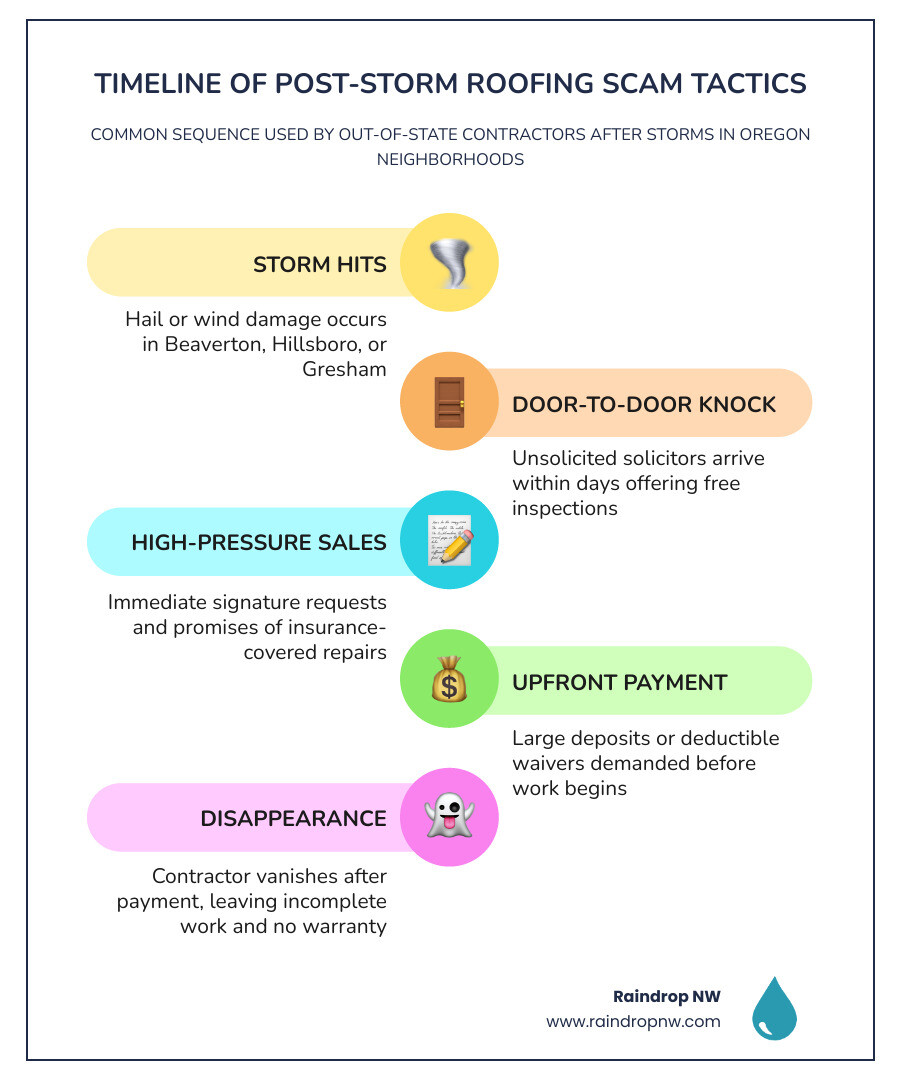
The problem is especially acute in Oregon and the greater Portland metro area. After any significant wind or hail event, out-of-state contractors flood neighborhoods like Beaverton, Hillsboro, and Gresham — going door to door, promising quick fixes and easy insurance money, then disappearing before the first rain of the season.

This guide walks you through the five biggest red flags to watch for, how to verify a contractor’s credentials in Oregon, and what to do if you’ve already signed with someone who’s raising concerns.

I’m Torrey Yungeberg, owner of Raindrop Roofing NW and a longtime advocate for ethics and professionalism in Oregon’s roofing industry — and helping homeowners recognize red flags when hiring a roofing contractor is something I’m deeply passionate about after years of seeing families hurt by scams. Let’s make sure that doesn’t happen to you.

Timeline of post-storm roofing scam tactics from door-knock to disappearance infographic

Red Flag 1: Unsolicited Door-to-Door Storm Chasers

unsolicited door-to-door solicitor

One of the most common ways homeowners get caught in a roofing scam is through unsolicited door-to-door sales. It usually begins a few days after a major weather event—like a severe windstorm in Lake Oswego or a heavy winter storm in Clackamas. A representative knocks on your door, claiming they “just happened to be in the neighborhood” working on a neighbor’s home and noticed wind or hail damage on your roof from the street.

While some legitimate local businesses occasionally use canvassing to introduce themselves, unsolicited post-storm visits are the primary operating method for traveling “storm chasers.” These are transient operations that move from state to state, following weather maps to target vulnerable neighborhoods.

In major storm zones, a staggering 85.19% of repair requests are driven by sheer panic in the first seven days after a weather event. Storm chasers exploit this emotional window. They rely on the urgency of the situation to bypass your normal vetting process. In contrast, modern consumers initiate quotes through secure digital channels 94.8% of the time under normal circumstances.

When you bypass secure, digital, and self-initiated channels to sign a contract on your front porch, you inherit massive structural and financial risks. If you need immediate assistance after a storm, it is always safer to take control of the process yourself.

For a deeper dive into protecting your home from post-storm pressure, read our guide on Don’t Get Ripped Off: How to Pick the Right Roof Repair Contractor in Forest Grove.

Spotting Storm Chaser Red Flags When Hiring a Roofing Contractor

Identifying a storm chaser before they step onto your roof can save you from a lifetime of structural headaches. Look for these specific warning signs during your very first interaction:

  • Out-of-State License Plates and Phone Numbers: Check the vehicle parked in your driveway. If the trucks have out-of-state license plates or magnetic door signs rather than permanent decals, proceed with extreme caution. Similarly, if their primary contact number has an out-of-state area code, they likely do not have a permanent local office.
  • High-Pressure Sales Tactics: If the sales representative insists that you must sign an agreement immediately to secure a “limited-time storm discount” or to get on their schedule, walk away.
  • Demanding Immediate Signatures for “Free” Inspections: A classic storm chaser tactic is asking you to sign an “authorization form” before they climb onto your roof. They may tell you it is simply permission to perform a free inspection or to speak with your insurance adjuster. In reality, these forms often contain binding language that commits you to using them for the replacement if your insurance company approves the claim.

If you want to ensure you are working with an established local professional rather than a traveling sales crew, check out our resource on Don’t Get Ripped Off: How to Pick the Top Rated New Roof Installer in Portland.

Red Flag 2: Demanding Large Upfront Payments or Deductible Waivers

A reputable roofing contractor operates on a stable financial foundation. They do not need your money to purchase the basic materials or pay their crew to start your project. One of the clearest red flags when hiring a roofing contractor is a demand for a large upfront payment—especially anything approaching or exceeding 50% of the total project value before any materials are delivered to your property.

In some neighboring states, like California, demanding more than 10% or $1,000 (whichever is less) upfront for a home improvement project is flat-out illegal. While Oregon’s Construction Contractors Board (CCB) does not set a rigid statutory cap on deposits, the industry standard for a reasonable deposit is 10% to 20% to secure your spot on the schedule, with further payments tied directly to verified project milestones (such as material delivery or the completion of the tear-off phase).

When a contractor demands a massive deposit upfront, it often signals financial instability. They may be using your deposit to finish a job for a previous homeowner, creating a dangerous cycle where your project is delayed because they lack the liquid cash to buy your shingles.

Another financial red flag is the offer to “cover,” “waive,” or “absorb” your homeowner’s insurance deductible. A solicitor might say, “Sign with us, and we’ll write off your deductible so your new roof is completely free.” While this sounds like an incredible deal, it is actually a form of insurance fraud.

In Oregon, as in most jurisdictions, it is illegal for a contractor to knowingly falsify an invoice to an insurance company to conceal the fact that the deductible was not paid by the policyholder. A contractor willing to commit insurance fraud to win your business is highly likely to cut corners on your roof installation as well.

To learn more about navigating the financial realities of a roof replacement safely, read our article on Don’t Get Ripped Off: How to Find Top Rated Roof Replacement in Beaverton.

Payment Red Flags When Hiring a Roofing Contractor

When negotiating the payment terms of your roofing project, keep an eye out for these financial warning signs:

  • Cash-Only Requests or Discounts: If a contractor offers a steep discount if you pay in cash, or insists on cash-only payments, they may be trying to avoid taxes, bypass licensing oversight, or operate off the books. This leaves you with zero paper trail if the work is substandard or incomplete.
  • Checks Made Out to an Individual: Always make payments to a registered business entity, never to an individual’s personal name. Paying an individual makes it incredibly easy for them to pocket the funds and walk away, leaving you with no legal recourse against the actual business.
  • The Assignment of Benefits (AOB) Trap: Be incredibly wary if a contractor asks you to sign an Assignment of Benefits (AOB) agreement. This legal document transfers your insurance claim rights, benefits, and decision-making power directly to the contractor. Once signed, the contractor can file claims, negotiate payouts, and even sue your insurance company without your consent—all while keeping you completely in the dark.

For a comprehensive checklist on how to structure a safe, professional contract agreement, explore our guide on How to Choose the Right Roofing Contractor.

Red Flag 3: Licensing and Insurance Red Flags When Hiring a Roofing Contractor

Every legitimate roofing contractor operating in Oregon must hold an active license with the Oregon Construction Contractors Board (CCB) and carry active general liability and workers’ compensation insurance. If a contractor cannot immediately produce their CCB number or current certificates of insurance, you should end the conversation immediately.

To help visualize the difference between a secure hiring choice and a high-risk gamble, consider this comparison:

Vetting Criteria Reputable Local Contractor Unlicensed / Uninsured Storm Chaser
Oregon CCB License Active, clean record, clearly displayed on all materials Missing, expired, or registered under a different name
General Liability Typically $2 million+; protects your home from accidental damage None, or expired policies that leave you liable for damage
Workers’ Comp Active coverage for all crew members on your property None; relies on uninsured day labor or independent subs
Local Reputation Verifiable local office, local references, years of community history P.O. Box, out-of-state phone number, zero local references
Warranty Security Factory-certified status; backed by manufacturer and local business Vague “handshake” warranties that disappear when they leave

Failing to verify these credentials puts you at massive physical and financial risk. If an uninsured worker falls from your roof during installation, your homeowner’s insurance policy may exclude commercial worker injuries, leaving you personally liable for medical bills and lost wages.

Similarly, if a contractor damages your home—such as dropping a heavy bundle of shingles through a skylight or leaving your roof exposed during a sudden Portland rainstorm—an uninsured contractor will likely vanish, leaving you to pay for the interior water damage out of pocket.

For a detailed walkthrough on how to protect your home from these liabilities, read our guide on How to Verify a Roofers License and Insurance.

Verifying Oregon CCB Licenses and Insurance

Verifying a contractor’s credentials in Oregon is a straightforward process, but you must do it yourself rather than relying on a printed piece of paper the salesman hands you.

First, ask for the contractor’s CCB license number. Then, visit the official Oregon Construction Contractors Board website and enter the number into their search tool.

Verify that the business name matches the entity on your contract, that the license is active, and that there are no active, unresolved consumer complaints or history of severe civil penalties.

Additionally, request a copy of their Certificate of Insurance (COI). A truly professional contractor will have their insurance agency send a copy of the certificate directly to you. Take five minutes to call the insurance agency listed on the certificate to confirm that the policy is currently active, has not lapsed due to non-payment, and carries sufficient general liability coverage (we recommend a minimum of $2,000,000).

To understand why consistent licensing is your best defense against structural failure, read about How Consistent Licensing Protects Past and Future Customers.

Red Flag 4: High-Pressure Sales Tactics and “Deal Ends Today” Urgency

A roof replacement is a major capital improvement project. A professional, ethical contractor understands that you need time to review proposals, compare options, and make an informed decision. If a contractor uses high-pressure sales tactics to force an immediate decision, it is a major warning sign.

A classic psychological tactic used by predatory sales representatives is the “long-form appointment.” The representative may schedule an inspection but turn it into a multi-hour presentation designed to wear you down. They might present overly complex technical jargon, show you dramatic videos of roof collapses, or use fear-based messaging to make you feel like your home is on the verge of structural failure. By the end of a two-hour meeting, mental fatigue sets in, making you far more likely to sign a contract just to get them out of your house.

Another common tactic is the artificial “one-day-only” discount. The salesman might say, “The price is normally higher, but if you sign the contract right now, I can give you our neighborhood discount of 20% off.”

Reputable contractors base their pricing on actual material costs, labor rates, and local building codes. They do not have massive, arbitrary margins that allow them to drop the price by thousands of dollars simply because you hesitated. If a price can drop significantly with a little resistance, the initial quote was heavily inflated, or they plan to make up the difference later through hidden fees.

Red Flag 5: Suspiciously Low Bids (The Low-Ball Decking Trap & Cheap Repair Hustle)

Everyone loves a good deal, but a roofing quote that is dramatically lower than other bids is often a trap. If you receive a bid that is significantly lower than other local quotes, the contractor is likely cutting critical corners.

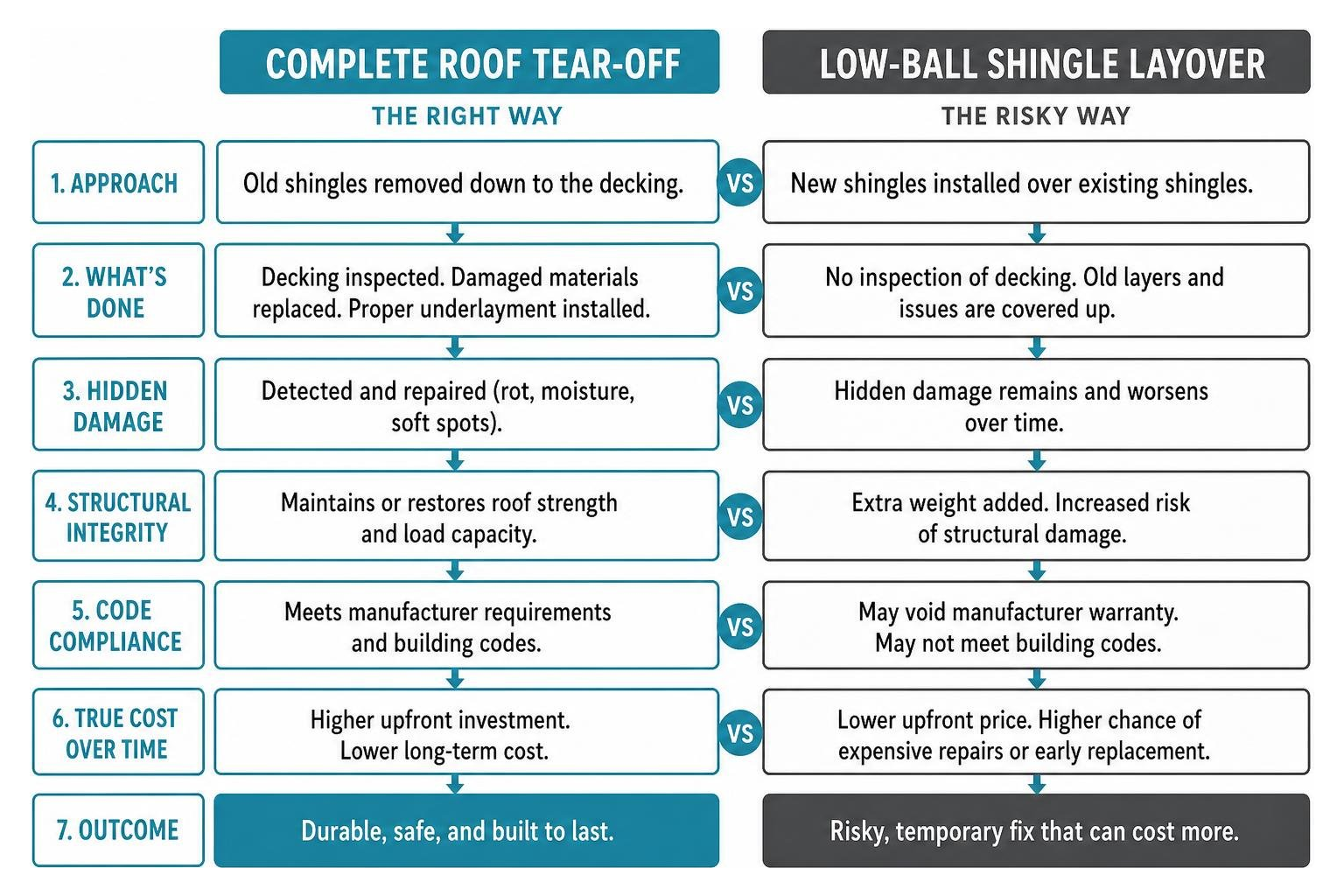
A detailed comparison of a complete roof tear-off versus a low-ball shingle layover

A common way dishonest contractors submit low-ball bids is through the “Low-Ball Decking Trap.” Our historical project data proves that exactly 20% of roofs—one in five—require extensive structural decking upgrades once the old shingles are removed.

A low-ball contractor will intentionally exclude the cost of replacing damaged, rotted plywood from their initial bid to make their price look incredibly attractive. Once your old roof is torn off and your home is exposed to the elements, they will hit you with massive, non-negotiable change orders for decking repairs, holding your home hostage until you pay the inflated costs.

Another variation is the “Cheap Repair Hustle.” A contractor might offer a cheap, quick spot repair on an aging, failing roof for a low flat rate. However, our 2025 network data shows that reputable contractors reported $0 in closed-won standalone repair revenue. Why? Because performing surface-level patches on a structurally compromised or aging roof is a liability.

Cheap spot repairs ignore the underlying underlayment and structural decking, often voiding the manufacturer’s long-term material warranties and leaving you with active leaks just months down the road. A quality contractor will always recommend a complete, code-compliant tear-off and replacement when a roof has reached the end of its functional life.

Frequently Asked Questions About Roofing Scams

What should a proper written roofing contract include?

A legally binding, professional roofing contract should leave zero room for interpretation. It must be highly detailed and include:

  • Complete Business Information: The contractor’s legal business name, physical address (not a P.O. Box), phone number, email, and active Oregon CCB license number.
  • Detailed Scope of Work: A clear statement specifying a full structural tear-off rather than a “roof layover” (which installs new shingles over old ones, adding dangerous weight and voiding warranties).
  • Specific Materials and Brands: The exact manufacturer, style, and color of the shingles, along with the specific underlayment, ice and water shield, drip edge, flashing, and ventilation systems to be installed.
  • Clear Payment Schedule: A structured payment timeline tied directly to completed project milestones, with a reasonable deposit upfront and the final payment withheld until a final inspection is passed and a lien waiver is provided.
  • Project Timeline: Estimated start and completion dates, along with a clear policy on how weather delays will be communicated and handled.
  • Warranty Details: Explicitly written terms for both the manufacturer’s material warranty and the contractor’s workmanship warranty.

What is an Assignment of Benefits (AOB) and why is it risky?

An Assignment of Benefits (AOB) is a legal agreement that signs over your insurance claim rights directly to a third-party contractor. While contractors often pitch this as a convenient way to “let us handle the insurance hassle for you,” it strips you of your rights as the policyholder.

Once you sign an AOB, the contractor can file claims, inflate project scopes, and negotiate payouts directly with your insurance carrier. If the insurance company disputes the contractor’s inflated bill, the contractor can file a lawsuit against the insurer in your name.

This can lead to severe delays in your project, potential policy cancellation, and even personal financial liability if the contractor performs substandard work or leaves the job unfinished while pocketing the insurance payout. Always retain control of your insurance claim and pay your contractor directly through documented, milestone-based payments.

What steps can I take if I already signed with a problematic roofer?

If you have already signed a contract and are beginning to notice significant red flags, you still have options to protect your home and wallet:

  1. Review Your Cancellation Rights: Under Oregon law and federal consumer protection rules, you typically have a “three-day right to cancel” (cooling-off period) for contracts signed in your home or at a location other than the contractor’s permanent place of business. Review your contract for a cancellation clause.
  2. Communicate Exclusively in Writing: Stop taking phone calls or verbal promises. Send all correspondence via email or certified mail so you have a clear, date-stamped paper trail of your concerns, requests, and any contract disputes.
  3. Document Everything Meticulously: Take high-resolution photos and videos of your property before, during, and after any work is performed. Document any property damage, safety violations, or incomplete work.
  4. Contact the Oregon CCB: If the contractor is licensed but engaging in unethical behavior, violating contract terms, or threatening legal action, file a formal complaint with the Oregon Construction Contractors Board. They can mediate disputes and help hold the contractor accountable.
  5. Seek Legal Counsel: If a significant amount of money is involved or the contractor has placed a mechanic’s lien on your home, consult with a construction attorney immediately to explore your legal remedies.

Conclusion

Your roof is the single most important protective barrier shielding your family, your belongings, and your home’s structural integrity from the elements. Entrusting its replacement or care to a contractor who exhibits any of these warning signs is a risk you simply do not need to take.

At Raindrop Roofing NW, we believe in a completely different approach. As a family-owned, truly local business deeply rooted in Beaverton and serving the greater Portland metro area, we don’t rely on door-knocking, high-pressure sales pitches, or deceptive financial structures to earn your trust. Our reputation is built on decades of transparent communication, certified craftsmanship, and a commitment to our local community.

We are independently owned. This means we are directly accountable to you, our neighbors, long after the project is complete. We stand behind our work with authentic, verifiable warranties that actually mean something because we will still be here in the community to honor them.

To learn more about how to protect your home and make an informed decision, explore our resources on:

  • Choosing a Roofing Company That Won’t Sell Out
  • Benefits of Choosing a Truly Local Independent Roofer
  • How Independent Ownership Protects Your Warranty

If you suspect your roof has storm damage, or if you simply want an honest, comprehensive evaluation of your roof’s current health without any sales pressure, we are here to help. Schedule a Free Inspection with Raindrop Roofing NW today, and experience what a professional, community-focused roofing experience should feel like.

https://www.raindropnw.com/wp-content/uploads/2026/07/pexels-photo-34527090.avif 529 940 SEO Stats https://www.raindropnw.com/wp-content/uploads/2024/05/logo-raindrop-space-300x92.png SEO Stats2026-07-21 08:41:212026-07-21 08:41:215 Red Flags When Hiring a Roofing Contractor

A Comprehensive Guide to Roofing Tips for Beaverton & Portland Homeowners

Roofing

If you’ve been searching for roofing tips for Beaverton and Portland homeowners, here’s what you need to know right away:

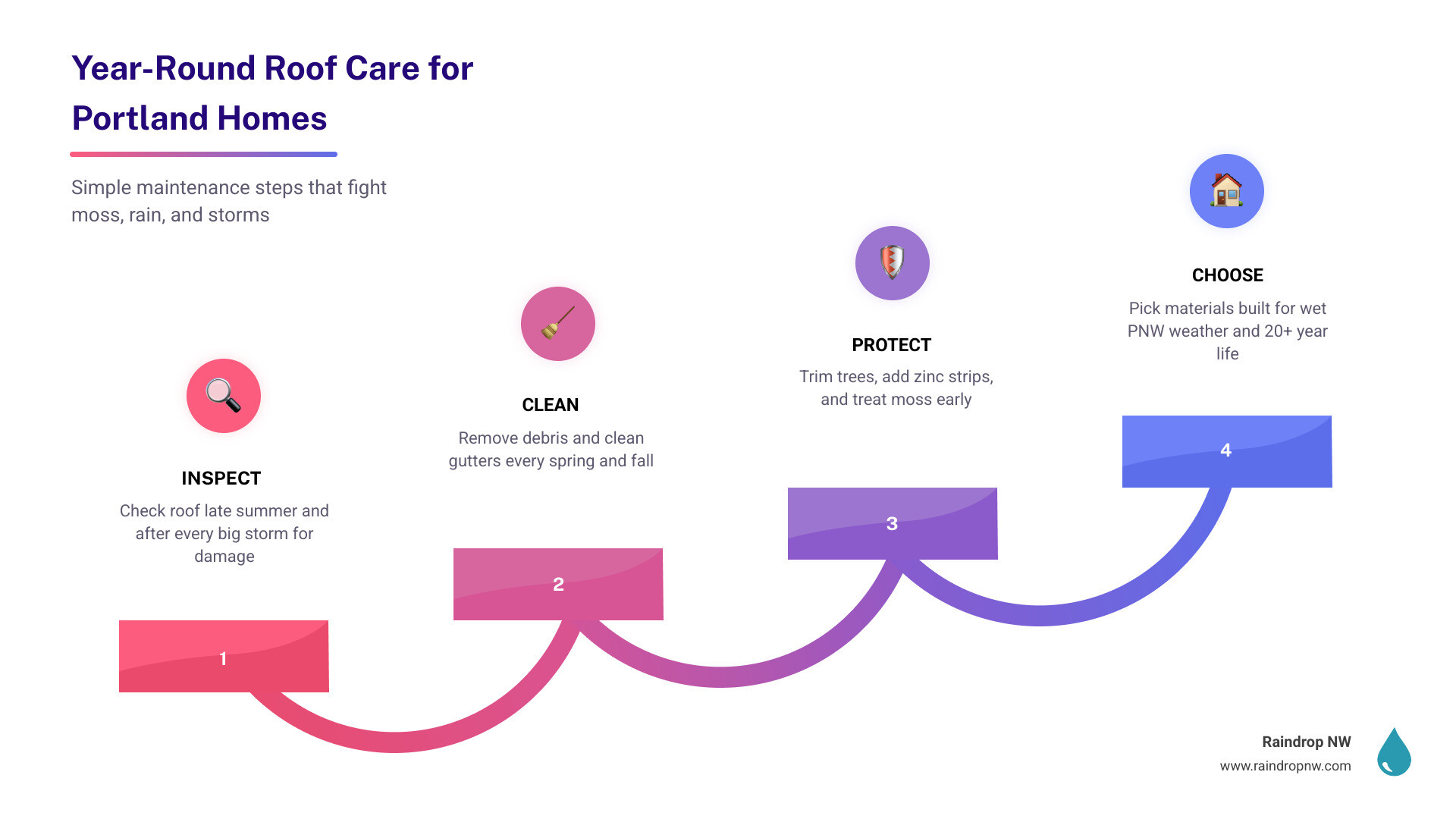
  • Inspect your roof at least once a year — ideally in late summer, and after any major storm
  • Clean your gutters every spring and fall — Portland’s 36–42 inches of annual rainfall makes clogged gutters a fast path to water damage
  • Treat moss early — damp, shaded PNW conditions can shorten shingle lifespan by up to 30% if moss is left unchecked
  • Trim overhanging tree branches — debris and shade accelerate moisture buildup and roof wear
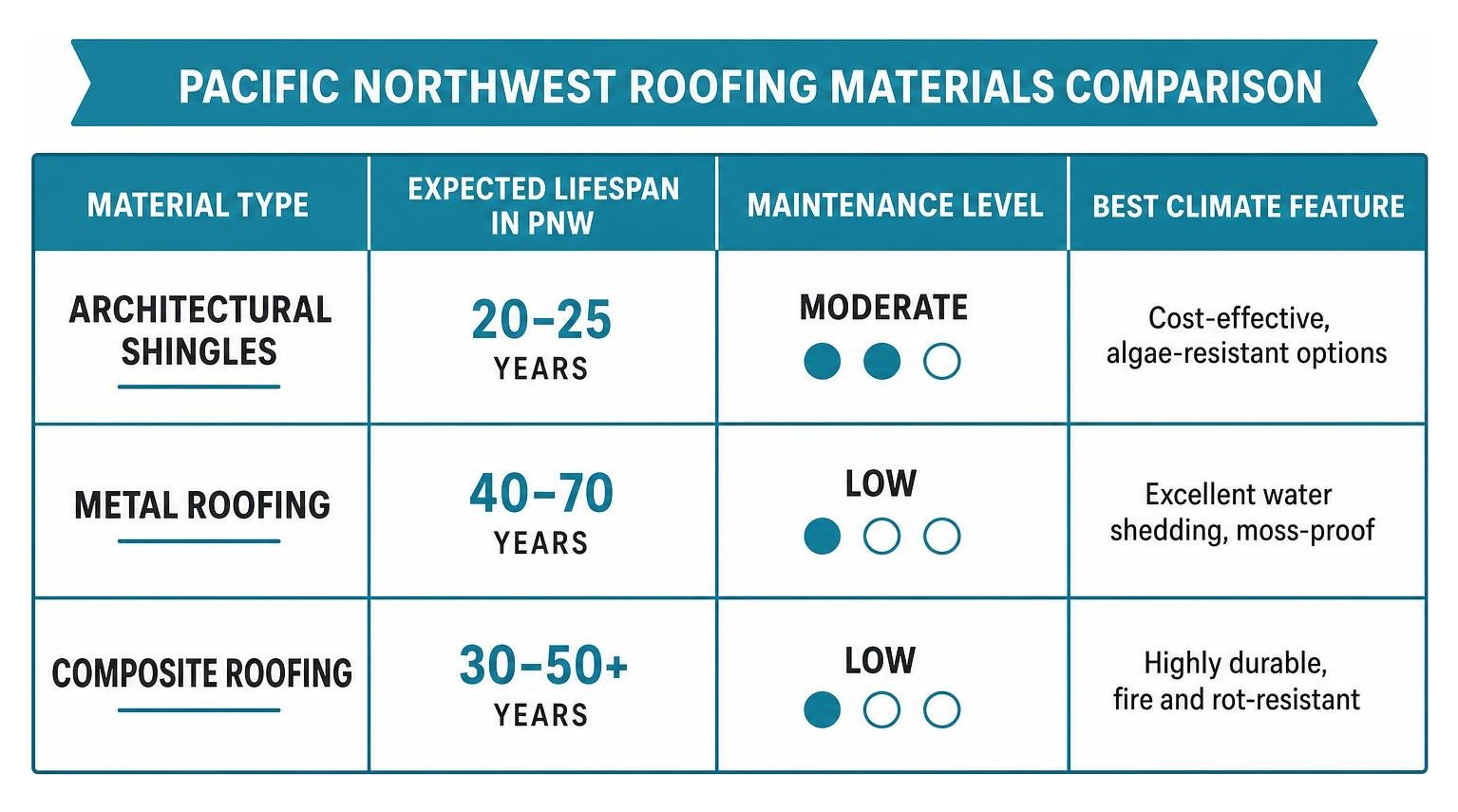
  • Know your roof’s age — asphalt shingles in the Pacific Northwest typically last 20–25 years, and age directly affects insurance coverage
  • Choose materials built for wet climates — architectural asphalt shingles, metal roofing, and quality composites all outperform standard shingles in Oregon conditions
  • Hire a local, licensed, and independently owned roofer — not a national chain that may be sold to an out-of-state investment firm after your project is done

Your roof is arguably the hardest-working part of your home — and in the Portland metro area, it faces a relentless lineup of challenges. Steady rainfall from October through May, thick tree canopies that trap moisture, moss that quietly pries apart shingles, and the occasional windstorm all add up to a roofing environment that’s genuinely tougher than the national average. A roof that might last 30 years in a dry climate could show serious wear by year 20 here in the Tualatin Valley. That’s not a sales pitch — it’s just the reality of living in the Pacific Northwest.

The good news? Most of the damage that shortens roof life in Beaverton and Portland is preventable. With the right materials, regular maintenance, and a contractor you can actually trust, your roof can protect your home for decades. This guide walks you through everything you need to know — from moss prevention and material selection to storm damage response and what to ask before you hire anyone.

I’m Torrey Yungeberg, owner of Raindrop Roofing NW, a family-owned roofing company rooted right here in Oregon, and I’ve built my career on getting the details right — from the first inspection to the final shingle — so that the roofing tips for Beaverton and Portland homeowners in this guide reflect what actually works in our climate. Let’s get into it.

Key roofing tips for Beaverton and Portland homeowners: inspection schedule, moss prevention, materials, and gutters

Climate Challenges: Why You Need Roofing Tips for Beaverton and Portland Homeowners

Understanding our regional weather is the first step toward effective roof care. In places like Beaverton, Hillsboro, and Portland, we don’t just deal with rain; we deal with a unique combination of moisture, shade, and seasonal shifts.

Here is how the local environment directly impacts your roof:

  • The Long Wet Season: Portland receives an average of 36–42 inches of rainfall annually. This consistent, low-intensity moisture keeps roofs damp for months at a time, creating the perfect breeding ground for organic growth.
  • Thick Tree Canopies: Neighborhoods like Forest Heights, Lake Oswego, and Murrayhill are famous for their beautiful, mature trees. However, these canopies drop needles, leaves, and branches directly onto roof surfaces, trapping moisture in valleys and along flashing.
  • Summer UV Exposure: While we focus heavily on the rain, our hot, dry Pacific Northwest summers bring intense UV radiation. This heat dries out shingles, making them brittle and prone to cracking when the autumn rains return.
  • Seismic Considerations: Oregon sits in an active seismic zone. Roof design must account for lateral movement, meaning materials must be securely fastened, and heavier options (like slate or clay tile) require careful structural evaluation to ensure the home’s framing can safely support the weight during an earthquake.

To dive deeper into how these seasonal patterns affect your home over time, check out our detailed guide on How Portland Weather Affects Roof Lifespan.

Essential Moss and Moisture Prevention Roofing Tips for Beaverton and Portland Homeowners

If there is one enemy every Beaverton and Portland homeowner faces, it’s moss. Moss acts like a sponge, soaking up rain and holding it flat against your shingles. Over time, as the moss grows, its roots lift the edges of the shingles. This allows water to seep underneath, rotting the wooden decking below and causing slow, hidden leaks.

To protect your roof from moss damage, we recommend these preventive measures:

  1. Install Zinc or Copper Strips: When rainwater washes over zinc or copper, it releases metallic particles that naturally inhibit moss and algae growth. Installing these strips near the ridge caps of your roof can keep the slopes below clean for years.
  2. Trim Overhanging Branches: Keep tree branches trimmed back at least several feet from your roofline. This increases sunlight and airflow, helping your roof dry out much faster after a downpour.
  3. Control Moss Early: Don’t wait for a thick green carpet to form. Treat moss when it first appears as small green spots. Never use a high-pressure washer on asphalt shingles, as this strips away the protective granules and ruins the material. Instead, use gentle, eco-friendly chemical treatments or professional low-pressure washing techniques.

For more tailored advice on protecting your home’s exterior, read our comprehensive guide on Beaverton Homeowners: Everything You Need to Know About Residential Roofing.

Seasonal Maintenance Roofing Tips for Beaverton and Portland Homeowners

A consistent maintenance routine can extend your roof’s lifespan by 30% to 50%. Rather than waiting for a leak to show up on your ceiling, follow this simple seasonal schedule:

  • Spring Inspection (March/April): Once the heavy winter storms wind down, check your roof for wind damage, missing shingles, and loose flashing around chimneys and vents. Clean out any debris that accumulated over the winter.
  • Fall Preparation (September/October): Before the rainy season returns, clear all leaves and pine needles from your roof valleys and gutters. Ensure downspouts are clear and directing water away from your foundation.
  • Year-Round Gutter Cleaning: If your property is heavily shaded, you may need to clean your gutters three or four times a year. Clogged gutters cause water to back up under the lower edge of your roof, rotting the fascia boards and roof edge.

For a complete seasonal checklist, read The Ultimate Guide to Roof Care in Portland Oregon.

Choosing the Best Roofing Materials for the Pacific Northwest

Choosing the right material is critical when replacing a roof in our climate. While standard materials work fine in dry regions, Oregon homes require products engineered to resist constant moisture and organic growth.

Here is a breakdown of the best options for our area:

  • Architectural Asphalt Shingles: This is the most popular choice for residential homes. Unlike basic 3-tab shingles, architectural shingles are thicker, carry longer warranties, and often feature built-in algae-resistant granules. They offer excellent durability under normal PNW conditions.
  • Metal Roofing: Standing seam metal roofs are highly recommended for heavily wooded or rainy areas. They shed water, pine needles, and snow effortlessly, and moss cannot easily take root on their smooth surfaces. While the upfront investment is higher, they can last up to 70 years.
  • Composite Roofing: Made from recycled plastics and rubber, composite shingles mimic the look of natural slate or cedar shakes without the weight or high maintenance. They are highly resistant to moisture, UV damage, and moss.
  • Cedar Shakes: Cedar offers a classic Pacific Northwest aesthetic and natural insulation. However, they require high maintenance, regular moss treatments, and may be restricted in some fire-prone areas.
  • Flat Roof Membranes: Homes with low-slope or flat sections (common in modern architecture) require specialized membranes like TPO or PVC. These systems must be installed with a minimum slope of 1/4 inch per foot to prevent ponding water.

Comparison of Pacific Northwest roofing materials: lifespan, maintenance levels, and key climate benefits

Material Type Expected Lifespan in PNW Maintenance Level Best Climate Feature
Architectural Shingles 20–25 Years Moderate Cost-effective, algae-resistant options
Metal Roofing 40–70 Years Low Excellent water shedding, moss-proof
Composite Roofing 30–50+ Years Low Highly durable, fire and rot-resistant
Cedar Shakes 20–30 Years High Classic aesthetic, natural insulation
Flat Membranes (TPO/PVC) 15–30 Years Moderate Seamless protection for low-slope areas

Protecting Your Home with Proper Gutters, Ventilation, and Insulation

A roof is more than just shingles; it is a complex system that includes gutters, ventilation, and insulation. If any of these components fail, your entire home is at risk.

  • The Role of Gutters: Gutters are your home’s primary defense against water damage. Seamless gutters are highly recommended because they lack joints where debris can catch and leaks can form. Properly functioning gutters protect your siding from rot, prevent basement flooding, and keep water from eroding the soil around your foundation.
  • Attic Ventilation: Proper airflow is crucial. In the winter, warm, moist air from your living spaces escapes into the attic. If your roof lacks adequate intake and exhaust vents, this moisture traps inside, condensing on the underside of your roof deck. This causes wood rot and mold. In the summer, poor ventilation traps extreme heat, baking your shingles from the inside out and shortening their lifespan.
  • Attic Insulation: Quality insulation keeps heat inside your home. During rare winter freezes in the Portland area, escaping attic heat can melt snow on your roof. This water runs down to the cold roof edge, where it refreezes, forming “ice dams” that force water back under your shingles. Proper insulation prevents this cycle while lowering your heating bills.

How to Handle Storm Damage and Navigate Insurance Claims

When severe windstorms or heavy winter freezes strike the Portland metro area, roof damage can happen fast. Knowing how to respond can save you from costly water damage and insurance headaches.

If you suspect storm damage, follow these steps:

  1. Perform a Safe Visual Check: From the ground, look for missing shingles, exposed underlayment, or damaged flashing around vents and chimneys. Check your attic for fresh water stains.
  2. Document Everything: Take clear photos of any visible damage on your roof, as well as any interior leaks. Note the date and time of the storm.
  3. Call a Local Roofer First: Before calling your insurance company, have a professional roofing contractor inspect the roof. We can provide a detailed damage report and temporary tarping if necessary. This prevents you from filing unnecessary claims that could raise your rates.
  4. Understand Your Policy: Roof age plays a major role in insurance claims. Many insurers adjust payouts based on the age of the roof, offering actual cash value (depreciated value) rather than full replacement cost for older roofs.

To ensure your roof is thoroughly evaluated after a major weather event, learn more about our process for Portland Roof Inspections: Protecting Your Home from the Top Down.

Frequently Asked Questions About Portland Metro Roofing

How often should Portland-area homeowners schedule roof inspections?

We recommend scheduling a professional roof inspection at least once a year, with late summer being the ideal time. This allows you to identify and repair any minor issues before the heavy winter rains arrive. Additionally, you should have your roof checked after any major wind or hail storm.

Catching small issues early, like a cracked pipe boot or loose flashing, can prevent major water damage down the road. For expert local assistance, you can rely on a trusted Beaverton Roofing Contractor: Your Partner for Roof Health to keep your system in top shape.

What signs indicate that a roof needs repair or replacement?

Look out for these common warning signs:

  • Curling or Clawing Shingles: This indicates the shingles are reaching the end of their lifespan and losing their flexibility.
  • Granule Loss: Finding dark, sand-like granules in your gutters means your shingles have lost their protective UV coating.
  • Interior Water Stains: Discoloration on your ceilings or attic rafters is a clear sign of an active leak.
  • Sagging Roof Deck: A drooping roofline indicates structural wood damage from long-term water exposure.
  • Damaged Flashing: Cracks, rust, or gaps in the metal flashing around chimneys, dormers, and valleys are common leak sources.

What questions should homeowners ask when hiring a local roofer?

To protect your investment, always ask these questions before signing a contract:

  1. Are you licensed, bonded, and insured in the state of Oregon? (Verify their CCB license online).
  2. Are you a truly local, independently owned company? Out-of-state investment firms frequently buy out local roofing brands, which can make warranty claims difficult to resolve down the road.
  3. Do you use certified in-house crews or do you subcontract all the work?
  4. What manufacturer certifications do you hold? (This affects the strength of your material warranties).
  5. Do you provide written warranties covering both materials and craftsmanship?

Conclusion

Your roof is your home’s primary shield against the challenging Pacific Northwest climate. By staying proactive with moss control, seasonal gutter cleaning, and annual inspections, you can maximize your roof’s lifespan and protect your home for decades to come.

At Raindrop Roofing NW, we are proud to be a family-owned, truly local roofing company serving Beaverton, Portland, and surrounding communities like Tigard, Hillsboro, Lake Oswego, and Oregon City. We believe in transparency, multi-generational craftsmanship, and long-term accountability. We don’t believe in high-pressure sales tactics — just honest, expert advice to help you keep a safe roof over your head.

Ready to check the health of your roof? Schedule a Free Roof Inspection with Raindrop NW today, and let our family take care of yours.
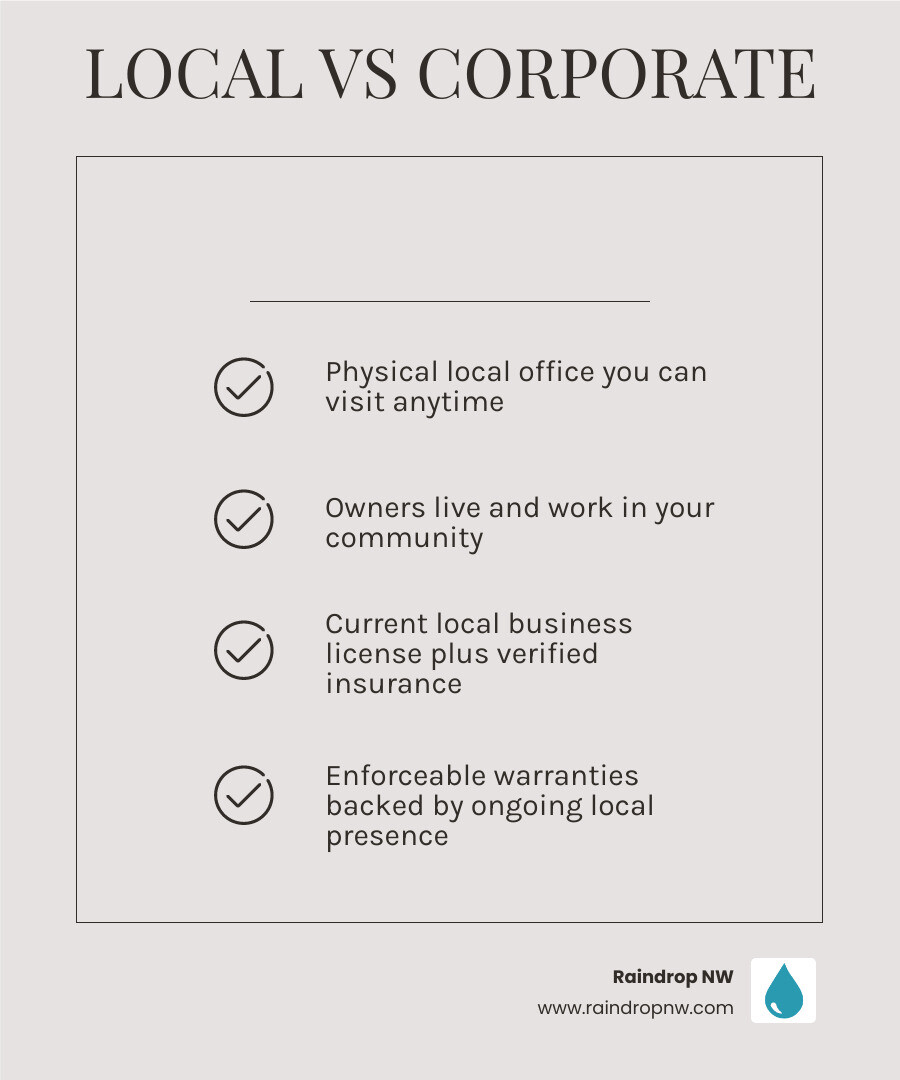
https://www.raindropnw.com/wp-content/uploads/2026/07/0e8f39c6a2b62134d0b2a317ff592ea47e030e69.jpg 1024 1536 SEO Stats https://www.raindropnw.com/wp-content/uploads/2024/05/logo-raindrop-space-300x92.png SEO Stats2026-07-20 09:16:122026-07-20 09:16:12A Comprehensive Guide to Roofing Tips for Beaverton & Portland Homeowners

The Battle for Your Roof: Local Pros vs Corporate Giants

Roofing

The Local Independent Roofer vs Corporate Chain Comparison Every Beaverton Homeowner Should Make Before Signing Anything

When it comes to protecting your home, the local independent roofer vs corporate chain comparison is one of the most important decisions you’ll face — and the differences go much deeper than price.

Here’s a quick breakdown to help you compare at a glance:

Factor Local Independent Roofer Corporate Chain
Ownership Community-based, often family-owned May be owned by out-of-state investment firms
Accountability Owner is reachable and personally invested Call centers, rotating contacts
Workmanship In-house crews, reputation-driven Often subcontracted, variable quality
Local knowledge Familiar with NW Oregon codes and climate Standardized national protocols
Warranty support Direct follow-up, owner-backed Brand warranty, harder to claim
Community impact Dollars stay local Profits flow out of state
Pricing transparency Customized estimates, room to discuss Flat-rate structures, less flexibility

The roofing industry has been changing fast. More and more companies that look local are quietly being purchased by out-of-state investment firms — which means the friendly face that sold you the job may be gone before your roof ever needs a warranty call. That’s a serious problem when a roof replacement is one of the biggest investments you’ll make in your home.

I’m Torrey Yungeberg, owner of Raindrop Roofing NW and a lifelong part of the trades community in Oregon — and the local independent roofer vs corporate chain comparison is something I’ve seen play out for families across the Portland metro. As we dig into this topic, I’ll walk you through exactly what to look for so you can make a confident, informed choice for your home.

Local roofer vs corporate chain comparison infographic with key differences in accountability, warranties, pricing, and

I’m planning a roof replacement in Beaverton. Why does the local independent roofer vs corporate chain comparison matter?

Choosing who installs your roof is just as critical as choosing the shingles themselves. In the Portland metro area, we are seeing a massive influx of “corporate giants”—large national brands backed by out-of-state investment firms. While their flashy TV commercials and fleets of brand-new trucks look impressive, the underlying business model is often built on volume rather than relationships.

The reality of the roofing industry is sobering: 95% of roofing contractors go out of business within just five years. When a corporate chain is owned by a distant investment firm, their primary goal is often short-term profit to satisfy shareholders. If the local branch isn’t hitting its numbers, it can be closed or rebranded overnight. As a homeowner, that leaves you with a “ghost” warranty and no one to call when a leak appears two years later.

Conversely, a truly local independent roofer relies on their reputation to survive. We live in the same neighborhoods where we work—from Hillsboro to Oregon City. Our business stability isn’t tied to a stock price; it’s tied to the word-of-mouth referrals from your neighbors. We focus on residential roofing services that prioritize long-term accountability over a quick, transactional sale.

Workmanship standards in a local independent roofer vs corporate chain comparison

One of the biggest hidden risks in the local independent roofer vs corporate chain comparison is what we call the “subcontractor gamble.” Many national chains are essentially sales and marketing organizations. Once you sign the contract, they hire a third-party crew—who may or may not be from the local area—to do the actual work. This creates a gap in quality control. If the salesperson doesn’t know the installers, how can they guarantee the workmanship?

Local independent pros typically use in-house crews. These are craftsmen we know by name, who have been trained to our specific standards. This allows for personalized care and tight quality control on every project. Because our names are on the line, we don’t just “slap on shingles.” We perform thorough roof inspections to ensure the decking is solid and the ventilation is correct before a single nail is driven.

Will a local roofer or a national chain provide better service quality in Portland?

Service quality often comes down to communication. Have you ever tried to call a national chain to ask a question about your project, only to be routed to a call center in another time zone? It’s frustrating. National chains often rely on standardized protocols that don’t always account for the unique needs of a specific home.

When you work with a local team, the lines of communication are direct. You aren’t “Customer #4829”; you’re the family down the street in Tualatin or Lake Oswego. We manage our new roof replacements with a focus on your timeline and your peace of mind. If an issue arises during the project, you can talk to the owner or a project manager who is actually on-site, not a representative reading from a script.

Corporate chains may offer “quicker” timelines because they have massive resources, but those timelines can fall apart if their subcontracted crews are overbooked. Local pros provide specialized expertise tailored to the Pacific Northwest, ensuring the job is done right the first time, even if it takes a day longer to ensure every detail is perfect.

How does local knowledge of NW Oregon weather affect my roof’s lifespan?

The Beaverton climate is unique. We deal with high annual rainfall, intense moisture, and the ever-present threat of moss. A corporate chain using a “one-size-fits-all” national manual might miss the regional nuances that define a roof’s lifespan in Oregon.

For example, moss mitigation is a major concern here. Without proper zinc or copper strips and specialized shingles, a roof in Portland can be covered in green growth within a few years. Local roofers also understand the importance of wind resistance for our seasonal storms and the specific ice and water shield requirements dictated by the Oregon building codes.

Whether it’s navigating the preservation guidelines of historic architecture in Westmoreland or addressing the rot often found in older homes in Damascus, local knowledge is invaluable. We see these regional challenges every day. We know that a roof in the NW needs to breathe differently than one in Arizona or Florida, and we build that knowledge into every repair and installation.

What are the warranty differences in a local independent roofer vs corporate chain comparison?

Warranties are often the most misunderstood part of the local independent roofer vs corporate chain comparison. There are two types: material warranties (from the manufacturer) and workmanship warranties (from the installer).

National chains often tout “Lifetime Labor Warranties.” However, read the fine print. These warranties are often tied to the specific branch staying in business. If that corporate location closes, your labor warranty may vanish.

Local independent roofers who are manufacturer-certified can offer the best of both worlds. Because we hold high-level certifications with major shingle brands, we can offer enhanced system warranties that are backed by the manufacturer. This means even if a local company were to close (though we’ve been here for generations!), the manufacturer stands behind the installation. We help you navigate different roof types to find the best coverage, ensuring your labor and materials are protected for decades, not just until the next corporate merger.

Navigating long-term support in a local independent roofer vs corporate chain comparison

Think about who will be there in ten years. If you have a minor leak after a windstorm, a corporate chain might not find it “profitable” to send a crew out for a small repair. They are geared for big replacements.

A local company thrives on long-term maintenance. We have a physical address in the community, not just a PO Box or a temporary office. We prioritize our past customers because we want to be your roofer for life. Ownership stability matters; when the leadership of a company stays the same for 20 or 30 years, you know exactly who is responsible for the work on your home.

How does choosing a local roofing professional impact the Beaverton economy?

When you spend money on your home, you are also making an investment in your community. The economic impact of the local independent roofer vs corporate chain comparison is significant.

Statistics show that for every $100 spent at a locally owned business, about $68 stays in the local economy. In contrast, when you spend that same $100 at a national chain, only about $43 remains in the community. The rest goes to corporate headquarters, national advertising, and out-of-state shareholders.

By choosing a local roofer, you are supporting:

  • Local Jobs: We hire people who live in Vancouver, Camas, and Tigard.
  • Local Supply Chains: We buy our materials from local distributors and use local waste disposal companies.
  • Community Support: Local businesses are the ones sponsoring Beaverton youth soccer teams and local high school events.

Choosing local creates an economic multiplier effect that keeps our NW Oregon communities vibrant and strong.

What red flags should I look for when hiring a roofer in the Portland metro area?

Whether you go local or corporate, you must protect yourself from “storm chasers” and unestablished contractors. Here are the critical red flags:

  1. High-Pressure Sales: If a salesperson says a “deal expires today” or pressures you to sign a contract before you’ve seen a written estimate, walk away.
  2. Lack of Licensing: Always verify an Oregon CCB license. If they can’t provide it, they shouldn’t be on your roof.
  3. No Insurance Proof: They must have active liability and workers’ compensation insurance. Be wary of “ghost policies” that meet state minimums but don’t actually cover the workers on your property.
  4. No Local References: A reputable roofer should be able to point to a house they did two years ago in Sherwood or Tualatin that you can actually go look at.
  5. Unpermitted Work: If a contractor suggests skipping the permit process to “save money,” they are putting you at legal and financial risk.

While national chains are rarely “scams,” their high-volume models can sometimes lead to the same lack of accountability found with “Chuck in a truck” contractors. Always do your homework, even with commercial roofing projects, where the stakes are even higher.

Frequently Asked Questions about Local and Corporate Roofers

How do I verify if a roofer is truly local to Beaverton?

Check their physical address. Is it a real office in the Portland metro area, or is it a virtual suite or a shared co-working space? Look at their history—how many years have they been operating under the same name and license number in Oregon? Truly local companies will have deep roots in community sponsorships and local reviews that span years, not just months.

What happens to my warranty if a roofing company is bought by an investment firm?

This is a major concern today. Often, when a company is bought, the new entity may not be legally required to honor the workmanship warranties of the previous owner, or the process becomes so buried in corporate red tape that it’s impossible to get a technician to your house. This is why we emphasize manufacturer-backed warranties; they protect you even if the business ownership changes.

Why do national chains often use subcontractors for installation?

It’s a matter of “scalability.” To maintain a national presence and handle a high volume of sales, it is cheaper for a corporation to hire independent crews on a per-job basis than to employ, train, and provide benefits for a full-time staff. While some subcontractors are skilled, the lack of direct oversight from the company that sold you the roof often leads to inconsistent results.

Conclusion

At the end of the day, your roof is your home’s first line of defense. In the local independent roofer vs corporate chain comparison, the winner is usually the company that offers the most accountability.

At Raindrop NW, we are proud to be a family-owned, multi-generational business rooted right here in Beaverton. We don’t answer to an investment firm in another state; we answer to you, our neighbors. From the first inspection to the final cleanup, we provide the transparency and craftsmanship that only a truly local professional can offer.

If you’re ready to work with a team that values your home as much as you do, we invite you to learn more about our residential roofing services and see the difference that local accountability makes.

https://www.raindropnw.com/wp-content/uploads/2026/07/pexels-photo-32050399.avif 627 940 SEO Stats https://www.raindropnw.com/wp-content/uploads/2024/05/logo-raindrop-space-300x92.png SEO Stats2026-07-16 12:20:462026-07-16 12:20:46The Battle for Your Roof: Local Pros vs Corporate Giants

A Practical Guide to How Proper Ventilation Extends Roof Life

Roofing

Why Proper Ventilation Is the Quiet Secret Behind a Long-Lasting Roof

Understanding how proper ventilation extends roof life starts with a simple truth: most roofs don’t fail from the outside in — they fail from the inside out. Heat and moisture trapped in an unventilated attic quietly attack your shingles, your roof deck, and your structural framing long before you see a single water stain on your ceiling.

How proper ventilation extends roof life — quick answer:

  • Reduces attic heat — A poorly ventilated attic can reach 140–160°F on a summer day, softening asphalt shingles and accelerating granule loss. Proper airflow keeps temperatures close to outdoor ambient levels.
  • Removes trapped moisture — Everyday activities like cooking and showering push humid air into the attic. Without ventilation, that moisture condenses on wood framing, causing rot, mold, and sheathing damage.
  • Prevents ice dams — In wet Oregon winters, uneven attic temperatures cause snow to melt and refreeze at the eaves, forcing water under shingles and into your home.
  • Protects your warranty — Most major shingle manufacturers require documented ventilation compliance. Without it, warranty claims can be denied.
  • Extends roof lifespan by 5–10 years or more — A properly ventilated roof system operates within the conditions it was designed for, allowing materials to last as long as they’re rated.

The problem is that ventilation is invisible. You can’t see it working from the street, and most homeowners only discover a problem after the damage is already done. A roof that should last 25–30 years can fail in 12–15 when the attic beneath it runs hot and wet year after year.

Here in the Pacific Northwest, that risk is real. Oregon’s combination of heavy rainfall, high humidity, and temperature swings between seasons creates the exact conditions that punish under-ventilated roofs fastest.

I’m Torrey Yungeberg, owner of Raindrop Roofing NW, and after years of inspecting roofs across the Portland metro and surrounding communities, I’ve seen how proper ventilation extends roof life — and how quickly things go wrong when it doesn’t. In this guide, I’ll walk you through everything you need to know to protect your roof from the inside out.

Infographic showing stack effect attic airflow intake exhaust and how ventilation extends roof life infographic

What is Attic Ventilation and How Does It Work?

At its core, attic ventilation is a balanced system that allows continuous airflow through your attic space. It is not just about letting hot air escape; it is about creating a reliable, continuous loop where cool, fresh air enters at the lowest point of your roof and warm, moist air exits at the highest point.

This continuous cycle relies on two primary natural forces:

  1. The Stack Effect (Thermal Buoyancy): Warm air is naturally less dense than cold air, meaning it rises. As the air inside your attic warms up, it climbs toward the peak of your roof. If you have exhaust vents installed at the ridge, this hot air escapes, creating a natural vacuum that draws cooler air in through the intake vents at the eaves.
  2. The Wind Effect: Even a gentle breeze blowing against your home creates localized pressure differences. Wind hitting the side of your house forces air into your intake vents (usually under the eaves or soffits) while pulling air out of the exhaust vents on the opposite side or peak.

To make this natural system work efficiently, we use a combination of passive and active ventilation. Passive ventilation relies entirely on these natural forces without using mechanical parts. It is the gold standard for most modern residential roofs because it is quiet, requires no electricity, and has no moving parts to break down. Active ventilation, such as powered attic fans or solar-powered vents, uses mechanical force to pull air through the space. While active systems can be useful in complex roof designs, they must be carefully designed so they do not accidentally pull conditioned air out of your living space.

For any ventilation system to work, it must have two equally balanced components:

  • Intake Vents: Located at the lower edge of the roof (usually soffit or eave vents), these allow cool, dry air to enter the attic.
  • Exhaust Vents: Located at or near the peak of the roof (such as ridge vents or box vents), these allow hot, humid air to escape.

Without both working in harmony, the system stalls. If you have plenty of exhaust vents but your intake vents are blocked by insulation, no air will move.

balanced intake and exhaust vents on a residential roof peak and eave

Understanding How Proper Ventilation Extends Roof Life in Summer

Summer in the Pacific Northwest can bring intense sunny days that bake your roof deck. When the sun beats down on your roof, asphalt shingles absorb an immense amount of radiant heat. In an unventilated attic, this heat has nowhere to go. On a 90°F summer afternoon in Beaverton, a poorly ventilated attic can easily reach temperatures between 140°F and 160°F.

This extreme attic heat acts like an oven, baking your roofing materials from below. Asphalt shingles are designed to withstand high temperatures from the sun, but they are not designed to be roasted from both sides. When the attic reaches these extreme temperatures, the asphalt in your shingles begins to soften. This leads to accelerated granule loss (the protective ceramic coating on your shingles), curling, and cracking.

Furthermore, this extreme heat causes intense thermal cycling. Every day, your roof heats up to extreme temperatures under the sun and then cools down rapidly when the sun sets. This constant expansion and contraction puts massive mechanical stress on your shingles, underlayment, and roof deck, causing them to age prematurely. By keeping attic temperatures close to the ambient outdoor temperature, proper airflow minimizes this thermal stress. If you want to dive deeper into protecting your roof from seasonal wear, check out our guide on How to Extend the Life of Your Roof.

How Proper Ventilation Extends Roof Life by Preventing Ice Dams

While summer heat is a major threat, winter brings a completely different set of challenges to Oregon roofs. When winter storms hit the Portland metro area, snow can accumulate on your roof. If your attic is poorly ventilated, warm air rising from your living space accumulates at the peak of the attic, heating the upper sections of your roof deck.

This uneven roof temperature creates a dangerous cycle:

  1. The snow on the upper, warmer sections of your roof melts.
  2. The meltwater flows down the slope of the roof until it reaches the eaves.
  3. Because the eaves extend past the heated attic space, they remain at freezing temperatures.
  4. The water refreezes at the cold eaves, forming a thick barrier of ice known as an ice dam.

As more snow melts, the water pools behind this ice dam. Water is incredibly patient. When it is trapped on your roof, it will back up under your shingles, bypass your underlayment, and seep directly into your roof deck, ceiling, and walls.

A balanced ventilation system prevents this by keeping the entire roof deck at a uniform, cold temperature close to the outdoor ambient air. This ensures that if snow melts, it melts evenly across the entire roof, preventing the freeze-thaw cycle that leads to destructive ice dams and gutter backups. To learn more about how our local weather patterns impact your home, read our article on How Portland Weather Affects Roof Lifespan.

How Proper Ventilation Extends Roof Life

A roof is a significant investment in your home, and maximizing its lifespan is a top priority for any homeowner. When we look at roofs that have reached their full 25- or 30-year design life, they almost always share one common feature: excellent attic ventilation.

By regulating both temperature and humidity, proper ventilation protects the structural integrity of your entire roofing system. It prevents the wood framing from warping, keeps the roof deck flat, and protects the shingles from premature aging. Understanding How Ventilation Reduces Moisture Damage is essential for keeping your home’s structural bones strong and dry.

Preventing Trapped Moisture, Mold, and Wood Rot

Moisture is the single greatest enemy of a wood-framed home. Every single day, a typical family of four generates gallons of water vapor through simple activities like breathing, showering, cooking, and running the dishwasher. Because warm, humid air naturally rises, this moisture travels upward, passing through drywall joints, light fixtures, and attic hatches into your attic.

In the winter, when the outdoor air is cold and wet, your roof deck becomes very cold. When warm, humid air from your living space hits this cold wood sheathing, it condenses into liquid water — a process identical to water droplets forming on a cold glass of iced tea.

Without continuous airflow to sweep this moisture away, several destructive things happen:

  • Plywood Sheathing Damage: The plywood or OSB roof deck absorbs this moisture, causing it to swell, delaminate, and buckle. This leads to a wavy roofline and weakens the grip of your roofing nails.
  • Wood Rot: Over time, damp rafters and trusses will begin to rot, compromising the structural integrity of your entire roof.
  • Attic Mold: Dark, damp, and warm environments are the perfect breeding ground for mold and mildew, which can ruin your insulation and eventually migrate into your living space, affecting your family’s health.

This risk is especially high in our rainy Pacific Northwest climate. For practical tips on managing this damp environment, explore our article on How to Extend the Life of Your Roof in Rainy Climates.

Protecting Shingles from Extreme Attic Heat

The shingles on your roof are designed to shed water and protect your home, but their longevity depends heavily on the health of the materials beneath them. When an attic is poorly ventilated, the trapped heat cooks the shingles from the underside.

This constant high-heat exposure causes the volatile oils within the asphalt shingles to evaporate. As these oils dry out, the shingles lose their flexibility and become brittle. Once brittle, they are highly susceptible to:

  • Granule Loss: The protective mineral granules on the surface wash away, leaving the underlying asphalt exposed to damaging UV rays.
  • Shingle Curling and Cupping: The edges of the shingles curl upward or cup downward, making them easy targets for wind uplift and blow-offs during storm season.
  • Thermal Degradation: The shingle mat itself breaks down, leading to cracks and tears that allow water to penetrate your home.

Proper ventilation prevents this thermal degradation, keeping your shingles flexible, strong, and capable of defending your home for decades.

Common Ventilation Failures and Warning Signs

Even if a roof has vents installed, they may not be functioning correctly. In our years of inspecting roofs in Beaverton, Portland, and Hillsboro, we frequently find ventilation systems that are completely non-functional due to common installation mistakes or lack of maintenance.

One of the most frequent issues we see is blocked soffits. During insulation upgrades, well-meaning homeowners or insulation contractors often blow loose-fill fiberglass or cellulose directly into the eaves, completely blocking the soffit vents. Without proper baffles (plastic or foam channels that keep a clear pathway for air), the intake system is completely starved of air.

Signs Your Attic Lacks Adequate Airflow

You do not always need to climb into your attic to know if your roof is struggling to breathe. There are several clear warning signs that indicate your attic lacks adequate airflow:

  • Musty Odors in the Attic: A damp, earthy smell is a clear sign that moisture is trapped and mold is beginning to grow.
  • Rusty Nails (Shiners): Look at the nails protruding through your roof deck in the attic. If they are rusty, or if you see white frost on them in the winter, moisture is condensing on the cold metal.
  • Peeling Paint: Extreme attic heat can cause paint to peel or blister on the exterior trim near the roofline, or on the ceilings of rooms directly below the attic.
  • Unusually High Energy Bills: If your air conditioner is running constantly in the summer and your energy bills are spiking, your attic is likely acting as a giant radiator, transferring heat down into your home.

Catching these signs early can save you from a premature roof replacement. To learn more about identifying these issues before they turn into major headaches, read about How Regular Inspections Catch Problems Early.

The Danger of Short-Circuiting Your Ventilation System

One of the most misunderstood concepts in roofing is how different vent types interact. Many homeowners assume that “more is better” when it comes to vents. However, mixing different types of exhaust vents can actually short-circuit your entire system.

For example, if a home has both a continuous ridge vent along the peak and gable vents on the side walls, the air will not flow as intended. Instead of drawing cool air up from the soffit vents at the eaves, the ridge vent will draw air from the nearby gable vent.

This creates a localized loop of airflow right at the peak of the roof, leaving the lower portion of the roof deck completely stagnant. This stagnant zone traps heat and moisture, leading to localized shingle curling and wood rot on the lower half of your roof. For a comprehensive overview of how to care for your roof system as a whole, consult The Ultimate Guide to Roof Care in Portland Oregon.

Calculating and Balancing Your Attic Ventilation

Designing a roof ventilation system is a precise science. It requires calculating the correct amount of Net Free Ventilation Area (NFVA), which is the total unobstructed area through which air can freely pass.

The International Residential Code (IRC Section R806) establishes the standard rules for attic ventilation:

  • The 1:150 Rule: For every 150 square feet of attic floor space, you must provide 1 square foot of net free ventilation area.
  • The 1:300 Rule: This ratio can be reduced to 1 square foot of ventilation area per 300 square feet of attic space if the ventilation is balanced. To qualify for this rule, 40% to 50% of the ventilation must be located in the upper portion of the roof (exhaust) and the remaining balance must be in the lower portion (intake).

A balanced system is highly efficient because it prevents negative pressure zones that could pull conditioned air out of your living space.

Vent Type Flow Direction Best Use Case Pros Cons
Soffit / Eave Vents Intake All roof types with eaves Excellent, low-profile air intake Can be easily blocked by insulation
Ridge Vents Exhaust Gabled roofs Continuous, highly efficient, invisible Must be paired with balanced intake
Gable Vents Exhaust / Intake Simple gabled roofs Traditional look, passive airflow Can short-circuit ridge vents; wind-dependent
Static Box Vents Exhaust Hip roofs or complex designs Simple to install, localized relief Requires multiple penetrations in the roof
Powered Attic Fans Exhaust High-heat climates Active, high-volume airflow Uses electricity; can pull conditioned air from home

Manufacturer Warranties and Code Requirements

When you invest in high-quality shingles from major manufacturers like GAF or Owens Corning, they typically come with long-term or lifetime warranties. However, these warranties come with a critical catch: proper ventilation must be installed and documented.

If your roof fails prematurely and the manufacturer determines that your attic did not meet local building codes or their specific ventilation guidelines, your warranty claim will likely be denied. Manufacturers know that excessive heat and moisture will destroy even the highest-quality shingles, which is why they require proof of proper NFVA calculations during installation. Ensuring your ventilation is correctly balanced is just as important as knowing How Proper Flashing Prevents Leaks when it comes to protecting your home and keeping your warranty intact.

Frequently Asked Questions about Roof Ventilation

Navigating roof ventilation can feel overwhelming. Here are answers to some of the most common questions we hear from homeowners in the Portland metro area.

Can poor attic ventilation void my shingle warranty?

Yes. Almost all major asphalt shingle manufacturers condition their warranties on proper ventilation. If you experience premature shingle curling, cracking, or granule loss, the manufacturer will inspect your attic’s ventilation. If they find that the attic lacks adequate intake and exhaust according to the 1:300 rule, they can void your warranty, leaving you responsible for the cost of repairs or replacement.

How does attic ventilation improve home energy efficiency?

In the summer, an unventilated attic acts like a giant radiator, trapping heat that radiates down through your ceiling insulation and into your living space. This forces your air conditioning system to work much harder to keep your home cool. By continuously flushing out this hot air, proper ventilation reduces your cooling load, lowering your summer utility bills and extending the life of your heating and cooling equipment.

How often should I have my roof ventilation inspected?

We recommend having your roof and attic ventilation inspected at least once a year, ideally in the fall before the rainy winter season begins. This ensures that your soffits are clear of insulation, your vents are free of debris or pest nests, and your roof is ready to handle the winter weather. To understand how proactive care saves you money, read about How Inspections Prevent Costly Repairs.

Conclusion

Your roof is a complex, integrated system where every component — from the shingles on top to the air flowing underneath — must work in perfect harmony. Investing in the highest-quality shingles won’t matter if they are being cooked from below by a poorly ventilated attic. Understanding how proper ventilation extends roof life is the key to ensuring your home stays safe, dry, and energy-efficient for decades to come.

At Raindrop Roofing NW, we are proud to be a truly local, family-owned roofing company based right here in Beaverton, Oregon. Unlike many local roofing companies that have been bought out by out-of-state investment firms, we remain independently owned and deeply committed to long-term service and accountability. When we install a roof, we don’t just look at the shingles — we audit your entire attic space to design a balanced, code-compliant ventilation system tailored specifically to your home.

Whether you are in Portland, Beaverton, Hillsboro, Tigard, or any of our surrounding communities, our experienced team is here to help you protect your investment.

Ready to ensure your roof is breathing properly and built to last? Schedule a professional roof inspection with Raindrop Roofing NW today, and let our family take care of yours.

https://www.raindropnw.com/wp-content/uploads/2026/07/photo-1779449606919-4bc5a4db5062.jpeg 722 1080 SEO Stats https://www.raindropnw.com/wp-content/uploads/2024/05/logo-raindrop-space-300x92.png SEO Stats2026-07-15 13:30:292026-07-15 13:30:29A Practical Guide to How Proper Ventilation Extends Roof Life

X Practical Ways to Verify Roofer Reliability

Roofing

Why the Questions You Ask Before Hiring a Roofer Can Make or Break Your Roof

Knowing the right questions to ask before hiring a roofer can save you from a leaky roof, a vanished contractor, and a warranty that’s worth nothing. Here are the most important ones:

  1. Are you licensed and insured? Ask for your state’s license number and a Certificate of Insurance showing general liability and workers’ compensation.
  2. Do you have a physical business address? A real local office means real accountability — not a P.O. box that disappears after a storm.
  3. Can you provide recent local references? Ask for three references from jobs completed in the last six to twelve months, then actually call them.
  4. Will you remove the old roof completely? Installing new shingles over old ones traps moisture and hides rot.
  5. Will you replace all flashing and drip edge? These are the most common spots where water gets in.
  6. What warranties do you offer? You need both a manufacturer warranty on materials and a workmanship warranty on the installation — in writing.
  7. Who will actually be doing the work? Ask whether the crew are employees or subcontractors, and confirm who your point of contact is each day.
  8. What is your payment schedule? A fair deposit is 10–15% upfront. Never pay the full amount before work is done.
  9. Will you provide a detailed written estimate? Every cost — materials, labor, disposal, and potential decking repairs — should be itemized.
  10. How will you protect my property? Ask about tarps, dumpster placement, driveway protection, and magnetic nail sweeps after the job.

Roofing is one of the biggest investments you’ll make in your home — and unfortunately, it’s also one of the most complaint-heavy trades out there. According to Better Business Bureau data, more than 30% of roofing contractor complaints filed in a single year went unresolved, and in nearly 7% of cases, the contractor simply couldn’t be found. That’s not a small risk when you’re trusting someone to protect your home from the Pacific Northwest’s relentless rain.

The roofing industry has another uncomfortable truth: the average roofing company lasts only about four years. That matters a lot when you’re counting on a ten-year workmanship warranty. If the company folds — or gets bought out by a private equity firm that reshuffles everything — you may have no one to call when a leak shows up two winters from now.

This guide walks you through every question worth asking before a single shingle gets touched. Think of it as your contractor interview script — the kind that separates the pros who welcome hard questions from the ones who get defensive when you ask for proof of insurance.

I’m Torrey Yungeberg, owner of Raindrop Roofing NW and a longtime advocate for homeowner education through my roles with the Oregon Chapter of National Women in Roofing and the Associated Roofing Contractors of Oregon and Southwest Washington — because knowing the right questions to ask before hiring a roofer is exactly how you protect your family and your home. Let’s walk through each one so you feel confident before you sign anything.

checklist of essential questions to ask before hiring a roofer with key categories and red flags infographic

Verifying Legitimacy: Key Questions to Ask Before Hiring a Roofer

contractor showing licensing paperwork

When we talk about vetting a contractor, we always start with the absolute basics of business legitimacy. It is surprisingly easy for someone to buy a ladder, print some magnetic truck signs, and call themselves a roofer. In our damp Pacific Northwest climate, hiring an unverified contractor is a recipe for structural disaster.

Before we look at shingles or talk about timelines, we must establish that the contractor is legally registered, fully insured, and bonded to operate in our communities. To learn more about this process, check out our guide on How to Verify a Roofers License and Insurance.

Can you provide proof of insurance and your license number?

In Oregon, any business doing construction work must be licensed with the Oregon Construction Contractors Board (CCB). If you are across the river in Vancouver, Camas, or Ridgefield, they must be registered with the Washington State Department of Labor & Industries (L&I).

When you ask for a license number, a reputable contractor will hand it over immediately. Once you have it, take ten minutes to look it up on the state database. You want to make sure the license is active, in good standing, and has no history of unresolved consumer complaints or serious disciplinary actions. To understand why this matters for your long-term protection, read about How Consistent Licensing Protects Past and Future Customers.

Equally important is proof of insurance. You must ask for a Certificate of Insurance (COI) sent directly from their insurance agency, showing:

  • General Liability Insurance: This protects your home and property if a heavy bundle of shingles accidentally crashes through a window.
  • Workers’ Compensation Insurance: This is non-negotiable. Roofing is one of the most dangerous jobs in the country. If a worker slips on a wet roof and the contractor does not carry workers’ comp, you as the homeowner could be held liable for those medical bills.

Do you have a physical business address or are you a storm chaser?

Always ask for a physical street address. A post office box or a UPS Store address is a major red flag. “Storm chasers” are out-of-state crews that travel from region to region following major weather events like windstorms or hail. They set up temporary operations, complete quick and often substandard installations, collect payments, and vanish.

If your roof begins leaking six months later, their phone number will be disconnected, and you will have no way to enforce your workmanship warranty. A brick-and-mortar office in the Portland metro area or Southwest Washington shows that the company has deep roots in the community, physical assets, and local accountability. There are massive Benefits of Choosing a Truly Local Independent Roofer who will actually be around to service your roof for decades to come.

Can you provide recent local references?

Do not settle for online reviews alone, which can sometimes be manipulated. Ask the contractor for three references from local projects completed within the last six to twelve months in areas like Beaverton, Hillsboro, or Tigard.

When you call these references, do not just ask if they like their new roof. Ask specific, telling questions:

  • Was the project completed on time and within the agreed scope?
  • Did the crew keep a clean job site, or did you find nails and trash in your yard?
  • Was the final amount on the invoice the same as the initial estimate?
  • How did the contractor handle unexpected issues or communication?

A reliable contractor will gladly share these references because they are proud of their work. For more tips on making the right choice, see How to Choose the Right Roofing Contractor.

Technical Execution: Questions to Ask Before Hiring a Roofer About Installation

A roof is a complex, engineered system designed to shed thousands of gallons of water every year. How a crew installs that system determines whether it lasts thirty years or fails in five. You need to understand their technical process before they begin tearing off your old roof.

Will you remove the old roof or install over existing shingles?

Some contractors will suggest saving time by nailing new shingles directly over your existing roof (known as an overlay or nail-over). While this might seem convenient, we strongly advise against it.

An overlay adds massive structural weight to your home. More importantly, it traps heat, shortens the lifespan of your new shingles, and completely prevents the crew from inspecting the wood decking underneath. If you have hidden dry rot or water damage in your plywood sheathing, nailing new shingles over it simply covers up a structural safety hazard. A complete tear-off is the only way to guarantee a healthy, long-lasting roof.

Feature Complete Tear-Off Overlay (Nail-Over)
Plywood Inspection Full inspection of roof deck; rotted wood replaced Hidden; rotted wood remains untouched
Weight on Structure Standard weight Double weight, straining roof trusses
Shingle Lifespan Maximized; proper heat dissipation Reduced; shingles run hotter and degrade faster
Moisture Risk Low; brand-new underlayment and barrier High; old moisture can be trapped between layers

Will you replace all flashing and drip edge?

Flashing consists of metal pieces installed at critical transition points—such as around chimneys, skylights, valleys, and where the roof meets a wall. These are the most common areas for leaks to develop.

Some cut-rate contractors will reuse your old, rusted flashing to save on material costs. Insist that all flashing and drip edge be replaced with brand-new, high-quality metal. The drip edge is particularly important in our wet climate; it guides water away from your fascia boards and directly into your gutters, preventing wood rot along the eaves.

What happens if you find damaged decking or structural issues?

Once the old shingles are removed, it is common to find sections of rotted plywood or sagging roof rafters, especially on older homes in historic neighborhoods like Westmoreland or Eastmoreland.

Ask the contractor exactly how they handle this. A professional team will not just roof over bad wood. They should stop work, take photographs of the damage, and contact you immediately with a clear explanation and a formal change order showing the cost per sheet of plywood to replace the damaged decking. You should know this rate upfront before the project begins so there are no surprises on your final bill.

Will the installation be inspected by a third party?

Depending on where you live—whether in Clackamas County, Washington County, or Clark County—local building codes may require municipal permits and inspections.

Ask the contractor if they pull all necessary building permits and if they will coordinate the final inspection with local city or county officials. A third-party inspection from a municipal building inspector provides an extra layer of quality assurance, proving that your new roof meets or exceeds all local structural and safety codes.

Project Logistics: Questions to Ask Before Hiring a Roofer About the Job Site

Roofing is a loud, messy construction project. Tearing off an average-sized residential roof can generate thousands of pounds of heavy, sharp debris. Understanding how the contractor manages the job site will protect your family, your pets, and your property from damage.

Do you use subcontractors or your own employees?

Many roofing companies act as sales organizations; they secure your contract and immediately outsource the actual labor to the lowest-bidding subcontractor crew. This often leads to inconsistent workmanship, poor communication, and safety lapses on your property.

We believe that consistency and accountability are paramount. When a company uses its own trained, in-house employees, they can guarantee that the crew follows strict safety standards and certified installation practices. To understand the risks of corporate-owned companies that rely heavily on subcontracted labor, read our thoughts on Choosing a Roofing Company That Wont Sell Out.

How long will the project take and who is my point of contact?

A standard residential roof replacement should take a skilled crew anywhere from one to three days, depending on the size and complexity of your roof.

Ask who will be on-site managing the daily work. You should have the name and direct cell phone number of a dedicated, English-speaking on-site supervisor. If you have a question about dumpster placement, property protection, or a sudden change in the weather, you need to know exactly who to talk to without having to call a corporate office and wait for a callback.

How will you protect my home, landscaping, and property?

A falling bundle of shingles or a misplaced ladder can easily destroy expensive landscaping, dent gutters, or crack a concrete driveway. Ask the contractor about their property protection protocols:

  • Will they use heavy-duty tarps draped from the roofline to catch falling debris and protect your siding and windows?
  • Will they place protective wooden planks under the wheels of their dumpsters to prevent your driveway from cracking?
  • Do they use ladder stabilizers to avoid crushing your gutters?

How do you handle cleanup and waste disposal?

The job is not finished until your yard is completely clean. Roofing nails are notorious for ending up in lawnmower blades, car tires, and pet paws.

Make sure your contractor’s cleanup protocol includes running a powerful, industrial-strength magnetic roller over your yard, driveway, and flowerbeds multiple times a day to collect stray nails. They should also handle all debris removal and disposal, recycling asphalt shingles whenever local recycling programs are available.

Contracts, Warranties, and Payment Terms

A verbal promise is worth nothing when it comes to a major home improvement project. Every detail, timeline, and material choice must be documented in a legally binding contract. Before signing anything, read our guide on Understanding Roofing Estimates and What to Look For.

Will you provide a detailed written proposal and contract?

Never accept a vague, single-figure estimate written on the back of a business card. Your contract should be highly detailed and itemized, explicitly listing:

  • The exact brand, line, and color of shingles being installed.
  • The type of underlayment, ice and water shield, and ventilation products.
  • A clear scope of work detailing tear-off, disposal, and cleanup.
  • Approximate start and completion dates.
  • A clear process for change orders if hidden damage is discovered.

What is your payment schedule and deposit policy?

A reputable roofing contractor will never ask for the entire project cost upfront. Asking for a massive down payment is a classic sign of a financially unstable business or a potential scam.

A standard, safe payment schedule typically involves a small deposit (usually around 10% to 15%) upon signing the contract, a progress payment when materials are delivered and work begins, and the final balance paid only after the project is fully completed, inspected, and you have completed a final walkthrough with the supervisor. Always use traceable payment methods like credit cards or checks, and never pay cash.

What warranties do you offer for materials and workmanship?

It is vital to understand that a new roof comes with two entirely separate warranties:

  1. Manufacturer Warranty: This covers defects in the roofing materials themselves (such as shingles cracking or losing granules prematurely). This can last anywhere from twenty to fifty years, but it only covers the cost of the materials, not the labor to replace them.
  2. Workmanship Warranty: This is provided by the contractor and covers installation errors (such as shingles blowing off because they were nailed incorrectly).

Many corporate-backed roofing companies offer short workmanship warranties because they know their high-turnover crews are prone to mistakes. A truly local, independent roofer who stands behind their work will offer a robust, long-term workmanship warranty. Furthermore, make sure to ask if the warranty is transferable to a new homeowner if you decide to sell your house in the future. Discover How Independent Ownership Protects Your Warranty over the long haul.

Frequently Asked Questions About Hiring a Roofer

What is the average lifespan of a roofing company?

The average roofing company only lasts about four years. Many newer businesses struggle to manage their cash flow during the slow, rainy winter months in the Pacific Northwest. When these companies close, their workmanship warranties disappear with them. That is why it is always safest to hire an established contractor with a long, proven track record in your local community.

Why are unresolved contractor complaints so common?

According to the Better Business Bureau, roofing consistently ranks among the top industries for consumer complaints. Many of these disputes remain unresolved because fly-by-night contractors operate without physical offices, proper licensing, or adequate insurance. When a homeowner attempts to resolve a dispute over a leaking roof, the contractor simply closes their temporary business and reopens under a new name, leaving the homeowner with expensive repair bills.

How does local weather in Beaverton affect my roofing timeline?

In Beaverton and the broader Portland metro area, our rainy season lasts from October through May. While a professional crew can install a roof year-round, heavy rain and freezing temperatures require special precautions. Asphalt shingles need warm, dry weather for their self-sealing adhesive strips to bond properly. A local contractor who understands our climate will carefully monitor local weather windows, ensuring your roof deck remains dry during the tear-off process and that materials are installed under optimal conditions.

Conclusion

Hiring a roofer does not have to be a stressful, high-risk gamble. By arming yourself with these essential questions to ask before hiring a roofer, you shift the power back into your hands, ensuring you work with a professional who respects your home, your time, and your investment.

At Raindrop NW, we are proud of our deep roots in Beaverton and the surrounding Portland metro communities. As a family-owned, multi-generational, truly independent local roofing company, we do not answer to out-of-state private equity firms or cut corners to meet corporate sales quotas. We answer to you—our neighbors.

Whether you need a minor leak repaired before the winter rains return or a complete, certified roof replacement, our team is here to provide the transparent communication, clear contracts, and exceptional craftsmanship you deserve.

Ready to experience the difference that true local accountability makes? Schedule your free residential roofing consultation with Raindrop NW today and let us help you protect what matters most.

https://www.raindropnw.com/wp-content/uploads/2026/07/photo-1618218138128-8dc84f1ccc22.jpeg 810 1080 SEO Stats https://www.raindropnw.com/wp-content/uploads/2024/05/logo-raindrop-space-300x92.png SEO Stats2026-07-14 12:34:372026-07-14 12:34:37X Practical Ways to Verify Roofer Reliability

How Wind Storms and Ice Affect Your Roof: A Quick Start Guide

Roofing

Why Wind Storms and Ice Are a Real Threat to Oregon Roofs

Understanding how wind storms and ice affect your roof could save you from a costly surprise — because most storm damage doesn’t announce itself with an obvious leak. It starts quietly: a lifted shingle edge here, a hairline crack there, a gutter filling with granules after a hard freeze. By the time water shows up on your ceiling, the damage has often been building for months.

Here is a quick summary of the main ways wind and ice put your roof at risk:

Wind Storm Damage

  • Wind speeds as low as 45–50 mph can lift or loosen older shingles
  • Roof edges, corners, and ridges fail first due to uplift pressure
  • Flying debris can puncture shingles and clog gutters
  • Broken adhesive seals may leave no visible sign until the next storm

Ice and Freeze-Thaw Damage

  • Ice dams form when warm attic air melts snow, which refreezes at the cold eaves
  • Water backs up under shingles, seeping into your attic and walls
  • Repeated freeze-thaw cycles expand water in small cracks by about 9%, widening gaps around flashing and fasteners
  • Heavy snow and ice accumulation can cause structural sagging

Both Together

  • Winter storms in the Pacific Northwest often combine wind, freezing rain, and wet snow — stressing every part of your roof system at once

For Oregon homeowners, this is not a distant risk. The Portland metro area regularly sees wind events, ice storms, and rapid temperature swings that put even well-built roofs to the test.

I’m Torrey Yungeberg, owner of Raindrop Roofing NW, and after years of inspecting roofs across Beaverton and the greater Portland area, I’ve seen how wind storms and ice affect your roof in ways most homeowners never notice until significant damage has already occurred. In the sections ahead, I’ll walk you through exactly what’s happening to your roof during these events — and what you can do about it.

infographic showing wind uplift and ice dam damage mechanisms on a residential roof

How Wind Storms and Ice Affect Your Roof in the Pacific Northwest

Living in the Pacific Northwest, we enjoy a unique climate. From the lush greenery of Beaverton to the rolling hills of Lake Oswego and West Linn, our environment is beautiful but demanding. Our roofs face a constant gauntlet of high winds, persistent dampness, and occasional severe winter freezes.

When we look at How Portland Metro Climate Affects Your Roof, it is clear that our local weather patterns present a double whammy of wind uplift and freeze-thaw cycles. During our stormy seasons, strong winds sweep through the Columbia River Gorge, creating violent gusts that can easily compromise weakened roofing materials.

As these storms pass, they are frequently followed by sudden temperature drops. This rapid transition is where freeze-thaw cycles do their silent work. Water from rain or melting snow slips into tiny, pre-existing micro-cracks in your roofing materials. When the temperature drops below freezing, that trapped water expands by about 9%. This physical expansion acts like a tiny wedge, slowly prying apart shingles, widening gaps around nails, and loosening flashing. Over time, these small stresses dramatically shorten your system’s life, which is a major factor when evaluating How Portland Weather Affects Roof Lifespan.

How Wind Storms and Ice Affect Your Roof Shingles

Your shingles are your home’s primary shield. To do their job, they rely on a continuous, unbroken adhesive seal. Strong winds put this seal to the test. When high gusts find a loose edge, they push underneath, lifting the shingle and breaking its factory-applied adhesive bond.

Even if the shingle doesn’t blow off completely, it can flap like a flag in the wind. This flapping creates permanent creases across the shingle’s surface, fracturing the internal fiberglass mat. Once this mat is fractured, the shingle loses its structural integrity and water-shedding capability.

Furthermore, both wind and ice accelerate granule loss. Those tiny mineral granules on your asphalt shingles aren’t just for color; they protect the underlying asphalt from harmful UV rays. When wind-blown debris scrapes across your roof, or when ice slides down the slope, it strips these granules away. This leaves bald spots that dry out, crack, and leak. Understanding these mechanical stresses is essential, especially when you consider How Persistent Rain And Humidity Stress Your Roof, as bald, cracked shingles quickly fail under our region’s relentless seasonal rainfall.

How Wind Storms and Ice Affect Your Roof Drainage Systems

A roof is only as good as its ability to shed water, which makes your drainage system a critical component of storm defense. Wind and ice storms are notoriously tough on gutters and downspouts.

During a severe wind storm, twigs, leaves, and pine needles are ripped from overhanging branches, landing directly on your roof and washing into your gutters. This debris quickly creates stubborn clogs. When winter ice storms hit, any standing water in those clogged gutters freezes solid. The sheer weight of frozen water and debris can bend gutter hangers, pull the fascia board away from your home’s rafters, or cause the entire gutter system to collapse.

Worse yet, clogged gutters prevent melting snow and ice from draining safely. When water has nowhere to go, it backs up under the lower edge of your roof shingles. This moisture can rot your roof deck, ruin your soffits, and seep into your home’s exterior walls. Implementing smart safeguards is crucial to keeping your home dry, and you can find excellent strategies in our Water Damage Prevention Tips For Pacific Northwest Homeowners.

The Aerodynamics of Wind Damage and Shingle Uplift

To understand wind damage, we have to look at the physics of airflow. When wind hits your home, it doesn’t just push against the walls; it is forced upward and over your roof. This movement creates a pocket of high-velocity airflow, resulting in negative pressure (suction) directly above your roof’s surface. This is the exact same aerodynamic principle that gives an airplane wing its lift.

This suction force, known as uplift pressure, pulls upward on your shingles. At the same time, positive pressure can build up inside your attic if you have unsealed penetrations or if wind enters through open soffit vents. This combination of upward suction from the outside and pushing pressure from the inside is what tears shingles loose.

While standard residential roofs are engineered to withstand typical regional wind loads, older or improperly installed materials can begin to fail at sustained wind speeds as low as 45–50 mph. Once a single shingle seal is broken, a “zipper effect” can occur: the wind peels back one shingle, exposing the next, and quickly zips open an entire section of your roof. This is why major weather events can cause sudden, widespread failure, reinforcing How Weather Events Trigger The Need For Inspections to catch these broken seals before they lead to catastrophic leaks.

Vulnerable Areas: Edges, Flashing, and Ridges

Wind doesn’t attack a roof evenly. It targets the weakest, most exposed areas first:

  • The Roof Edges (Rakes and Eaves): This is where wind first meets your roof line. If the starter shingles or drip edge are not fastened securely, the wind can easily get underneath and peel them back.
  • The Ridge Caps: Because the ridge is the highest point of your roof, it experiences the highest wind speeds and strongest suction forces. Loose ridge caps can easily blow off, exposing the ridge vent and attic directly to rain.
  • Flashing and Penetrations: Areas around chimneys, dormers, and skylights rely on metal flashing and sealant to stay watertight. Wind can loosen this flashing, while shifting roof structures can tear the seals, creating immediate pathways for water.

Material Performance: How Different Roofs Stand Up to Storms

Different roofing materials have distinct physical properties that dictate how they handle extreme wind, hail, snow, and ice. Here is how the most common materials perform in our Pacific Northwest climate:

Roofing Material Wind Resistance Ice & Snow Performance Vulnerabilities Typical Lifespan in NW
Asphalt Shingles Moderate to High (60–110+ mph depending on class) Moderate; prone to ice dams if attic ventilation is poor Sealant failure, granule loss, cracking in extreme cold 18–25 Years
Cedar Shakes High; naturally wind-resistant due to interlocking texture Good; natural insulator, but requires proper breathing space Moss growth, splitting over time, curling if neglected 30–40 Years
Metal Roofing Excellent (can withstand 140+ mph gusts) Outstanding; sheds snow easily, highly resistant to ice damage Fastener wear, denting from heavy debris impact 50+ Years
Tile & Slate High (relies on extreme weight for wind resistance) Good; highly durable, but heavy snow loads require strong framing Fragile under debris impact, high structural weight 50–100 Years

Choosing the right material and maintaining it properly is the best way to ensure your home stays protected. For more detailed tips on maximizing your roof’s longevity, check out our guide on How To Extend The Life Of Your Roof In Rainy Climates.

The Winter Threat: Snow Loads, Ice Dams, and Freeze-Thaw Cycles

While our winters in places like Tigard, Hillsboro, and Beaverton are generally mild, we do get hit with heavy, wet snow and freezing rain. Unlike the dry, powdery snow found in other parts of the country, Pacific Northwest snow is incredibly dense and heavy.

When several inches of this wet snow pile onto your roof, the weight can put immense stress on your home’s framing. This load can cause structural sagging, visible drywall cracks in your ceilings, and, in extreme cases, partial roof collapse. This risk is compounded when snow is followed by freezing rain, which seals the snow in a heavy, solid block of ice.

As this snow and ice sits on your roof, it sets the stage for one of the most destructive winter roofing hazards: the ice dam. To protect your home from these complex winter issues, it is highly beneficial to read our dedicated breakdown on How Ice Dams Form And What To Do About Them.

The Physics of Ice Dams and Attic Heat Leaks

An ice dam is a thick ridge of solid ice that forms along the eaves (edges) of your roof. They don’t just happen because it’s cold outside; they are caused by a temperature imbalance on your roof deck.

Here is exactly how the process works:

  1. Heat Leaks: Warm air escapes from your living space into the attic due to inadequate insulation or unsealed air leaks (such as around can lights, chimney chases, or bath fans).
  2. Snow Melts: This escaping heat warms the upper portions of your roof deck, causing the bottom layer of snow to melt.
  3. Water Flows: The melted snow flows down the warm roof slope beneath the snowpack until it reaches the cold eaves, which overhang the exterior walls and remain at outdoor freezing temperatures.
  4. Water Refreezes: The water refreezes at the cold eave, forming a barrier of ice.
  5. The Dam Backs Up: As more snow melts, the water pools behind this ice barrier. Because it has nowhere to go, this standing water backs up under your shingles, eventually dripping into your attic, ceiling drywall, and insulation.

The key to preventing this destructive cycle is maintaining a cold roof deck. This is achieved through a combination of proper attic insulation (R-38 is highly recommended for our climate) and balanced ventilation. By ensuring continuous airflow from your soffit vents to your ridge vents, you keep the roof deck temperature closer to the outdoor temperature, preventing the snow from melting prematurely.

Proactive Storm Preparedness and Post-Storm Inspections

The best time to deal with storm damage is before the storm even arrives. Taking a few proactive steps in the autumn can save you from emergency repairs in the dead of winter.

  • Trim Overhanging Trees: Cut back branches to at least 10 feet away from your roof line. Heavy ice and snow can cause limbs to snap, dropping heavy wood directly onto your shingles.
  • Clean Your Gutters: Ensure all leaves, needles, and debris are completely cleared out so winter rains and melting snow can drain freely.
  • Conduct Visual Checks: Scan your roof from the ground using binoculars. Look for curling shingle edges, cracked flashing, or missing ridge caps.
  • Check the Attic: Go into your attic with a flashlight. Look for daylight shining through the roof deck, wet insulation, or water stains on the rafters.

Taking these precautions is your first line of defense. To dive deeper into safeguarding your home, read our guide on How To Protect Your Home From Water Damage Through Your Roof.

Frequently Asked Questions about Storm Damage

Recovering from a severe weather event can be overwhelming. Here are answers to some of the most common questions we hear from homeowners across the Portland metro area.

What wind speed begins to damage residential roof shingles?

Damage can begin at sustained wind speeds as low as 45 to 50 mph. At these speeds, older, brittle, or improperly installed shingles can lift, breaking their adhesive seals.

Once wind speeds reach 55 to 75 mph (which is common during severe thunderstorms and winter wind events in Oregon), the risk increases significantly. These winds can tear away entire sections of shingles, damage gutters, loosen flashing, and send flying tree debris crashing into your roof structure.

Can I safely remove snow and ice from my roof myself?

We strongly advise against DIY snow and ice removal. Climbing onto a wet, icy, and sloped roof is incredibly dangerous.

Using tools like shovels, rakes, or hammers to break up ice can easily puncture your shingles, tear away gutters, and void your manufacturer warranty. Additionally, applying rock salt or chemical ice-melts to your roof can chemically damage asphalt shingles, corrode metal valleys, and kill the landscaping below your eaves when the ice melts. If you have heavy snow accumulation, it is always safest to hire professional snow removal services.

How do I know if my roof has storm damage if it isn’t leaking?

A leak is often the last sign of roof damage, not the first. To spot hidden storm damage without climbing onto your roof, look for these clues from the ground:

  • Granules in Downspouts: Check the exit points of your downspouts. If you see piles of dark, sand-like grit, your shingles have suffered significant wear.
  • Creased Shingles: Look for dark horizontal lines across your shingles, which indicate they have been flapping in the wind and their internal fiberglass mat is broken.
  • Dented Metal: Inspect your gutters, metal valleys, and roof vents for small dents, which are clear indicators of hail or heavy debris impact.
  • Attic Dampness: Check your attic rafters and insulation for damp spots or musty odors after a heavy storm.

Conclusion

Your roof is your home’s primary shield against the elements, and understanding how wind storms and ice affect your roof is the first step toward long-term home protection. From wind uplift to the slow, destructive creep of ice dams, our Pacific Northwest weather requires proactive care and expert attention.

At Raindrop Roofing NW, we are a truly local, family-owned roofing company based right here in Beaverton, Oregon. Unlike many roofing contractors in the area who have been bought out by out-of-state investment firms, we remain independently owned and deeply committed to our community. We believe in multi-generational craftsmanship, absolute transparency, and long-term accountability.

Whether you need a proactive pre-winter inspection, minor repairs after a wind storm, or a complete, high-quality roof replacement, our certified team is here to help. Don’t wait for a small leak to turn into a major headache. Contact us today to Schedule a Professional Roof Inspection and keep your home safe, dry, and secure for years to come.

https://www.raindropnw.com/wp-content/uploads/2026/07/pexels-photo-4170461.avif 528 940 SEO Stats https://www.raindropnw.com/wp-content/uploads/2024/05/logo-raindrop-space-300x92.png SEO Stats2026-07-13 12:08:222026-07-13 12:08:22How Wind Storms and Ice Affect Your Roof: A Quick Start Guide

A Quick Start Guide to Assessing Roof Repair Costs

Roofing

Is It Worth Fixing an Old Roof? Here’s What Oregon Homeowners Need to Know First

Is it worth fixing an old roof? The honest answer depends on a few key factors — and getting them right can save you thousands of dollars.

Quick answer:

  • Repair if your roof is under 15 years old, damage is isolated to one area, and repair costs stay below 30% of full replacement cost
  • Replace if your roof is 20+ years old, leaks keep coming back, damage covers more than 30% of the surface, or repair costs are climbing toward half the price of a new roof
  • Get an inspection first if you’re unsure — age and visible damage alone don’t tell the whole story

Most homeowners discover they have a problem after a wet Oregon winter reveals a water stain on the ceiling or moss creeping across the shingles. The pressure to act fast is real. But rushing that decision — in either direction — is exactly how homeowners end up overpaying. About 70% of roofs that get evaluated can still be repaired; the other 30% genuinely need full replacement. Knowing which category your roof falls into is the most important thing you can do before spending a dollar.

I’m Torrey Yungeberg, owner of Raindrop Roofing NW, and I’ve spent years helping Portland-area homeowners navigate the repair-versus-replace question — including the complicated cases where the answer isn’t obvious. In this guide, I’ll walk you through exactly how to assess whether it’s worth fixing an old roof, so you can make a confident, clear-eyed decision.

Roof repair vs replacement decision matrix infographic with age, damage percentage, and cost thresholds infographic

The Core Decision: Is It Worth Fixing an Old Roof?

When you are staring at a water spot on your ceiling, the immediate reaction is often panic. You might wonder if a quick patch will buy you another decade or if you are looking at a complete system failure. To make the right financial and structural choice, you must look at the roof as a complete, integrated system rather than just a collection of shingles.

The first step in our decision framework is comparing the current age of your roof against its expected functional lifespan. In the Pacific Northwest, our damp, temperate climate means roofs face unique environmental stressors that can cause materials to degrade faster than the manufacturer’s national averages might suggest.

When we evaluate a home in Beaverton, Tigard, or Hillsboro, we often look for the “80% lifespan threshold.” Once a roofing material has reached 80% of its expected life, investing in anything more than a very minor patch rarely makes long-term financial sense. At this stage, the materials have lost their flexibility, shingles have become brittle, and a repair in one spot often triggers a new failure nearby.

To help you understand where your home stands, we have outlined the general lifespans and repair viability of the most common roofing materials below. For a deeper dive into this initial decision-making process, you can read our complete guide on Should I Repair or Replace My Roof?.

Roofing Material Expected Lifespan (PNW Climate) Repair Viability (Under 15 Years) Repair Viability (Over 20 Years)
Asphalt 3-Tab Shingles 15–20 Years High (for isolated wind/impact damage) Very Low (shingles are too brittle to seal)
Architectural Shingles 20–30 Years High (excellent candidate for targeted repairs) Moderate to Low (conditional on overall wear)
Metal Roofing 40–70 Years High (usually limited to flashing/fasteners) High (panels remain structurally sound)
Clay / Concrete Tile 50–100 Years High (replacing individual broken tiles) Moderate (underlayment often fails first)
Wood Shake 20–30 Years Moderate (requires specialized care) Low (widespread rot or splitting is common)
Slate 75–150 Years High (replacing individual slipped slates) High (focus is on flashings and fasteners)

Assessing Lifespan by Material Type

Asphalt shingles remain the most common choice for homes throughout the Portland metro area, but they are also the most sensitive to aging. Traditional three-tab shingles have a shorter functional lifespan, often showing severe wear after 15 years in our wet climate. Modern architectural shingles are thicker and far more resilient, typically lasting up to 25 or 30 years before a full replacement becomes necessary.

Metal roofing is exceptionally durable, standing up well to wind, rain, and falling debris. While the panels themselves can easily last half a century, the sealants, boots, and exposed fasteners may require maintenance after 20 to 25 years.

Clay and concrete tiles, as well as natural slate, are incredibly heavy and durable, often lasting up to a century. However, the waterproof underlayment beneath these heavy materials typically only lasts 30 to 40 years. This means you might need to lift the tiles, replace the barrier underneath, and reinstall the original tiles.

Wood shakes bring a classic Northwest aesthetic, but they require diligent maintenance. Without regular treatment, the constant moisture in places like Lake Oswego and West Linn can lead to rot, moss intrusion, and splitting within 20 to 25 years. To understand how these different options affect your long-term investment, check out our guide on How Material Choice Impacts Your Roof Cost.

When Is It Worth Fixing an Old Roof with Minor Damage?

There are many scenarios where a repair is absolutely the smartest, most responsible path forward. If your roof is relatively young (under 15 years old) and has suffered localized damage, there is no need to jump to a full replacement.

Common examples of highly repairable issues include:

  • A tree branch falling and damaging a small cluster of shingles on a single slope.
  • Strong wind lifting a few shingles on an otherwise healthy, flexible roof field.
  • A cracked pipe boot or localized flashing failure around a chimney or skylight.

In these cases, a targeted repair can seamlessly restore the integrity of the system and buy you another decade of reliable protection. The key is catching these issues early before water penetrates the underlayment and rots the wooden roof deck beneath. You can learn more about keeping your system in top shape by reading our tips on How to Extend the Life of Your Roof.

Additionally, many recurring leaks are not actually failures of the shingles themselves, but rather failures of the metal transitions. Ensuring your valleys and penetrations are properly sealed is critical, which is why we emphasize How Proper Flashing Prevents Leaks to protect your home’s structural framing.

The Financial Thresholds: The 30% and 50% Rules

Professional roofer examining roof deck and flashing during an inspection

When evaluating whether is it worth fixing an old roof, you can use two simple, industry-standard financial rules to remove the guesswork from your decision: the 30% Cost Rule and the 50% Rule.

The 30% Cost Rule looks at the immediate project at hand. If a professional, itemized estimate for repairing your current roof exceeds 30% of what a complete, brand-new roof replacement would cost, the smarter financial move is almost always replacement. Spending a significant portion of a replacement budget on a repair only delays the inevitable, and you will still have an aging, depreciating asset overhead.

The 50% Rule is a broader framework that looks at both repair costs and the overall condition of the system. If the cost of a single major repair climbs toward 50% of a full replacement, or if the cumulative cost of repeated minor repairs over a 3-to-5-year period reaches that 50% threshold, you are throwing good money after bad.

For a complete breakdown of how these ratios translate into long-term home budgeting, explore our Roof Replacement Cost Guide for Homeowners.

Is It Worth Fixing an Old Roof When Leaks Keep Returning?

One of the clearest warning signs of a failing roof is the recurring leak. If you pay to patch a leak in your living room ceiling, only for a new water stain to appear in the hallway six months later, your roof is likely experiencing systemic failure.

When a roof reaches the end of its life, the materials degrade globally, not locally. Patching one weak spot simply shifts the water pressure to the next vulnerable area. Homeowners who try to stretch a dying roof for five additional years through constant patching often end up spending thousands of dollars on temporary fixes, only to pay for a full replacement in the end anyway.

By choosing a timely replacement instead, you gain immediate peace of mind, protect your home’s interior, and stop paying for repeated service calls. To see how proactive management can keep your home dry, read about How Inspections Prevent Costly Repairs.

Homeowner Timelines and Resale ROI

Your personal timeline for living in the home is another critical piece of the puzzle. If you plan to live in your home for the next 10, 20, or 30 years, replacing an aging roof immediately is a highly sensible investment. You will get to enjoy decades of worry-free protection, improved energy efficiency, and lower insurance costs.

However, if you are planning to sell your home within the next year or two, the math shifts:

  • Minor Repairs: If the roof is in fair condition with a small, isolated issue, a professional repair is usually the best choice to ensure the home passes a buyer’s inspection without requiring a massive upfront investment.
  • Full Replacement: If the roof is clearly at the end of its life, trying to hide it with minor patches will likely backfire. Savvy buyers and home inspectors in the Portland area will easily spot an aged roof. A failing roof often becomes a major point of negotiation, leading to buyers demanding steep price drops or repair credits.

According to national real estate data, a brand-new roof is one of the most attractive features for prospective buyers, recovering roughly 60% to 70% of its cost at resale. It removes a major immediate expense for the new owner, speeds up the closing process, and significantly boosts your home’s curb appeal.

Hidden Risks and Pacific Northwest Climate Challenges

Living in Western Oregon and Southwest Washington means our homes face some of the most demanding moisture conditions in the country. From Gresham and Clackamas down to Newberg and Oregon City, our roofs must endure months of persistent rain, high humidity, and limited sunlight.

This environment makes moss growth a constant battle. Moss is not just an aesthetic issue; it is a destructive organism. Moss acts like a sponge, holding water flat against your shingles and preventing the roof from drying out. Over time, the root-like structures of moss pry up the edges of shingles, allowing water to migrate underneath.

Additionally, our winter freeze-thaw cycles can cause major damage. When water gets trapped under shingles or behind metal flashings and then freezes, it expands. This expansion pulls apart seams, cracks brittle sealants, and widens tiny gaps into major leaks. For specialized advice on protecting your home from our local weather, read our guide on How to Extend the Life of Your Roof in Rainy Climates.

Structural Damage and Mold Growth

When an old roof is left to slowly fail, the damage is rarely confined to the shingles. Water that slips past a compromised barrier will quietly saturate the wooden roof deck (the plywood or oriented strand board beneath the shingles). Over time, this leads to dry rot, which structurally weakens the roof and can cause dangerous sagging.

Furthermore, trapped moisture in a poorly ventilated attic creates the perfect breeding ground for mold and mildew. Mold remediation in an attic space is a highly complex, expensive process that can impact your family’s respiratory health.

A compromised roof also destroys your home’s energy efficiency. Saturated attic insulation loses its ability to resist heat flow, causing your heating and cooling systems to work much harder and driving up your monthly utility bills.

Shingle Matching and Local Building Codes

If you decide to move forward with a localized repair on an older roof, you will often run into the challenge of shingle matching. Shingle manufacturers discontinue color lines every few years, and even if the exact line is still active, years of UV exposure will have faded your existing roof. A repaired patch on an old roof will almost always look like a mismatched band-aid, which can hurt your home’s curb appeal.

You must also consider local building codes. In Oregon and Washington, building codes permit a maximum of two layers of shingles on a residential roof. If your home already has two layers, you cannot simply lay a third layer of shingles over the old ones to save money. A complete tear-off of both layers down to the bare wood deck is legally required, which is always the safest and most reliable way to inspect for hidden rot.

Navigating Homeowners Insurance and Professional Inspections

Understanding how your homeowners insurance policy treats roof damage is essential when deciding whether to repair or replace. Insurance is designed to cover sudden, accidental damage from covered perils—such as a severe windstorm blowing off a section of shingles, a fallen Douglas fir branch puncturing the deck, or a rare hail event.

Insurance does not cover gradual wear and tear, aging, or deferred maintenance. If your roof is leaking simply because it is 25 years old and has reached the end of its natural life, your insurance claim will be denied.

When a claim is approved, how much you receive depends on your policy type:

  • Replacement Cost Value (RCV): This is the most homeowner-friendly policy. It covers the actual cost of replacing the damaged roof with a new one of similar quality, minus your deductible.
  • Actual Cash Value (ACV): This type of policy factors in depreciation. If your 20-year-old roof is damaged, the insurance company will only pay what a 20-year-old roof is worth today, which may cover only a small fraction of a new installation.

Because policies are complex, we recommend having a professional inspection completed before filing a claim, ensuring you have clear documentation of the damage. To learn more about timing these evaluations, see How Often Should You Have Your Roof Inspected?.

The Role of a Professional Roof Inspection

You should never rely on a quick look from the ground to decide the fate of your roof. A professional roof inspection involves a thorough, hands-on evaluation of the entire system.

An experienced inspector will walk the roof to check for:

  • Granule loss and shingle pliability.
  • The integrity of the flashings in valleys and around chimneys.
  • The condition of the underlayment and drip edges.
  • The attic space, looking for proper ventilation, water stains, or sagging wood.

This comprehensive approach ensures you get an honest assessment of whether a repair will buy you real time or if replacement is the only safe option. To see how these early evaluations protect your home, read about How Regular Inspections Catch Problems Early.

When you are ready to hire a professional, it is crucial to work with a team that has deep roots in your community and a reputation for honesty. You can find our best advice on this process in our guide on How to Choose the Right Roofing Contractor.

Insurance Premium Discounts with a New Roof

Investing in a new roof can also lead to ongoing savings on your homeowners insurance premiums. Insurance companies prefer new roofs because they drastically reduce the risk of water damage claims.

Many insurers offer significant premium discounts (often ranging from 5% to 20%) for homes with brand-new roofs, especially those installed with modern, impact-resistant shingles or class-A fire-rated materials. Over the lifespan of your new roof, these monthly savings can help offset a portion of your initial investment.

Frequently Asked Questions about Roof Replacement

Can I put a new roof over my old shingles?

While some local building codes allow you to overlay a second layer of asphalt shingles over an existing single layer, we strongly advise against it.

Overlaying saves a small amount of money upfront on tear-off labor, but it introduces several serious long-term risks:

  • Trapped Heat: A second layer traps heat, which bakes the new shingles from both sides and can cut their lifespan in half.
  • Hidden Rot: You cannot inspect the wooden roof deck for rot or structural damage without tearing off the old shingles.
  • Voided Warranties: Many major shingle manufacturers will void or severely limit their product warranties if the shingles are installed over an existing layer.
  • Added Weight: Two layers of shingles add immense structural weight to your home’s framing, which can lead to sagging.

What is the best month to replace a roof in Oregon?

The ideal window for roof replacement in the Pacific Northwest runs from late spring through early autumn (typically June through September). During these dry, warm summer months, the weather is predictable, which allows projects to be completed quickly and safely.

Furthermore, asphalt shingles require warm temperatures and direct sunlight for their self-sealing adhesive strips to activate and bond properly. While experienced local crews can install roofs during dry winter stretches, scheduling your project for the dry season ensures the best install conditions.

How long does a typical roof replacement take?

The installation timeline depends on the size of your home, the pitch of your roof, and the materials used:

  • Asphalt Shingles: A standard single-family home can typically be torn down and fully replaced with new asphalt shingles in just 1 to 3 days.
  • Metal Roofing: Due to the precision required for cutting and fastening panels, a metal roof replacement usually takes 3 to 5 days.
  • Tile or Slate: These heavy, premium materials require structural reinforcement checks and meticulous hand-installation, taking anywhere from 5 to 10 days to complete.

Conclusion

Deciding whether is it worth fixing an old roof can feel overwhelming, but you do not have to make the decision alone. At Raindrop Roofing NW, we believe in giving our neighbors in Beaverton, Portland, and the surrounding communities honest, straightforward guidance.

As a family-owned, multi-generational company, our focus is on long-term service and accountability. We live and work in the same neighborhoods we serve, and we treat every home as if it were our own. Whether your roof simply needs a targeted repair to get through the next decade or it is time for a complete, high-quality replacement, we are here to provide clear options with no high-pressure sales tactics.

If you are ready to get a professional, honest assessment of your roof’s condition, Schedule a professional assessment with Raindrop Roofing NW today. We will help you protect your home, your family, and your investment for decades to come.

https://www.raindropnw.com/wp-content/uploads/2026/07/pexels-photo-34190870.avif 627 940 SEO Stats https://www.raindropnw.com/wp-content/uploads/2024/05/logo-raindrop-space-300x92.png SEO Stats2026-07-08 10:46:542026-07-08 10:46:54A Quick Start Guide to Assessing Roof Repair Costs
Page 3 of 12‹12345›»
Search Search
  • Plant & PlantJuly 15, 2015 - 3:40 pm

Categories

  • Chimneys
  • general
  • Gutter Cleaning
  • Gutter Maintenance
  • Gutters
  • Low Slope Roofing
  • News
  • Personal
  • Residential Roofing
  • Roof Inspections
  • Roof Leak Repair
  • Roof Maintenance
  • Roof Replacement
  • Roofing
  • Roofing Services
  • Shingle Roofing
  • Uncategorized

CLICK FOR A FREE ESTIMATE

CLICK NOW

Phone: (503)526-3887
Email:
info@raindropnw.com

Mon–Fri: 9:00am – 5:00pm
8305 SW Cirrus Dr.
Beaverton, OR 97008

Raindrop Roofing NW LLC BBB Business Review

 
Previous Previous Previous Next Next Next

©2026 Copyright - RAINDROP ROOFING NW | PORTLAND, OR
  • Link to X
  • Link to Instagram
  • Link to Youtube
  • Link to Facebook
  • Link to WhatsApp
Scroll to top Scroll to top Scroll to top

This site uses cookies. By continuing to browse the site, you are agreeing to our use of cookies.

AcceptDecline

Cookie and Privacy Settings


How we use cookies

We may request cookies to be set on your device. We use cookies to let us know when you visit our websites, how you interact with us, to enrich your user experience, and to customize your relationship with our website.

Click on the different category headings to find out more. You can also change some of your preferences. Note that blocking some types of cookies may impact your experience on our websites and the services we are able to offer.

Essential Website Cookies

These cookies are strictly necessary to provide you with services available through our website and to use some of its features.

Because these cookies are strictly necessary to deliver the website, refusing them will have impact how our site functions. You always can block or delete cookies by changing your browser settings and force blocking all cookies on this website. But this will always prompt you to accept/refuse cookies when revisiting our site.

We fully respect if you want to refuse cookies but to avoid asking you again and again kindly allow us to store a cookie for that. You are free to opt out any time or opt in for other cookies to get a better experience. If you refuse cookies we will remove all set cookies in our domain.

We provide you with a list of stored cookies on your computer in our domain so you can check what we stored. Due to security reasons we are not able to show or modify cookies from other domains. You can check these in your browser security settings.

Analytics & Advertising Cookies

These cookies help us understand how visitors use our website (Google Analytics) and measure how well our advertising works, including the Meta (Facebook/Instagram) Pixel. They are only used if you allow them.

You can turn analytics and advertising cookies on or off here:

Other external services

We also use different external services like Google Webfonts, Google Maps, and external Video providers. Since these providers may collect personal data like your IP address we allow you to block them here. Please be aware that this might heavily reduce the functionality and appearance of our site. Changes will take effect once you reload the page.

Google Webfont Settings:

Google Map Settings:

Google reCaptcha Settings:

Vimeo and Youtube video embeds:

Privacy Policy

You can read about our cookies and privacy settings in detail on our Privacy Policy Page.

Footer
Accept settingsDecline