
X Practical Ways to Verify Roofer Reliability

Why the Questions You Ask Before Hiring a Roofer Can Make or Break Your Roof
Knowing the right questions to ask before hiring a roofer can save you from a leaky roof, a vanished contractor, and a warranty that’s worth nothing. Here are the most important ones:
- Are you licensed and insured? Ask for your state’s license number and a Certificate of Insurance showing general liability and workers’ compensation.
- Do you have a physical business address? A real local office means real accountability — not a P.O. box that disappears after a storm.
- Can you provide recent local references? Ask for three references from jobs completed in the last six to twelve months, then actually call them.
- Will you remove the old roof completely? Installing new shingles over old ones traps moisture and hides rot.
- Will you replace all flashing and drip edge? These are the most common spots where water gets in.
- What warranties do you offer? You need both a manufacturer warranty on materials and a workmanship warranty on the installation — in writing.
- Who will actually be doing the work? Ask whether the crew are employees or subcontractors, and confirm who your point of contact is each day.
- What is your payment schedule? A fair deposit is 10–15% upfront. Never pay the full amount before work is done.
- Will you provide a detailed written estimate? Every cost — materials, labor, disposal, and potential decking repairs — should be itemized.
- How will you protect my property? Ask about tarps, dumpster placement, driveway protection, and magnetic nail sweeps after the job.
Roofing is one of the biggest investments you’ll make in your home — and unfortunately, it’s also one of the most complaint-heavy trades out there. According to Better Business Bureau data, more than 30% of roofing contractor complaints filed in a single year went unresolved, and in nearly 7% of cases, the contractor simply couldn’t be found. That’s not a small risk when you’re trusting someone to protect your home from the Pacific Northwest’s relentless rain.
The roofing industry has another uncomfortable truth: the average roofing company lasts only about four years. That matters a lot when you’re counting on a ten-year workmanship warranty. If the company folds — or gets bought out by a private equity firm that reshuffles everything — you may have no one to call when a leak shows up two winters from now.
This guide walks you through every question worth asking before a single shingle gets touched. Think of it as your contractor interview script — the kind that separates the pros who welcome hard questions from the ones who get defensive when you ask for proof of insurance.
I’m Torrey Yungeberg, owner of Raindrop Roofing NW and a longtime advocate for homeowner education through my roles with the Oregon Chapter of National Women in Roofing and the Associated Roofing Contractors of Oregon and Southwest Washington — because knowing the right questions to ask before hiring a roofer is exactly how you protect your family and your home. Let’s walk through each one so you feel confident before you sign anything.
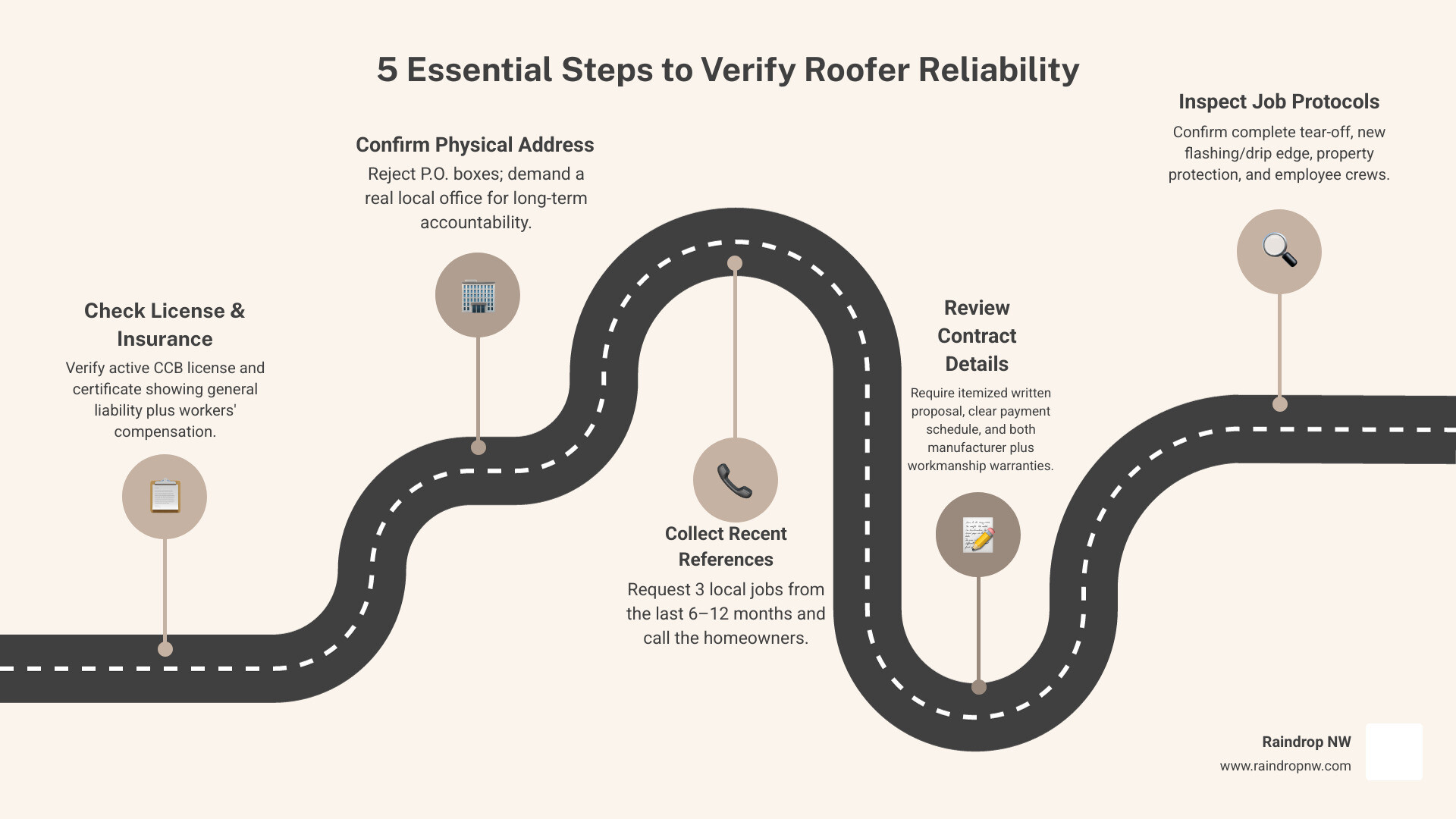
Verifying Legitimacy: Key Questions to Ask Before Hiring a Roofer

When we talk about vetting a contractor, we always start with the absolute basics of business legitimacy. It is surprisingly easy for someone to buy a ladder, print some magnetic truck signs, and call themselves a roofer. In our damp Pacific Northwest climate, hiring an unverified contractor is a recipe for structural disaster.
Before we look at shingles or talk about timelines, we must establish that the contractor is legally registered, fully insured, and bonded to operate in our communities. To learn more about this process, check out our guide on How to Verify a Roofers License and Insurance.
Can you provide proof of insurance and your license number?
In Oregon, any business doing construction work must be licensed with the Oregon Construction Contractors Board (CCB). If you are across the river in Vancouver, Camas, or Ridgefield, they must be registered with the Washington State Department of Labor & Industries (L&I).
When you ask for a license number, a reputable contractor will hand it over immediately. Once you have it, take ten minutes to look it up on the state database. You want to make sure the license is active, in good standing, and has no history of unresolved consumer complaints or serious disciplinary actions. To understand why this matters for your long-term protection, read about How Consistent Licensing Protects Past and Future Customers.
Equally important is proof of insurance. You must ask for a Certificate of Insurance (COI) sent directly from their insurance agency, showing:
- General Liability Insurance: This protects your home and property if a heavy bundle of shingles accidentally crashes through a window.
- Workers’ Compensation Insurance: This is non-negotiable. Roofing is one of the most dangerous jobs in the country. If a worker slips on a wet roof and the contractor does not carry workers’ comp, you as the homeowner could be held liable for those medical bills.
Do you have a physical business address or are you a storm chaser?
Always ask for a physical street address. A post office box or a UPS Store address is a major red flag. “Storm chasers” are out-of-state crews that travel from region to region following major weather events like windstorms or hail. They set up temporary operations, complete quick and often substandard installations, collect payments, and vanish.
If your roof begins leaking six months later, their phone number will be disconnected, and you will have no way to enforce your workmanship warranty. A brick-and-mortar office in the Portland metro area or Southwest Washington shows that the company has deep roots in the community, physical assets, and local accountability. There are massive Benefits of Choosing a Truly Local Independent Roofer who will actually be around to service your roof for decades to come.
Can you provide recent local references?
Do not settle for online reviews alone, which can sometimes be manipulated. Ask the contractor for three references from local projects completed within the last six to twelve months in areas like Beaverton, Hillsboro, or Tigard.
When you call these references, do not just ask if they like their new roof. Ask specific, telling questions:
- Was the project completed on time and within the agreed scope?
- Did the crew keep a clean job site, or did you find nails and trash in your yard?
- Was the final amount on the invoice the same as the initial estimate?
- How did the contractor handle unexpected issues or communication?
A reliable contractor will gladly share these references because they are proud of their work. For more tips on making the right choice, see How to Choose the Right Roofing Contractor.
Technical Execution: Questions to Ask Before Hiring a Roofer About Installation
A roof is a complex, engineered system designed to shed thousands of gallons of water every year. How a crew installs that system determines whether it lasts thirty years or fails in five. You need to understand their technical process before they begin tearing off your old roof.
Will you remove the old roof or install over existing shingles?
Some contractors will suggest saving time by nailing new shingles directly over your existing roof (known as an overlay or nail-over). While this might seem convenient, we strongly advise against it.
An overlay adds massive structural weight to your home. More importantly, it traps heat, shortens the lifespan of your new shingles, and completely prevents the crew from inspecting the wood decking underneath. If you have hidden dry rot or water damage in your plywood sheathing, nailing new shingles over it simply covers up a structural safety hazard. A complete tear-off is the only way to guarantee a healthy, long-lasting roof.
| Feature | Complete Tear-Off | Overlay (Nail-Over) |
|---|---|---|
| Plywood Inspection | Full inspection of roof deck; rotted wood replaced | Hidden; rotted wood remains untouched |
| Weight on Structure | Standard weight | Double weight, straining roof trusses |
| Shingle Lifespan | Maximized; proper heat dissipation | Reduced; shingles run hotter and degrade faster |
| Moisture Risk | Low; brand-new underlayment and barrier | High; old moisture can be trapped between layers |
Will you replace all flashing and drip edge?
Flashing consists of metal pieces installed at critical transition points—such as around chimneys, skylights, valleys, and where the roof meets a wall. These are the most common areas for leaks to develop.
Some cut-rate contractors will reuse your old, rusted flashing to save on material costs. Insist that all flashing and drip edge be replaced with brand-new, high-quality metal. The drip edge is particularly important in our wet climate; it guides water away from your fascia boards and directly into your gutters, preventing wood rot along the eaves.
What happens if you find damaged decking or structural issues?
Once the old shingles are removed, it is common to find sections of rotted plywood or sagging roof rafters, especially on older homes in historic neighborhoods like Westmoreland or Eastmoreland.
Ask the contractor exactly how they handle this. A professional team will not just roof over bad wood. They should stop work, take photographs of the damage, and contact you immediately with a clear explanation and a formal change order showing the cost per sheet of plywood to replace the damaged decking. You should know this rate upfront before the project begins so there are no surprises on your final bill.
Will the installation be inspected by a third party?
Depending on where you live—whether in Clackamas County, Washington County, or Clark County—local building codes may require municipal permits and inspections.
Ask the contractor if they pull all necessary building permits and if they will coordinate the final inspection with local city or county officials. A third-party inspection from a municipal building inspector provides an extra layer of quality assurance, proving that your new roof meets or exceeds all local structural and safety codes.
Project Logistics: Questions to Ask Before Hiring a Roofer About the Job Site
Roofing is a loud, messy construction project. Tearing off an average-sized residential roof can generate thousands of pounds of heavy, sharp debris. Understanding how the contractor manages the job site will protect your family, your pets, and your property from damage.
Do you use subcontractors or your own employees?
Many roofing companies act as sales organizations; they secure your contract and immediately outsource the actual labor to the lowest-bidding subcontractor crew. This often leads to inconsistent workmanship, poor communication, and safety lapses on your property.
We believe that consistency and accountability are paramount. When a company uses its own trained, in-house employees, they can guarantee that the crew follows strict safety standards and certified installation practices. To understand the risks of corporate-owned companies that rely heavily on subcontracted labor, read our thoughts on Choosing a Roofing Company That Wont Sell Out.
How long will the project take and who is my point of contact?
A standard residential roof replacement should take a skilled crew anywhere from one to three days, depending on the size and complexity of your roof.
Ask who will be on-site managing the daily work. You should have the name and direct cell phone number of a dedicated, English-speaking on-site supervisor. If you have a question about dumpster placement, property protection, or a sudden change in the weather, you need to know exactly who to talk to without having to call a corporate office and wait for a callback.
How will you protect my home, landscaping, and property?
A falling bundle of shingles or a misplaced ladder can easily destroy expensive landscaping, dent gutters, or crack a concrete driveway. Ask the contractor about their property protection protocols:
- Will they use heavy-duty tarps draped from the roofline to catch falling debris and protect your siding and windows?
- Will they place protective wooden planks under the wheels of their dumpsters to prevent your driveway from cracking?
- Do they use ladder stabilizers to avoid crushing your gutters?
How do you handle cleanup and waste disposal?
The job is not finished until your yard is completely clean. Roofing nails are notorious for ending up in lawnmower blades, car tires, and pet paws.
Make sure your contractor’s cleanup protocol includes running a powerful, industrial-strength magnetic roller over your yard, driveway, and flowerbeds multiple times a day to collect stray nails. They should also handle all debris removal and disposal, recycling asphalt shingles whenever local recycling programs are available.
Contracts, Warranties, and Payment Terms
A verbal promise is worth nothing when it comes to a major home improvement project. Every detail, timeline, and material choice must be documented in a legally binding contract. Before signing anything, read our guide on Understanding Roofing Estimates and What to Look For.
Will you provide a detailed written proposal and contract?
Never accept a vague, single-figure estimate written on the back of a business card. Your contract should be highly detailed and itemized, explicitly listing:
- The exact brand, line, and color of shingles being installed.
- The type of underlayment, ice and water shield, and ventilation products.
- A clear scope of work detailing tear-off, disposal, and cleanup.
- Approximate start and completion dates.
- A clear process for change orders if hidden damage is discovered.
What is your payment schedule and deposit policy?
A reputable roofing contractor will never ask for the entire project cost upfront. Asking for a massive down payment is a classic sign of a financially unstable business or a potential scam.
A standard, safe payment schedule typically involves a small deposit (usually around 10% to 15%) upon signing the contract, a progress payment when materials are delivered and work begins, and the final balance paid only after the project is fully completed, inspected, and you have completed a final walkthrough with the supervisor. Always use traceable payment methods like credit cards or checks, and never pay cash.
What warranties do you offer for materials and workmanship?
It is vital to understand that a new roof comes with two entirely separate warranties:
- Manufacturer Warranty: This covers defects in the roofing materials themselves (such as shingles cracking or losing granules prematurely). This can last anywhere from twenty to fifty years, but it only covers the cost of the materials, not the labor to replace them.
- Workmanship Warranty: This is provided by the contractor and covers installation errors (such as shingles blowing off because they were nailed incorrectly).
Many corporate-backed roofing companies offer short workmanship warranties because they know their high-turnover crews are prone to mistakes. A truly local, independent roofer who stands behind their work will offer a robust, long-term workmanship warranty. Furthermore, make sure to ask if the warranty is transferable to a new homeowner if you decide to sell your house in the future. Discover How Independent Ownership Protects Your Warranty over the long haul.
Frequently Asked Questions About Hiring a Roofer
What is the average lifespan of a roofing company?
The average roofing company only lasts about four years. Many newer businesses struggle to manage their cash flow during the slow, rainy winter months in the Pacific Northwest. When these companies close, their workmanship warranties disappear with them. That is why it is always safest to hire an established contractor with a long, proven track record in your local community.
Why are unresolved contractor complaints so common?
According to the Better Business Bureau, roofing consistently ranks among the top industries for consumer complaints. Many of these disputes remain unresolved because fly-by-night contractors operate without physical offices, proper licensing, or adequate insurance. When a homeowner attempts to resolve a dispute over a leaking roof, the contractor simply closes their temporary business and reopens under a new name, leaving the homeowner with expensive repair bills.
How does local weather in Beaverton affect my roofing timeline?
In Beaverton and the broader Portland metro area, our rainy season lasts from October through May. While a professional crew can install a roof year-round, heavy rain and freezing temperatures require special precautions. Asphalt shingles need warm, dry weather for their self-sealing adhesive strips to bond properly. A local contractor who understands our climate will carefully monitor local weather windows, ensuring your roof deck remains dry during the tear-off process and that materials are installed under optimal conditions.
Conclusion
Hiring a roofer does not have to be a stressful, high-risk gamble. By arming yourself with these essential questions to ask before hiring a roofer, you shift the power back into your hands, ensuring you work with a professional who respects your home, your time, and your investment.
At Raindrop NW, we are proud of our deep roots in Beaverton and the surrounding Portland metro communities. As a family-owned, multi-generational, truly independent local roofing company, we do not answer to out-of-state private equity firms or cut corners to meet corporate sales quotas. We answer to you—our neighbors.
Whether you need a minor leak repaired before the winter rains return or a complete, certified roof replacement, our team is here to provide the transparent communication, clear contracts, and exceptional craftsmanship you deserve.
Ready to experience the difference that true local accountability makes? Schedule your free residential roofing consultation with Raindrop NW today and let us help you protect what matters most.




Leave a Reply
Want to join the discussion?Feel free to contribute!