
5 Red Flags When Hiring a Roofing Contractor

Why Knowing the Red Flags When Hiring a Roofing Contractor Can Save You Thousands
Spotting the red flags when hiring a roofing contractor before you sign anything is one of the most important things you can do as a homeowner. Here are the most common warning signs to watch for:
- Unsolicited door-to-door solicitation — especially right after a storm
- Large upfront payment demands — legitimate contractors don’t ask for most of the money before work begins
- No proof of license or insurance — always verify Oregon CCB credentials independently
- High-pressure “sign today” tactics — reputable contractors give you time to decide
- Vague or missing written contract — no clear scope, materials, or warranty terms is a serious problem
Roofing is the most commonly reported home improvement scam category, accounting for 15% of all BBB complaints. The median loss from a home improvement scam is $1,700 — more than three times higher than the median loss across all scam types. And those are just the cases that get reported. Many homeowners discover the real damage months later, when leaks appear, warranties turn out to be worthless, or the contractor’s phone number is disconnected.
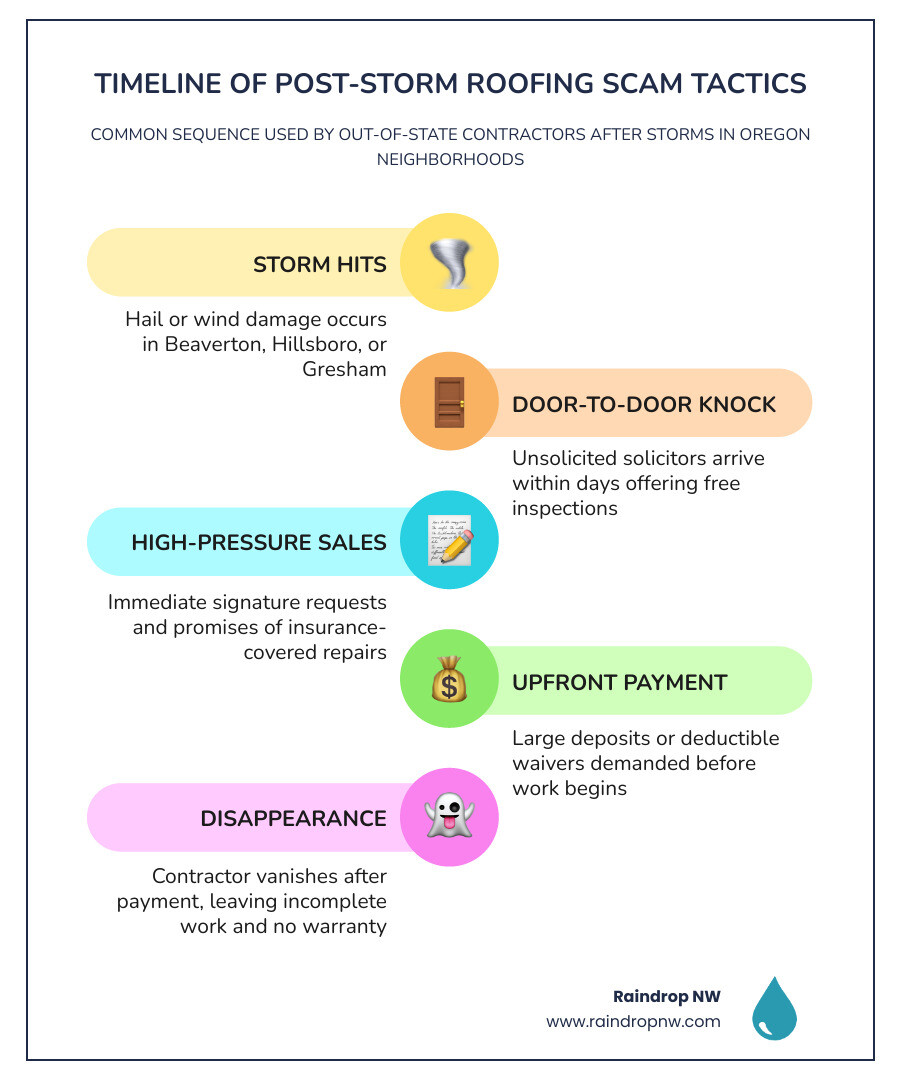
The problem is especially acute in Oregon and the greater Portland metro area. After any significant wind or hail event, out-of-state contractors flood neighborhoods like Beaverton, Hillsboro, and Gresham — going door to door, promising quick fixes and easy insurance money, then disappearing before the first rain of the season.
This guide walks you through the five biggest red flags to watch for, how to verify a contractor’s credentials in Oregon, and what to do if you’ve already signed with someone who’s raising concerns.
I’m Torrey Yungeberg, owner of Raindrop Roofing NW and a longtime advocate for ethics and professionalism in Oregon’s roofing industry — and helping homeowners recognize red flags when hiring a roofing contractor is something I’m deeply passionate about after years of seeing families hurt by scams. Let’s make sure that doesn’t happen to you.
Red Flag 1: Unsolicited Door-to-Door Storm Chasers

One of the most common ways homeowners get caught in a roofing scam is through unsolicited door-to-door sales. It usually begins a few days after a major weather event—like a severe windstorm in Lake Oswego or a heavy winter storm in Clackamas. A representative knocks on your door, claiming they “just happened to be in the neighborhood” working on a neighbor’s home and noticed wind or hail damage on your roof from the street.
While some legitimate local businesses occasionally use canvassing to introduce themselves, unsolicited post-storm visits are the primary operating method for traveling “storm chasers.” These are transient operations that move from state to state, following weather maps to target vulnerable neighborhoods.
In major storm zones, a staggering 85.19% of repair requests are driven by sheer panic in the first seven days after a weather event. Storm chasers exploit this emotional window. They rely on the urgency of the situation to bypass your normal vetting process. In contrast, modern consumers initiate quotes through secure digital channels 94.8% of the time under normal circumstances.
When you bypass secure, digital, and self-initiated channels to sign a contract on your front porch, you inherit massive structural and financial risks. If you need immediate assistance after a storm, it is always safer to take control of the process yourself.
For a deeper dive into protecting your home from post-storm pressure, read our guide on Don’t Get Ripped Off: How to Pick the Right Roof Repair Contractor in Forest Grove.
Spotting Storm Chaser Red Flags When Hiring a Roofing Contractor
Identifying a storm chaser before they step onto your roof can save you from a lifetime of structural headaches. Look for these specific warning signs during your very first interaction:
- Out-of-State License Plates and Phone Numbers: Check the vehicle parked in your driveway. If the trucks have out-of-state license plates or magnetic door signs rather than permanent decals, proceed with extreme caution. Similarly, if their primary contact number has an out-of-state area code, they likely do not have a permanent local office.
- High-Pressure Sales Tactics: If the sales representative insists that you must sign an agreement immediately to secure a “limited-time storm discount” or to get on their schedule, walk away.
- Demanding Immediate Signatures for “Free” Inspections: A classic storm chaser tactic is asking you to sign an “authorization form” before they climb onto your roof. They may tell you it is simply permission to perform a free inspection or to speak with your insurance adjuster. In reality, these forms often contain binding language that commits you to using them for the replacement if your insurance company approves the claim.
If you want to ensure you are working with an established local professional rather than a traveling sales crew, check out our resource on Don’t Get Ripped Off: How to Pick the Top Rated New Roof Installer in Portland.
Red Flag 2: Demanding Large Upfront Payments or Deductible Waivers
A reputable roofing contractor operates on a stable financial foundation. They do not need your money to purchase the basic materials or pay their crew to start your project. One of the clearest red flags when hiring a roofing contractor is a demand for a large upfront payment—especially anything approaching or exceeding 50% of the total project value before any materials are delivered to your property.
In some neighboring states, like California, demanding more than 10% or $1,000 (whichever is less) upfront for a home improvement project is flat-out illegal. While Oregon’s Construction Contractors Board (CCB) does not set a rigid statutory cap on deposits, the industry standard for a reasonable deposit is 10% to 20% to secure your spot on the schedule, with further payments tied directly to verified project milestones (such as material delivery or the completion of the tear-off phase).
When a contractor demands a massive deposit upfront, it often signals financial instability. They may be using your deposit to finish a job for a previous homeowner, creating a dangerous cycle where your project is delayed because they lack the liquid cash to buy your shingles.
Another financial red flag is the offer to “cover,” “waive,” or “absorb” your homeowner’s insurance deductible. A solicitor might say, “Sign with us, and we’ll write off your deductible so your new roof is completely free.” While this sounds like an incredible deal, it is actually a form of insurance fraud.
In Oregon, as in most jurisdictions, it is illegal for a contractor to knowingly falsify an invoice to an insurance company to conceal the fact that the deductible was not paid by the policyholder. A contractor willing to commit insurance fraud to win your business is highly likely to cut corners on your roof installation as well.
To learn more about navigating the financial realities of a roof replacement safely, read our article on Don’t Get Ripped Off: How to Find Top Rated Roof Replacement in Beaverton.
Payment Red Flags When Hiring a Roofing Contractor
When negotiating the payment terms of your roofing project, keep an eye out for these financial warning signs:
- Cash-Only Requests or Discounts: If a contractor offers a steep discount if you pay in cash, or insists on cash-only payments, they may be trying to avoid taxes, bypass licensing oversight, or operate off the books. This leaves you with zero paper trail if the work is substandard or incomplete.
- Checks Made Out to an Individual: Always make payments to a registered business entity, never to an individual’s personal name. Paying an individual makes it incredibly easy for them to pocket the funds and walk away, leaving you with no legal recourse against the actual business.
- The Assignment of Benefits (AOB) Trap: Be incredibly wary if a contractor asks you to sign an Assignment of Benefits (AOB) agreement. This legal document transfers your insurance claim rights, benefits, and decision-making power directly to the contractor. Once signed, the contractor can file claims, negotiate payouts, and even sue your insurance company without your consent—all while keeping you completely in the dark.
For a comprehensive checklist on how to structure a safe, professional contract agreement, explore our guide on How to Choose the Right Roofing Contractor.
Red Flag 3: Licensing and Insurance Red Flags When Hiring a Roofing Contractor
Every legitimate roofing contractor operating in Oregon must hold an active license with the Oregon Construction Contractors Board (CCB) and carry active general liability and workers’ compensation insurance. If a contractor cannot immediately produce their CCB number or current certificates of insurance, you should end the conversation immediately.
To help visualize the difference between a secure hiring choice and a high-risk gamble, consider this comparison:
| Vetting Criteria | Reputable Local Contractor | Unlicensed / Uninsured Storm Chaser |
|---|---|---|
| Oregon CCB License | Active, clean record, clearly displayed on all materials | Missing, expired, or registered under a different name |
| General Liability | Typically $2 million+; protects your home from accidental damage | None, or expired policies that leave you liable for damage |
| Workers’ Comp | Active coverage for all crew members on your property | None; relies on uninsured day labor or independent subs |
| Local Reputation | Verifiable local office, local references, years of community history | P.O. Box, out-of-state phone number, zero local references |
| Warranty Security | Factory-certified status; backed by manufacturer and local business | Vague “handshake” warranties that disappear when they leave |
Failing to verify these credentials puts you at massive physical and financial risk. If an uninsured worker falls from your roof during installation, your homeowner’s insurance policy may exclude commercial worker injuries, leaving you personally liable for medical bills and lost wages.
Similarly, if a contractor damages your home—such as dropping a heavy bundle of shingles through a skylight or leaving your roof exposed during a sudden Portland rainstorm—an uninsured contractor will likely vanish, leaving you to pay for the interior water damage out of pocket.
For a detailed walkthrough on how to protect your home from these liabilities, read our guide on How to Verify a Roofers License and Insurance.
Verifying Oregon CCB Licenses and Insurance
Verifying a contractor’s credentials in Oregon is a straightforward process, but you must do it yourself rather than relying on a printed piece of paper the salesman hands you.
First, ask for the contractor’s CCB license number. Then, visit the official Oregon Construction Contractors Board website and enter the number into their search tool.
Verify that the business name matches the entity on your contract, that the license is active, and that there are no active, unresolved consumer complaints or history of severe civil penalties.
Additionally, request a copy of their Certificate of Insurance (COI). A truly professional contractor will have their insurance agency send a copy of the certificate directly to you. Take five minutes to call the insurance agency listed on the certificate to confirm that the policy is currently active, has not lapsed due to non-payment, and carries sufficient general liability coverage (we recommend a minimum of $2,000,000).
To understand why consistent licensing is your best defense against structural failure, read about How Consistent Licensing Protects Past and Future Customers.
Red Flag 4: High-Pressure Sales Tactics and “Deal Ends Today” Urgency
A roof replacement is a major capital improvement project. A professional, ethical contractor understands that you need time to review proposals, compare options, and make an informed decision. If a contractor uses high-pressure sales tactics to force an immediate decision, it is a major warning sign.
A classic psychological tactic used by predatory sales representatives is the “long-form appointment.” The representative may schedule an inspection but turn it into a multi-hour presentation designed to wear you down. They might present overly complex technical jargon, show you dramatic videos of roof collapses, or use fear-based messaging to make you feel like your home is on the verge of structural failure. By the end of a two-hour meeting, mental fatigue sets in, making you far more likely to sign a contract just to get them out of your house.
Another common tactic is the artificial “one-day-only” discount. The salesman might say, “The price is normally higher, but if you sign the contract right now, I can give you our neighborhood discount of 20% off.”
Reputable contractors base their pricing on actual material costs, labor rates, and local building codes. They do not have massive, arbitrary margins that allow them to drop the price by thousands of dollars simply because you hesitated. If a price can drop significantly with a little resistance, the initial quote was heavily inflated, or they plan to make up the difference later through hidden fees.
Red Flag 5: Suspiciously Low Bids (The Low-Ball Decking Trap & Cheap Repair Hustle)
Everyone loves a good deal, but a roofing quote that is dramatically lower than other bids is often a trap. If you receive a bid that is significantly lower than other local quotes, the contractor is likely cutting critical corners.
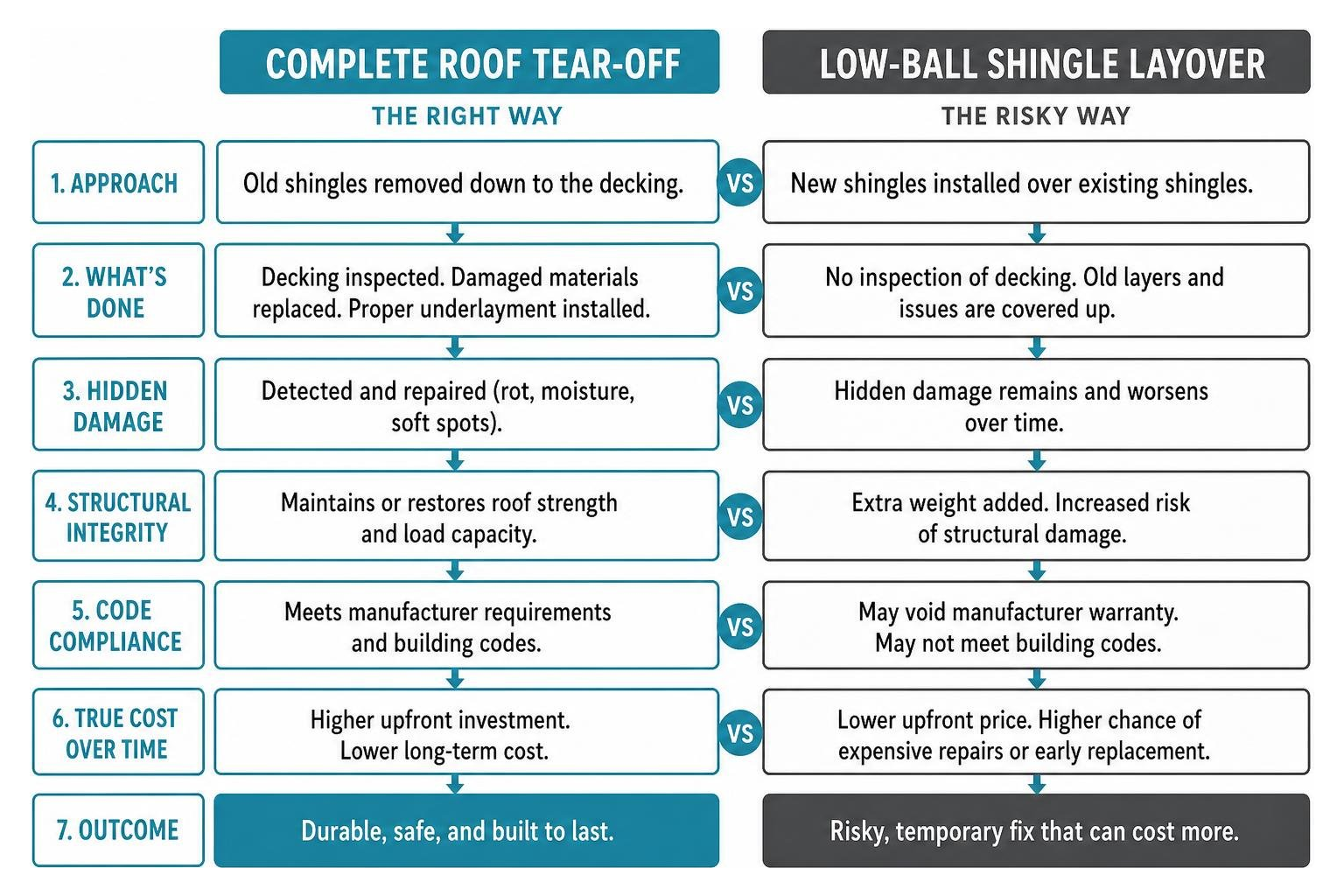
A common way dishonest contractors submit low-ball bids is through the “Low-Ball Decking Trap.” Our historical project data proves that exactly 20% of roofs—one in five—require extensive structural decking upgrades once the old shingles are removed.
A low-ball contractor will intentionally exclude the cost of replacing damaged, rotted plywood from their initial bid to make their price look incredibly attractive. Once your old roof is torn off and your home is exposed to the elements, they will hit you with massive, non-negotiable change orders for decking repairs, holding your home hostage until you pay the inflated costs.
Another variation is the “Cheap Repair Hustle.” A contractor might offer a cheap, quick spot repair on an aging, failing roof for a low flat rate. However, our 2025 network data shows that reputable contractors reported $0 in closed-won standalone repair revenue. Why? Because performing surface-level patches on a structurally compromised or aging roof is a liability.
Cheap spot repairs ignore the underlying underlayment and structural decking, often voiding the manufacturer’s long-term material warranties and leaving you with active leaks just months down the road. A quality contractor will always recommend a complete, code-compliant tear-off and replacement when a roof has reached the end of its functional life.
Frequently Asked Questions About Roofing Scams
What should a proper written roofing contract include?
A legally binding, professional roofing contract should leave zero room for interpretation. It must be highly detailed and include:
- Complete Business Information: The contractor’s legal business name, physical address (not a P.O. Box), phone number, email, and active Oregon CCB license number.
- Detailed Scope of Work: A clear statement specifying a full structural tear-off rather than a “roof layover” (which installs new shingles over old ones, adding dangerous weight and voiding warranties).
- Specific Materials and Brands: The exact manufacturer, style, and color of the shingles, along with the specific underlayment, ice and water shield, drip edge, flashing, and ventilation systems to be installed.
- Clear Payment Schedule: A structured payment timeline tied directly to completed project milestones, with a reasonable deposit upfront and the final payment withheld until a final inspection is passed and a lien waiver is provided.
- Project Timeline: Estimated start and completion dates, along with a clear policy on how weather delays will be communicated and handled.
- Warranty Details: Explicitly written terms for both the manufacturer’s material warranty and the contractor’s workmanship warranty.
What is an Assignment of Benefits (AOB) and why is it risky?
An Assignment of Benefits (AOB) is a legal agreement that signs over your insurance claim rights directly to a third-party contractor. While contractors often pitch this as a convenient way to “let us handle the insurance hassle for you,” it strips you of your rights as the policyholder.
Once you sign an AOB, the contractor can file claims, inflate project scopes, and negotiate payouts directly with your insurance carrier. If the insurance company disputes the contractor’s inflated bill, the contractor can file a lawsuit against the insurer in your name.
This can lead to severe delays in your project, potential policy cancellation, and even personal financial liability if the contractor performs substandard work or leaves the job unfinished while pocketing the insurance payout. Always retain control of your insurance claim and pay your contractor directly through documented, milestone-based payments.
What steps can I take if I already signed with a problematic roofer?
If you have already signed a contract and are beginning to notice significant red flags, you still have options to protect your home and wallet:
- Review Your Cancellation Rights: Under Oregon law and federal consumer protection rules, you typically have a “three-day right to cancel” (cooling-off period) for contracts signed in your home or at a location other than the contractor’s permanent place of business. Review your contract for a cancellation clause.
- Communicate Exclusively in Writing: Stop taking phone calls or verbal promises. Send all correspondence via email or certified mail so you have a clear, date-stamped paper trail of your concerns, requests, and any contract disputes.
- Document Everything Meticulously: Take high-resolution photos and videos of your property before, during, and after any work is performed. Document any property damage, safety violations, or incomplete work.
- Contact the Oregon CCB: If the contractor is licensed but engaging in unethical behavior, violating contract terms, or threatening legal action, file a formal complaint with the Oregon Construction Contractors Board. They can mediate disputes and help hold the contractor accountable.
- Seek Legal Counsel: If a significant amount of money is involved or the contractor has placed a mechanic’s lien on your home, consult with a construction attorney immediately to explore your legal remedies.
Conclusion
Your roof is the single most important protective barrier shielding your family, your belongings, and your home’s structural integrity from the elements. Entrusting its replacement or care to a contractor who exhibits any of these warning signs is a risk you simply do not need to take.
At Raindrop Roofing NW, we believe in a completely different approach. As a family-owned, truly local business deeply rooted in Beaverton and serving the greater Portland metro area, we don’t rely on door-knocking, high-pressure sales pitches, or deceptive financial structures to earn your trust. Our reputation is built on decades of transparent communication, certified craftsmanship, and a commitment to our local community.
We are independently owned. This means we are directly accountable to you, our neighbors, long after the project is complete. We stand behind our work with authentic, verifiable warranties that actually mean something because we will still be here in the community to honor them.
To learn more about how to protect your home and make an informed decision, explore our resources on:
- Choosing a Roofing Company That Won’t Sell Out
- Benefits of Choosing a Truly Local Independent Roofer
- How Independent Ownership Protects Your Warranty
If you suspect your roof has storm damage, or if you simply want an honest, comprehensive evaluation of your roof’s current health without any sales pressure, we are here to help. Schedule a Free Inspection with Raindrop Roofing NW today, and experience what a professional, community-focused roofing experience should feel like.




Leave a Reply
Want to join the discussion?Feel free to contribute!