
The Definitive Guide to Roofing Estimates

I need a roof replacement in the Portland metro area. How do I go about understanding roofing estimates and what to look for?
Understanding roofing estimates and what to look for is one of the most important steps you can take before committing to a roof replacement or major repair. A professional roofing estimate is not just a price — it is a written plan that tells you exactly what work will be done, what materials will be used, and what protections you have after the job is finished.
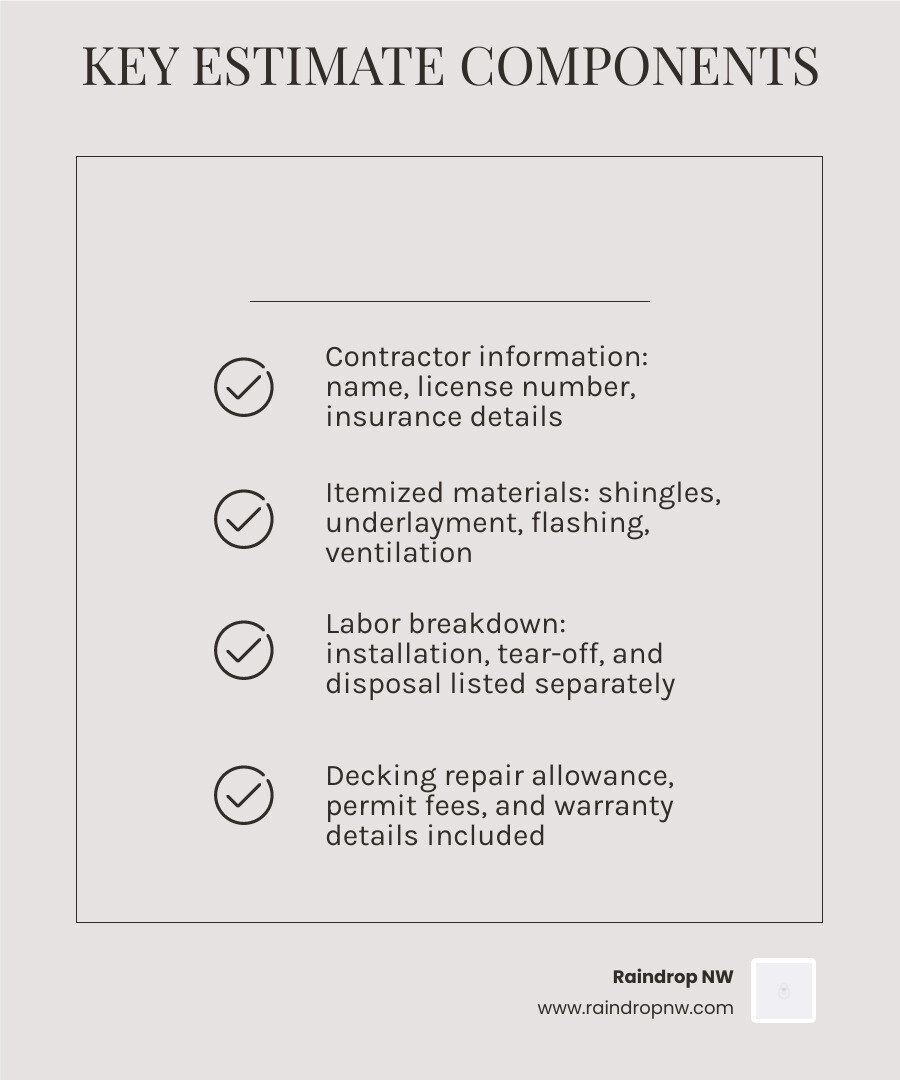
Here is what every roofing estimate should include:
- Contractor information — company name, license number, insurance details, and contact info
- Itemized materials — shingle brand and model, underlayment type, flashing, drip edge, ridge cap, and ventilation
- Labor breakdown — installation, tear-off, and disposal listed separately
- Decking repair allowance — a pre-agreed per-sheet price for any damaged decking found after tear-off
- Permit fees — pulled by the contractor, not you
- Waste factor — typically 10–15% added to material quantities
- Timeline — projected start and completion dates
- Warranty details — both manufacturer coverage and workmanship guarantee
- Payment schedule — a reasonable deposit (10–30%) with the balance due at completion
If an estimate is missing several of these items, that is a problem worth paying attention to before you sign.
I’m Torrey Yungeberg, owner of Raindrop Roofing NW, and after years of leading roofing projects across the Portland metro and serving on the boards of both the Oregon Chapter of National Women in Roofing and the Associated Roofing Contractors of Oregon and Southwest Washington, I’ve seen how confusing understanding roofing estimates and what to look for can be for homeowners. In this guide, I’ll walk you through every section of a roofing estimate so you know exactly what you’re comparing — and what to question.
Estimate vs. Quote vs. Bid: What is the Difference?
Before diving into the fine print, it is helpful to clarify the terminology. Homeowners often use the words “estimate,” “quote,” and “bid” interchangeably, but in the professional roofing world, these documents serve different purposes.
- Roofing Estimate: This is an educated approximation of the project scope and cost based on an initial physical inspection. An estimate recognizes that there are hidden variables—such as rotten roof decking or multiple layers of old shingles hidden beneath the surface—that cannot be fully verified until the old roof is torn off.
- Roofing Quote: A quote is a fixed-price offer for a highly specific, defined scope of work. Once you sign a quote, the price for that exact scope is locked in, assuming no hidden structural issues are discovered during the process.
- Roofing Bid: A bid is a formal proposal submitted by a contractor, often in a competitive situation. It outlines how they plan to execute the project, the specific materials they will use, and their pricing structure.
When planning your project, understanding these nuances helps you anticipate where variable costs might arise. This is especially true in the Pacific Northwest, where our high-moisture climate frequently conceals hidden water damage beneath older shingles. For a deeper dive into regional pricing variables, read our guide on How Much Does a New Roof Cost in the Pacific Northwest.
Key Components of Understanding Roofing Estimates and What to Look For
When you receive a professional roofing proposal, it should be a multi-page, detailed document rather than a single-page sheet with a handwritten total. A comprehensive estimate protects both you and the contractor by establishing clear expectations.
Every professional estimate must prominently feature:
- Complete Company Information: This includes the business name, physical address, phone number, email, and website.
- Licensing and Credentials: In Oregon, contractors must display their Construction Contractors Board (CCB) license number. In Washington, they must display their Department of Labor & Industries (L&I) registration.
- Insurance and Bonding Verification: The estimate should state that the contractor carries active general liability insurance and workers’ compensation.
- Project Timeline: It should clearly outline the estimated start date and the number of working days required to complete the project, weather permitting.
- Payment Terms: A structured payment schedule detailing the deposit required, milestone payments (if any), and when the final balance is due.
To understand how these components fit into your overall financial planning, check out our Roof Replacement Cost Guide for Homeowners.
Material Specifications: Understanding Roofing Estimates and What to Look For
The materials section is where many low-ball estimates hide their cost-cutting measures. A professional estimate must specify the exact manufacturer, product line, and color of every component being installed. Vague descriptions like “install architectural shingles” are a major red flag.
When reviewing the materials section, look for these specific line items:
- Field Shingles: The estimate must name the brand (such as GAF, Owens Corning, or CertainTeed) and the specific product line. To see how these choices affect your investment, read about How Material Choice Impacts Your Roof Cost.
- Underlayment: The barrier installed directly on the wood decking. High-quality synthetic underlayment is highly recommended over traditional organic felt paper due to its superior tear resistance and moisture protection.
- Ice and Water Shield: A self-adhering waterproof membrane. In our local climate, this should be specified for installation in critical leak-prone areas, including valleys, roof penetrations, and along the eaves.
- Drip Edge: A metal flashing installed along the roof edges to direct water away from the fascia boards and into the gutters. Most modern building codes require a drip edge, yet budget contractors frequently leave it off their estimates.
- Flashing Replacement: Flashing prevents water from entering transitions around chimneys, dormers, and skylights. A quality estimate will specify the replacement of old flashing rather than reusing corroded or bent metal.
- Ventilation Calculations: The estimate should detail the types of vents being installed (ridge vents, intake vents, or box vents) to ensure your attic space meets local building codes for balanced airflow.
- Waste Factor: Roofing materials are ordered with an extra percentage to account for cuts, valleys, and starter courses. A standard waste factor is 10% for simple roofs, but complex roofs with multiple valleys and dormers can require 15% to 20%.
Labor, Tear-Off, and Decking: Understanding Roofing Estimates and What to Look For
Labor is a significant portion of your roofing project, typically accounting for 35% to 45% of the total cost, while materials make up about 40% to 50%. A clear estimate should break down the labor phases so you know exactly what you are paying for.
- Tear-Off and Disposal: The estimate must state whether the crew is tearing off the existing roof down to the bare wood decking or performing an overlay (installing new shingles over old ones). Overlays are generally discouraged as they add excessive weight and hide underlying structural rot. The estimate should also include the cost of dumpster rentals and local disposal fees.
- Decking Repair Allowance: Because we cannot see through shingles, the true condition of your roof’s plywood decking remains a mystery until the tear-off phase. A professional estimate handles this by including a clear, pre-negotiated rate for decking replacement (usually priced per sheet of plywood or per board foot of spaced sheathing) so you are not surprised by a massive, unpriced change order later.
- Property Protection: The process of tearing off an old roof is messy. Your estimate should detail how the crew plans to protect your landscaping, siding, windows, and outdoor furniture during the project.
- Cleanup Scope: Ensure the estimate explicitly states that the contractor is responsible for daily cleanup, magnetic sweeping to collect stray nails, and hauling away all debris.
Red Flags to Watch Out For in a Roofing Proposal
As you review proposals from different contractors, keep an eye out for warning signs that indicate a contractor may be cutting corners, underinsured, or using high-pressure sales tactics.
- Lump Sum Pricing: A single total price with no breakdown of materials, labor, permits, or disposal is a major warning sign. Vague estimates protect the contractor, while detailed estimates protect the homeowner.
- Missing Permit Line Item: If the estimate does not mention building permits, or if the contractor asks you to pull the permit, walk away. This is often an attempt to bypass code inspections or hide unlicensed work.
- Excessive Upfront Deposits: While a deposit is standard to secure your spot on the schedule and order materials, asking for more than 30% upfront is a red flag. Never pay for the entire project before the work is completed and fully inspected.
- High-Pressure, Today-Only Discounts: If a salesperson tells you that a price is only valid if you sign the contract right then and there, they are trying to prevent you from getting other estimates. Reputable contractors provide estimates that are valid for at least 30 to 90 days.
- No On-Roof Physical Inspection: Be wary of estimates generated solely via satellite imagery without a representative physically walking the roof or inspecting the attic space. Satellite tools are great for measurements, but they cannot detect soft decking, rotted fascia, or ventilation issues.
- Unlicensed or Uninsured Status: Always verify the contractor’s license number directly on the state’s licensing portal. If they cannot provide an active certificate of general liability and workers’ compensation insurance, do not allow them onto your property.
How to Compare Multiple Roofing Bids Side-by-Side
We always recommend obtaining at least three written estimates. However, comparing them is not as simple as looking at the bottom-line price. You must normalize the scopes of work to ensure you are comparing “apples to apples.”
Use the scorecard below to compare your bids:
| Comparison Variable | Estimate A | Estimate B | Estimate C |
|---|---|---|---|
| Shingle Brand & Model | Specified (Premium) | Specified (Standard) | Vague (“Architectural”) |
| Underlayment Type | Synthetic | Synthetic | 15# Felt Paper |
| Ice & Water Shield | Valleys & Eaves | Valleys Only | None Listed |
| Flashing Replacement | All New Metal | Reusing Old | Not Mentioned |
| Ventilation Changes | Added Ridge Vents | None | None |
| Workmanship Warranty | 10 Years | 5 Years | 1 Year |
| Permit Responsibility | Contractor | Contractor | Homeowner |
| Decking Replacement Rate | Clear Per-Sheet Rate | Clear Per-Sheet Rate | “TBD” (No Rate Listed) |
When you line up your estimates this way, you will often find that the cheapest estimate is actually the most expensive in the long run because it skips critical components like new flashing, synthetic underlayment, and proper ventilation.
Additionally, pay close attention to the warranty stack. A complete roofing warranty has multiple layers:
- Manufacturer Product Warranty: Covers defects in the shingles themselves (typically 20 to 50 years).
- Contractor Workmanship Warranty: Covers installation errors (we recommend looking for a minimum of 5 to 10 years).
- Manufacturer Certified System Warranty: Offered only by certified contractors (like GAF Master Elite or Owens Corning Preferred), which binds the manufacturer to back the contractor’s workmanship.
Frequently Asked Questions about Roofing Estimates
Navigating the roof replacement process brings up plenty of questions. Here are the answers to the most common inquiries we receive from local homeowners.
How long is a roofing estimate typically valid?
Most roofing estimates are valid for 90 days. The roofing industry is subject to fluctuations in petroleum prices (which directly impact asphalt shingle manufacturing costs) and seasonal labor demands. If you receive an estimate in the winter but wait until the peak summer season to sign, the contractor may need to issue an updated proposal to reflect current material and labor rates.
Should the contractor or the homeowner pull the building permit?
The contractor should always pull the building permit under their own business name and license. When a contractor pulls the permit, they are legally registering themselves as the party responsible for code compliance, safety regulations, and passing the final city or county inspection. If a contractor asks you to pull the permit as an “owner-builder,” they are transferring all code and safety liability to you—which is a massive risk.
How does insurance coverage affect my roofing estimate?
If your roof replacement is the result of storm, wind, or tree damage, your homeowner’s insurance policy will likely play a major role.
- Adjuster Scope: Your insurance adjuster will inspect the damage and write an initial estimate of the repair costs.
- Overhead and Profit (O&P): If your project is complex and requires multiple trades, your insurance estimate should include an additional percentage for overhead and profit.
- Supplements: It is common for a roofing contractor to discover additional storm damage once the shingles are removed. A reputable contractor will document this damage with photos and submit a “supplement” directly to your insurance company to ensure the additional work is covered.
To make sure you are fully protected throughout this process, we recommend reading our resources on Understanding Your Insurance Policy and Roofing Coverage as well as our step-by-step guide on How to File a Roof Damage Insurance Claim.
Conclusion
Taking the time to understand your roofing estimate ensures that your home is protected by high-quality materials and skilled craftsmanship. A roof is a complex system designed to shed water, vent heat, and protect your family for decades—not just a layer of shingles nailed to plywood.
At Raindrop NW, we believe in complete transparency. As a family-owned, truly local roofing company based right here in Beaverton, Oregon, we are proud of our deep roots in the Portland metro area. With our multi-generational ownership, our accountability is entirely to our local community. We don’t believe in high-pressure sales pitches or hidden fees; we believe in clear, itemized proposals, certified craftsmanship, and long-term relationships with our neighbors.
If you are ready to work with a local team that values clarity and quality, Schedule a professional consultation with Raindrop NW today. We will provide you with a detailed, itemized estimate so you can make the absolute best decision for your home.




Leave a Reply
Want to join the discussion?Feel free to contribute!