Why Your Attic’s Air Quality Determines Your Home’s Long-Term Health
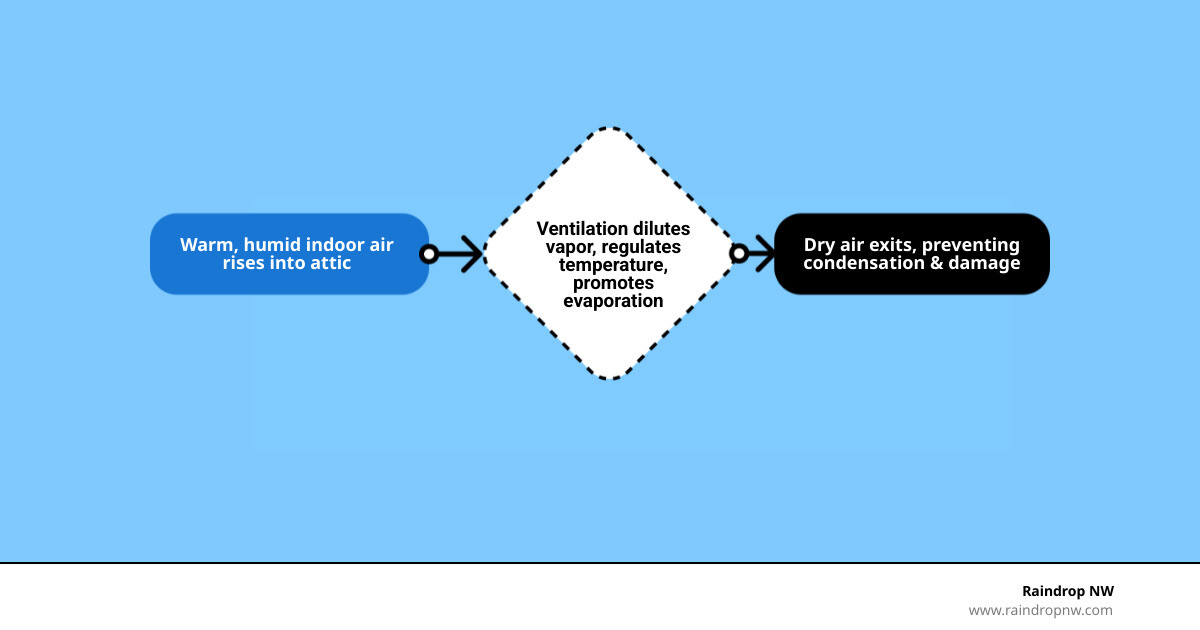
How ventilation reduces moisture damage comes down to one core principle: moving air carries moisture out before it can settle, condense, and destroy your home from the inside out. Here’s a quick breakdown:
- Dilution – Fresh air mixes with humid indoor air, lowering overall moisture concentration
- Evaporation – Airflow across damp surfaces speeds up drying before water can soak in
- Temperature regulation – Consistent airflow prevents cold spots where condensation forms
- Pressure balance – Balanced intake and exhaust stops moisture-laden air from being forced into walls and attic cavities
Most homeowners don’t think about their attic until something goes wrong. But by then, the damage is often already done. Research shows that 75–80% of all building envelope problems trace back to moisture in some form. In Sweden, a study of 420 buildings found that 65% had moisture problems serious enough to trigger visible microbial growth. These aren’t edge cases — they’re the predictable result of homes that trap more air than they move.
Modern homes are better insulated and more airtight than ever. That’s great for energy bills, but it creates a hidden problem: moisture from everyday activities like cooking, showering, and even breathing has nowhere to go. It builds up, finds the coldest surface it can, and condenses. In an attic, that means wet insulation, rotting rafters, warped sheathing, and eventually, a very expensive repair bill.
Here in Oregon, where wet winters and damp air are just part of life, this issue hits closer to home than almost anywhere else.
I’m Torrey Yungeberg, owner of Raindrop Roofing NW, and I’ve seen how poor attic airflow quietly ruins roofs that look perfectly fine from the street — understanding how ventilation reduces moisture damage is something I apply to every inspection and roof project we take on. Let’s walk through exactly what’s happening up there, and what you can do about it.
Understanding How Ventilation Reduces Moisture Damage
To understand why your roof needs to “breathe,” we have to look at the physics of air. In any given home, air movement is responsible for more than 98% of water vapor movement into building cavities. It isn’t just seeping through the wood; it’s hitching a ride on air currents that travel through every tiny crack, wire penetration, and light fixture.
The Science of Relative Humidity and Dew Point
Relative humidity (RH) is a measure of how much water vapor the air is holding compared to the maximum it could hold at that specific temperature. Here is the kicker: warm air can hold significantly more water than cold air. When warm, moist air from your living room escapes into a cold attic in April 2026, it hits its “dew point”—the temperature where it can no longer hold that water. The vapor then turns into liquid droplets on your rafters and roof sheathing.
By providing residential roofing services that prioritize airflow, we use “vapor dilution.” By constantly bringing in drier outdoor air, we lower the concentration of moisture in the attic, ensuring the air never reaches that critical dew point. Without this, you create thermal bridges where cold meets warm, leading to structural integrity issues that can cost between €10,000 and €40,000 to repair according to international building studies.
How Ventilation Reduces Moisture Damage from Condensation
Condensation is the “silent killer” of roofs. When air becomes saturated, it looks for the coldest surface available. In the winter, that is usually the underside of your roof deck.
- Saturated Air: Daily activities like showering and cooking add gallons of water to your indoor air.
- Cold Surfaces: Without airflow, this moisture sits against cold plywood.
- The Result: You get mold spores, mildew growth, and eventually, wood rot.
Effective ventilation ensures that the temperature gradient between the inside of your attic and the outside air is as small as possible. We often find during our roof inspections and certifications that homes with “mystery leaks” are actually just suffering from severe internal condensation.
Preventing Ice Dams Through Balanced Airflow
For our neighbors in higher elevations or during those rare Portland freezes, ice dams are a major threat. They happen when heat escapes into the attic, melts the snow on the roof, and the water then refreezes at the cold eaves. This creates a dam that backs water up under your shingles.
Properly installed soffit vents (intake) and ridge vents (exhaust) create a “cold roof” environment. By keeping the attic temperature close to the outside temperature, you prevent the freeze-thaw cycle that causes dams. This is a critical part of roof repairs and maintenance because once an ice dam forms, the weight and water intrusion can destroy your gutters and structural fascia.
Primary Causes of Attic Moisture and Structural Decay
It is easy to blame a leaky shingle for a damp attic, but often the call is coming from inside the house.
Common Sources of Moisture
- Household Activities: A family of four can release several gallons of water vapor daily just through breathing, cooking, and showering.
- Construction Drying: If you’ve recently had work done, new concrete curing and “green” lumber release massive amounts of moisture as they dry.
- Capillary Suction: Moisture can be “wicked” up from the soil through a concrete foundation if there isn’t a proper vapor barrier.
- Air Leaks: Unsealed “heat bypasses” around chimneys or attic hatches allow warm air to rush into the attic.
When we install new replacement roofs, we often find that the bathroom exhaust fan was never actually ducted to the outside—it was just blowing steam directly into the attic. That is a recipe for instant mold.
How Ventilation Reduces Moisture Damage in High-Humidity Zones
Kitchens and bathrooms are “moisture factories.” To prevent this air from migrating to your attic, you need a combination of spot ventilation (extractor fans) and whole-house airflow.
- Negative Pressure: Extractor fans create a slight vacuum, pulling moist air out before it can spread to other rooms.
- Continuous Air Displacement: Systems like Positive Input Ventilation (PIV) or Heat Recovery Ventilation (HRV) ensure that “stale” air is constantly swapped for fresh air.
If you are planning remodels and additions, ensuring that these new spaces have dedicated ventilation paths is vital to prevent “dead air” zones where mold thrives.
Effective Ventilation Systems for Moisture Control
Not all vents are created equal. The goal is a “balanced” system where the amount of air coming in matches the amount going out.
| System Type | Mechanism | Best Use Case |
|---|---|---|
| Soffit Vents | Intake (Passive) | Under the eaves; provides the “cool” air source. |
| Ridge Vents | Exhaust (Passive) | Along the roof peak; lets warm air escape naturally. |
| Powered Fans | Exhaust (Mechanical) | High-pitch roofs or areas with low natural wind. |
| HRV/ERV | Balanced (Mechanical) | Airtight, modern homes needing energy-efficient air exchange. |
| PIV Systems | Supply (Mechanical) | Older homes with persistent condensation dampness. |
Choosing the right roof types and products means matching the ventilation to your home’s specific geometry. A ridge vent is great, but if your soffits are blocked by insulation, the ridge vent will actually start pulling air (and conditioned heat) from your living space instead of the outside.
How Ventilation Reduces Moisture Damage Across Different Climates
In the Pacific Northwest, our challenge is the “Humid Winter.” While cold air generally holds less moisture, our 100% humidity rainy days mean the air coming into the attic is already damp.
The secret here is maintaining an indoor relative humidity of 35-50%. Any higher, and you risk dust mite infestations and mold. As a manufacturer certified roofing contractor, we emphasize that ventilation must work in tandem with air sealing and vapor retarders to keep the “house air” separate from the “attic air.”
Practical Steps to Improve Home Airflow
You don’t always need a full roof tear-off to improve your situation. Here are some practical steps you can take right now:
- Clear Your Soffits: Go into your attic (carefully!) and make sure your insulation isn’t shoved into the corners, blocking the eave vents. Installing “attic baffles” can keep these channels open permanently.
- Check Your Exhaust Fans: Ensure your bathroom and kitchen fans actually vent to the outdoors, not just into the attic or soffit.
- Monitor Humidity: Buy a cheap hygrometer. If your indoor RH is consistently above 50%, you need more airflow or a dehumidifier.
- Mind the Furniture: Don’t push large wardrobes or beds directly against outside walls; leave an inch or two for air to circulate and prevent “ghosting” mold.
- Air Sealing: Seal the gaps around light fixtures and attic hatches to stop the “stack effect” from pushing moisture into your roof space.
We love showing off successful projects in our roofing gallery—most of the “cleanest” looking attics are the ones where the homeowner simply took the time to ensure the vents weren’t blocked by Christmas decorations or old boxes.
Frequently Asked Questions about Ventilation and Dampness
Can ventilation fix rising or penetrating damp?
Ventilation is the champion of condensation damp, but it has limitations.
- Rising Damp: This is moisture wicking up from the ground through walls. It requires a physical damp-proof course or better drainage.
- Penetrating Damp: This is usually a leak—water coming through a hole in the roof or a crack in the siding. While ventilation helps dry these areas out, it won’t fix the source of the water. For outdoor areas, we often recommend waterproof deck surfaces to prevent water from soaking into structural framing in the first place.
What are the signs of poor attic ventilation?
Keep an eye out for these red flags:
- Musty Odors: That “old attic” smell is usually mold.
- Rusty Nails: If the nails sticking through your roof deck are rusty, you have a condensation problem.
- Warped Shingles: Excessive heat and moisture can cause shingles to curl or “fishmouth.”
- High Energy Bills: If your AC is working overtime in the summer, your attic might be a 150-degree oven due to trapped air. Check our owner resources for a full checklist of what to look for during your seasonal home maintenance.
When should I consult a professional for moisture issues?
If you see visible mold, sagging roof decks, or if you’ve had recurring leaks that “disappear” and come back, it’s time for a professional survey. A building envelope assessment can determine if the problem is your shingles, your ventilation, or your insulation. We also offer roofing financing to help homeowners address these structural issues before they turn into a total roof failure.
Conclusion: Protect Your Home with Raindrop NW
At the end of the day, how ventilation reduces moisture damage is about balance. You want a home that stays warm and dry, but you can’t achieve that by sealing it in a plastic bag. Air needs to move.
At Raindrop NW, we take pride in being a truly local, Beaverton-based company. Unlike those big out-of-state firms that just want to slap on some shingles and move to the next city, we live here. We know the Oregon rain, we know the local building codes, and we know that a roof is a system—not just a covering. Our independent ownership means we answer to you, our neighbor, ensuring long-term accountability and protection for your home.
Don’t let hidden moisture quietly eat away at your investment. Whether you need a quick inspection or a completely redesigned ventilation system, we’re here to help.
Protect your home with expert residential roofing—Contact Raindrop NW today!