• Link to X
  • Link to Instagram
  • Link to Youtube
  • Link to Facebook
  • Link to WhatsApp
CALL: (503)526-3887 or EMAIL: info@raindropnw.com
RAINDROP ROOFING NW | PORTLAND, OR
  • Home
  • About Us
    • About Raindrop Roofing NW
    • Our Team
    • Areas We Serve
    • Who We Support
    • Our Commitment to a Greener Future
    • Careers
    • Blog
  • Residential Roofing
    • Services
      • New / Replacement Roofs
      • Repairs and Maintenance
      • Remodels and Additions
      • Balconies, Patios, and Flat Decks
      • Roof Inspections and Certifications
    • Financing
    • Roof Gallery
    • Roof Types and Products
    • Manufacturer-Certified Roofing Contractor
    • Owner Resources
  • Commercial Roofing
    • Services
      • New and Replacement Roofs
      • Estimates and Inspections
      • Warranties
      • Real Estate Partnerships
      • Roof Certifications
    • Commercial Gallery
    • Roof Types and Products
    • Featured Project
  • Reviews
  • Contact Us
  • Menu Menu
You are here: Home1 / Gutters

Step-by-Step Guide to Decide Replace or Repair Gutters

Gutters

Is It Time to Fix or Replace Your Gutters? Here’s How to Decide

Knowing when to replace vs repair your gutters can save you from a costly mistake — either throwing money at a failing system or replacing something that just needs a quick fix.

Quick answer: Should you repair or replace your gutters?

Situation Recommended Action
Small leak at one seam or joint Repair
One or two loose hangers Repair
Minor crack or hole in a single section Repair
Gutters over 20 years old with multiple issues Replace
Widespread rust, sagging, or warping Replace
Water pooling near your foundation Replace
Damage affecting more than 30% of the system Replace
Replacing your roof at the same time Replace gutters too

Your gutters do a quiet but critical job. Every time it rains — and in the Pacific Northwest, that’s often — they channel water away from your roof edge, siding, and foundation. When they stop working, that water has to go somewhere, and it usually goes somewhere expensive. The tricky part is figuring out whether a targeted repair will solve the problem or whether you’re patching something that’s already past its useful life.

I’m Torrey Yungeberg, owner of Raindrop Roofing NW, and after years of inspecting gutter systems across the Portland metro area, I’ve seen how the wrong call on when to replace vs repair your gutters leads to avoidable damage and repeat service calls. In this guide, I’ll walk you through a clear, honest decision-making process so you can move forward with confidence.
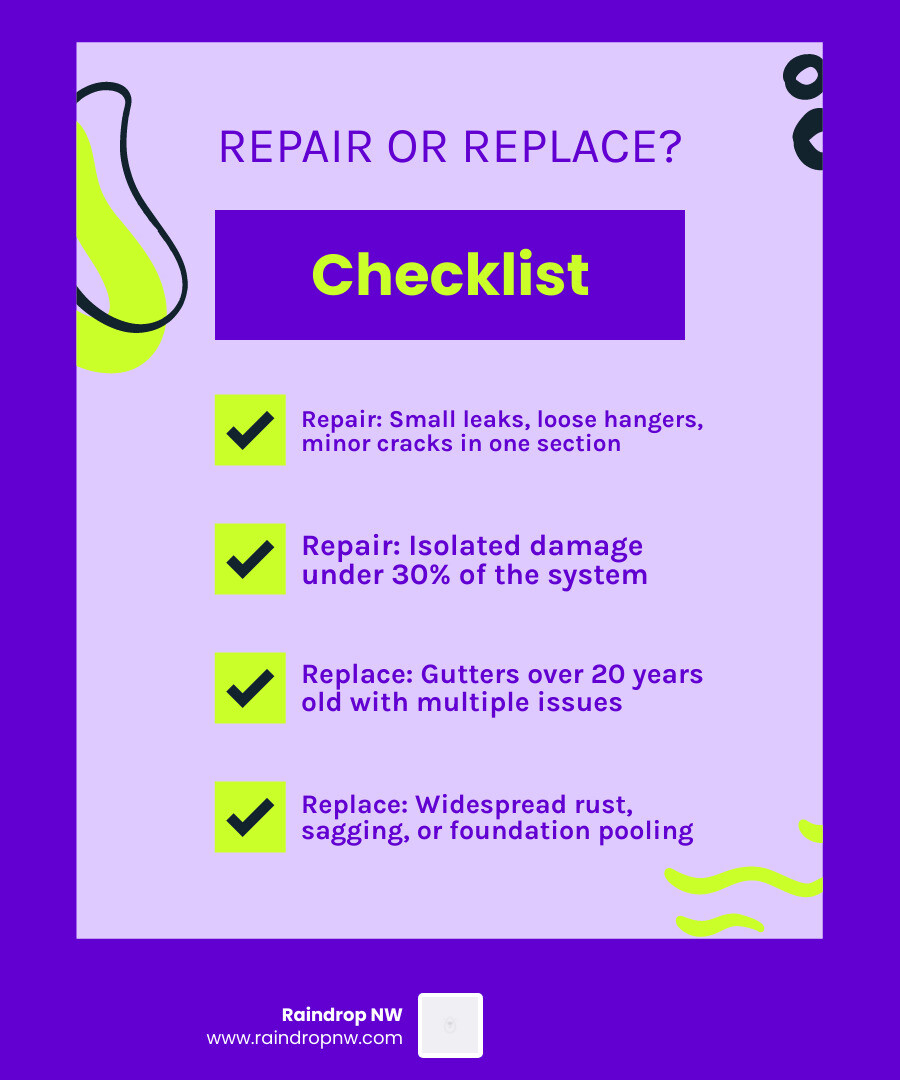
Gutter repair vs replacement decision matrix infographic for homeowners infographic

When to Replace vs Repair Your Gutters: The Core Decision Factors

When evaluating your gutter system, we look at the big picture rather than just the single leak that caught your eye during yesterday’s downpour. Deciding when to replace vs repair your gutters requires looking at three core factors: the overall extent of the damage, the age of the system, and the expected lifespan of the gutter material.

Decision Factor Lean Toward Repair Lean Toward Replacement
Damage Extent Localized to one or two sections, minor seam leaks, or a few loose brackets. Widespread across multiple runs, continuous sagging, or extensive rust.
System Age Well under its expected lifespan (e.g., a 5-year-old aluminum system). Approaching or exceeding its typical service life (e.g., 20+ years).
Fascia & Substrate Strong, dry, and structurally sound wood behind the gutters. Rotted, soft, or crumbling fascia boards that cannot hold fasteners.
Past Repairs First or second minor issue in several years. Recurring leaks and sagging despite multiple previous patching attempts.

Understanding these variables is essential because your gutters do not operate in a vacuum. They are a fundamental element of your home’s exterior envelope. For a deeper look at how these systems integrate with your shingles and underlayment, you can read about Gutter Systems and Why They Matter for Your Roof.

Understanding When to Replace vs Repair Your Gutters for Small Holes

Small holes and minor cracks are common, especially in older sectional systems. If you notice a tiny drip, you do not necessarily need to budget for an entire new system.

For isolated holes, a targeted repair is highly effective. We typically clean the area thoroughly with alcohol to remove dirt and tar, apply a high-grade, industrial-strength waterproof sealant, and sometimes reinforce the area with a small piece of metal flashing or a specialized patch kit.

However, these patches should be viewed as localized fixes. If your gutters are nearing the end of their remaining lifespan, a patch is merely a temporary delay. If you find yourself patching new holes every autumn, the metal has likely thinned to the point of systemic failure, and patching is no longer a smart use of your time or money.

Evaluating Systemic Failure: When to Replace vs Repair Your Gutters

Systemic failure occurs when the structural integrity of the entire gutter run is compromised. This is where we apply the 50% Rule: if the cumulative cost of repairing various sections, replacing rotted fascia boards, and rehanging sagging runs exceeds 50% of the cost of a brand-new, seamless gutter system, replacement is the more economical decision.

sagging gutters pulling away from the fascia board on a home

Signs of systemic failure include:

  • Widespread Warping: Gutters that have twisted or bent out of shape due to heavy snow, ice, or ladder pressure. Once metal or vinyl wraps, it loses its original structural strength and cannot reliably hold the correct pitch.
  • Repeated Repairs: If you are calling a technician out every season to seal the same joints or re-secure the same runs, you are paying for temporary patches on a system that fundamentally needs to be retired.
  • Failing Structural Support: When gutters pull away from the home because the wood behind them has rotted, simply putting in larger screws will not solve the problem. The entire run must be taken down so the underlying structure can be rebuilt.

Spotting the Signs: Gutter Repair vs. Full Replacement

Knowing exactly what to look for can help you make a swift, practical decision before the next major Pacific Northwest rainstorm arrives.

Identifying localized leaks, loose hangers, minor cracks, and seam separation early allows you to address issues before they cause rot in your roof deck. For proactive steps you can take to keep your system running smoothly, check out our Gutter Maintenance Tips for Homeowners.

When Localized Repair is Sufficient

In many cases, a professional touch can restore your gutters to perfect working order without requiring a full teardown. Localized repairs are highly successful under the following conditions:

  • Tightening and Replacing Hangers: If a heavy snow load or a buildup of wet leaves has caused a few hangers to loosen, we can simply back out the old fasteners and install new, heavy-duty screw-in hangers.
  • Sealing Joint and Seam Leaks: Sectional gutters naturally expand and contract with temperature changes, which degrades the sealant at the joints over time. Scraping away the old, dry caulk and applying a fresh layer of commercial-grade elastomeric sealant will usually stop the leak for another three to five years.
  • Clearing Downspout Elbows: When water backs up and pours over the sides, it is often just a stubborn clog in the downspout elbow. Clearing the debris and flushing the system with a hose is a simple maintenance fix.
  • Isolated Physical Damage: If a fallen tree branch dents a single ten-foot section of a sectional system, we can often replace just that single damaged piece while leaving the rest of the system intact.

Red Flags That Demand Full Replacement

On the other hand, some symptoms indicate your gutter system has reached the end of the road. Ignoring these red flags can lead to severe structural issues.

  • Widespread Rust and Corrosion: If you see orange flecks, scaling, or rust holes spreading along the bottom of your steel or older aluminum gutters, the metal is disintegrating from the inside out.
  • Sagging Runs That Cannot Be Re-Pitched: Gutters must slope precisely toward the downspouts (typically a quarter-inch drop for every ten feet of run). If the metal has sagged permanently and cannot be adjusted, standing water will pool, accelerate rust, and attract pests.
  • Multiple Persistent Leaks: When leaks appear at six, seven, or more points across your home, it means the entire system is failing simultaneously.
  • Water Pooling Near the Foundation: If water is consistently overflowing the gutters and pooling next to your basement or crawlspace, the system is failing its primary objective. To understand the severe consequences of leaving this unaddressed, read How Gutter Maintenance Prevents Foundation Damage.

How Gutter Material, Age, and Roofing Projects Influence Your Choice

The materials your gutters are made of, combined with their age, play a massive role in determining whether a repair will hold up over time.

Because your roof and gutters work as a single, cohesive water management system, choices made on one directly impact the other. To learn how to keep your home dry from the shingles down, explore How to Protect Your Home from Water Damage Through Your Roof.

Material Lifespans and Seamless vs. Sectional Performance

Different gutter materials react uniquely to the damp, seasonal climate of the Pacific Northwest:

  • Vinyl (Plastic) Gutters: These typically last 10 to 15 years. While they do not rust, they become highly brittle when exposed to cold temperatures and UV light. If your vinyl gutters are cracking, they must be replaced, as patches rarely hold on aged plastic.
  • Aluminum Gutters: The industry standard, lasting 20 to 30 years. They are lightweight and rust-resistant, making them excellent candidates for localized repairs if they are under 15 years old.
  • Galvanized Steel Gutters: Highly durable but prone to eventual rust. They usually last 15 to 25 years. Once rust begins to eat through the protective zinc coating, replacement is inevitable.
  • Copper and Zinc Gutters: Premium materials that can last 50 to 80+ years. Because of their high value, we almost always recommend specialized repairs (such as professional soldering) to preserve the system rather than replacing it.

The style of your gutters also dictates their vulnerability to leaks. Sectional gutters feature joints every 10 to 20 feet, creating multiple potential failure points. Every joint is a spot where sealant can dry out, crack, and leak.

Seamless aluminum gutters, which are custom-fabricated on-site to match the exact dimensions of your home, only have joints at the corners. This design eliminates up to 90% of potential leak points, significantly reducing maintenance needs and extending the system’s active lifespan.

Coordinating Gutter Replacement with Roof Projects

If your roof is nearing the end of its life and you are planning a replacement, it is highly advantageous to coordinate your gutter replacement at the exact same time. Here is why:

  • Financial and Labor Efficiency: The roofing crew is already on-site, safety rigging is established, and old materials are being hauled away. Combining the projects reduces overall labor overhead.
  • Perfect Drip Edge Integration: The drip edge is a metal flashing installed under the first row of shingles that directs water directly into the center of the gutter. Installing new gutters alongside a new roof ensures these two critical components overlap perfectly, preventing water from slipping behind the gutter and rotting your fascia board.
  • Protection of Your Investment: Installing new gutters first, only to have heavy roofing materials and ladders lean against them during a subsequent roof replacement, risks denting or damaging your brand-new gutters. Doing them together, in the correct construction sequence, guarantees a flawless, protected finish.

Frequently Asked Questions About Gutter Care

How often should Pacific Northwest homeowners inspect their gutters?

In the Portland metro and Beaverton areas, we recommend inspecting your gutters at least twice a year — once in the late spring and once in the late autumn.

Because of our dense canopy of Douglas firs, maples, and pine trees, pine needles and leaves can pack down quickly, creating heavy, wet blockages. If your property is heavily wooded, you may need to clear them more frequently to prevent water from backing up under your shingles. For more regional advice on keeping your home dry, check out our Water Damage Prevention Tips for Pacific Northwest Homeowners.

Can sagging gutters be repaired, or must they be replaced?

It depends entirely on the condition of the wood behind them. If the sagging is simply due to loose or bent hangers, we can correct the slope and secure the run with new, heavy-duty hidden hangers.

However, if the gutters are sagging because water has leaked behind them and caused the fascia board to rot, the hangers will no longer have solid wood to bite into. In this scenario, the gutters must be removed, the rotted wood replaced, and a new gutter system installed.

Do gutter guards extend the lifespan of an existing system?

Yes, high-quality leaf protection and micro-mesh gutter guards can significantly extend the lifespan of your gutters. By keeping leaves, twigs, and pine needles out, they prevent the heavy standing clogs that lead to stagnant water, accelerated rust, and sagging runs.

However, gutter guards are not a cure-all for an already failing system. If your gutters are already rusted, warped, or structurally compromised, installing guards will not save them. Guards should be installed on structurally sound systems to protect and preserve your investment.

Conclusion

Deciding when to replace vs repair your gutters does not have to be a guessing game. By looking at the pattern of damage — whether it is a single, isolated leak or a systemic issue affecting multiple areas of your home — you can make a smart, cost-effective decision that protects your property for years to come.

At Raindrop Roofing NW, we have spent decades helping our neighbors in Beaverton, Portland, Hillsboro, Tigard, and throughout the surrounding communities navigate these decisions. As a family-owned, multi-generational local business, we pride ourselves on honesty and craftsmanship. We do not believe in high-pressure sales tactics or recommending a full replacement when a straightforward, professional repair will do the job.

If you are unsure whether your gutters can survive another wet winter, let us take a look. We offer comprehensive, transparent inspections to give you clear answers. Contact us today to schedule your assessment, and visit our Raindrop NW Residential Roofing Repairs and Maintenance page to see how we can keep your home safe, dry, and secure.

https://www.raindropnw.com/wp-content/uploads/2026/06/photo-1701885596400-dbd217337026.jpeg 720 1080 SEO Stats https://www.raindropnw.com/wp-content/uploads/2024/05/logo-raindrop-space-300x92.png SEO Stats2026-06-23 09:40:112026-06-23 09:40:11Step-by-Step Guide to Decide Replace or Repair Gutters

A Comprehensive Guide to Gutter Styles and Materials

Gutters

Why Gutter Styles and Materials Compared Side by Side Can Save Your Home from Costly Water Damage

When it comes to gutter styles and materials compared side by side, the differences matter far more than most homeowners realize. Gutters are your home’s first line of defense against water damage — quietly redirecting thousands of gallons of rainwater away from your foundation, siding, and landscaping every year. Choose the wrong style or material, and you could be facing premature failure, chronic leaks, or expensive repairs down the road. Choose wisely, and a quality gutter system can last decades with minimal upkeep.

Here is a quick overview of the main gutter styles and materials to help you get oriented:

Gutter Styles at a Glance

Style Best For Water Capacity Installation
K-Style Most modern homes High DIY or pro
Half-Round Historic/traditional homes Moderate DIY or pro
Box Commercial/high-volume Very high Pro only
Fascia Contemporary custom homes Moderate Pro only
Seamless Long-term leak prevention Varies by profile Pro only
Sectional Budget DIY projects Varies by profile DIY friendly

Gutter Materials at a Glance

Material Lifespan Durability Maintenance
Aluminum 20-30 years Good Low
Vinyl 10-15 years Fair Low
Galvanized Steel 20-30 years Very good Moderate
Zinc 50+ years Excellent Very low
Copper 50-100 years Exceptional Low

Whether you are replacing aging gutters, building a new home, or just trying to understand what is already hanging on your roofline, this guide breaks down every major option in plain language — so you can make a confident, informed decision.

In the Pacific Northwest especially, where Beaverton and the greater Portland metro see heavy rainfall season after season, the stakes are real. A gutter system that cannot keep up with Oregon’s wet winters is not just an inconvenience — it is a slow threat to your foundation, your walls, and your home’s long-term value.

I’m Torrey Yungeberg, owner of Raindrop Roofing NW, and after years of helping Oregon homeowners navigate decisions around gutter styles and materials compared across all kinds of rooflines and climates, I have seen how the right choice protects a home for decades. Let’s walk through everything you need to know.

Infographic comparing gutter styles and materials by lifespan, capacity, cost tier, and best use case

Understanding Gutter Styles and Profiles

Every home has its own unique architectural personality, and the shape of your gutters plays a huge role in both how your home looks and how well it handles water. When we look at gutter profiles, we are looking at the cross-section shape of the gutter trough. The shape dictates how much water the system can hold, how easily debris flows through it, and how it attaches to your roofline.

Let’s look at the four primary gutter styles found on homes throughout Beaverton, Portland, and Vancouver:

K-Style Gutters

By far the most popular residential choice in North America, K-style gutters account for roughly 80% of modern installations. They get their name because their outer profile vaguely resembles the letter “K” when viewed from the side, mimicking the elegant look of interior crown molding.

  • Appearance: Classic, decorative, and highly versatile. They blend seamlessly with modern, craftsman, and colonial architectural styles.
  • Water Capacity: Excellent. Because of their flat bottom and outward-curving front wall, K-style gutters can hold significantly more water than a half-round gutter of the same width.
  • Installation: Highly practical. Their flat back allows them to be nailed or screwed directly flush against your home’s fascia board, providing great structural stability.

Half-Round Gutters

Semicircular troughs that resemble a pipe cut in half, half-round gutters are the traditional standard for older homes. They offer a softer, more fluid aesthetic that lets the natural beauty of the home take center stage.

  • Appearance: Timeless and elegant. They are the standard choice for historic restorations, Tudor-style homes, and classic brick residences in neighborhoods like Eastmoreland and Westmoreland.
  • Water Capacity: Moderate. Because of their curved design, half-round gutters have lower capacity than K-style gutters of the same width. To handle the same volume of water, a half-round gutter typically needs to be sized one inch larger than its K-style counterpart.
  • Installation: They do not have a flat back, meaning they cannot be mounted directly to the fascia board. Instead, they require external brackets and hangers, which adds some complexity to the installation process.

Box Gutters

Box gutters are wide, rectangular troughs designed to handle massive volumes of water. While they are the standard for commercial buildings, they are also found on mid-century modern homes and contemporary residential designs in the Portland metro area.

  • Appearance: Industrial, clean, and completely concealed. Traditional box gutters are often built directly into the roof structure (known as integral gutters), tucking under the shingles or roofing material so they are virtually invisible from the ground.
  • Water Capacity: Massive. They are built to move torrential downpours away from large, flat, or steeply pitched roof areas.
  • Installation: Highly complex. Because they are integrated into the roofline, they must be planned and installed during construction or major roof reconstruction. If they leak, water can migrate directly into the home’s framing, making professional installation and high-quality materials non-negotiable.

Fascia Gutters

Custom fascia gutters are designed to perform double duty. They act as both the rain gutter and the smooth fascia board itself, creating a clean, unified edge along your roofline.

  • Appearance: Sleek, modern, and highly integrated. They are popular on contemporary Northwest homes where clean lines are a priority.
  • Water Capacity: Good, but they are often narrower than standard K-style gutters of the same height.
  • Installation: They are installed directly to the rafter tails, bypassing the need for a separate fascia board. However, their deep, narrow profile can make cleaning out stubborn pine needles and leaves a bit more challenging.

Understanding these shapes is the first step in designing a system that works. To learn more about how these components work in harmony with your entire roof system, take a look at our guide on Gutter Systems and Why They Matter for Your Roof.

Seamless vs. Sectional Gutter Styles and Materials Compared

Once you have chosen a profile, the next major decision is how the gutters are constructed: seamless or sectional. This choice has a massive impact on your system’s lifespan, maintenance needs, and resistance to leaks.

Sectional Gutters (The DIY Route)

Sectional gutters are sold in pre-cut segments (typically 10 to 20 feet long) at local home improvement stores. During installation, these segments are joined together using connectors, rivets, and heavy-duty gutter sealant to form the necessary length.

  • The Pros: They are lightweight, highly accessible, and easy to transport in a standard vehicle, making them the default choice for quick weekend DIY projects. If a single section gets damaged by a fallen branch, you can easily replace just that segment.
  • The Cons: Every single joint is a potential failure point. Over time, the constant expansion and contraction of the metal caused by Oregon’s temperature swings will break down the sealant. This leads to chronic leaks at the seams, which can rot your fascia boards and drop water directly next to your foundation.

Seamless Gutters (The Professional Standard)

Seamless gutters are custom-fabricated right in your driveway. A professional installer brings a mobile roll-forming machine to your home, feeds a flat coil of metal (usually aluminum or steel) through the machine, and extrudes a continuous gutter run customized to the exact length of your roofline. The only seams in the entire run are at the corners (miters) and downspout outlets.

  • The Pros: By eliminating mid-run seams, you virtually eliminate the risk of leaks. Debris is also much less likely to get caught inside the gutter because there are no internal joints, ridges, or screws to snag leaves and twigs. This translates to significantly less maintenance and a much longer lifespan.
  • The Cons: Because they require specialized machinery and a trained crew to handle long, continuous runs without bending them, they require professional installation.

For homeowners looking for long-term reliability and peace of mind through our rainy winters, seamless gutters are the undisputed gold standard.

Gutter Styles and Materials Compared for Pacific Northwest Climates

Living in western Oregon and southwest Washington means our homes face a unique set of meteorological challenges. We do not just get rain; we get prolonged, misty dampness punctuated by sudden heavy downpours, occasional heavy snow loads in the winter, and hot, dry summers.

When we look at gutter styles and materials compared for our specific climate, we have to evaluate how materials react to constant moisture, organic debris, and temperature fluctuations. Failing to choose a climate-appropriate material can result in sagging troughs, water backing up under your shingles, or premature rusting.

To understand how water can damage your property when your drainage system fails, read our detailed article on How Gutter Maintenance Prevents Foundation Damage.

How Gutter Styles and Materials Compared Perform in Heavy Rain

A standard rainstorm can dump thousands of gallons of water onto your roof in a matter of hours. In Beaverton and the surrounding Portland metro, our winter storms can be incredibly persistent. If your gutters lack the capacity to handle this volume, water will spill over the front edge, washing away your landscaping, flooding your crawlspace, and potentially rotting your siding.

To prevent overflow during heavy rainfall, your system needs:

  1. Adequate Drainage Capacity: The gutter profile must be deep enough to hold the volume of water sheeting off your roof pitch.
  2. Proper Slope (Pitch): Gutters must be installed with a slight downward slope toward the downspouts (typically 1/4 inch of fall for every 10 feet of run) so water drains quickly instead of pooling.
  3. Correct Downspout Placement: We recommend installing at least one downspout for every 30 to 35 linear feet of gutter to ensure water is cleared out of the troughs efficiently.

Choosing the Right Gutter and Downspout Sizes

Size matters just as much as style. While standard 5-inch gutters have been the residential default for decades, the trend in 2026 is rapidly shifting toward 6-inch systems.

Why is this upgrade so important?

  • Water Capacity: A 6-inch K-style gutter holds nearly 67% more water than a standard 5-inch system. This extra capacity is a game-changer during intense “flash rain” events.
  • Steep Roof Pitches: If your home has a steep roof, water travels down the shingles at a high velocity. A wider 6-inch gutter acts as a larger target, catching fast-moving water that might otherwise shoot right over a narrower 5-inch trough.
  • Large Roof Areas: Homes with large roof surfaces collect massive amounts of water that must be funneled away quickly.
  • Downspout Sizing: To get the most out of your gutters, you must pair them with the right downspouts. Standard 2×3-inch rectangular downspouts work well for 5-inch gutters, but 6-inch gutters should always be paired with oversized 3×4-inch downspouts (or 4-inch round downspouts for half-round styles) to prevent bottlenecks at the outlets.

Comparing Gutter Materials: From Budget to Premium

Now that we have covered the shapes and sizes, let’s dive into the physical materials. The material you choose dictates how your gutters look, how they handle physical impacts (like leaning ladders or falling limbs), and how many years they will protect your home before needing replacement.

Aluminum (The Workhorse)

Aluminum is the undisputed king of residential gutters, and for good reason. It hits the absolute sweet spot of durability, performance, and value.

  • Pros: It is lightweight, completely rust-proof, and highly customizable. It comes in a wide array of factory-painted colors to match your home’s trim. Because it is highly malleable, it is the perfect material for seamless roll-forming.
  • Cons: Because it is lightweight, it can dent if a heavy ladder is leaned directly against it or if a large tree branch falls on it.

Vinyl / PVC (The Budget Entry)

Vinyl gutters are lightweight plastic troughs sold in sections at home improvement stores.

  • Pros: They are inexpensive, completely rust-proof, and incredibly easy for a DIYer to snap together. They also pop back into shape after minor impacts.
  • Cons: Vinyl is “fast fashion” for your roofline. It is highly susceptible to UV damage from our summer sun, which makes the plastic brittle over time. In freezing winter temperatures, brittle vinyl can easily crack or shatter under the weight of ice and snow. It is only available in sectional forms, meaning leaks are inevitable. We rarely recommend vinyl for primary residences in the Pacific Northwest.

Galvanized Steel (The Strength Champion)

Galvanized steel is steel coated with a thin layer of zinc to protect it from water damage.

  • Pros: It is incredibly strong — up to three times stronger than aluminum. It stands up beautifully to heavy snow loads, ice dams, and physical impacts without sagging or denting.
  • Cons: It is heavy, requiring sturdy fascia boards and heavy-duty hangers. Despite the zinc coating, galvanized steel will eventually rust after decades of constant exposure to wet Northwest weather, especially if the protective coating is scratched. It requires periodic inspection and maintenance to keep rust at bay.

Zinc (The Modern Architect’s Choice)

Zinc is a premium metal that is highly prized in modern architectural design.

  • Pros: Like copper, zinc is a self-healing metal. Over time, it develops a beautiful matte-gray protective patina that naturally heals minor scratches and prevents corrosion. It can easily last 50 to 80 years with virtually zero maintenance and is highly resistant to coastal salt air.
  • Cons: It requires specialized professional installation because the joints must be soldered. It is also a significant upfront investment compared to aluminum.

Copper (The Legacy Luxury)

Copper is the ultimate luxury material for gutters, often referred to as “jewelry for your house.”

  • Pros: It is incredibly durable, lasting 100 years or more. It never rusts, resists moss and algae growth naturally, and develops a stunning greenish-blue patina over 15 to 20 years (faster in damp climates). It adds immense curb appeal and can recover a significant portion of its installation cost in home resale value.
  • Cons: It is a premium-tier investment. It requires expert soldering during installation and can occasionally be a target for theft due to its high scrap value.

Here is a quick comparison table to help you weigh your options:

Material Lifespan Strength Rust Resistance Maintenance Best Use Case
Aluminum 20-30 Years Moderate High (Rust-proof) Low Standard modern homes
Vinyl 10-15 Years Low High (Rust-proof) Low Temporary structures/Sheds
Galvanized Steel 20-30 Years High Moderate Moderate High snow load areas
Zinc 50-80 Years High High (Self-healing) Very Low Modern/Architectural homes
Copper 50-100+ Years High High (Rust-proof) Low Historic & luxury homes

The Role of Gutter Accessories and Maintenance

A gutter system is only as good as its weakest link. To keep your gutters operating at peak efficiency, several key accessories and maintenance practices are essential:

  • Gutter Guards: In our heavily wooded Pacific Northwest neighborhoods, leaves, twigs, and pine needles are constant hazards. High-quality micro-mesh gutter guards sit over your gutters, allowing water to flow freely through the mesh while shedding organic debris. This keeps your system running smoothly and dramatically reduces the need to climb ladders for cleaning.
  • Downspout Extensions and Splash Blocks: Getting water out of your gutters is only half the battle; you also need to direct it away from your home. Downspout extensions or concrete splash blocks should direct water at least 3 to 5 feet away from your foundation to prevent crawlspace flooding and soil erosion.
  • Regular Maintenance: Even with the best materials, gutters need a little love. Regular inspections ensure that hangers are tight, seams are sealed, and downspouts are clear of clogs. For practical advice on keeping your system in top shape, check out our Gutter Maintenance Tips for Homeowners.

Frequently Asked Questions About Gutter Systems

We hear a lot of questions from homeowners in Beaverton, Lake Oswego, and Tigard about how to choose and care for their gutters. Here are a few of the most common:

Which gutter style is best for historic homes in the Portland metro?

For historic homes — such as those in Portland’s older neighborhoods or historic districts in Oregon City — half-round gutters made of copper or painted steel are almost always the best choice. They preserve the architectural integrity of the home and comply with local historic preservation guidelines while providing reliable water management.

How often should I clean my gutters in Beaverton?

For most homes in Beaverton, Hillsboro, and surrounding areas, we recommend cleaning your gutters at least twice a year — once in the late spring after trees drop their seeds and tassels, and once in the late fall after the leaves have finished falling. If your property is heavily wooded with Douglas firs or pines, you may need to clean them more frequently to prevent pine needle dams.

Why are seamless gutters preferred over sectional gutters?

Seamless gutters are preferred because they eliminate the joints where 99% of gutter leaks occur. Because they are custom-extruded from a single piece of high-quality metal, they offer superior structural strength, require less maintenance, look much cleaner along your roofline, and last significantly longer than sectional DIY systems.

Conclusion

Choosing the right gutter system is one of the most important protective measures you can take for your home. By understanding how different gutter styles and materials compared side by side perform in our unique Pacific Northwest climate, you can make a choice that keeps your home dry, safe, and beautiful for decades.

At Raindrop Roofing NW, we are proud to be a truly local, family-owned business based in Beaverton, Oregon. Unlike the big national companies backed by out-of-state investment firms, we live and work in the communities we serve — from Gresham and Lake Oswego to Hillsboro, Vancouver, and beyond. We are fully committed to long-term accountability, exceptional craftsmanship, and transparent service.

Whether you need a quick repair, a complete gutter replacement, or a comprehensive roof inspection, we are here to help. Schedule a free inspection with Raindrop Roofing NW today, and let’s make sure your home is ready for whatever the Oregon skies throw our way.

https://www.raindropnw.com/wp-content/uploads/2026/06/photo-1779755376652-22ca6eba86b8.jpeg 753 1080 SEO Stats https://www.raindropnw.com/wp-content/uploads/2024/05/logo-raindrop-space-300x92.png SEO Stats2026-06-17 10:30:272026-06-17 10:30:27A Comprehensive Guide to Gutter Styles and Materials

Don’t Let Your Foundation Sink Without a Gutter System

Gutters

Why Gutter Systems and Why They Matter for Your Roof Is the Question Every Oregon Homeowner Should Be Asking

Gutter systems and why they matter for your roof comes down to one simple idea: without a way to move water off and away from your home, that water will find somewhere to go — and it won’t be somewhere you want it.

Here is a quick answer if you need it now:

Gutter systems protect your home by:

  • Channeling rainwater away from your roof’s edge, fascia, and shingles to prevent rot and decay
  • Directing water away from your foundation to prevent cracking, settling, and basement flooding
  • Reducing soil erosion and protecting your landscaping from runoff damage
  • Preventing mold growth inside your walls and crawl spaces
  • Stopping ice dams from forming along your roofline in cold weather
  • Preserving your siding, windows, and exterior trim from water staining and deterioration

Most homeowners don’t think about their gutters until something goes wrong. By then, a small, inexpensive fix has often turned into a major structural repair. As one industry observation puts it: water doesn’t knock politely — it finds every weakness and exploits it. On an average-size roof, just one inch of rain sends roughly 1,900 gallons of water rushing toward your eaves. Without a functioning gutter system in place, all of that water hits your foundation, soaks into your soil, and works its way into your home’s structure over time.

In the Pacific Northwest, where rain is a near-constant companion, this isn’t a hypothetical risk. It’s a year-round reality.

I’m Torrey Yungeberg, owner of Raindrop Roofing NW and a roofing professional with years of hands-on experience helping Oregon and Southwest Washington homeowners understand exactly how gutter systems and why they matter for your roof connects directly to the long-term health of their entire home. In the sections below, I’ll walk you through everything you need to know — from gutter types and materials to maintenance schedules and when it’s time to replace.

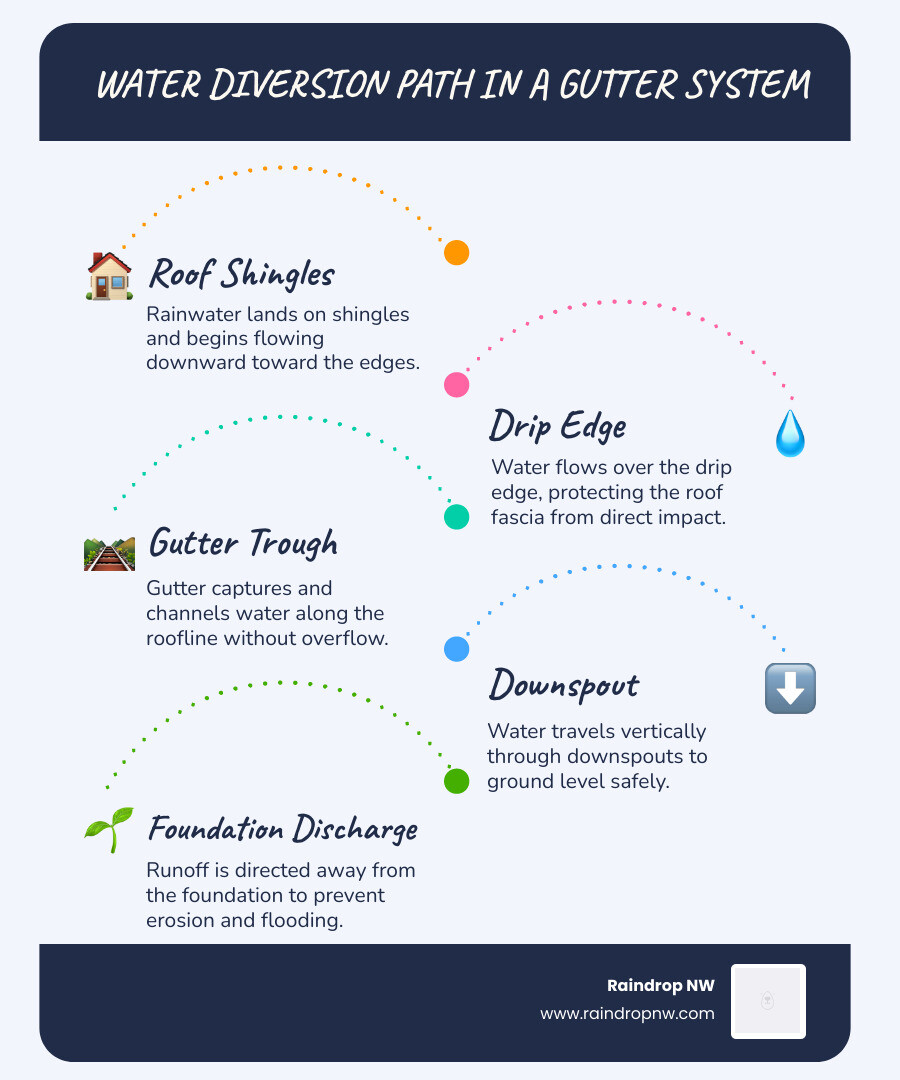
Infographic showing water diversion path from roof shingles through gutters downspouts and away from foundation - gutter

The Primary Purpose of Gutter Systems and Why They Matter for Your Roof

Water cascading off a roof without gutters during a storm - gutter systems and why they matter for your roof

When we talk about residential roofing, we often focus on the shingles. While the shingles are your first line of defense, the gutter system is the hydraulic mechanism that ensures that defense doesn’t fail. The primary purpose of a gutter is simple: controlled management of water.

When rain hits your roof, it gathers momentum. Without gutters, this water cascades off the eaves in a heavy sheet, landing directly at the base of your home. This creates several critical issues:

  • Foundation Protection: Constant water pooling at the base of your home saturates the soil. In the Beaverton and Portland area, our clay-heavy soils expand and contract. This movement causes foundation cracking, settling, and structural shifting.
  • Basement and Crawl Space Flooding: If water isn’t directed away, it will eventually find its way through porous concrete or small cracks, leading to wet basements and damp crawl spaces.
  • Siding and Trim Preservation: Falling water splashes back up, carrying dirt and microorganisms that cause siding rot, paint peeling, and staining.
  • Landscape Defense: A heavy “waterfall” from your roof can wash away expensive mulch, drown plants, and create unsightly trenches in your lawn.
  • Mold Mitigation: Moisture trapped near the home’s exterior or under the roofline is a breeding ground for mold and mildew, which can eventually migrate into your interior walls.

Why gutter systems and why they matter for your roof in dry climates

It is a common misconception that homes in dry climates don’t need gutters. Even in places like Phoenix, which only sees about 7.22 inches of annual rain, a typical 1,800-square-foot roof still sheds over 8,000 gallons of water a year. Because rainfall in dry climates often comes in intense bursts or flash floods, the volume of water hitting the foundation all at once can be even more damaging than a steady drizzle.

In regions like Colorado’s Front Range, an average home (1,800 sq ft) sheds over 16,000 gallons of water annually. During extreme events, such as the 11.85 inches of rain recorded in 24 hours at Fort Carson, a single roof can discharge over 13,000 gallons in one day. This reinforces why we emphasize roof inspections and certifications to ensure your drainage system can handle these “once-in-a-century” storms that seem to be happening more frequently in April 2026.

Protecting the roof deck and fascia

Gutters do more than protect the ground; they protect the roof itself. When gutters are clogged or missing, water can “back up” under the shingles. This leads to:

  1. Shingle Rot: Prolonged moisture exposure softens shingle tabs and erodes granules.
  2. Fascia Board Decay: The fascia is the wooden board your gutters are mounted to. If water overflows or leaks behind the gutter, the fascia will rot, eventually losing the strength to hold the gutters at all.
  3. Drip Edge Integration: A proper gutter system works with the drip edge—a metal flashing installed under the first row of shingles—to ensure water falls into the trough and not behind it.
  4. Ice Dam Mitigation: In our colder months, clogged gutters contribute to ice dams. Trapped water freezes, expands, and lifts shingles, allowing melted water to leak directly into your attic. For these reasons, regular repairs and maintenance are non-negotiable for a long-lasting roof.

Comparing Gutter Types and Materials for the Pacific Northwest

Choosing the right material is vital for our unique climate. We need systems that can handle heavy moss growth, pine needles, and consistent moisture without rusting out.

Gutter Profile Best Use Case Pros Cons
K-Style Modern Homes High water capacity; mimics crown molding Harder to clean; corners can catch debris
Half-Round Historic/European Excellent water flow; easy to clean Lower capacity than K-style; more expensive
Box Gutters Commercial/Large Residential Maximum volume; industrial strength Often requires professional integration into roofline

When looking at roof types and products, you must also consider the material:

  • Aluminum: The industry standard. It’s lightweight, rust-proof, and comes in many colors. In 2026, it remains the most popular choice for Oregon homes.
  • Copper: The “50-year gutter.” It develops a beautiful green patina over time and is incredibly durable, though it requires a higher initial investment.
  • Zinc: Similar to copper, it is long-lasting and self-healing regarding scratches, making it a favorite for high-end custom homes.
  • Steel: Very strong and great for heavy snow loads, but it must be galvanized or stainless to prevent rust in our wet climate.
  • Vinyl: A budget-friendly option, but prone to becoming brittle in the sun and cracking in the cold. We generally recommend more durable metal options for long-term protection.

The benefits of seamless gutter systems and why they matter for your roof

In the past, gutters were sold in 10-foot sections and “snapped” together. Every one of those joints was a potential leak point. Today, we recommend seamless gutters for almost every project.

Seamless gutters are custom-extruded on-site using a specialized machine to the exact length of your roofline. Because they lack seams, they have much higher structural integrity and are far less likely to leak. They also look much cleaner, providing better curb appeal. When we install new and replacement roofs, we almost always suggest upgrading to a seamless system to ensure the new roof is supported by the best possible drainage.

Sizing and slope for maximum efficiency

A gutter that isn’t sloped correctly is just a very long, narrow birdbath. To function, gutters must have a slight “pitch” toward the downspouts. The standard rule is approximately 1/16 to 1/8 inch of fall for every foot of gutter run.

Sizing is equally important. A standard 5-inch gutter is sufficient for many homes, but for large, steep roofs or commercial roofing applications, 6-inch or even 7-inch troughs may be necessary to prevent overflow during heavy downpours.

How Gutters Integrate with Your Entire Roofing System

Your gutter system isn’t just the trough; it’s a series of components working in harmony.

  • Hidden Hangers: These are internal brackets that clip into the gutter and screw into the fascia. They are stronger than old-fashioned “spike and ferrule” systems and are invisible from the ground.
  • Outlets and Elbows: These transition the water from the horizontal gutter to the vertical downspout.
  • Scuppers: Common on flat roofs, these are openings in the parapet wall that allow water to drain into a conductor head.
  • Secondary Overflow Drains: Essential for flat roofs to prevent “ponding.” Just one inch of standing water on a 1,000-square-foot roof weighs about 5,200 pounds—an “undesigned load” that can cause structural collapse. This is why waterproof deck surfaces and proper drainage are critical for flat-roofed homes.

Managing downspout discharge

The job isn’t done when the water reaches the bottom of the downspout. If the water discharges right at the corner of the house, you’ve just moved the problem three feet down. We recommend that downspouts extend at least 3 to 5 feet away from the foundation. Using splash blocks or underground drainage pipes ensures the water is moved to a safe location where it won’t cause soil shifting or foundation saturation. Our residential roofing services always include an assessment of where that water is actually going.

Maintenance, Gutter Guards, and Signs of Failure

In Beaverton and Portland, the “twice a year” rule is the gold standard. You should clean your gutters in the Spring (after trees finish dropping tassels and seeds) and in the Fall (after the leaves have dropped).

Signs your gutters are failing include:

  • Sagging: This usually means the hangers have pulled loose or the gutters are filled with heavy, wet debris.
  • Rust Spots or Peeling Paint: Signs that the metal is degrading or water is constantly overflowing.
  • Granule Accumulation: If you see a lot of “sand” in your gutters, your shingles are reaching the end of their life.
  • Water Stains on Siding: A clear indicator that your gutters are overflowing or leaking from the back.

Gutter Guards: Are they worth it?

Gutter guards, especially micro-mesh technology, can significantly reduce the frequency of cleanings. They allow water in while keeping leaves and pine needles out. However, no system is “maintenance-free.” You still need to inspect them periodically to ensure moss isn’t growing over the mesh or that fine silt hasn’t built up inside.

When to replace gutters with your roof

If your gutters are over 15 years old, it is almost always best to replace them at the same time you get a new roof. This allows us to inspect the fascia boards, install a new drip edge properly, and ensure the entire water management system is under the same warranty. Plus, if you’ve suffered storm damage, we can help with roofing financing and insurance documentation to cover the entire system at once.

Frequently Asked Questions about Gutter Systems

How often should I clean my gutters in the Pacific Northwest?

At a minimum, twice per year. However, if your home is tucked into a wooded area with Douglas Firs or Maples, you may need to check them quarterly. Storms can also dump large amounts of debris in a single afternoon, so a quick post-storm check is always a good idea. Check out our owner resources for more maintenance tips.

Do gutter guards really prevent all clogs?

They prevent most clogs caused by large debris like leaves and twigs. They do not prevent the buildup of fine silt or the growth of algae and moss. Think of them as “maintenance reducers” rather than “maintenance eliminators.”

Are gutters necessary for flat roofs?

Absolutely. Flat roofs aren’t actually flat; they have a slight pitch. They rely on scupper boxes and interior drains to move massive amounts of water. Without them, the weight of ponding water can lead to leaks or even roof failure. We provide specialized commercial roofing estimates and inspections to handle these complex drainage needs.

Conclusion

At Raindrop NW, we’ve seen what happens when gutters are ignored. We are a truly local, Beaverton-based company. We aren’t an out-of-state firm looking for a quick sale; we live in this community and want to make sure your home stands strong for decades.

Gutter systems and why they matter for your roof is about more than just rain—it’s about protecting your biggest investment. Whether you need a simple repair, a cleaning, or a full system upgrade, we are here to provide the accountability and long-term service you deserve.

Don’t wait for the next atmospheric river to find out your gutters aren’t up to the task. Schedule your new roof replacement or gutter inspection today and let us help you keep your foundation on solid ground.

https://www.raindropnw.com/wp-content/uploads/2026/05/photo-1766603636700-e9d80473f40f.jpeg 608 1080 SEO Stats https://www.raindropnw.com/wp-content/uploads/2024/05/logo-raindrop-space-300x92.png SEO Stats2026-05-07 07:49:012026-05-07 07:49:01Don’t Let Your Foundation Sink Without a Gutter System

What Happens to Your Home’s Foundation When Gutters and Downspouts Are Missing or Damaged

Gutters, Roofing

Gutters and downspouts are not merely ornamental add-ons to the aesthetics of your home; they serve a fundamental purpose in maintaining the structural integrity of your house, particularly the foundation. These essential components of your roofing system work tirelessly to direct rainwater away from your home, safeguarding its foundation from potential damage. When gutters and downspouts are missing or damaged, it can set off a chain of adverse effects, culminating in significant, costly repairs to your foundation.

Water Accumulation Around the Foundation

The absence or impairment of gutters and downspouts means that rainwater has no guided path away from your house, causing it to pool around the base. This accumulation seeps into the soil, increases moisture levels, and creates hydrostatic pressure against your home’s foundation. Over time, this pressure can induce cracks, leaks, or even foundational shifts, compromising the structural stability of your residence.

Soil Erosion and Foundation Settling

One of the prime roles of gutters and downspouts is to mitigate soil erosion around the foundation. When water is allowed to fall directly from the roof to the ground, it erodes the soil, leading to uneven settling of the foundation. This can manifest as cracks in walls, uneven floors, and doors that stick or won’t close properly, hinting at a compromised foundation that could incur significant repair costs.

Basement Flooding Risks

Missing or damaged gutters increase the likelihood of your basement flooding. Water accumulating around the foundation can find its way into your basement through cracks, leading to potential damage to belongings, mold growth, and a persistent musty odor. Such conditions not only affect your living environment but can also pose health risks to the inhabitants.

Landscaping and Exterior Damage

The flow of unchanneled water off a roof can wreak havoc on landscaping, eroding soil, killing plants, and damaging the façade of a home. Such damage detracts from your home’s curb appeal and could necessitate costly landscaping and exterior repairs or renovations.

Regular Maintenance and Repairs: A Necessity

The detrimental impacts of water damage underscore the importance of regular gutter and downspout maintenance. Ensuring these components are in good condition protects not only the foundation but the entire structure and aesthetic appeal of your home.

Protect Your Beaverton Home with Raindrop Roofing NW

In Beaverton, OR, where the rains can be relentless, ensuring that your gutters and downspouts are functional and effectively installed is crucial to protecting your home. At Raindrop Roofing NW, we partner with top-tier gutter and downspout companies designed to safeguard your foundation against water damage. Whether it’s routine maintenance, inspections, or comprehensive repair and replacement services, our team can help to ensure your home remains safe and secure against the elements.

Don’t wait for water damage to compromise your home’s foundation. Take proactive steps to prevent costly repairs and preserve the value of your home. Contact Raindrop Roofing NW today at (503) 526-3887 or fill out our online form to schedule a free inspection. Our service area proudly includes Beaverton, OR, and the surrounding regions, ensuring homes are protected rain or shine.

https://www.raindropnw.com/wp-content/uploads/2025/05/gallery_downspout_3_1744647005.avif 1183 887 Ryan Bowen https://www.raindropnw.com/wp-content/uploads/2024/05/logo-raindrop-space-300x92.png Ryan Bowen2025-04-30 13:06:442025-07-28 19:44:48What Happens to Your Home’s Foundation When Gutters and Downspouts Are Missing or Damaged
Search Search
  • Plant & PlantJuly 15, 2015 - 3:40 pm

Categories

  • Chimneys
  • general
  • Gutter Cleaning
  • Gutter Maintenance
  • Gutters
  • Low Slope Roofing
  • News
  • Personal
  • Residential Roofing
  • Roof Inspections
  • Roof Leak Repair
  • Roof Maintenance
  • Roof Replacement
  • Roofing
  • Roofing Services
  • Shingle Roofing
  • Uncategorized

CLICK FOR A FREE ESTIMATE

CLICK NOW

Phone: (503)526-3887
Email:
info@raindropnw.com

Mon–Fri: 9:00am – 5:00pm
8305 SW Cirrus Dr.
Beaverton, OR 97008

Raindrop Roofing NW LLC BBB Business Review

 
Previous Previous Previous Next Next Next

©2026 Copyright - RAINDROP ROOFING NW | PORTLAND, OR
  • Link to X
  • Link to Instagram
  • Link to Youtube
  • Link to Facebook
  • Link to WhatsApp
Scroll to top Scroll to top Scroll to top

This site uses cookies. By continuing to browse the site, you are agreeing to our use of cookies.

AcceptDecline

Cookie and Privacy Settings


How we use cookies

We may request cookies to be set on your device. We use cookies to let us know when you visit our websites, how you interact with us, to enrich your user experience, and to customize your relationship with our website.

Click on the different category headings to find out more. You can also change some of your preferences. Note that blocking some types of cookies may impact your experience on our websites and the services we are able to offer.

Essential Website Cookies

These cookies are strictly necessary to provide you with services available through our website and to use some of its features.

Because these cookies are strictly necessary to deliver the website, refusing them will have impact how our site functions. You always can block or delete cookies by changing your browser settings and force blocking all cookies on this website. But this will always prompt you to accept/refuse cookies when revisiting our site.

We fully respect if you want to refuse cookies but to avoid asking you again and again kindly allow us to store a cookie for that. You are free to opt out any time or opt in for other cookies to get a better experience. If you refuse cookies we will remove all set cookies in our domain.

We provide you with a list of stored cookies on your computer in our domain so you can check what we stored. Due to security reasons we are not able to show or modify cookies from other domains. You can check these in your browser security settings.

Analytics & Advertising Cookies

These cookies help us understand how visitors use our website (Google Analytics) and measure how well our advertising works, including the Meta (Facebook/Instagram) Pixel. They are only used if you allow them.

You can turn analytics and advertising cookies on or off here:

Other external services

We also use different external services like Google Webfonts, Google Maps, and external Video providers. Since these providers may collect personal data like your IP address we allow you to block them here. Please be aware that this might heavily reduce the functionality and appearance of our site. Changes will take effect once you reload the page.

Google Webfont Settings:

Google Map Settings:

Google reCaptcha Settings:

Vimeo and Youtube video embeds:

Privacy Policy

You can read about our cookies and privacy settings in detail on our Privacy Policy Page.

Footer
Accept settingsDecline