
The Willamette Valley Survival Guide for Your Home’s Roof
Why the Portland Metro Climate Is Uniquely Hard on Your Roof
How Portland metro climate affects your roof is one of the most important things to understand as a homeowner in the Willamette Valley. Here’s a quick summary:
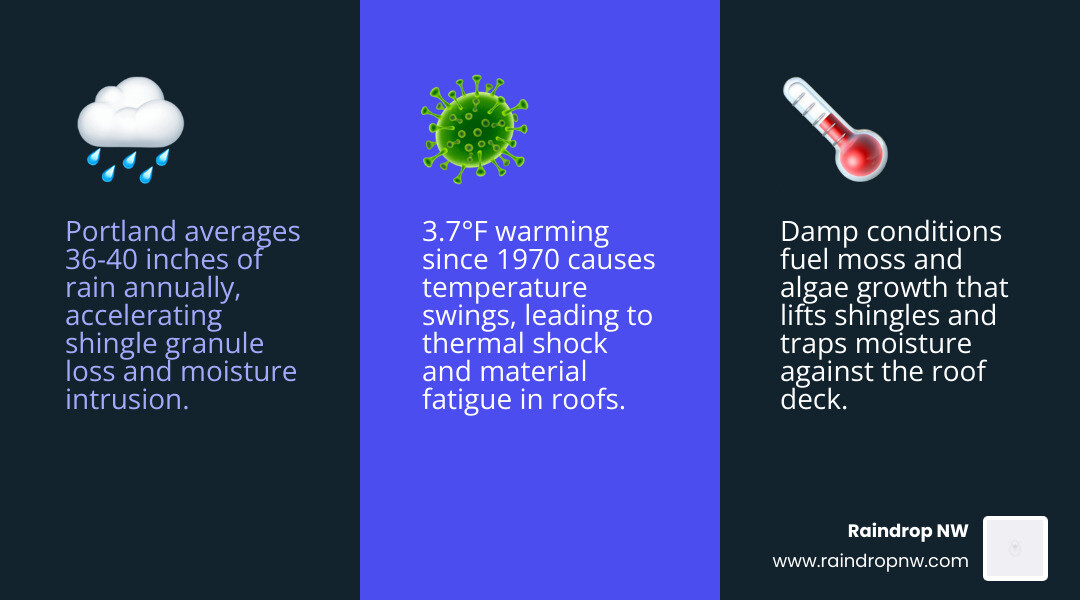
- Heavy rainfall – Portland averages 36-40 inches of rain per year, accelerating shingle degradation and moisture intrusion
- Moss and algae growth – The damp, shaded environment is ideal for biological growth that lifts shingles and traps moisture against your roof deck
- Temperature swings – Portland has warmed 3.7°F since 1970, bringing heatwaves followed by cool, wet seasons that cause thermal shock and material fatigue
- Wind and debris – Seasonal windstorms and Portland’s tree-lined streets send branches and organic debris onto roofs, clogging gutters and accelerating decay
- Humidity cycles – Repeated wet-dry cycles break down sealants and granules faster than in drier climates, shortening roof lifespan by 10-15 years compared to drier regions
If you live in the Portland metro area, your roof is working harder than you might think. The Pacific Northwest’s mix of relentless rain, biological growth, and increasingly extreme summer heat creates a set of challenges that simply don’t exist in most other parts of the country. A roof that might last 30 years in Arizona or Colorado can show signs of serious failure in 15-20 years here — not because of poor materials, but because of what our climate puts those materials through every single season.
The good news is that knowing what you’re up against is the first step to doing something about it.
I’m Torrey Yungeberg, owner of Raindrop Roofing NW, a family-owned company based in Boring, Oregon — and after years of inspecting and replacing roofs across the Portland metro, I’ve seen how Portland metro climate affects your roof in ways that catch homeowners completely off guard. In the sections below, I’ll walk you through exactly what’s happening to your roof and what you can do to protect it.
How portland metro climate affects your roof
Living in the Portland Metro area, from the busy streets of Beaverton to the quiet neighborhoods of Damascus, means accepting that water is a constant neighbor. While we all love our green summers, the 36 to 40 inches of rain we receive annually isn’t just hitting your roof; it’s testing its engineering every single day.
In drier regions, an asphalt shingle roof might stay flexible and intact for its entire rated lifespan. However, in our neck of the woods, that relentless moisture accelerates degradation. When shingles are constantly saturated, the protective granules—those little sand-like pebbles on top—begin to loosen and wash away. Once those granules are gone, the underlying asphalt is exposed to the elements, leading to brittleness and cracking.
This isn’t just an aesthetic issue. When your roof’s primary defense system is weakened, moisture intrusion becomes inevitable. In the Willamette Valley, we often see roofs fail 10 to 15 years earlier than they would in a drier state. This is why understanding More info about residential roofing is vital for anyone living in Clackamas, Oregon City, or Hillsboro.
How portland metro climate affects your roof through persistent moisture
The real danger in Portland isn’t always the “big storm”; it’s the persistent, light drizzle that keeps everything damp for months on end. This constant wetness leads to water pooling in areas with poor drainage, which is a death sentence for standard shingles.
When water sits, it finds the smallest path of least resistance. We frequently see flashing failure around chimneys and vents in homes across Lake Oswego and West Linn. Flashing is designed to redirect water, but when it’s subjected to months of moisture, the sealants can pull away, allowing water to seep into the roof deck.
Once moisture gets under the shingles, it starts to rot the wooden structure underneath. You might not see a leak in your living room for years, but the plywood decking could be turning into a sponge. This is why we emphasize More info about roof repairs and maintenance as a proactive measure rather than a reactive one.
The impact of humidity and damp cycles
Humidity in the NW Oregon region plays a sneaky role in roof decay. We experience high humidity during our long rainy seasons, followed by rapid drying periods. These wet-dry cycles cause roofing materials to expand and contract repeatedly.
Over time, this “breathing” of the materials leads to:
- Sealant breakdown: The caulking around your roof penetrations becomes brittle and cracks.
- Shingle curling: The edges of the shingles lift up, making them vulnerable to wind.
- Granule loss: You’ll often find piles of granules in your gutters after a heavy rain, which is a clear sign your roof is losing its protective “sunscreen.”
The Green Menace: Moss and Algae Growth in NW Oregon
If you’ve lived in Portland, Gresham, or Tualatin for more than a week, you know that if something stays still long enough, moss will grow on it. While it might look charming on a stone wall, moss is a “green menace” when it comes to your roof.
Moss thrives in our damp, shaded environment. It loves the north-facing slopes of roofs in tree-heavy areas like Camas and Ridgefield. Unlike grass, moss doesn’t have traditional roots; it has rhizoids that actually grip and penetrate the surface of your shingles.
How portland metro climate affects your roof by fueling moss growth
The primary way how portland metro climate affects your roof regarding moss is through the “sponge effect.” Moss absorbs and holds water. When a thick layer of moss sits on your roof, it keeps the shingles underneath saturated for weeks or even months.
This constant moisture does several things:
- Lifts Shingles: As moss grows, it gets under the lip of the shingle and physically pries it up. This creates a perfect entry point for wind-driven rain.
- Promotes Rot: The moisture trapped by moss eventually reaches the roof deck, fueling wood-decaying fungi that eat away at your home’s structure.
- Increases Weight: Wet moss is incredibly heavy. A roof covered in it is carrying a significant “biological load” that it wasn’t necessarily designed to support long-term.
Regular check-ups are the only way to catch this early. You can find More info about roof inspections and certifications to see how we identify these issues before they require a full replacement.
Preventing algae and lichen streaks
Have you ever noticed those ugly black streaks on a roof in Wilsonville or Sherwood? That’s not dirt or soot; it’s likely Gloeocapsa magma, a type of blue-green algae. While it doesn’t cause the structural damage that moss does, it eats away at the limestone filler in asphalt shingles, weakening them over time.
To combat this, we recommend:
- Zinc or Copper Strips: Installing these at the roof ridge allows metallic particles to wash down the roof during rain, creating an environment where algae and moss can’t survive.
- Soft Washing: Never, ever use a high-pressure washer on your roof. It will strip the granules and ruin the shingles. We use gentle, pH-balanced solutions to neutralize growth safely.
- Debris Removal: Keeping pine needles and leaves off the roof prevents the organic “compost” that moss loves to grow in.
Temperature Fluctuations and Thermal Shock in the Willamette Valley
It’s a common misconception that Portland roofs only have to worry about the rain. In reality, our warming climate is introducing a new threat: thermal shock. Since 1970, Northwest Oregon has warmed by about 3.7°F, and we are seeing more frequent triple-digit heatwaves in the summer.
When your roof goes from a cool, damp 55°F morning to a blistering 100°F afternoon, the materials undergo rapid expansion. Then, when a sudden “cool down” storm hits, they contract just as fast. This is thermal shock.
Thermal expansion and contraction cycles
The materials on your roof—the shingles, the metal flashing, the plastic vents—all expand and contract at different rates. This constant movement can lead to:
- Loosened Fasteners: Nails can “back out” of the wood, creating small holes where water can enter.
- Adhesive Failure: The seal strips that hold shingles together can break, making the roof susceptible to wind damage.
- Material Fatigue: Much like bending a paperclip back and forth, the shingles eventually become brittle and crack.
For those considering a new roof in Beaverton or Vancouver, choosing materials designed for these swings is essential. Check out More info about new replacement roofs for modern options that handle thermal stress better than the materials of 20 years ago.
Attic ventilation and heat management
One of the best ways to protect your shingles from “baking” is proper attic ventilation. In many older homes in Eastmoreland or Westmoreland, the attics lack sufficient airflow. When heat gets trapped in your attic, it reaches temperatures far higher than the outside air, essentially cooking your shingles from the inside out.
We follow the 1-to-300 rule: for every 300 square feet of attic floor space, you need at least 1 square foot of net free vent area. Proper baffle installation ensures that your insulation doesn’t block the soffit vents, allowing cool air to enter at the bottom and hot air to escape through the ridge vents at the top. This simple balance can add a decade to your roof’s life.
Climate-Resilient Materials and Maintenance Strategies
Given how portland metro climate affects your roof, you can’t just pick the cheapest material and hope for the best. You need a system designed for the Pacific Northwest.
| Material Type | Realistic Lifespan in Portland | Moss Resistance | Best For |
|---|---|---|---|
| 3-Tab Asphalt Shingles | 15-20 Years | Low | Budget-conscious repairs |
| Architectural Shingles | 25-30 Years | Moderate | Most residential homes |
| Metal Roofing | 40-70+ Years | High | Long-term durability & moss prevention |
| Synthetic Composites | 50+ Years | High | Premium protection & aesthetics |
Best practices for Portland homeowners
Whether you are in Sandy, Boring, or Battle Ground, a little bit of maintenance goes a long way. We recommend a “twice a year” rule for gutter cleaning—once in the late fall after the leaves have dropped, and once in the spring to clear out any winter debris and moss spores.
Other essential tips include:
- Trim Overhanging Branches: Trees provide shade, which moss loves, and they drop debris that traps moisture. Keep branches at least 3-5 feet away from the roofline.
- Inspect After Storms: High winds in the Columbia River Gorge or the Willamette Valley can lift shingles. A quick visual check from the ground can save you thousands in interior repairs later.
- Debris Removal: Don’t let “valleys” in your roof fill up with pine needles. These act as dams, forcing water under your shingles.
To learn more about the specific products we trust, visit More info about roof types and products.
Professional maintenance benefits
We’ve found that regular professional maintenance can extend a roof’s lifespan by 30-50%. That’s the difference between replacing your roof every 18 years or every 28 years. In Portland’s climate, a “set it and forget it” mentality is the most expensive mistake a homeowner can make.
Professional maintenance isn’t just about cleaning; it’s about preserving your warranty. Most shingle manufacturers require proof of maintenance to honor their long-term claims. We provide the documentation and the expertise to ensure your home stays dry through every atmospheric river and summer heatwave.
Frequently Asked Questions about Portland Roofing
What are the most common signs of climate damage on a Portland roof?
Look for “balding” shingles where granules have washed away, curling edges, or dark patches that indicate moss or algae. Inside your home, look for yellow or brown water stains on the ceiling or a sudden spike in your heating and cooling bills, which could indicate failing attic insulation due to moisture.
How often should I have my roof inspected in the Portland Metro area?
Because of our unique rainfall and moss issues, we recommend a professional inspection at least once a year. Ideally, this should happen in the spring so you can address any damage caused by winter storms and treat for moss before the summer growing season.
Is moss growth actually dangerous for my roof’s structure?
Yes. It is more than just an eyesore. Moss acts as a sponge, holding water against your roof and shingles. Over time, this constant moisture rots the wooden decking (the structural “skin” of your house) and can lead to mold growth in your attic, which is a health hazard for your family.
Conclusion
At Raindrop NW, we understand that your roof is the most important part of your home’s defense system. As a truly local, independently owned company based in Beaverton, we’ve seen exactly how portland metro climate affects your roof across every neighborhood from Camas to Newberg. Unlike the big out-of-state firms, we are your neighbors, and we are committed to long-term accountability and craftsmanship.
Our family-owned, multi-generational team is here to help you navigate the challenges of the Willamette Valley climate. Whether you need a small repair in Tigard or a full replacement in Vancouver, we provide transparent service and expert advice.
Don’t wait for a leak to tell you there’s a problem. Protect your investment and your family today. Schedule your free estimate with Raindrop NW and let us ensure your roof is ready for whatever the Oregon sky throws at it.




Leave a Reply
Want to join the discussion?Feel free to contribute!