
A Practical Guide to How Proper Ventilation Extends Roof Life

Why Proper Ventilation Is the Quiet Secret Behind a Long-Lasting Roof
Understanding how proper ventilation extends roof life starts with a simple truth: most roofs don’t fail from the outside in — they fail from the inside out. Heat and moisture trapped in an unventilated attic quietly attack your shingles, your roof deck, and your structural framing long before you see a single water stain on your ceiling.
How proper ventilation extends roof life — quick answer:
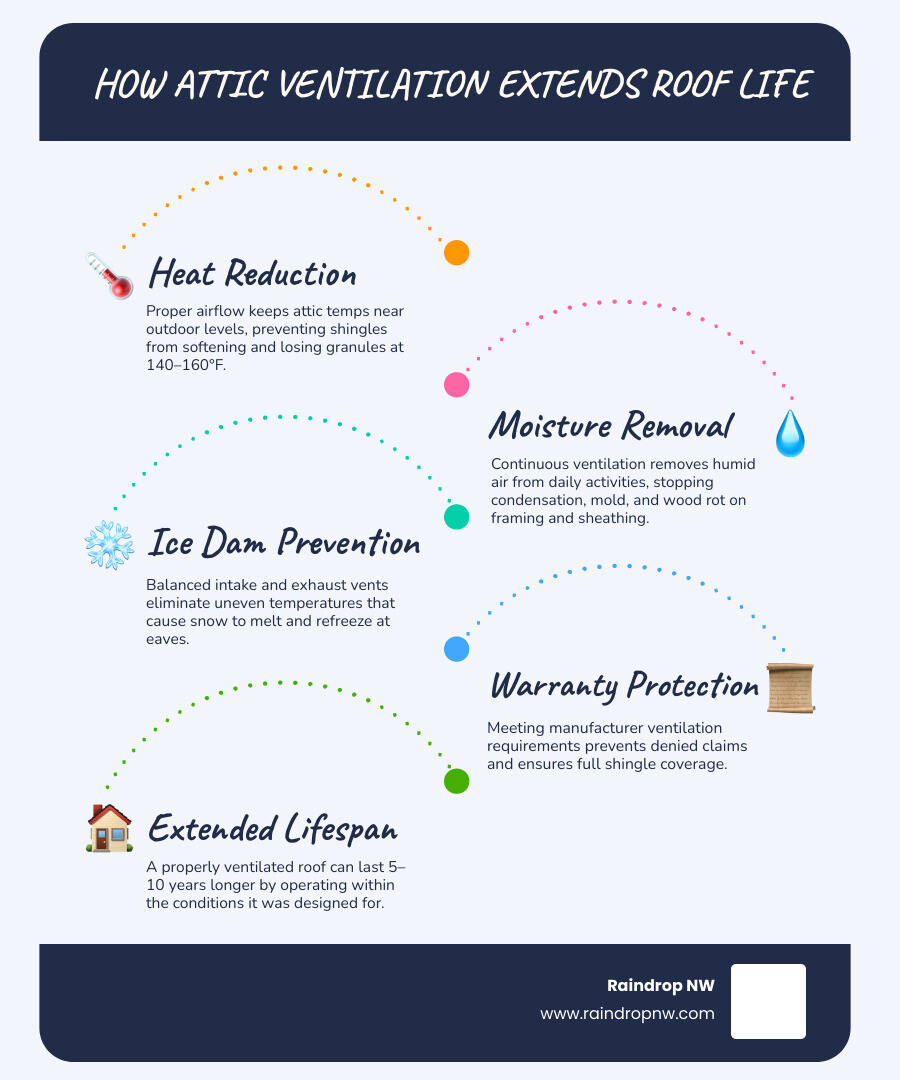
- Reduces attic heat — A poorly ventilated attic can reach 140–160°F on a summer day, softening asphalt shingles and accelerating granule loss. Proper airflow keeps temperatures close to outdoor ambient levels.
- Removes trapped moisture — Everyday activities like cooking and showering push humid air into the attic. Without ventilation, that moisture condenses on wood framing, causing rot, mold, and sheathing damage.
- Prevents ice dams — In wet Oregon winters, uneven attic temperatures cause snow to melt and refreeze at the eaves, forcing water under shingles and into your home.
- Protects your warranty — Most major shingle manufacturers require documented ventilation compliance. Without it, warranty claims can be denied.
- Extends roof lifespan by 5–10 years or more — A properly ventilated roof system operates within the conditions it was designed for, allowing materials to last as long as they’re rated.
The problem is that ventilation is invisible. You can’t see it working from the street, and most homeowners only discover a problem after the damage is already done. A roof that should last 25–30 years can fail in 12–15 when the attic beneath it runs hot and wet year after year.
Here in the Pacific Northwest, that risk is real. Oregon’s combination of heavy rainfall, high humidity, and temperature swings between seasons creates the exact conditions that punish under-ventilated roofs fastest.
I’m Torrey Yungeberg, owner of Raindrop Roofing NW, and after years of inspecting roofs across the Portland metro and surrounding communities, I’ve seen how proper ventilation extends roof life — and how quickly things go wrong when it doesn’t. In this guide, I’ll walk you through everything you need to know to protect your roof from the inside out.
What is Attic Ventilation and How Does It Work?
At its core, attic ventilation is a balanced system that allows continuous airflow through your attic space. It is not just about letting hot air escape; it is about creating a reliable, continuous loop where cool, fresh air enters at the lowest point of your roof and warm, moist air exits at the highest point.
This continuous cycle relies on two primary natural forces:
- The Stack Effect (Thermal Buoyancy): Warm air is naturally less dense than cold air, meaning it rises. As the air inside your attic warms up, it climbs toward the peak of your roof. If you have exhaust vents installed at the ridge, this hot air escapes, creating a natural vacuum that draws cooler air in through the intake vents at the eaves.
- The Wind Effect: Even a gentle breeze blowing against your home creates localized pressure differences. Wind hitting the side of your house forces air into your intake vents (usually under the eaves or soffits) while pulling air out of the exhaust vents on the opposite side or peak.
To make this natural system work efficiently, we use a combination of passive and active ventilation. Passive ventilation relies entirely on these natural forces without using mechanical parts. It is the gold standard for most modern residential roofs because it is quiet, requires no electricity, and has no moving parts to break down. Active ventilation, such as powered attic fans or solar-powered vents, uses mechanical force to pull air through the space. While active systems can be useful in complex roof designs, they must be carefully designed so they do not accidentally pull conditioned air out of your living space.
For any ventilation system to work, it must have two equally balanced components:
- Intake Vents: Located at the lower edge of the roof (usually soffit or eave vents), these allow cool, dry air to enter the attic.
- Exhaust Vents: Located at or near the peak of the roof (such as ridge vents or box vents), these allow hot, humid air to escape.
Without both working in harmony, the system stalls. If you have plenty of exhaust vents but your intake vents are blocked by insulation, no air will move.

Understanding How Proper Ventilation Extends Roof Life in Summer
Summer in the Pacific Northwest can bring intense sunny days that bake your roof deck. When the sun beats down on your roof, asphalt shingles absorb an immense amount of radiant heat. In an unventilated attic, this heat has nowhere to go. On a 90°F summer afternoon in Beaverton, a poorly ventilated attic can easily reach temperatures between 140°F and 160°F.
This extreme attic heat acts like an oven, baking your roofing materials from below. Asphalt shingles are designed to withstand high temperatures from the sun, but they are not designed to be roasted from both sides. When the attic reaches these extreme temperatures, the asphalt in your shingles begins to soften. This leads to accelerated granule loss (the protective ceramic coating on your shingles), curling, and cracking.
Furthermore, this extreme heat causes intense thermal cycling. Every day, your roof heats up to extreme temperatures under the sun and then cools down rapidly when the sun sets. This constant expansion and contraction puts massive mechanical stress on your shingles, underlayment, and roof deck, causing them to age prematurely. By keeping attic temperatures close to the ambient outdoor temperature, proper airflow minimizes this thermal stress. If you want to dive deeper into protecting your roof from seasonal wear, check out our guide on How to Extend the Life of Your Roof.
How Proper Ventilation Extends Roof Life by Preventing Ice Dams
While summer heat is a major threat, winter brings a completely different set of challenges to Oregon roofs. When winter storms hit the Portland metro area, snow can accumulate on your roof. If your attic is poorly ventilated, warm air rising from your living space accumulates at the peak of the attic, heating the upper sections of your roof deck.
This uneven roof temperature creates a dangerous cycle:
- The snow on the upper, warmer sections of your roof melts.
- The meltwater flows down the slope of the roof until it reaches the eaves.
- Because the eaves extend past the heated attic space, they remain at freezing temperatures.
- The water refreezes at the cold eaves, forming a thick barrier of ice known as an ice dam.
As more snow melts, the water pools behind this ice dam. Water is incredibly patient. When it is trapped on your roof, it will back up under your shingles, bypass your underlayment, and seep directly into your roof deck, ceiling, and walls.
A balanced ventilation system prevents this by keeping the entire roof deck at a uniform, cold temperature close to the outdoor ambient air. This ensures that if snow melts, it melts evenly across the entire roof, preventing the freeze-thaw cycle that leads to destructive ice dams and gutter backups. To learn more about how our local weather patterns impact your home, read our article on How Portland Weather Affects Roof Lifespan.
How Proper Ventilation Extends Roof Life
A roof is a significant investment in your home, and maximizing its lifespan is a top priority for any homeowner. When we look at roofs that have reached their full 25- or 30-year design life, they almost always share one common feature: excellent attic ventilation.
By regulating both temperature and humidity, proper ventilation protects the structural integrity of your entire roofing system. It prevents the wood framing from warping, keeps the roof deck flat, and protects the shingles from premature aging. Understanding How Ventilation Reduces Moisture Damage is essential for keeping your home’s structural bones strong and dry.
Preventing Trapped Moisture, Mold, and Wood Rot
Moisture is the single greatest enemy of a wood-framed home. Every single day, a typical family of four generates gallons of water vapor through simple activities like breathing, showering, cooking, and running the dishwasher. Because warm, humid air naturally rises, this moisture travels upward, passing through drywall joints, light fixtures, and attic hatches into your attic.
In the winter, when the outdoor air is cold and wet, your roof deck becomes very cold. When warm, humid air from your living space hits this cold wood sheathing, it condenses into liquid water — a process identical to water droplets forming on a cold glass of iced tea.
Without continuous airflow to sweep this moisture away, several destructive things happen:
- Plywood Sheathing Damage: The plywood or OSB roof deck absorbs this moisture, causing it to swell, delaminate, and buckle. This leads to a wavy roofline and weakens the grip of your roofing nails.
- Wood Rot: Over time, damp rafters and trusses will begin to rot, compromising the structural integrity of your entire roof.
- Attic Mold: Dark, damp, and warm environments are the perfect breeding ground for mold and mildew, which can ruin your insulation and eventually migrate into your living space, affecting your family’s health.
This risk is especially high in our rainy Pacific Northwest climate. For practical tips on managing this damp environment, explore our article on How to Extend the Life of Your Roof in Rainy Climates.
Protecting Shingles from Extreme Attic Heat
The shingles on your roof are designed to shed water and protect your home, but their longevity depends heavily on the health of the materials beneath them. When an attic is poorly ventilated, the trapped heat cooks the shingles from the underside.
This constant high-heat exposure causes the volatile oils within the asphalt shingles to evaporate. As these oils dry out, the shingles lose their flexibility and become brittle. Once brittle, they are highly susceptible to:
- Granule Loss: The protective mineral granules on the surface wash away, leaving the underlying asphalt exposed to damaging UV rays.
- Shingle Curling and Cupping: The edges of the shingles curl upward or cup downward, making them easy targets for wind uplift and blow-offs during storm season.
- Thermal Degradation: The shingle mat itself breaks down, leading to cracks and tears that allow water to penetrate your home.
Proper ventilation prevents this thermal degradation, keeping your shingles flexible, strong, and capable of defending your home for decades.
Common Ventilation Failures and Warning Signs
Even if a roof has vents installed, they may not be functioning correctly. In our years of inspecting roofs in Beaverton, Portland, and Hillsboro, we frequently find ventilation systems that are completely non-functional due to common installation mistakes or lack of maintenance.
One of the most frequent issues we see is blocked soffits. During insulation upgrades, well-meaning homeowners or insulation contractors often blow loose-fill fiberglass or cellulose directly into the eaves, completely blocking the soffit vents. Without proper baffles (plastic or foam channels that keep a clear pathway for air), the intake system is completely starved of air.
Signs Your Attic Lacks Adequate Airflow
You do not always need to climb into your attic to know if your roof is struggling to breathe. There are several clear warning signs that indicate your attic lacks adequate airflow:
- Musty Odors in the Attic: A damp, earthy smell is a clear sign that moisture is trapped and mold is beginning to grow.
- Rusty Nails (Shiners): Look at the nails protruding through your roof deck in the attic. If they are rusty, or if you see white frost on them in the winter, moisture is condensing on the cold metal.
- Peeling Paint: Extreme attic heat can cause paint to peel or blister on the exterior trim near the roofline, or on the ceilings of rooms directly below the attic.
- Unusually High Energy Bills: If your air conditioner is running constantly in the summer and your energy bills are spiking, your attic is likely acting as a giant radiator, transferring heat down into your home.
Catching these signs early can save you from a premature roof replacement. To learn more about identifying these issues before they turn into major headaches, read about How Regular Inspections Catch Problems Early.
The Danger of Short-Circuiting Your Ventilation System
One of the most misunderstood concepts in roofing is how different vent types interact. Many homeowners assume that “more is better” when it comes to vents. However, mixing different types of exhaust vents can actually short-circuit your entire system.
For example, if a home has both a continuous ridge vent along the peak and gable vents on the side walls, the air will not flow as intended. Instead of drawing cool air up from the soffit vents at the eaves, the ridge vent will draw air from the nearby gable vent.
This creates a localized loop of airflow right at the peak of the roof, leaving the lower portion of the roof deck completely stagnant. This stagnant zone traps heat and moisture, leading to localized shingle curling and wood rot on the lower half of your roof. For a comprehensive overview of how to care for your roof system as a whole, consult The Ultimate Guide to Roof Care in Portland Oregon.
Calculating and Balancing Your Attic Ventilation
Designing a roof ventilation system is a precise science. It requires calculating the correct amount of Net Free Ventilation Area (NFVA), which is the total unobstructed area through which air can freely pass.
The International Residential Code (IRC Section R806) establishes the standard rules for attic ventilation:
- The 1:150 Rule: For every 150 square feet of attic floor space, you must provide 1 square foot of net free ventilation area.
- The 1:300 Rule: This ratio can be reduced to 1 square foot of ventilation area per 300 square feet of attic space if the ventilation is balanced. To qualify for this rule, 40% to 50% of the ventilation must be located in the upper portion of the roof (exhaust) and the remaining balance must be in the lower portion (intake).
A balanced system is highly efficient because it prevents negative pressure zones that could pull conditioned air out of your living space.
| Vent Type | Flow Direction | Best Use Case | Pros | Cons |
|---|---|---|---|---|
| Soffit / Eave Vents | Intake | All roof types with eaves | Excellent, low-profile air intake | Can be easily blocked by insulation |
| Ridge Vents | Exhaust | Gabled roofs | Continuous, highly efficient, invisible | Must be paired with balanced intake |
| Gable Vents | Exhaust / Intake | Simple gabled roofs | Traditional look, passive airflow | Can short-circuit ridge vents; wind-dependent |
| Static Box Vents | Exhaust | Hip roofs or complex designs | Simple to install, localized relief | Requires multiple penetrations in the roof |
| Powered Attic Fans | Exhaust | High-heat climates | Active, high-volume airflow | Uses electricity; can pull conditioned air from home |
Manufacturer Warranties and Code Requirements
When you invest in high-quality shingles from major manufacturers like GAF or Owens Corning, they typically come with long-term or lifetime warranties. However, these warranties come with a critical catch: proper ventilation must be installed and documented.
If your roof fails prematurely and the manufacturer determines that your attic did not meet local building codes or their specific ventilation guidelines, your warranty claim will likely be denied. Manufacturers know that excessive heat and moisture will destroy even the highest-quality shingles, which is why they require proof of proper NFVA calculations during installation. Ensuring your ventilation is correctly balanced is just as important as knowing How Proper Flashing Prevents Leaks when it comes to protecting your home and keeping your warranty intact.
Frequently Asked Questions about Roof Ventilation
Navigating roof ventilation can feel overwhelming. Here are answers to some of the most common questions we hear from homeowners in the Portland metro area.
Can poor attic ventilation void my shingle warranty?
Yes. Almost all major asphalt shingle manufacturers condition their warranties on proper ventilation. If you experience premature shingle curling, cracking, or granule loss, the manufacturer will inspect your attic’s ventilation. If they find that the attic lacks adequate intake and exhaust according to the 1:300 rule, they can void your warranty, leaving you responsible for the cost of repairs or replacement.
How does attic ventilation improve home energy efficiency?
In the summer, an unventilated attic acts like a giant radiator, trapping heat that radiates down through your ceiling insulation and into your living space. This forces your air conditioning system to work much harder to keep your home cool. By continuously flushing out this hot air, proper ventilation reduces your cooling load, lowering your summer utility bills and extending the life of your heating and cooling equipment.
How often should I have my roof ventilation inspected?
We recommend having your roof and attic ventilation inspected at least once a year, ideally in the fall before the rainy winter season begins. This ensures that your soffits are clear of insulation, your vents are free of debris or pest nests, and your roof is ready to handle the winter weather. To understand how proactive care saves you money, read about How Inspections Prevent Costly Repairs.
Conclusion
Your roof is a complex, integrated system where every component — from the shingles on top to the air flowing underneath — must work in perfect harmony. Investing in the highest-quality shingles won’t matter if they are being cooked from below by a poorly ventilated attic. Understanding how proper ventilation extends roof life is the key to ensuring your home stays safe, dry, and energy-efficient for decades to come.
At Raindrop Roofing NW, we are proud to be a truly local, family-owned roofing company based right here in Beaverton, Oregon. Unlike many local roofing companies that have been bought out by out-of-state investment firms, we remain independently owned and deeply committed to long-term service and accountability. When we install a roof, we don’t just look at the shingles — we audit your entire attic space to design a balanced, code-compliant ventilation system tailored specifically to your home.
Whether you are in Portland, Beaverton, Hillsboro, Tigard, or any of our surrounding communities, our experienced team is here to help you protect your investment.
Ready to ensure your roof is breathing properly and built to last? Schedule a professional roof inspection with Raindrop Roofing NW today, and let our family take care of yours.




Trackbacks & Pingbacks
[…] During our damp winters, poor ventilation also traps warm, humid air inside the attic, leading to condensation, wood rot, and mold growth on your roof decking. Ensuring your attic meets proper ventilation standards is essential for roof health. Discover how proper airflow protects your home in our guide on How Proper Ventilation Extends Roof Life. […]
Leave a Reply
Want to join the discussion?Feel free to contribute!