Why Moss on Your Roof Is a Bigger Problem Than It Looks
How moss removal protects your shingles comes down to one simple idea: moss holds moisture, and moisture destroys roofing materials over time. Here is a quick summary before we dive deeper:
Moss removal protects your shingles by:
- Stopping moisture from being trapped against your shingles 24/7
- Preventing shingle edges from lifting, which leads to wind blow-off and leaks
- Reducing granule loss that exposes asphalt to UV damage
- Protecting the roof deck and underlayment from rot and fungi
- Extending the usable life of your shingles before replacement is needed
In the Portland metro area, moss is not just a cosmetic issue — it is a year-round threat. The Pacific Northwest’s wet winters, heavy shade from tree canopy, and north-facing roof slopes create nearly perfect conditions for moss to take hold and spread. According to Oregon State University, moss traps soil and debris that retain water long after rain stops, keeping your roof damp far longer than it should be. Left unchecked, that constant moisture accelerates wear on every layer of your roofing system — from the surface granules down to the wood deck beneath.
The frustrating part? Many homeowners either ignore the green growth or reach for a pressure washer — and both choices can make things worse. Moss that is left alone thickens season by season, wedging under shingle edges and prying them loose. Pressure washing, on the other hand, strips the protective granules right off the surface, doing in one afternoon what moss might take five years to accomplish on its own.
The good news is that moss removal done correctly — and done at the right time — genuinely protects your roof and can add years to its lifespan without risking further damage.
I’m Torrey Yungeberg, owner of Raindrop Roofing NW, and after years of inspecting and restoring roofs across the Portland metro, I’ve seen how how moss removal protects your shingles can be the difference between a roof that lasts decades and one that fails far too soon. Let’s walk through everything you need to know to protect your home.
Moss vs. Algae: Understanding the Green on Your Roof

When homeowners look up at their roofs in Beaverton, Hillsboro, or Lake Oswego, they often see dark streaks or green patches and assume it is all the same problem. However, there is a massive biological and structural difference between roof algae and roof moss. Understanding this distinction is the first step in knowing how to protect your investment.
Algae: The Aesthetic Concern
The dark, soot-like streaks you see on many local roofs are typically caused by Gloeocapsa magma, a type of blue-green algae. This hardy, ancient organism spreads through airborne spores carried by the wind or animals. To protect itself from harsh ultraviolet (UV) rays, the algae produces a dark pigment that leaves unsightly black streaks across your shingles.
While algae is certainly an eyesore and can reduce the efficiency of “cool roofs” by absorbing more heat, there is no scientific evidence that algae causes direct structural damage to asphalt shingles. It is primarily an aesthetic issue.
Moss: The Structural Threat
Moss is an entirely different beast. Unlike algae, moss is a primitive, non-vascular plant. Because it lacks a traditional root system, it does not draw nutrients from the soil. Instead, it absorbs water and nutrients directly through its leaves. This unique biology is exactly why moss is so dangerous to your roof.
On asphalt shingles, species like Dicranoweisia cirrata and Bryum capillare find a perfect anchoring ground. The rough mineral granules on asphalt shingles and the seams between them provide ideal crevices for moss spores to take root. Once established, moss thrives in cool, shaded, damp environments. In the Pacific Northwest, our mild winters and heavily shaded neighborhoods mean moss grows actively from autumn through early spring.
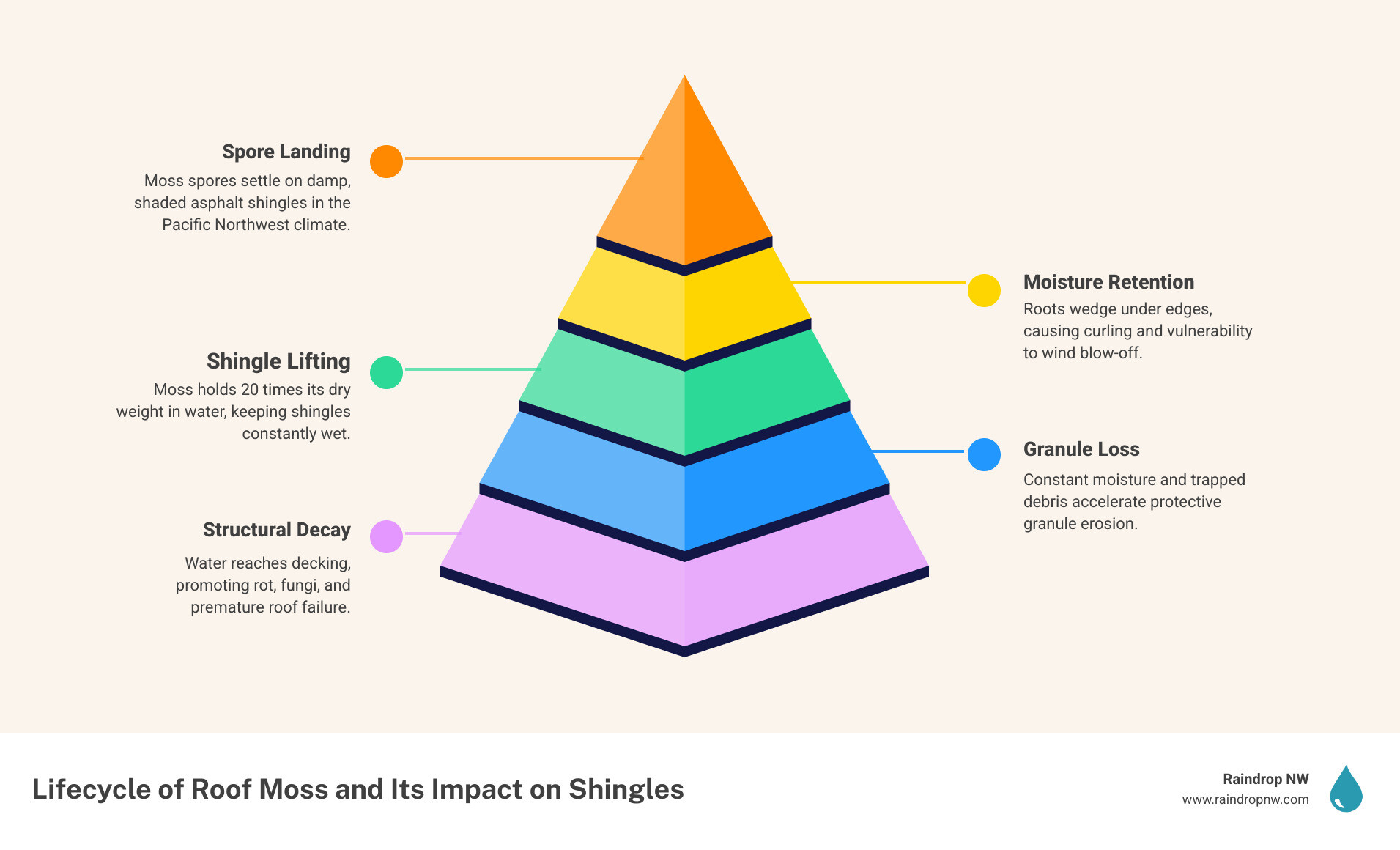
Because moss is a plant that absorbs water through its leaves, it acts like a literal sponge on your roof. It can absorb up to 20 times its dry weight in water. This keeps your shingles constantly damp, preventing them from drying out between rainstorms. To understand how this constant moisture shortens your roof’s lifespan, you can read more about How Portland Weather Affects Roof Lifespan.
| Feature | Roof Algae (Gloeocapsa magma) | Roof Moss (Non-Vascular Plants) |
|---|---|---|
| Appearance | Dark, black, or dark-brown streaks | Green, fuzzy, thick cushions or clumps |
| Growth Conditions | Moisture and sunlight (often on southern slopes) | Moisture, shade, and debris (often on northern slopes) |
| Damage Mechanism | Aesthetic discoloration; minor heat absorption | Physical displacement of shingles; heavy water retention |
| Structural Threat | Minimal to none | Severe (causes leaks, rot, and wind blow-off) |
| Anchor Method | Surface adhesion | Wedges into shingle seams and grabs surface granules |
How Moss Removal Protects Your Shingles: The Science of Roof Longevity
To truly appreciate how moss removal protects your shingles, we must look at the physical and chemical forces at play when moss is allowed to grow unchecked on asphalt shingles.
Asphalt shingles are engineered to shed water downward along a sloped surface. They rely on gravity and a clean, unobstructed path to guide rain into your gutters. When moss takes root, it completely disrupts this design.
The Sponge Effect and Granule Loss
Because moss absorbs up to 20 times its dry weight in water, it holds a pocket of constant moisture directly against the shingle surface. This continuous dampness softens the asphalt mixture within the shingle. Over time, the decomposition of organic matter trapped by the moss releases mild acids. These acids slowly break down the asphalt binder that holds the protective mineral granules in place.
These granules are your roof’s primary defense against UV radiation from the sun. As the moss expands and contracts with changes in temperature and moisture, it physically grinds away these granules. When the granules are lost, the underlying asphalt is exposed to direct sunlight, which leads to cracking, brittleness, and rapid deterioration. By removing moss early, you halt this granule abrasion and preserve the protective outer layer of your shingles. To learn more about maximizing the years you get out of your roofing system, check out our guide on How to Extend the Life of Your Roof.
How Moss Removal Protects Your Shingles from Wind and Storm Damage
As moss grows, it doesn’t just sit on top of the shingles; it actively creeps underneath the leading edges of the shingles above it. As the moss clump thickens, it acts as a wedge, slowly prying the shingle tab upward.
This lifting has two devastating consequences:
- Breaking the Seal: Shingles rely on a factory-applied sealant strip to bond them to the course below. Once moss lifts the shingle, this seal is broken.
- Wind Vulnerability: Lifted, curled shingles lose their aerodynamics. During a high-wind event or winter storm in Tualatin, Sherwood, or Tigard, wind can easily catch the raised edges of these compromised shingles, leading to severe shingle blow-off.
Regular moss removal keeps the leading edges of your shingles flat, maintaining their wind resistance and preventing storm damage. You can read more about how different materials handle these stresses in our article on How Shingle Grade Affects Lifespan and Appearance.
How Moss Removal Protects Your Shingles by Preventing Wood Rot
When moss wedges under shingles and grows thick in your roof’s valleys, it creates a physical barrier to natural water flow. Instead of running straight down into the gutters, water is forced to move laterally (sideways) or even wick upward underneath the shingles via capillary action.
Once water gets beneath the shingles, it bypasses your roof’s primary defense layer. It saturates the underlayment and eventually reaches the plywood roof deck. This constant moisture encourages the growth of wood-rotting fungi, leading to:
- Soft spots in your roof decking
- Interior ceiling leaks and drywall damage
- Mold growth in your attic space
- Costly structural repairs to the rafter system
Removing moss prevents this lateral water movement, ensuring that rain flows smoothly off your roof and away from your home’s structure. For more tips on keeping your home dry, explore our Water Damage Prevention Tips for Pacific Northwest Homeowners.
Safe Moss Removal and Long-Term Prevention Strategies
Now that we understand the damage moss causes, the question is: how do we get rid of it safely? In our rainy climate, taking the wrong approach to roof cleaning can easily cause more damage than the moss itself. Managing this process correctly requires a balance of safety, the right chemical treatments, and smart preventative steps. For a deeper dive into maintaining roofs in wet environments, see our specialized guide on How to Extend the Life of Your Roof in Rainy Climates.
Why You Must Avoid Pressure Washing and Aggressive Scrubbing
If there is one golden rule of roof maintenance, it is this: never use a pressure washer on asphalt shingles.
While a pressure washer provides instant gratification by blasting away green moss, the high-pressure stream of water is incredibly destructive to asphalt shingles. The force of the water immediately strips away the protective mineral granules, leaving the asphalt bare and vulnerable to UV failure. Furthermore, pressure washing can easily force water upward underneath the shingles, blowing past the underlayment and causing immediate leaks in your attic.
Similarly, aggressive scrubbing with wire brushes or metal scrapers should be avoided. These harsh tools gouge the shingles, tear the asphalt mat, and scrape away granules. If physical agitation is necessary, it should only be done using a soft-bristle nylon brush or a soft broom, brushing gently in a downward direction (along the slope of the shingles) to avoid lifting the tabs.
Eco-Friendly and DIY Moss Removal Solutions
If you want to tackle mild moss growth yourself, there are several effective, roof-safe chemical solutions that will kill the moss without destroying your shingles.
- 50:50 Bleach and Water Mix: Recommended by the Asphalt Roofing Manufacturers Association (ARMA), this is a highly effective treatment. Mix equal parts laundry-strength chlorine bleach and water. Apply it with a garden pump sprayer, let it dwell for 15 to 20 minutes, and then rinse thoroughly with a low-pressure garden hose.
- Oxygen-Based Bleach: A safer, more eco-friendly alternative to chlorine bleach. It kills the moss over a few days without harming surrounding plants or staining concrete.
- Potassium Salts of Fatty Acids: These are biodegradable, soap-based products that naturally disrupt the cellular structure of moss, causing it to die and wash away over time.
- Zinc Sulfate: A classic and highly effective moss killer. However, zinc sulfate should never be used if you have copper gutters, copper flashing, or metal roofs, as it can cause severe corrosion.
Important Step – Plant Protection: When using any chemical treatment, always water your surrounding landscaping thoroughly before and after application. Cover delicate shrubs with tarps to protect them from chemical runoff.
Long-Term Prevention: Keeping Moss Off Your Roof for Good
Once your roof is clean, the goal is to keep the moss from returning. A combination of environmental modifications and preventative hardware is the most effective approach.
- Tree Trimming: Moss needs shade to survive. Trim back overhanging branches to allow maximum sunlight and airflow to reach your roof surface. This also reduces the amount of organic debris (leaves and needles) that falls onto your roof and traps moisture.
- Zinc or Copper Strips: Installing zinc or copper strips along the ridge line of your roof is an excellent long-term preventative measure. When it rains, water runs over the metal strips, releasing trace metal ions. These ions wash down the slope of the roof, creating an environment where moss and algae spores cannot survive. That these strips generally protect about 10 to 15 feet downslope, so large roofs may require multiple rows of strips.
- Gutter Cleaning: Keep your gutters free of debris so water can drain quickly. Clogged gutters cause water to back up, keeping the lower edges of your roof constantly wet.
- Attic Ventilation: Proper ventilation keeps your roof deck cool and dry, preventing moisture from condensing on the underside of your roof. To understand this balance, read about How Ventilation Reduces Moisture Damage and learn How Proper Flashing Prevents Leaks.
Frequently Asked Questions about Roof Moss
Is it worth removing moss on a 9-year-old roof?
Absolutely. A 9-year-old asphalt shingle roof is in the prime of its life. Most modern architectural shingles are designed to last 25 to 30 years if properly maintained. Allowing moss to grow unchecked on a 9-year-old roof will rapidly accelerate its aging, potentially cutting its lifespan in half.
Removing the moss now is a highly cost-effective investment that preserves the integrity of your shingles and protects your home’s structural components, saving you from a premature and expensive roof replacement. To see how proactive care saves money in the long run, read How Inspections Prevent Costly Repairs.
When should I hire a professional instead of doing it myself?
While DIY moss removal is possible for single-story homes with low-slope roofs, you should hire a professional if:
- Your roof has a steep pitch (over 23 degrees or a 5:12 slope)
- The moss growth is thick and covers large areas of the roof
- You do not have proper fall-protection safety gear (harnesses, roof anchors, and high-traction footwear)
- You are uncomfortable working at heights
Professional roofing contractors use specialized “soft-wash” equipment that applies roof-safe cleaning solutions at very low pressure (similar to a heavy rainstorm), killing the moss completely without damaging your shingles. For more on when to bring in an expert, check out our guide on How Often Should You Have Your Roof Inspected.
Do zinc or copper strips really prevent moss?
Yes, they are highly effective, but with one major caveat: metal strips are growth inhibitors, not cleaners. They will not remove or kill an active, deeply rooted patch of moss. You must clean the roof and remove the existing moss first. Once the shingles are clean, installing zinc or copper strips will successfully prevent new moss spores from establishing a foothold for up to 20 years.
Conclusion
Understanding how moss removal protects your shingles is essential for any homeowner in the Pacific Northwest. Moss is far more than an aesthetic blemish; it is a living sponge that holds moisture against your roof, breaks down protective granules, lifts shingle edges, and paves the way for rot and structural leaks.
By taking a gentle, systematic approach to moss removal — and avoiding destructive methods like pressure washing — you can safeguard your home and extend the life of your roof.
At Raindrop NW, we are proud to be a multi-generational, family-owned roofing company based right here in Beaverton, Oregon. Unlike many local roofing businesses that have been bought out by out-of-state investment firms, we remain completely local and independently owned. Our commitment is to long-term service, craftsmanship, and true local accountability for our neighbors throughout the Portland metro area.
If you are noticing green patches, lifted shingles, or debris buildup on your roof, don’t wait for a leak to show up on your ceiling. Catching these issues early is the key to protecting your investment. Learn more about How Regular Inspections Catch Problems Early and take the first step toward a dry, secure home.
Schedule a professional roof inspection and maintenance service with Raindrop NW today, and let our experienced team help you keep your roof in perfect shape for years to come.