
Signs Your Roof Needs Repair or Replacement Before the Rain Hits

Is Your Roof Trying to Tell You Something? Warning Signs Oregon Homeowners Should Not Ignore
The signs your roof needs repair or replacement are often easier to spot than most homeowners expect — if you know what to look for. Here is a quick overview before we dig into the details:
Common signs your roof needs repair or replacement:
- Missing, curling, or cracked shingles
- Granules collecting in your gutters
- Moss or algae growing on the roof surface
- Water stains on ceilings or attic rafters
- Sagging or wavy sections along the roofline
- Damaged or rusted flashing around chimneys and vents
- A roof that is 20 or more years old
- Recurring leaks after previous repairs
Here in the Pacific Northwest, your roof faces a relentless cycle of rain, moisture, and the occasional windstorm. Most of the time, a roof does its job quietly — until it doesn’t. By then, a small problem that could have been caught early has had months, sometimes years, to work its way into your decking, insulation, and walls. Catching the early warning signs is the difference between a straightforward repair and a much larger headache.
I’m Torrey Yungeberg, owner of Raindrop Roofing NW, and after years of inspecting roofs across Beaverton, Portland, and the surrounding communities, I have seen how the signs your roof needs repair or replacement show up long before a leak ever reaches your ceiling. In this guide, I will walk you through exactly what to look for — from the ground up.
Signs Your Roof Needs Repair or Replacement You Can See From the Ground
You don’t need to be a professional acrobat to spot trouble. In fact, we recommend staying off the ladder whenever possible. Most major signs your roof needs repair or replacement are visible right from your driveway or sidewalk if you have a keen eye or a pair of binoculars.
When you look up, you aren’t just looking for a hole in the roof; you are looking for “pattern failures.” These are subtle shifts in how your shingles lay or how the edges of your roof look. In our experience serving the Portland metro area, we find that catching these exterior cues early can save you thousands in interior drywall repairs.
How Often Should You Have Your Roof Inspected
The most common visible signs your roof needs repair or replacement
Start by scanning the “field” of the roof—the main flat areas. Are there missing shingles? In May 2026, we are still seeing the effects of the previous winter’s windstorms. If you see a shingle that has slid out of place or is missing entirely, your underlayment is exposed to the elements.
Look for “lifted tabs,” where the wind has broken the adhesive seal, causing the shingle to flap like a loose tooth. You should also watch for “bald spots” where the protective coating has worn away, or exposed nails that have “popped” up. These little metal intruders create a direct path for water to travel into your home. If you see rust stains trailing down a shingle, it’s a sure sign that a fastener is failing.
Why granules in gutters are a major warning sign for asphalt roofs
If you are cleaning your gutters and find what looks like coarse, dark sand, pay attention. These are granules—crushed stone that protects your asphalt shingles from the sun’s UV rays. Shingles age three to five times faster once they lose this protective layer.
Think of granules like the tread on a tire. Once they wear down, the “rubber” (in this case, the asphalt) is exposed to the sun and rain, causing it to become brittle and crack. While some granule loss is normal for a brand-new roof, heavy accumulation in your downspouts on a roof that is 10 or 15 years old is one of the most reliable signs your roof needs repair or replacement.
Gutter Systems And Why They Matter For Your Roof
Moss, algae, and dark streaks: cosmetic issue or moisture problem?
In the Pacific Northwest, we are famous for our “green roofs.” While a little moss might look charming on a cottage, it is a nightmare for a roof’s lifespan. Moss acts like a sponge, holding moisture against the shingles and eventually working its “roots” under the edges, lifting them up. This creates a perfect entry point for water during our heavy Portland rains.
Algae (those dark, vertical streaks) is mostly a cosmetic issue, but it can indicate that a section of your roof stays damp and shaded, making it a prime candidate for future moss growth. If you see moss growing thick enough to look like a carpet, it’s likely trapping moisture that is rotting the wood underneath.
Water Damage Prevention Tips For Pacific Northwest Homeowners
Flashing, gutters, and roof edges that should not be ignored

The “seams” of your roof are its weakest points. This includes the flashing—the metal bits around chimneys, skylights, and vents. In older Beaverton homes, we often see flashing sealed with tar or cement that has cracked over time. Modern standards prefer metal flashing because it doesn’t dry out and crack.
Check your drip edge (the metal edge along the gutters). If it’s rusted or pulling away, water can “wick” backward into your fascia boards and rafter tails. If your gutters are sagging or pulling away from the house, they aren’t just a gutter problem—they are a sign that the wood they are attached to might be soft or rotting.
How Gutter Maintenance Prevents Foundation Damage
Indoor Clues That Point to a Roof Leak or Hidden Failure
Sometimes the roof looks fine from the street, but the truth is hiding in your living room or attic. Water is sneaky; it rarely travels in a straight line. It might enter through a chimney leak, travel six feet down a rafter, and then drip onto your ceiling in a completely different room.
Ceiling and wall changes homeowners often miss at first
The most obvious sign is a yellow or brown “water ring” on the ceiling. However, keep an eye out for bubbling paint or “crunchy” drywall. If you notice a musty smell in an upstairs bedroom that you can’t quite pinpoint, it might be mold growing behind the wall due to a slow, persistent leak. These “ghost leaks” are often the most damaging because they go unnoticed until the structural wood is compromised.
How To Protect Your Home From Water Damage Through Your Roof
What to look for in the attic after rain
Your attic is the “early warning system” for your home. Grab a flashlight after a heavy rain and look at the underside of the roof deck. You are looking for:
- Wet decking: Dark or damp-looking wood.
- Dark rafters: Streaks of moisture traveling down the beams.
- Daylight gaps: If you turn off the lights and see pinpoints of light through the roof boards, you have a problem (unless it’s near an intentional vent).
- Damp insulation: Matted or wet insulation loses its R-value and can harbor mold.
How poor attic ventilation can age a roof faster
A roof isn’t just a lid; it’s a breathing system. If your attic is too hot or humid, it “cooks” your shingles from the inside out. In the summer, trapped heat can reach 150 degrees, causing shingles to curl and buckle. In the winter, trapped moisture from your showers and cooking can condense on the cold underside of the roof, leading to rot. Proper airflow is essential to prevent premature aging.
How Ventilation Reduces Moisture Damage
How Roof Age and Material Help You Decide Between Repair and Replacement
Age is one of the most significant signs your roof needs repair or replacement. Even if a roof looks okay, the materials have a chemical expiration date.
Expected lifespan by roofing material
| Material Type | Average Lifespan (Years) | When to Start Worrying |
|---|---|---|
| 3-Tab Asphalt | 15–20 | Year 12 |
| Architectural Asphalt | 25–50 | Year 20 |
| Metal Roofing | 40–80 | Year 35 |
| Clay/Concrete Tile | 50–100 | Year 40 (Check Underlayment) |
| Slate | 75–200 | Year 60 |
Climate plays a huge role here. In the Pacific Northwest, the constant moisture can shave years off the “national average” lifespan of a roof compared to a drier climate.
How Shingle Grade Affects Lifespan And Appearance
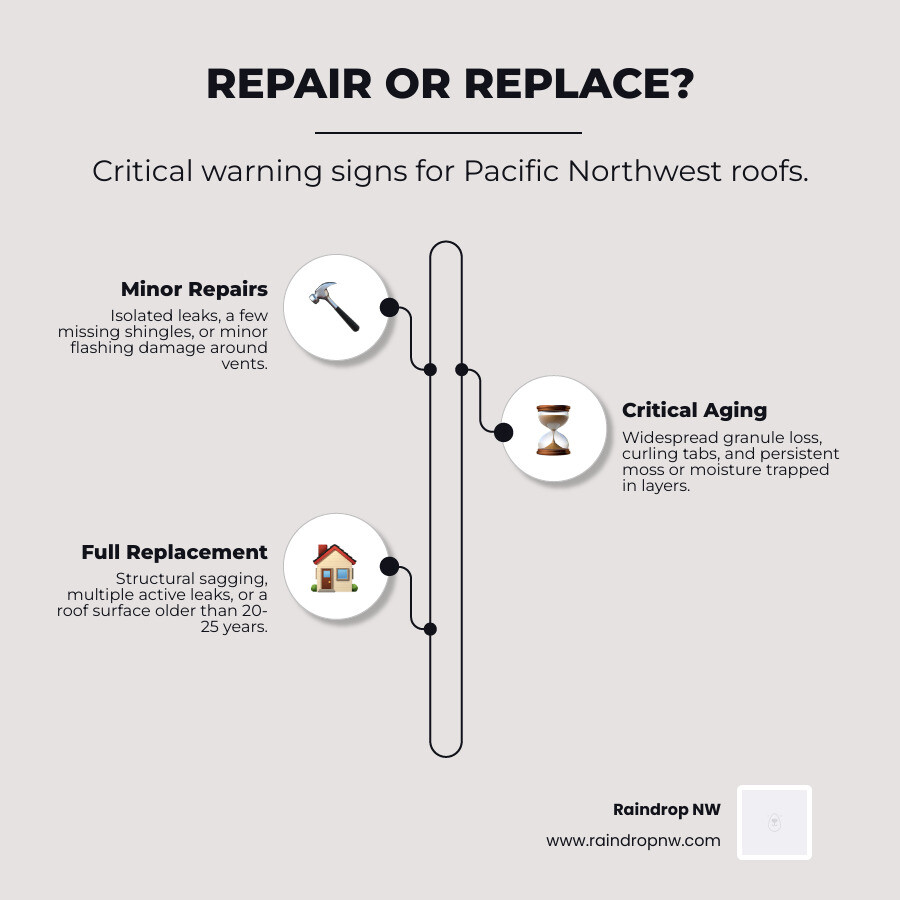
When age tips the scale from repair to replacement
If your asphalt roof is approaching the 20-year mark, you are in the “danger zone.” While a single leak on a 5-year-old roof is usually a simple repair, multiple leaks on a 20-year-old roof suggest the entire system is failing. In May 2026, many homes built in the early 2000s are reaching this critical tipping point. If you find yourself calling a roofer every year for a new patch, it’s more cost-effective to invest in a replacement rather than continuing to “throw good money after bad.”
Why neighbors replacing roofs can be a useful clue
Notice a lot of roofing trucks in your neighborhood lately? If your subdivision was built at the same time, all the roofs are likely the same age and have been exposed to the same Oregon weather. When your neighbors start replacing their roofs, it’s a strong signal that yours is likely due for an inspection.
Structural Red Flags and Storm Damage That Need Fast Action
Some signs your roof needs repair or replacement are emergencies that require immediate attention to prevent a total collapse or catastrophic water damage.
A sagging or wavy roofline is not a wait-and-see problem
If you stand across the street and notice that your roofline looks “wavy” or has a visible dip, this is a major red flag. This usually means the wooden decking underneath is soaked and has lost its structural integrity. It could also point to foundation issues or failing support beams. A sagging roof is a structural emergency and should be inspected by a professional within 48 hours.
After storms, watch for damage patterns across multiple areas
High winds in the Portland area can create “chatter” damage, where shingles are lifted and creased even if they don’t blow off. Hail can leave “bruises”—small indentations that knock the granules loose and expose the asphalt. If you see damage scattered across multiple slopes of your roof, it’s rarely a “quick fix” situation.
How Weather Events Trigger The Need For Inspections
When to treat roof damage as an emergency
You have a roofing emergency if:
- You have an active, heavy leak during a storm.
- There is a visible bulge in your ceiling.
- A tree limb has fallen and punctured the roof deck.
- The roof is visibly sagging.
In these cases, you need a professional to secure the area and likely apply an emergency tarp to prevent further interior destruction.
How To Handle A Wilsonville Roof Emergency Fast
How to Inspect Your Roof Safely and What a Professional Inspection Should Cover
We want you to stay safe. Every year, thousands of people are injured in ladder falls. You can do a very effective preliminary check without ever leaving the ground.
A safe DIY roof check from the ground and attic
- Binocular Scan: Walk around your home with binoculars and look for missing shingles, cracked flashing, or moss buildup.
- Curb View: Step back across the street to check for sagging or uneven rooflines.
- Gutter Check: Look at your downspout exits for “sand” (granules).
- Attic “Light” Test: On a sunny day, go into the attic, turn off the lights, and look for “stars” (light coming through the roof).
- Post-Storm Scan: Always do a quick walk-around after any major Oregon wind event.
Roof Inspection Frequency For Pacific Northwest Homes
What a professional roof inspection should include
A professional from Raindrop Roofing NW doesn’t just look at shingles. A real inspection covers:
- The Underlayment: Checking the “skin” beneath the shingles.
- Penetrations: Inspecting the seals around pipes, vents, and chimneys.
- Valleys: Checking the areas where two roof planes meet, as these carry the most water.
- Ventilation: Ensuring your intake and exhaust vents are clear and balanced.
- Decking: Feeling for “soft spots” that indicate rot.
How often homeowners should inspect their roof in the Pacific Northwest
We recommend a professional inspection at least twice a year—once in the spring to assess winter damage, and once in the fall to prepare for the rain. Given our moist climate, catching moss early can extend your roof’s life by five to ten years.
How Regular Inspections Catch Problems Early
When Repeated Repairs Stop Making Sense
There comes a time when patching a roof is like putting a band-aid on a broken leg. It might stop the bleeding for a minute, but it isn’t solving the problem.
Signs repairs are only buying a little more time
If you are fixing the same leak for the third time, the problem isn’t the repair—it’s the system. Aging shingles become brittle; when a roofer tries to repair one area, the surrounding shingles often crack because they are too “stiff” to be lifted. This creates a “domino effect” of repairs that never truly ends.
How to think about repair versus replacement without guessing
Think of your roof as an investment. A new roof typically provides a return on investment (ROI) of 60% to 70% in home value. If your repair costs are starting to exceed 20% of the cost of a new roof, or if the roof is over 20 years old, replacement is almost always the smarter financial move. It protects your home’s equity and gives you peace of mind during our long Oregon winters.
Conclusion
At Raindrop Roofing NW, we believe in local accountability. We aren’t an out-of-state corporation; we are your neighbors in Beaverton and Portland. We take pride in helping our community understand the signs your roof needs repair or replacement so they can make informed, stress-free decisions.
If you’ve spotted any of the warning signs mentioned in this guide—or if you just haven’t had your roof looked at in a few years—don’t wait for the next big storm to find out if your roof is failing. We offer comprehensive, professional inspections to give you a clear picture of your roof’s health.




Trackbacks & Pingbacks
[…] or a displaced pipe boot can be fixed quickly, systemic failures require a total reset. Knowing the Signs Your Roof Needs Repair Or Replacement helps you protect your home’s structural […]
Leave a Reply
Want to join the discussion?Feel free to contribute!