
The Secret Life of Shingles and How Grades Change Everything
How Shingle Grade Affects lifespan and appearance — What Every Homeowner Should Know
How shingle grade affects lifespan and appearance is one of the most important things to understand before replacing your roof. Here’s the short answer:
| Shingle Grade | Typical Lifespan | Visual Profile | Key Strength |
|---|---|---|---|
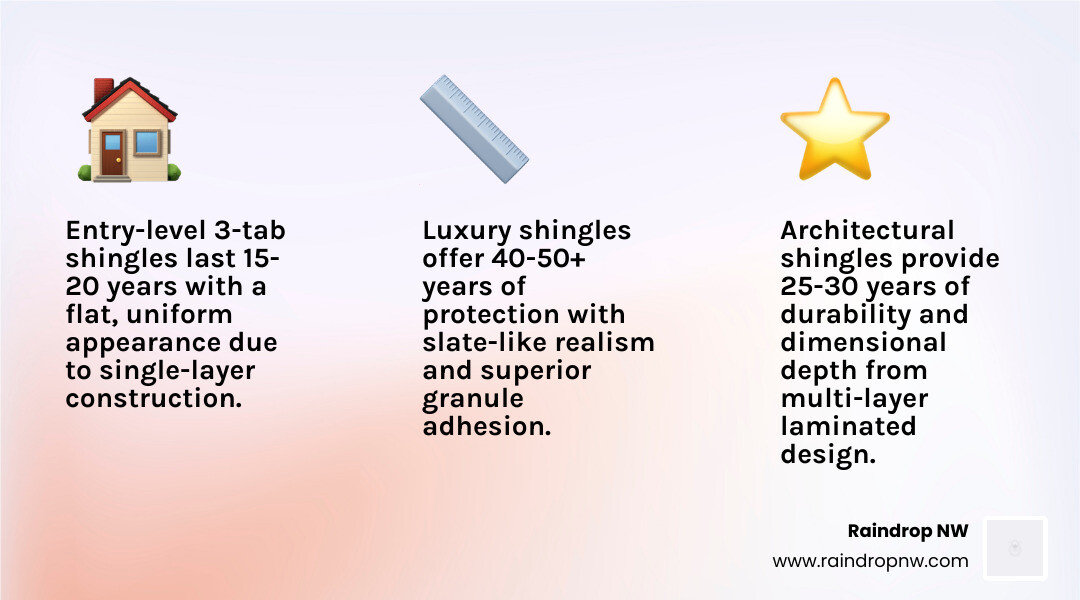
| 3-Tab (Entry-Level) | 15-20 years | Flat, uniform pattern | Low upfront cost |
| Architectural (Mid-Grade) | 25-30 years | Dimensional, textured depth | Balance of value and durability |
| Luxury (Premium) | 40-50+ years | Slate or wood-shake realism | Maximum protection and curb appeal |
Higher-grade shingles are heavier, use more asphalt, and hold their granules longer — which directly translates to a longer-lasting, better-looking roof. Entry-level shingles get the job done, but they show their age faster, fade sooner, and are more vulnerable to wind and UV damage. The grade you choose on day one shapes everything that follows: how long your roof lasts, how it looks in year ten, and how well it holds up through Oregon’s wet winters and summer heat swings.
I’m Torrey Yungeberg, owner of Raindrop Roofing NW, and after years of installing and inspecting roofs across Oregon and Southwest Washington, I’ve seen how shingle grade affects lifespan and appearance in real-world conditions — not just on paper. Understanding these differences is exactly what I want to walk you through in this guide.
Defining the Three Primary Shingle Grades
When we talk about “shingle grade,” we aren’t just talking about a brand name or a color. We are talking about the physical engineering of the product. In the roofing world, the grade is determined by three main factors: asphalt weight, the quality of the fiberglass mat, and granule adhesion.
Think of the fiberglass mat as the skeleton of the shingle. A higher-grade shingle has a thicker, tougher mat that can hold more asphalt. The asphalt is what provides the waterproofing, and the granules are the “sunscreen” that protects that asphalt from UV rays. As we move up the ladder from 3-tab to luxury, these components get beefier, heavier, and much more resilient.
If you are curious about the specific materials available for your home in the Portland or Beaverton area, you can find more info about roof types and products on our dedicated resource page.
How shingle grade affects lifespan and appearance in entry-level 3-tab roofs
3-tab shingles were the industry standard for decades, but in April 2026, they have largely moved into a “budget-only” category. These are single-layer shingles distinguished by three individual “tabs” that create a very flat, uniform, and thin appearance on the roof.
- Appearance: Because they are flat, they don’t hide imperfections in the roof deck very well. They offer a simple, clean look that works okay for rental properties or sheds, but they lack the “pop” that modern homeowners usually want.
- Lifespan: Typically, a 3-tab roof will last between 15 and 20 years. However, in the Pacific Northwest, where we deal with constant moisture and wind, that lifespan can often lean toward the shorter end of the spectrum.
- Wind Resistance: These are the lightweights of the roofing world. Most 3-tab shingles are only rated for winds up to 60 or 70 mph. In a nasty winter storm in the Willamette Valley, these are the shingles most likely to peel back or blow off.
How shingle grade affects lifespan and appearance in premium architectural systems
Architectural shingles (also called dimensional or laminate shingles) have become the go-to choice for over 75% of new installations. Instead of a single flat layer, these are made of two or more layers of asphalt shingles laminated together.
- Appearance: This multi-layer construction creates a “dimensional” look with shadows and highlights that mimic the appearance of traditional wood shakes. It adds immediate curb appeal and depth to a home.
- Lifespan: You can expect an architectural roof to last 25 to 30 years comfortably. Some high-end versions are even rated to last up to 50 years under ideal conditions.
- Durability: Because they are nearly twice as thick as 3-tab shingles, they are much harder to tear. Most carry wind ratings of 110 to 130 mph, which provides a massive safety margin for our local weather.
The Direct Link Between Shingle Grade and Roof Longevity
The reason how shingle grade affects lifespan and appearance is so dramatic comes down to science—specifically, how the materials handle the environment. Every roof is essentially in a slow-motion battle against the sun and the rain.
As shingles age, they undergo “oxidative hardening.” This means the oils in the asphalt dry out, making the shingle brittle. Higher-grade shingles contain more asphalt and higher-quality polymers that keep the shingle flexible for much longer. When a shingle stays flexible, it can handle “thermal cycling”—the expansion and contraction that happens when the sun hits the roof in the afternoon and then the temperature drops at night.
Granule loss is the first sign of trouble. Once those protective granules wash away into your gutters, the underlying asphalt is exposed to direct UV light, which accelerates the aging process. Higher-grade shingles have better “granule adhesion,” meaning they keep their “sunscreen” on much longer than budget options.
If you’re worried about how your current roof is holding up, getting a professional eye on it is key. You can find more info about roof inspections to see what we look for during a certification.
Why luxury shingles offer the longest protection
Luxury shingles are the “heavyweights” of the industry, often weighing over 400 lbs per square (a 10×10 foot area). They are often made with polymer-modified asphalt (SBS), which makes them feel almost rubber-like.
- Maximum Longevity: These shingles frequently reach the 50-year mark. They are built to be the last roof a homeowner ever needs to buy.
- Impact Resistance: Many luxury shingles carry a Class 4 impact rating. This means they can withstand being hit by large hailstones or falling debris without cracking—a huge plus if you have large Douglas firs or Maples overhanging your home.
- Aesthetic Realism: They are designed to be indistinguishable from natural slate or thick cedar shakes from the street. If you want a “statement” roof, this is the grade to choose.
How Shingle Grade Affects Lifespan and Appearance Over Time
When you look at a roof on day one, almost every grade looks “good.” The real test is what that roof looks like in year twelve. Lower-grade shingles tend to lose their luster quickly, while premium systems maintain their color and shape for decades.
| Feature | 3-Tab | Architectural | Luxury |
|---|---|---|---|
| Average Weight | 200-240 lbs/sq | 250-340 lbs/sq | 350-480+ lbs/sq |
| Wind Rating | 60-70 mph | 110-130 mph | 130+ mph |
| Fading Resistance | Moderate | High | Superior |
| Algae Resistance | Basic | Enhanced | Premium (Copper/Zinc) |
| Curb Appeal ROI | Lower | 60-70% | High |
Choosing a higher grade isn’t just about protection; it’s a financial move. Architectural shingles offer an excellent Return on Investment (ROI) because they significantly enhance the home’s resale value and curb appeal. To understand how these grades fit into the bigger picture of your home’s exterior, check out more info about residential roofing.
Visual signs of aging across different shingle grades
Different grades “fail” in different ways. Knowing what to look for can help you decide when it’s time to call us for an inspection.
- 3-Tab Aging: You’ll see “tabs” that have blown off completely. Because they are thin, they tend to “curl” at the edges (cupping) or in the middle (clawing) much sooner than thicker shingles.
- Architectural Aging: These rarely curl because they are so thick. Instead, you’ll see “bald spots” where granules have worn away, or you might notice dark streaks caused by algae growth if they weren’t treated with algae-resistant granules.
- General Signs: Brittle texture is a universal sign of aging. If you touch a shingle and it snaps like a cracker instead of bending, the asphalt has reached the end of its life.
Maximizing Performance in the Pacific Northwest Climate
In towns like Beaverton, Hillsboro, and Lake Oswego, our roofs face a unique challenge: the “slow soak.” We don’t just get rain; we get weeks of damp, overcast weather that encourages moss and algae growth. This is where how shingle grade affects lifespan and appearance becomes a local issue.
Moss is a roof-killer. Its roots (rhizoids) dig into the shingle, lifting the granules and trapping moisture against the asphalt. Higher-grade shingles often come with better algae-resistant technology (like copper-infused granules) that helps prevent those ugly black streaks and moss colonies from forming in the first place.
Proper maintenance is the secret weapon for any shingle grade. You can learn more info about roof repairs and maintenance to keep your investment safe.
The role of professional installation and maintenance
Even the highest-grade luxury shingle will fail if it’s installed poorly. We’ve seen “lifetime” shingles fail in ten years because the previous contractor used a 4-nail pattern instead of the 6-nail high-wind pattern required for our region.
- Fastening Patterns: Proper nail placement is critical. If nails are “high-nailed,” they don’t catch the common bond of the shingle, and the wind will rip it right off.
- Underlayment: The shingles are the primary defense, but the underlayment (the felt or synthetic layer underneath) is the backup. We always recommend high-quality synthetic underlayment for architectural and luxury grades.
- Gutter Cleaning: If your gutters are backed up, water can “wick” up under the shingles at the eaves, causing the roof deck to rot long before the shingles wear out.
- Annual Inspections: A quick check-up once a year can catch a loose shingle or a cracked flashing before it turns into a ceiling leak.
Frequently Asked Questions about Shingle Grades
When should I consider upgrading to a higher shingle grade?
We usually recommend an upgrade if you plan on staying in your home for more than 10 years. The cost difference between 3-tab and architectural is surprisingly small compared to the 10 extra years of life you get. You should also consider an upgrade if your home is in a high-wind area or if you want to significantly boost your curb appeal before a future sale.
Do higher-grade shingles improve energy efficiency?
Yes, they can. Many premium shingles are now designed with “cool roof” technology. These shingles have specialized granules that reflect solar energy back into the atmosphere rather than absorbing it into your attic. This can lower attic temperatures by up to 20-30 degrees on a hot July afternoon in Portland, reducing the load on your AC.
How does shingle color impact fading and heat absorption?
It’s a trade-off! Darker colors (like Charcoal or Black) are incredibly popular because they look sharp and hide minor imperfections. However, they absorb more heat, which can lead to faster “cooking” of the asphalt. Lighter colors (like Weathered Wood or Light Grey) stay cooler and tend to show fading less over time. If you go with a darker shingle, ensure your attic ventilation is top-notch to exhaust that extra heat.
Conclusion
Choosing the right roof isn’t just about picking a color you like—it’s about matching the material to your long-term goals for your home. At Raindrop NW, we take pride in being a truly local, independently owned company. Unlike the big firms bought out by out-of-state investment groups, we live in the same neighborhoods we work in. We’re committed to long-term accountability because we want to see your roof looking great 20 years from now.
Whether you’re in Beaverton, Tigard, or Vancouver, we’re here to help you navigate these choices without the high-pressure sales tactics. If you’re ready to see the difference a high-grade roof can make, it’s time to start your new roof replacement project with a team that cares about the details.




Leave a Reply
Want to join the discussion?Feel free to contribute!