
Step-by-Step Guide to Professional Moss Removal vs DIY Cost

Is Professional Moss Removal Worth It — Or Can You DIY It Safely?
When weighing professional moss removal vs DIY, here is the short answer most Oregon homeowners need:
| Factor | DIY | Professional |
|---|---|---|
| Upfront cost | Lower | Higher |
| Safety risk | High (ladder falls, steep pitches) | Low (OSHA gear, trained crew) |
| Treatment lifespan | 6 to 12 months | 2 to 4 years |
| Warranty risk | High (pressure washing voids most warranties) | Low (approved soft-wash methods) |
| Hidden damage found | Rarely | Routinely |
| Best for | Light moss, low-pitch, single-story | Moderate to heavy moss, steep or multi-story roofs |
DIY is a reasonable option if your roof is single-story, has a low pitch (4:12 or less), and the moss is light. Use a soft-wash chemical like Wet & Forget or diluted oxygen bleach — never a pressure washer — and plan to retreat every 6 to 12 months.
Call a professional if your roof is steep, two-story, has heavy moss coverage, or if you have any doubt about safely working at height. A professional soft-wash treatment lasts 2 to 4 years, catches hidden damage, and keeps your manufacturer warranty intact.
Here in the Pacific Northwest, moss is not just a cosmetic nuisance — it is an active structural threat. Oregon’s mild, wet winters and heavy tree canopy create near-perfect conditions for moss to take hold, spread across north-facing slopes, and quietly work its way under your shingles before you ever notice a leak indoors. Untreated moss can hold up to 20 to 30 times its own weight in water, pressing that moisture directly against your shingles season after season. According to field data from major shingle manufacturers and the National Roofing Contractors Association, that kind of sustained moisture exposure can shorten an asphalt shingle roof’s lifespan by 5 to 10 years — or more.
The decision between handling this yourself and calling a roofing professional is not always obvious. The materials for a DIY treatment look affordable at first glance. But once you factor in the right safety gear, the risk of a warranty-voiding mistake, and how much shorter a DIY treatment lasts compared to a professional soft-wash, the math shifts considerably. This guide walks through both options honestly — costs, risks, methods, and when each one actually makes sense for your home.
I’m Torrey Yungeberg, owner of Raindrop Roofing NW, and after years of inspecting Pacific Northwest roofs and seeing the damage that DIY missteps — especially pressure washing — can cause, I’ve built this professional moss removal vs DIY guide to give you the straight facts so you can protect your roof with confidence. Let’s start with what moss is actually doing to your shingles right now.
Understanding the Threat: How Moss Damages Pacific Northwest Roofs
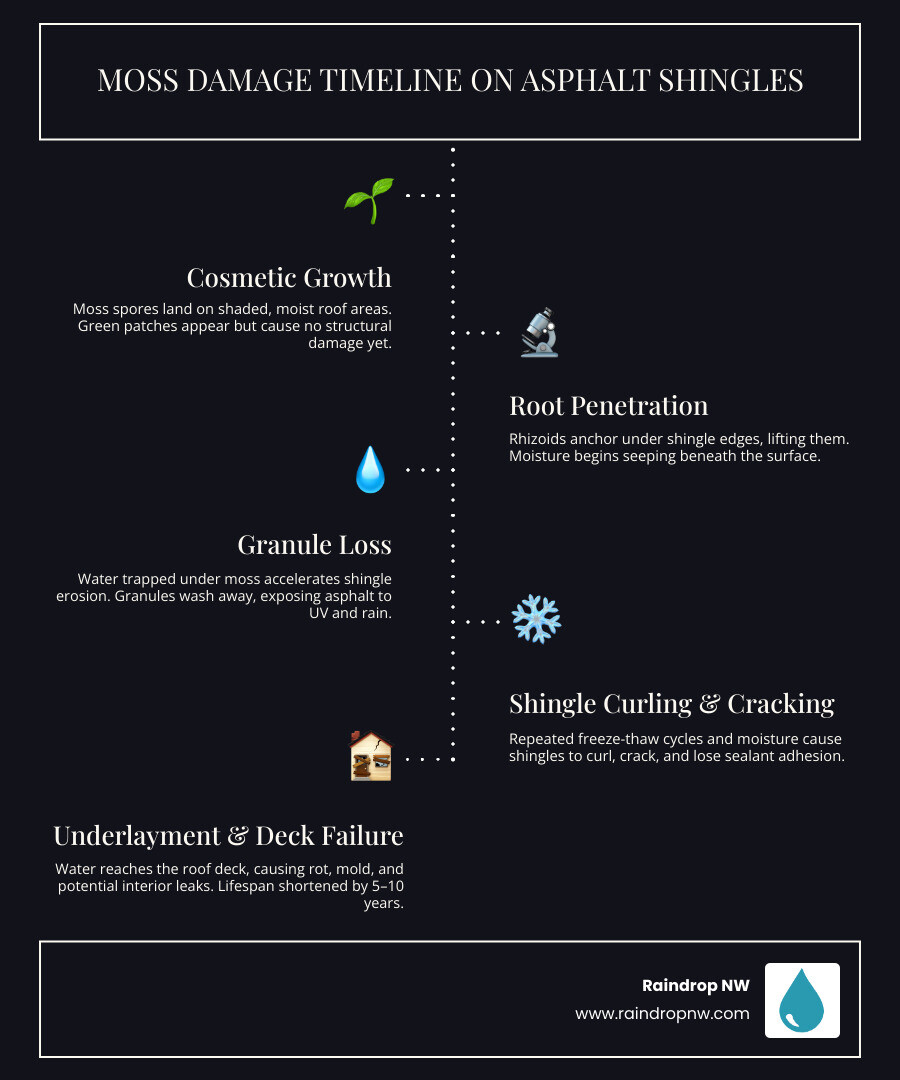
To understand why the right removal method is so critical, we have to look at how moss interacts with modern roofing materials. Unlike simple dust or dirt, moss is a living, growing organism. It does not have traditional roots, but it anchors itself using microscopic, root-like structures called rhizoids.
These rhizoids wrap around the protective ceramic granules on the surface of your asphalt shingles. As the moss grows, it anchors deeper, seeking out the calcium carbonate limestone fillers used in modern shingles as a food source. This biological anchoring causes two major forms of structural damage:
- Granule Dislodgement: When moss is physically pulled, scraped, or blasted off a roof, the rhizoids rip the ceramic granules away with them. These granules are your roof’s primary defense against solar UV rays and physical weathering. Without them, the underlying asphalt layer degrades rapidly under the sun, causing the shingles to crack, curl, and fail prematurely.
- Moisture Retention: Because moss acts like a sponge, holding 20 to 30 times its weight in water, it creates a constant zone of dampness on your roof deck. In our damp climate, this moisture never fully dries out during the winter months. To understand the broader environmental factors at play, you can read more about How Moss and Algae Thrive in Pacific Northwest Weather.
As this trapped moisture sits on the roof, it begins to rot the organic fibers of the shingles. During cold winter nights, this water freezes and expands. This freeze-thaw cycle physically lifts the edges of the shingles, breaking the factory adhesive seals. Once those seals are broken, wind storms can easily tear the shingles completely off your roof, leading to sudden, catastrophic water intrusions. Learning How Moss Removal Protects Your Shingles is the first step in avoiding these costly structural failures.
The Role of Shade and Moisture in Moss Growth
Moss cannot survive without consistent moisture and protection from direct, drying sunlight. This is why you will rarely see heavy moss growth on south-facing roof slopes that receive direct afternoon sun. Instead, moss establishes its stronghold on north-facing slopes and areas shaded by mature tree canopies.
These shaded areas create a highly localized microclimate. Morning dew and rainwater cling to these shingles for hours, or even days, longer than the rest of the roof. When you combine this persistent dampness with the organic debris dropped by overhanging Douglas firs or maples, you get the perfect incubator for spore germination. Over time, this localized growth can spread across the entire roof structure if left unaddressed. For a deeper dive into this process, explore How Moisture and Shade Encourage Moss Growth to see how your home’s surroundings impact its vulnerability.
Evaluating Professional Moss Removal vs DIY for Your Home
When deciding whether to tackle this project yourself or hire our team, you need to evaluate three primary factors: the pitch of your roof, the severity of the moss infestation, and the overall age and condition of your shingles.

If your roof is relatively flat (a pitch of 4:12 or less), has only a light dusting of green fuzz, and the shingles are in good, flexible condition, a DIY approach can be a safe and practical weekend project. You can work comfortably from a secure ladder or walk carefully on the low-slope surface to apply a gentle, manufacturer-approved treatment.
However, if your roof has a steep pitch (6:12 or greater), stands two stories or higher, or has thick, established clumps of moss lifting the shingle tabs, the scale tips heavily toward professional service. Walking on steep slopes requires specialized safety training and equipment. Furthermore, heavy moss cannot simply be sprayed and forgotten; it requires careful, multi-phase manual agitation that is physically exhausting and highly dangerous for an untrained homeowner.
Safety Risks of DIY vs Professional Moss Removal
It is easy to underestimate the physical danger of stepping onto a roof. According to national safety statistics, falls from ladders and roofs cause more than 500,000 emergency room visits per year in the United States, and roughly one in three home-injury hospital visits involves a fall.
When you add wet, soapy water, chemical treatments, and slippery, loose moss into the equation, a roof becomes one of the most hazardous environments imaginable. Even a single-story roof can present severe injury risks if you lose your footing.
Professional crews are bound by strict OSHA safety standards. When we work on your home, we use certified fall protection systems, including safety harnesses, roof anchors, and high-traction footwear designed specifically for wet shingles. If you want to learn how to safely navigate basic home care without putting yourself in harm’s way, check out our guide on How to Master Roof Maintenance in Aloha Without Losing Your Shingle.
Warranty and Damage Risks: Professional Moss Removal vs DIY
One of the most expensive mistakes a DIYer can make is using a cleaning method that voids their roof’s manufacturer warranty. Major shingle manufacturers—including GAF, Owens Corning, and CertainTeed—have very strict guidelines regarding how their products can be cleaned.
Specifically, these manufacturers explicitly state that the use of high-pressure washing equipment on asphalt shingles will void the material warranty. If you blast your shingles with a pressure washer to quickly clear away moss, and those shingles fail or leak a few years later, the manufacturer will deny your warranty claim.
Additionally, aggressive physical scraping with metal tools or wire brushes can scrape away the asphalt layer, exposing the fiberglass backing of the shingle. When we handle your maintenance, we use only manufacturer-approved, low-pressure soft-wash techniques and chemical applications that keep your warranty fully intact while extending the life of your home’s primary defense system. For more tips on protecting your investment, read How to Extend the Life of Your Roof.
Safe Moss Removal Methods vs Destructive Techniques
The key to successful, non-destructive moss removal is a process called soft washing. Unlike pressure washing, which relies on raw physical force to rip moss away, soft washing relies on gentle, targeted chemistry to kill the moss and its root-like rhizoids at the source.
A professional soft-wash system utilizes specialized agricultural pumps that operate at very low pressures—typically under 60 PSI, which is comparable to the pressure coming from your standard garden hose. This system is used to apply a highly controlled solution of water, sodium hypochlorite (diluted to a safe, manufacturer-approved ratio of 1:6 to 1:10), and a specialized surfactant that helps the solution cling to the vertical surfaces of your shingles.
For properties near sensitive landscaping or local waterways, we also utilize biodegradable biocides that eliminate organic growth without harming the surrounding environment. This gentle chemical application penetrates deep into the moss clumps, killing the plant down to its microscopic rhizoids within minutes. Once dead, the moss loses its grip on the shingle granules and naturally washes away over the course of the following rainy weeks, leaving your shingles completely clean and undamaged.
Why Pressure Washing and Aggressive Scraping Must Be Avoided
It is worth repeating: never use a pressure washer on an asphalt shingle roof. The American Roofing Association (ARA) estimates that you subtract five years from your roof’s life every time you power wash it.
The intense, concentrated stream of water from a pressure washer—which often runs between 1,500 and 3,000 PSI—instantly strips away the protective ceramic granules. It can also force water backward under the shingle tabs, saturating the underlayment and causing immediate wood rot in the roof decking below.
Similarly, aggressive scraping with metal putty knives, wire brushes, or stiff-bristled brooms should be avoided. While it may be satisfying to scrape away thick clumps of moss, this physical friction shears off the shingle granules and weakens the asphalt mat. To understand how to protect your roof from these destructive forces, read our specialized guide on How to Extend the Life of Your Roof in Rainy Climates.
Treatment Lifespan: DIY Sprays vs Professional Soft-Washing
When comparing professional moss removal vs diy, you must look beyond the immediate results and consider the long-term residual effectiveness of the treatment.
- DIY Sprays: Most consumer-grade moss sprays available at local home improvement stores are designed as temporary topical treatments. They kill the surface layers of the moss but rarely penetrate deep enough to destroy the underlying root systems. As a result, you can expect moss to begin returning within 6 to 12 months, requiring you to repeat the dangerous process of climbing your roof twice a year.
- Professional Soft-Washing: Because professional-grade biocides are formulated to fully saturate the moss and penetrate deep into the shingle overlaps, they eliminate the organic growth at its biological root. This thorough elimination, combined with the residual biocide left behind in the shingle pores, keeps moss from returning for 2 to 4 years.
By investing in a professional treatment, you break the constant cycle of temporary DIY fixes and give your roof years of uninterrupted protection. For a complete overview of regional roof care strategies, consult The Ultimate Guide to Roof Care in Portland Oregon.
Hidden Roof Issues That Professionals Catch During Maintenance
When you hire a professional roofing company to clean your roof, you are not just paying for a technician to spray a chemical solution. You are paying for a trained, experienced pair of eyes to thoroughly inspect your entire roofing system.
While walking your roof, our technicians routinely catch minor issues that are completely invisible from the ground and easily missed by a DIYer. These include:
- Underlayment Failure: Soft spots in the plywood decking beneath the shingles, indicating slow, hidden leaks that have not yet stained your interior drywall.
- Cracked or Slipped Tiles: Hairline fractures in concrete or clay tiles that will allow winter rains to seep directly onto your underlayment.
- Rusted or Damaged Flashing: Metal flashing around chimneys, dormers, and valleys that has begun to pull away or rust through, creating a direct path for water intrusion.
Catching these issues early can mean the difference between a simple, inexpensive repair and a premature, full roof replacement. To learn more about the value of proactive care, read How Regular Inspections Catch Problems Early and see How Proper Flashing Prevents Leaks to protect your home’s most vulnerable joints.
Post-Removal Prevention Strategies That Actually Work
Once your roof is completely clear of moss, the focus must shift to long-term prevention. The most effective preventative strategies involve modifying your roof’s microclimate and installing physical barriers that inhibit organic growth.
- Tree Trimming: Trim back overhanging branches to allow at least four hours of direct sunlight to reach your roof slopes daily. This helps the shingles dry out quickly after our frequent rainstorms.
- Gutter Clearing: Keep your gutters clean to ensure water flows rapidly off your roof rather than backing up under the eave shingles. Discover the connection between drainage and roof health in our guide on Gutter Maintenance and Its Impact on Your Roof.
- Metal Prevention Strips: Installing zinc or copper strips along the ridge line of your roof is one of the most effective ways to prevent moss from returning. When rainwater flows over these metal strips, it oxidizes, releasing metallic ions that wash down the roof slope. These ions create an environment where moss spores cannot survive.
Here is how zinc and copper compare as long-term prevention options:
| Feature | Zinc Strips | Copper Strips |
|---|---|---|
| Lifespan | 5 to 15 years | 20+ years |
| Material Cost | Economical | Premium |
| Aesthetic | Weathers to a dull gray | Weathers to a classic green patina |
| Effectiveness | Highly effective | Extremely effective |
Frequently Asked Questions About Roof Moss Removal
Does vinegar or bleach work for DIY roof moss removal?
Yes, both household vinegar and diluted chlorine bleach will kill moss on contact. However, they must be used with extreme caution.
Undiluted household bleach is highly corrosive and can damage the asphalt mat of your shingles, degrade aluminum gutters, and corrode metal valley flashing. Additionally, the chemical runoff from a heavy bleach or vinegar application can instantly kill the delicate ornamental plants, shrubs, and lawns surrounding your home’s foundation.
If you choose to use a bleach solution for a DIY project, always dilute it to a safe ratio (no stronger than 1 part bleach to 6 parts water), pre-wet all surrounding landscaping with fresh water before starting, and rinse the plants thoroughly afterward to neutralize any runoff. To learn more about safeguarding your home’s structural integrity, read How to Protect Your Home From Water Damage Through Your Roof.
How often should a Pacific Northwest roof be treated for moss?
In our damp, shaded climate, we recommend having your roof professionally inspected and evaluated annually. If your home is nestled under a heavy tree canopy or has extensive north-facing slopes, a preventative soft-wash treatment should be applied every 2 to 3 years.
If your home sits in full, open sunlight and has zinc or copper prevention strips installed along the ridge, you may easily go 5 to 7 years between full treatments. Keeping a consistent schedule is key; you can read about the recommended Roof Inspection Frequency for Pacific Northwest Homes to keep your home protected year-round.
Will removing moss myself void my manufacturer warranty?
It can if you use unapproved methods. As mentioned, using a pressure washer of any pressure level on your shingles will immediately void the warranties of major manufacturers like GAF, Owens Corning, and CertainTeed.
Similarly, using harsh, unapproved chemicals (such as pool shock or muriatic acid) or performing aggressive physical scraping that causes extensive granule loss will void your coverage. To protect your warranty, always keep copies of the product labels and treatment receipts in your home maintenance file to prove that only manufacturer-approved, low-pressure soft-wash methods were used. For more context on how our local climate impacts your materials, read about How Portland Weather Affects Roof Lifespan.
Conclusion
When deciding between professional moss removal vs DIY, the best choice ultimately comes down to your roof’s physical characteristics and your personal comfort with working at heights. While a DIY treatment can save money upfront on a simple, low-pitch, single-story home, the physical risks, short treatment lifespan, and potential for costly shingle damage make professional soft washing the smartest choice for most multi-story or steep-slope roofs.
At Raindrop NW, we are proud to be a family-owned, multi-generational roofing company based right here in Beaverton, Oregon. Unlike many regional roofing companies that have been bought out by out-of-state private equity firms, we remain completely independent and deeply committed to our local community. We don’t believe in high-pressure sales tactics or temporary, surface-level quick fixes. When we care for your roof, we treat it as if it were protecting our own families, ensuring every shingle is treated safely, thoroughly, and in strict compliance with manufacturer guidelines.
If you are ready to rid your roof of destructive moss and protect your home for years to come, we invite you to Schedule a Professional Roof Inspection and Maintenance Service with our experienced, certified team today. We will provide a comprehensive, transparent assessment of your roof’s condition and help you choose the safest, most effective path forward.




Leave a Reply
Want to join the discussion?Feel free to contribute!