
The Ultimate Guide to Gutter Maintenance and Roof Impact
Why Gutter Maintenance and Its Impact on Your Roof Should Be Every Oregon Homeowner’s Priority
Understanding gutter maintenance and its impact on your roof could be the difference between a roof that lasts decades and one that fails years too soon. Here is a quick summary of what you need to know:
- Gutters direct water away from your roof edge, fascia, and foundation
- Clogged gutters overflow back onto shingles, rotting the fascia and soaking the roof deck
- Clean gutters twice a year at minimum — more often if your property has heavy tree cover
- Warning signs include water stains on siding, peeling paint near the roofline, and soil puddling at the foundation
- Neglected gutters can lead to mold in the attic, ice dams in winter, and expensive structural repairs
- Routine maintenance is far less costly than repairing the damage that results from ignoring it
One inch of rain falling on a 2,000-square-foot roof generates over 1,200 gallons of water that must be moved away from your home efficiently. When gutters are blocked or damaged, that water has nowhere to go — and your roof, walls, and foundation pay the price.
Here in the Portland metro and greater Beaverton area, we see this play out every wet season. Pacific Northwest rainfall is relentless, and homes surrounded by Douglas firs, maples, and other overhanging trees are especially vulnerable. Gutters clog fast, and when they do, the damage compounds quietly — out of sight in your attic, behind your fascia boards, and along your foundation line — until it becomes a costly repair.
I’m Torrey Yungeberg, owner of Raindrop Roofing NW, and after years of inspecting roofs and drainage systems across Oregon and Southwest Washington, I’ve seen how gutter maintenance and its impact on your roof can be the deciding factor in how long a roofing system actually lasts. Whether you’re managing routine upkeep or noticing the first signs of trouble, this guide will walk you through everything you need to protect your home from the top down.
Why Gutter Maintenance and Its Impact on Your Roof Matters
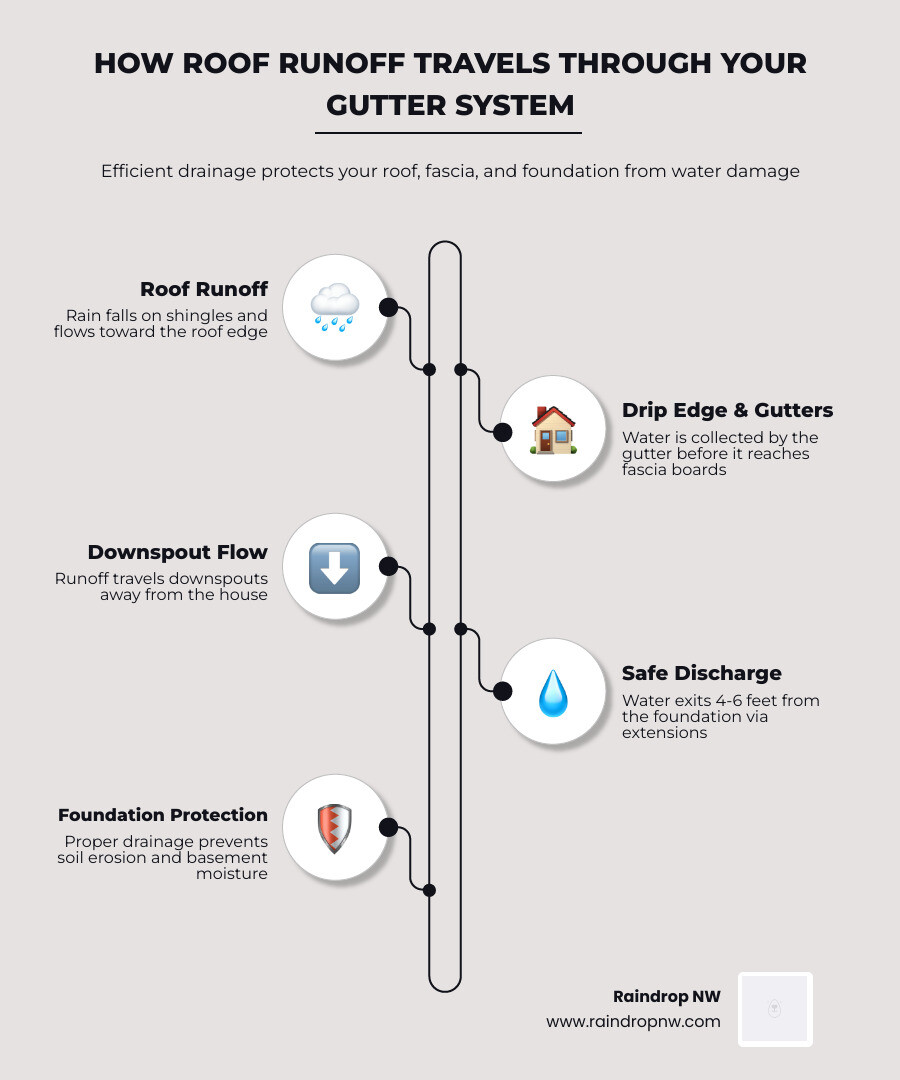
Your gutters are not just metal troughs hanging off the edge of your house. They are part of the roofing system. Their job is to catch runoff and move it safely away before it can soak roof edges, fascia boards, soffits, siding, or the soil around your foundation.
In our Northwest climate, that job is a big one. Poor drainage is a major contributor to residential water damage, and even a normal storm can test a neglected gutter system quickly. If you want a deeper overview of how gutters fit into roof performance, see Gutter Systems and Why They Matter for Your Roof and How to Protect Your Home from Water Damage Through Your Roof.
How gutters protect shingles, fascia, and attic spaces
When gutters are clean and properly sloped, they help protect:
- Shingle edges from constant splash-back
- Underlayment and roof decking from backed-up water
- Drip edge and roof edge trim from repeated saturation
- Fascia boards from overflow and rot
- Soffits from staining and wood decay
- Attic insulation from moisture intrusion
- Roof framing from mold and long-term dampness
This matters because roof problems often start at the edges. Once water works behind the gutter line, it can wick into wood components, damage paint, soften sheathing, and create the damp conditions mold likes best.
What happens when clogged gutters overflow back onto the roof
A clog does not just make a mess. It changes the path of water.
Instead of moving to the downspout, water starts to:
- Pool in the gutter
- Spill over the front and back edges
- Back up under lower shingle courses
- Run behind the fascia
- Stain siding and windows
- Collect near the foundation
- Contribute to attic humidity and hidden wood rot
In winter, trapped water can also freeze and support ice dam formation. In milder but wet Oregon winters, even repeated freeze-thaw cycles at roof edges can stress materials. The result is often granule loss, softened wood, fascia decay, and moisture where your home definitely did not order it.
The Most Common Gutter Problems That Lead to Roof Damage

Most gutter-related roof damage starts with a few very predictable issues:
- Clogs from leaves, fir needles, moss, seed pods, and roof grit
- Leaks at seams or corners
- Sagging sections caused by debris weight or loose hangers
- Improper pitch that leaves standing water
- Blocked downspouts
- Short downspout discharge near the foundation
- Rust, corrosion, or cracked sections
- Pull-away from rotted fascia boards
Research consistently shows that neglected gutters are tied to fascia damage and foundation problems. Licensed roofing contractors report that a large share of fascia rot cases can be traced back to gutters that were not cleaned or re-sloped within the previous two years.
Gutter maintenance and its impact on your roof in heavy tree cover and wet climates
For homes in Beaverton, Portland, Lake Oswego, Hillsboro, Vancouver, Camas, and nearby communities, tree cover changes the maintenance equation.
Heavy tree cover means more:
- Pine needles that slip into every opening
- Maple leaves that mat together like wet cardboard
- Seed pods and blossoms in spring
- Moss fragments and algae buildup
- Twigs that jam elbows and downspouts
Wet debris is especially hard on gutters because it gets heavy fast. Water weighs about 8.3 pounds per gallon, so clogged sections can put serious strain on hangers and fascia. That is why homes with overhanging branches or evergreen exposure often need quarterly attention instead of just spring and fall cleanings.
Warning signs your gutters need cleaning or repair
You do not need to climb onto the roof to spot trouble. Watch for these signs from the ground:
- Water spilling over the gutter edge during rain
- Plants or moss growing in the gutter
- Dark streaks or “tiger stripes” on the outside of the gutter
- Peeling paint near the roofline
- Water stains on fascia or soffits
- Puddling soil near the foundation
- Downspouts that drip from joints or elbows
- Gutters that look uneven or detached
- Visible rust, cracks, or separated seams
- Interior ceiling or attic stains near exterior walls
If you see more than one of these at the same time, maintenance is overdue.
How Often to Clean Gutters and What to Do Each Season
Most homes should have gutters cleaned at least twice a year. In the Portland-metro and Southwest Washington service area, that usually means:
- Late spring, after seed drop and winter debris
- Late fall, after most leaves have fallen but before hard freezes
If your home sits under firs, pines, big leaf maples, or other overhanging trees, quarterly cleaning is smarter. If you want more seasonal water-management guidance, see Water Damage Prevention Tips for Pacific Northwest Homeowners and How to Extend the Life of Your Roof.
Gutter maintenance and its impact on your roof through spring, summer, fall, and winter
Each season brings a different kind of debris and risk.
Spring
Spring gutters often collect:
- Blossoms
- Seed pods
- Pollen sludge
- Winter roof grit
This is a great time to flush the system, inspect for loose hangers, and confirm water exits properly through every downspout.
Summer
Summer is inspection season. Check for:
- Sagging runs
- Dried-out sealant at joints
- Rust spots
- Overflow marks from spring storms
- Branches hanging too close to the roofline
It is also the easiest season to repair minor slope or attachment issues before fall debris loads arrive.
Fall
Fall is the big one in our area. Leaves and needles can fill a gutter surprisingly fast. Complete a full cleaning after major leaf drop, and do not forget roof valleys, which often feed extra debris into the gutter system.
Winter
Winter is about monitoring, not heroic ladder work in bad weather. Watch for:
- Ice at roof edges
- Icicle formation
- Overflow during rain
- Water near the foundation
- Interior signs of attic dampness
If water is freezing in clogged sections, do not chip at it with tools. That often causes more damage than the ice.
Cleaning frequency by home type, tree coverage, and location
A simple rule of thumb:
- Open lot, few trees: usually twice yearly
- Moderate tree coverage: often 3 times yearly
- Heavy tree canopy or lots of evergreens: quarterly
- Multi-story or steep-roof homes: inspect more often and plan professional service
- After major windstorms: perform a ground-level check
In our area, wet weather and dense tree cover often make a “twice a year forever” plan too optimistic. Gutters love to prove homeowners wrong.
DIY Gutter Maintenance Steps Homeowners Can Follow Safely
DIY maintenance can work well on accessible single-story homes if you use the right tools and common sense. The goal is simple: remove debris, confirm flow, and spot small problems before they become big ones.
Basic tools include:
- Work gloves
- Eye protection
- Stable extension ladder
- Ladder stabilizer
- Gutter scoop or small plastic trowel
- Bucket or debris bag
- Garden hose with spray nozzle
- Basic screwdriver or drill for loose fasteners
Ladder safety matters. More than 164,000 ladder-related injuries send people to emergency rooms each year, so if a job feels sketchy, that is your cue to stop being brave and start being practical.
A simple step-by-step gutter cleaning and inspection routine
- Set the ladder on firm, level ground and use a stabilizer if possible.
- Remove debris by hand first, then use a scoop for compacted material.
- Bag debris instead of tossing it into landscaping.
- Flush each gutter run with a hose, starting away from the downspout.
- Watch for standing water, which can signal bad pitch.
- Check seams and corners for drips while water is running.
- Inspect hangers, brackets, and screws for looseness.
- Test each downspout for full flow.
- If a downspout is clogged, clear it from the bottom or disconnect the elbow if accessible.
- Confirm the discharge point sends water well away from the home.
A proper hose test tells you a lot. If water rushes toward the downspout cleanly, that is a good sign. If it puddles in sections, leaks from joints, or gushes over the edge, repairs may be needed.
When DIY is fine and when professional help is the safer choice
DIY is usually reasonable for:
- Single-story homes
- Light to moderate debris
- Minor leaks at easy-to-reach joints
- Tightening a loose screw or bracket
- Simple downspout extension adjustments
It is time to call a professional when you have:
- Two-story or higher gutters
- Steep rooflines
- Major sagging or pull-away
- Persistent overflow after cleaning
- Rotting fascia or soffit
- Storm damage
- Ice-damaged gutters
- Multiple leaks or failing seams
- Signs water has entered attic or walls
If the gutter issue might actually be a roof-edge issue, it makes sense to have both evaluated together.
Smart Upgrades That Help Prevent Roof-Related Gutter Problems
Maintenance is essential, but a few upgrades can make it easier and reduce the chance of overflow-related roof damage.
Useful upgrades include:
- Gutter guards
- Downspout extensions
- Splash blocks
- Downspout strainers
- Seamless gutters
- Larger-capacity gutters where runoff is heavy
- Branch trimming near the roofline
For more on drainage and structural protection, see How Gutter Maintenance Prevents Foundation Damage.
| Upgrade | What it helps with | What it does not do |
|---|---|---|
| Gutter guards | Reduces leaf buildup and large debris entry | Does not eliminate inspections or fine debris |
| Downspout extensions | Moves water farther from foundation | Will not help if the gutter above is clogged |
| Splash blocks | Improves discharge direction at grade | Can shift or sink over time |
| Strainers | Helps stop large debris at the downspout opening | Needs periodic clearing |
| Seamless gutters | Reduces leak points at joints | Still needs cleaning and slope checks |
What gutter guards can and cannot do
Gutter guards can be a smart upgrade, especially on heavily wooded lots. They can reduce the amount of large debris entering the gutter and lower cleaning frequency. Some systems perform better than others with wet leaves or fir needles.
But gutter guards are not magic.
They still allow some debris in, including:
- Pine needles
- Shingle granules
- Fine grit
- Algae film
- Seed fluff
Even with guards installed, annual inspection is still important. Think of guards as maintenance reducers, not maintenance eliminators.
Why proper pitch and downspout discharge matter
Even a clean gutter fails if water cannot move where it needs to go.
Best practice is a slight slope toward the downspout, commonly about a quarter-inch drop for every 10 feet of run. Without enough pitch, water sits in the gutter, increasing weight and corrosion. Too much pitch can also look awkward and cause uneven flow.
Downspouts matter just as much. They should discharge at least 4 to 6 feet from the foundation in most cases. That small detail can make a huge difference in preventing:
- Soil erosion
- Splash-back on siding
- Foundation saturation
- Basement moisture
- Crawlspace dampness
A clogged elbow is another common problem point, so if one section always seems slow, check there first.
Inspection Tips, FAQs, and When to Schedule Expert Roof Help
Routine inspection catches small drainage issues before they shorten roof life. We recommend checking the whole roof edge system, not just the gutter trough itself.
During an inspection, look for:
- Water stains on fascia
- Soft or peeling soffits
- Granules collecting in gutters
- Detached drip edge
- Overflow marks on siding
- Damp attic insulation near eaves
- Mold or mildew smell in upper spaces
- Recurring puddles near downspouts
Regular inspections are one of the best ways to prevent surprise repairs. You can learn more in How Regular Inspections Catch Problems Early and How Often Should You Have Your Roof Inspected?.
FAQ: Can gutter problems really damage a newer roof?
Yes. A newer roof is not immune to bad drainage. If gutters overflow or back up, water can still soak fascia, wick into roof decking, and shorten the life of shingles at the eaves. We sometimes see newer roofs with healthy field shingles but damaged roof edges because the gutter system was neglected.
FAQ: Do gutter guards eliminate the need for cleaning?
No. They help, but they do not remove the need for maintenance. Fine debris, granules, moss, and film buildup still collect over time. Plan on periodic inspection and at least occasional cleaning even if guards are installed.
FAQ: What other roof issues should be checked along with gutters?
Gutters should be inspected together with:
- Flashing at walls and penetrations
- Roof valleys
- Drip edge and edge metal
- Attic ventilation
- Insulation condition near eaves
- Signs of condensation or mold
Ventilation matters because not all attic moisture comes from exterior leaks. Poor airflow can also trap moisture and make roof-edge problems worse. For that topic, see How Ventilation Reduces Moisture Damage.
Conclusion
Gutters do quiet work, but the impact is anything but small. When they are clean, secure, properly sloped, and draining well, they help protect your shingles, fascia, soffits, attic, siding, and foundation all at once.
That is the real story behind gutter maintenance and its impact on your roof: a simple routine can prevent a long chain of water damage.
For homeowners in Beaverton, Portland, Gresham, Hillsboro, Lake Oswego, Vancouver, and surrounding communities, a smart plan is straightforward:
- Clean gutters at least twice yearly
- Increase frequency if trees overhang the roof
- Check downspouts after storms
- Watch for overflow, staining, and sagging
- Schedule expert help when drainage issues persist
If you want help protecting your roof and home from the Northwest rain, explore our residential roofing services.




Leave a Reply
Want to join the discussion?Feel free to contribute!