• Link to X
  • Link to Instagram
  • Link to Youtube
  • Link to Facebook
  • Link to WhatsApp
CALL: (503)526-3887 or EMAIL: info@raindropnw.com
RAINDROP ROOFING NW | PORTLAND, OR
  • Home
  • About Us
    • About Raindrop Roofing NW
    • Our Team
    • Areas We Serve
    • Who We Support
    • Our Commitment to a Greener Future
    • Careers
    • Blog
  • Residential Roofing
    • Services
      • New / Replacement Roofs
      • Repairs and Maintenance
      • Remodels and Additions
      • Balconies, Patios, and Flat Decks
      • Roof Inspections and Certifications
    • Financing
    • Roof Gallery
    • Roof Types and Products
    • Manufacturer-Certified Roofing Contractor
    • Owner Resources
  • Commercial Roofing
    • Services
      • New and Replacement Roofs
      • Estimates and Inspections
      • Warranties
      • Real Estate Partnerships
      • Roof Certifications
    • Commercial Gallery
    • Roof Types and Products
    • Featured Project
  • Reviews
  • Contact Us
  • Menu Menu
You are here: Home1 / Roofing

The Highs and Lows of Choosing Your Roof Style

Roofing

Structural Differences in a Flat Roof vs Pitched Roof Comparison

: Flat Roof vs Pitched Roof Comparison

A flat roof vs pitched roof comparison comes down to five key factors most homeowners care about:

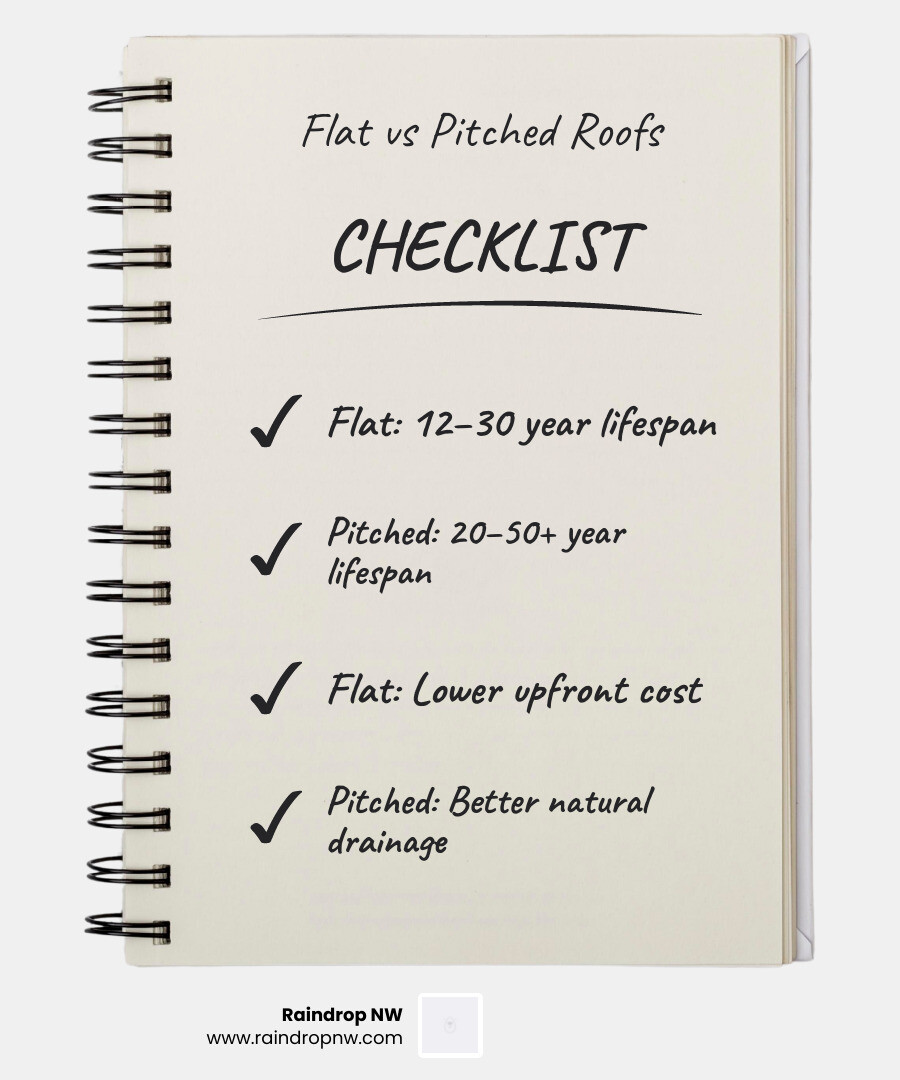
Factor Flat Roof Pitched Roof
Upfront Cost Lower Higher
Lifespan 12–30 years 20–50+ years
Weather Drainage Requires active drainage management Sheds water and snow naturally via gravity
Usable Space Rooftop decks, gardens, HVAC Attic storage, vaulted ceilings, loft space
Maintenance More frequent inspections needed Lower routine maintenance over time

The short answer: If you want lower upfront costs and usable rooftop space, a flat roof has real appeal. If you want longer lifespan, better drainage, and lower long-term maintenance — especially here in the Pacific Northwest where rain is a way of life — a pitched roof typically wins.

Your roof is one of the biggest decisions you’ll make for your home. It shapes how your house looks from the street, how well it holds up against Oregon’s relentless wet seasons, and what your maintenance calendar looks like for the next few decades. Yet most homeowners don’t think deeply about roof style until they’re already replacing one — often under pressure, and without time to weigh the real trade-offs.

That’s exactly why this guide exists. Whether you’re building new, replacing an aging roof, or just trying to understand what you’re working with, understanding the core differences between flat and pitched roofs helps you make a smarter, more confident decision.

I’m Torrey Yungeberg, owner of Raindrop Roofing NW, and I’ve spent years helping Oregon homeowners navigate this exact flat roof vs pitched roof comparison — from residential reroof projects to advising on new construction. I’ll walk you through everything that actually matters, without the fluff.
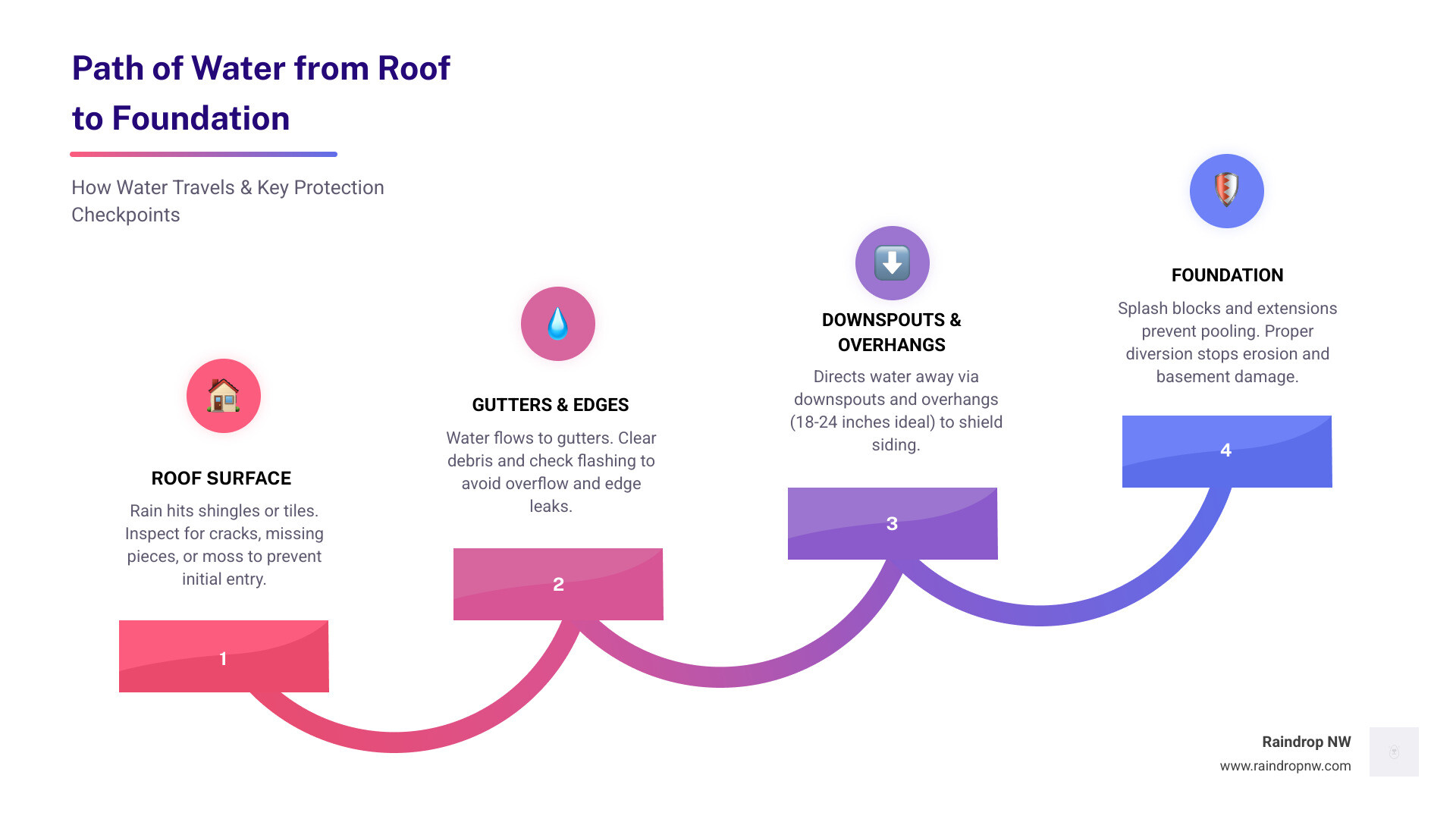
flat roof vs pitched roof comparison infographic showing drainage, lifespan, cost, and space trade-offs - flat roof vs

When we talk about the structural skeleton of your home, the roof is the crowning achievement. The fundamental difference lies in how they handle weight and water.

A pitched roof is designed with a steep angle—typically between 20° and 45°—which allows it to utilize gravity as a primary defense mechanism. Structurally, these roofs often rely on a system of rafters or trusses that meet at a central ridge. This triangular shape is incredibly strong and naturally creates a void between the ceiling of the top floor and the roof itself.

On the flip side, a flat roof isn’t actually “flat” in the way a kitchen table is. If it were, it would become a swimming pool after the first Portland rainstorm. Instead, it features a very slight pitch, often just 1/4 to 1/2 inch per foot. Structurally, flat roofs use horizontal joists similar to floor systems. Because they don’t have the natural strength of a triangle, they require careful engineering to handle “live loads” like snow or people walking on them.

For those looking into the nuts and bolts of how these systems are built, More info about residential roofing can provide deeper insight into the local standards we use here in the Beaverton area.

roof rafters vs joists showing slope degrees and water diversion - flat roof vs pitched roof comparison

Design and Interior Space Impact

The roof style you choose dictates the “feel” of your interior. In a flat roof vs pitched roof comparison, the impact on your living space is massive:

  • Pitched Roofs: These are the kings of character. They allow for vaulted ceilings that make rooms feel twice as large. They also provide that classic attic storage space or the potential for a cozy loft conversion.
  • Flat Roofs: These offer a more “compact” footprint. Because there is no attic, the ceiling height is consistent throughout the top floor. This is often a huge advantage for homeowners in areas with strict height restrictions or for those who want a sleek, minimalist modern aesthetic.

Performance, Weather Resistance, and Durability

In the Pacific Northwest, “weather resistance” is just another way of saying “how well does this handle rain?”

Pitched roofs are the gold standard for wet climates. Because of their slope, water and snow move off the surface almost instantly. This reduces the time moisture spends sitting on your roofing materials, which naturally extends the life of the roof. An asphalt shingle pitched roof can easily last 20 to 30 years, while premium materials like metal or composite can push past the 50-year mark.

Flat roofs face a tougher battle. Because water moves slowly across a flat surface, any small dip can lead to “ponding”—water that sits for more than 48 hours. This standing water is the enemy of longevity. While modern membranes like TPO and EPDM have made flat roofs much more reliable than they were in the 1970s, they still generally have a shorter lifespan, often requiring replacement every 12 to 25 years depending on the material and local conditions.

Feature Flat Roof Pitched Roof
Lifespan 12–30 Years 20–50+ Years
Leak Risk Higher (due to ponding) Lower (natural runoff)
Snow Load Vulnerable to accumulation Naturally sheds heavy snow
Wind Resistance Excellent (low profile) High (if using impact-rated materials)

To keep these systems performing at their peak, regular check-ups are non-negotiable. You can find More info about roof inspections and certifications to see how we verify the health of these different styles.

Maintenance Needs for a Flat Roof vs Pitched Roof Comparison

Maintenance is where the “personality” of your roof really shows.

If you have a pitched roof, your main chores involve keeping the gutters clear and checking for missing shingles after a windstorm. Because you can often see a pitched roof from the ground, it’s easier to spot problems like moss growth or debris buildup before they become emergencies.

Flat roofs require a bit more “hands-on” parenting. Because they don’t shed debris easily, leaves and pine needles can quickly clog scuppers and drains. If a drain clogs on a flat roof, you don’t just get a messy gutter—you get a heavy pool of water that can lead to structural rot or immediate leaks. We recommend flat roof owners inspect their systems at least twice a year and after every major storm. For those who prefer to leave it to the pros, More info about repairs and maintenance details how we handle these specific challenges.

Material Options and Energy Efficiency

The materials used in a flat roof vs pitched roof comparison are quite different, and each has its own energy profile.

For pitched roofs, the most common choice is asphalt shingles, though many Beaverton homeowners are moving toward metal or composite tiles for their durability and style. These roofs rely on an attic space to provide a thermal buffer, which, when properly ventilated, keeps your home cool in the summer and dry in the winter.

Flat roofs utilize “membrane” systems. You’ll often hear terms like TPO (Thermoplastic Polyolefin), EPDM (a durable synthetic rubber), or PVC. TPO is particularly popular for energy efficiency because it is typically white and highly reflective. This “cool roof” technology reflects UV rays away from the house, which can significantly lower cooling costs during those occasional Oregon heatwaves. You can explore these further with More info about roof types and products.

Usability and Long-Term Value in a Flat Roof vs Pitched Roof Comparison

This is where flat roofs get their revenge. While pitched roofs offer attic storage, flat roofs offer living space.

Imagine a rooftop garden, a private sun deck, or a dedicated space for your HVAC equipment that doesn’t take up yard space. In urban areas like Portland or parts of Beaverton where lot sizes are smaller, a flat roof can effectively double your usable outdoor area. However, this requires specialized waterproofing. If you’re considering turning your roof into a hangout spot, More info about waterproof deck surfaces is essential reading.

From a resale perspective, pitched roofs are often viewed as the “safer” bet by traditional buyers because of their longevity. However, a well-maintained, modern flat roof with a functional deck can be a massive selling point for younger buyers looking for that contemporary “city” vibe.

Frequently Asked Questions

Which roof type is better for heavy rain and snow?

In the Pacific Northwest, the pitched roof is generally superior for heavy precipitation. Its steep angle ensures that rain and melting snow exit the structure immediately, preventing the ponding and ice dams that can plague flat roofing systems.

How do lifespans compare between these styles?

Pitched roofs almost always last longer. A standard asphalt pitched roof lasts about 25 years, while high-end materials can last 50+. Flat roofs typically last between 15 and 25 years, though high-quality EPDM or TPO installations can push toward 30 years with meticulous maintenance.

Can I install solar panels on both roof types?

Absolutely! In fact, flat roofs can sometimes be even better for solar because you can use “tilt-up” racking systems to orient the panels at the perfect angle for the sun, regardless of which way the house faces. Pitched roofs are also excellent, provided you have a south-facing slope with enough surface area.

Conclusion

Choosing between a flat and pitched roof isn’t just about what looks better on a blueprint; it’s about how you want to live in your home and how much time you want to spend thinking about your roof.

At Raindrop NW, we’re proud to be a truly local, independently owned company right here in Beaverton. Unlike the big out-of-state firms that have been buying up local shops lately, we live in the same rainy climate you do. We’re committed to long-term service and accountability—because we’re going to see you at the grocery store next week.

Whether you’ve decided on the sleek lines of a flat roof or the timeless protection of a pitched one, we’re here to make sure it’s installed to last. If you’re ready to upgrade your home’s protection, check out More info about new replacement roofs and let’s get your project started.

https://www.raindropnw.com/wp-content/uploads/2026/05/photo-1770044001869-12315d4d6884.jpeg 721 1080 SEO Stats https://www.raindropnw.com/wp-content/uploads/2024/05/logo-raindrop-space-300x92.png SEO Stats2026-05-28 11:56:272026-05-28 11:56:27The Highs and Lows of Choosing Your Roof Style

The Ultimate Guide to Getting Your Roof Covered Without Raising the Roof

Roofing

Understanding When Does Insurance Cover Roof Replacement

When a Pacific Northwest storm rolls through the Portland-Vancouver area, it doesn’t just bring rain; it brings high winds and falling debris that can compromise your home’s first line of defense. The core of your policy rests on “dwelling coverage,” which protects the structure of your home. However, the answer to does insurance cover roof replacement depends entirely on the “peril” or cause of the damage.

Standard homeowners insurance policies are designed to protect you against sudden and accidental losses. In our region, the most common covered perils include:

  • Windstorms: High winds can lift shingles, crease them, or blow them off entirely, leaving the underlayment exposed.
  • Hail Damage: While less frequent than in the Midwest, hail in Oregon and Washington can dent metal roofing or knock the protective granules off asphalt shingles.
  • Fire and Lightning: A direct lightning strike or a house fire is almost always a covered event for a full replacement.
  • Falling Objects: If a Douglas Fir limb crashes through your roof during a winter storm, insurance typically covers the structural repair and the roofing.
  • Vandalism and Explosions: These are less common but are standard inclusions in most HO-3 and HO-5 policies.

It is important to note that insurance is not a maintenance plan. If your roof is simply “tired” or has reached the end of its natural life, it is your responsibility as a homeowner to replace it. For those looking to understand the full scope of what we can do to help, you can find more info about residential roofing services here.

Does insurance cover roof replacement for aging roofs?

The age of your roof is one of the biggest “make or break” factors in an insurance claim. In the eyes of an insurer, a roof is a depreciating asset. Most asphalt shingle roofs are expected to last between 15 and 30 years, but many insurers become wary once a roof hits the 15-to-20-year mark.

If your roof is over 20 years old, you might face several hurdles:

  1. Policy Restrictions: Some companies will only offer Actual Cash Value (ACV) coverage for older roofs, meaning they won’t pay for a brand-new roof, only what your old one was worth.
  2. Ineligibility: You may find it difficult to get a quote online or even face policy non-renewal if the insurer deems the roof too risky.
  3. Shingle Brittleness: As shingles age, they lose their flexibility. An adjuster might argue that damage occurred because the shingles were already failing due to age, not because of a specific storm.

To avoid surprises, we recommend more info about roof inspections to document the current state of your roof before a storm hits. Knowing your roof’s true age is vital, especially since inaccurate roof age data costs the insurance industry over $1.3 billion annually in lost premiums—a cost that eventually trickles down to homeowners.

Does insurance cover roof replacement caused by leaks?

This is a grey area that causes a lot of frustration. Generally, insurance covers the result of a leak (like your ruined drywall or carpet) if the leak was caused by a “covered peril.” For example, if a storm-driven branch pokes a hole in your roof and rain pours in, that is usually covered.

However, if the leak is caused by gradual seepage, clogged gutters, or “wear and tear,” the claim will likely be denied. This is why addressing more info about roof repairs immediately is so critical. Common scenarios include:

  • Ice Dams: When snow melts and refreezes at the gutters, it can back up under the shingles. Most policies cover this, but only if it’s a sudden occurrence.
  • Interior Damage: If a covered leak causes ceiling damage, your policy’s dwelling coverage helps fix the roof, while personal property coverage handles the contents.

Actual Cash Value vs. Replacement Cost Value

Understanding the difference between these two terms is the difference between paying a small deductible and paying thousands of dollars out of pocket.

Feature Actual Cash Value (ACV) Replacement Cost Value (RCV)
Definition Payout based on the current value (Cost minus Depreciation) Payout based on the cost to buy a new roof today
Age Factor Payout decreases as the roof gets older Age does not reduce the payout amount
Out-of-Pocket High; you pay the difference for the new materials Low; you typically only pay your deductible
Premium Cost Usually lower monthly premiums Higher premiums for better protection

For example, if a 20-year-old roof that costs $10,000 to replace is destroyed, an ACV policy might only pay out $2,000 after depreciation and your deductible are subtracted. An RCV policy, however, would cover the full $10,000 (minus your deductible).

When choosing more info about roof types and products, always check which coverage type you have. Many modern policies also include “Recoverable Depreciation,” where the insurer sends a second check once the work is completed and they receive a final invoice.

How to File a Roof Damage Insurance Claim Step-by-Step

homeowner documenting roof damage with a smartphone - does insurance cover roof replacement

If you suspect storm damage, don’t wait. The clock starts ticking the moment the event occurs. Here is the process we recommend to our neighbors in Beaverton and Portland:

  1. Document Everything: Take photos and videos of the damage from the ground. Look for shingles in the yard or water spots on your ceiling.
  2. Prevent Further Damage: You are required to mitigate further loss. This usually means “emergency tarping.” Keep your receipts, as these costs are often reimbursable.
  3. Get a Professional Estimate: Before calling the insurer, have a trusted local roofer inspect the site. We can provide a detailed report that you can hand to the adjuster. Check our more info about owner resources for tips on what to look for.
  4. File the Claim: Contact your agent or use your insurer’s mobile app. Be specific about the date of the storm.
  5. The Adjuster Meeting: An insurance adjuster will visit to verify the damage. It is often helpful to have your roofing contractor present to ensure the adjuster sees every creased shingle and dented vent.
  6. Review the Settlement: If the payout seems low, you can request a “supplement.” This happens when the contractor finds more damage during the tear-off process that the adjuster missed.

Why Maintenance and Local Expertise Matter in 2026

As we move through 2026, insurance companies are becoming increasingly strict. They are using drone technology and satellite imagery to spot moss buildup or overhanging branches. If they see a neglected roof, they may cancel your policy or deny a claim based on “failure to maintain.”

In the Beaverton and Portland area, our climate presents unique challenges. The constant moisture leads to moss, which traps water against shingles and causes premature rot. Regular maintenance—like gutter cleaning and moss treatment—isn’t just about curb appeal; it’s about insurance eligibility.

  • Premium Savings: Homeowners with brand-new roofs pay an average of 19% less for insurance than those with 20-year-old roofs.
  • Local Codes: Oregon and Washington have specific building codes regarding ice shields and ventilation. A local expert ensures your replacement meets these codes, which is vital because many insurance policies include “Law and Ordinance” coverage to pay for these mandatory upgrades.

For ongoing care, you can find more info about maintenance services to keep your policy in good standing.

Frequently Asked Questions about Roof Insurance

Will filing a roof claim increase my homeowners insurance premiums?

It is possible. While many states prohibit insurers from raising rates for a single “Act of God” claim (like a hailstorm), if you file multiple claims in a short period, you may be viewed as a higher risk. Furthermore, if an entire neighborhood is hit by a catastrophe, everyone’s rates might rise to reflect the increased regional risk. Your claim will also be recorded in a CLUE report (Comprehensive Loss Underwriting Exchange), which other insurers can see if you try to switch companies.

What is a roof deductible and how does it work?

Your deductible is the amount you pay out of pocket before the insurance kicks in. While some policies have a flat $1,000 or $2,000 deductible, many now use a percentage-based deductible for wind and hail (often 1% to 2% of your home’s total insured value). If your home is insured for $500,000, a 1% deductible means you are responsible for the first $5,000 of the roof replacement.

What should I do if my roof insurance claim is denied?

Don’t panic. Denials happen for many reasons, from “insufficient damage” to “wear and tear.” First, read the denial letter carefully and compare it to your policy language. You have the right to an independent inspection or to hire a public adjuster. You can also appeal the decision through your state’s insurance department. Often, a second inspection with a more experienced adjuster can lead to a different outcome.

Conclusion

Navigating insurance claims can feel like a storm of its own, but you don’t have to face it alone. At Raindrop NW, we take pride in being a truly local, independently owned company. Unlike the big firms bought out by out-of-state investors, we live and work right here in Beaverton and the surrounding Portland metro area. We are committed to long-term accountability and helping our neighbors protect their homes.

If you are wondering does insurance cover roof replacement for your specific situation, the best first step is a professional evaluation. We can help you understand the condition of your roof and provide the documentation you need to move forward with confidence.

Ready to secure your home? Get started with a new roof replacement by contacting our team today. Whether you need a simple repair or a full replacement, we’re here to ensure your roof remains your home’s best defense.

https://www.raindropnw.com/wp-content/uploads/2026/05/photo-1742156695571-fcc4035d32e2.jpeg 720 1080 SEO Stats https://www.raindropnw.com/wp-content/uploads/2024/05/logo-raindrop-space-300x92.png SEO Stats2026-05-27 13:17:062026-05-27 13:17:06The Ultimate Guide to Getting Your Roof Covered Without Raising the Roof

A Quick Start Guide to Metal Roof Durability vs Shingle in Oregon Rain

Roofing

Why Metal Roof Durability vs Shingle in Oregon Rain Is the Right Question to Ask Before Your Next Roof

When it comes to metal roof durability vs shingle in Oregon rain, the short answer is this: metal roofs last longer and handle moisture better, but asphalt shingles remain a solid, budget-friendly option for many homeowners.

Here’s a quick side-by-side to help you decide:

Factor Metal Roof Asphalt Shingle
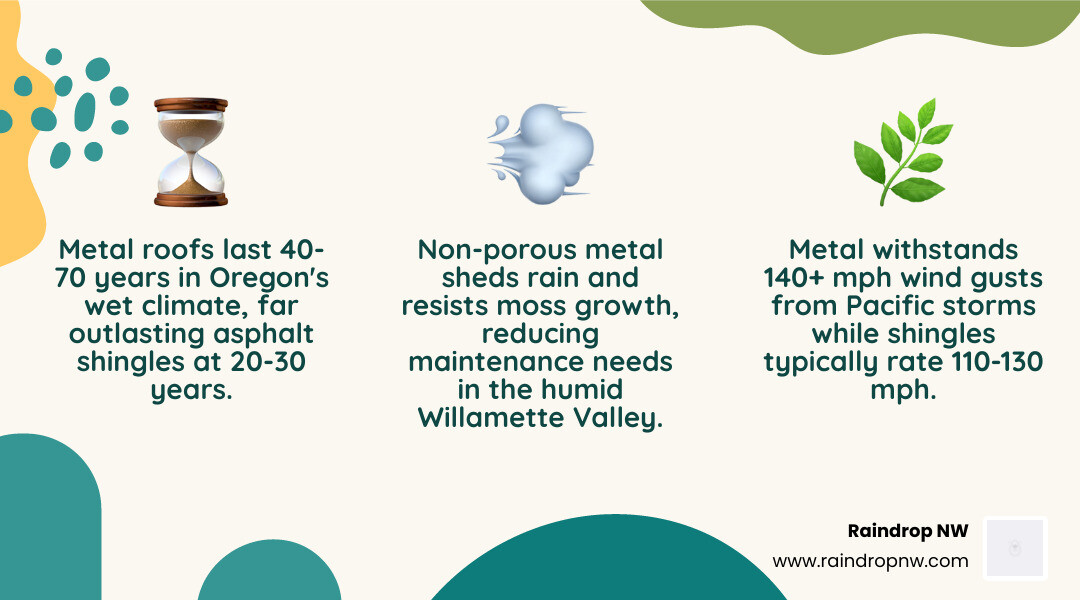
Lifespan 40–70 years 20–30 years
Wind resistance 140+ mph 110–130 mph
Moss/algae risk Very low Moderate to high
Rain shedding Excellent (smooth, non-porous) Good (when properly installed)
Maintenance needs Low Moderate (moss treatments, cleaning)
Best for Long-term homeowners Budget-conscious or short-term owners

Oregon’s climate doesn’t forgive a weak roof. The Willamette Valley averages months of persistent rain, coastal storms push wind-driven moisture into every seam and gap, and the damp, shaded conditions that make Oregon so green also make it a paradise for moss and algae. Portland alone receives 36 to 40 inches of rain per year — and that moisture doesn’t just fall straight down. It lingers. It seeps. It finds every vulnerability in a roofing system and exploits it slowly over time.

That’s why choosing the right roofing material here isn’t just about price or curb appeal. It’s about understanding how each material behaves when it’s wet — which in Oregon is most of the year.

I’m Torrey Yungeberg, owner of Raindrop Roofing NW, a family-owned company rooted right here in Boring, Oregon, and I’ve spent years helping homeowners across the Portland metro navigate exactly this decision — metal roof durability vs shingle in Oregon rain — with honest guidance built on real local experience. In the sections ahead, I’ll walk you through everything you need to know to make a confident, informed choice for your home.

Infographic comparing metal roof vs asphalt shingle performance in Pacific Northwest rain, wind, moss, and lifespan

Metal Roof Durability vs Shingle in Oregon Rain: The Lifespan Factor

In the roofing world, “durability” is often just another word for “how many Oregon winters can this thing survive before I have to pay for a new one?” When we look at metal roof durability vs shingle in Oregon rain, the timeline difference is staggering.

For many of our neighbors in places like Lake Oswego and West Linn, a roof isn’t just a purchase; it’s a legacy investment. Metal roofs in the Pacific Northwest typically last between 40 and 70 years. Some high-end systems, like stone-coated metal, can easily sail past the 50-year mark with minimal fuss. This is why many call it a “forever roof.” If you install a metal roof in your 40s, there is a very good chance you will never have to worry about a roof replacement again in your lifetime.

a modern metal roof installation on a Pacific Northwest home

Asphalt shingles, on the other hand, are the most common choice for a reason: they are reliable and cost-effective. However, their lifespan is shorter. In our wet climate, even Premium Shingle Options for Pacific Northwest Homes generally top out at 20 to 30 years. Standard architectural shingles might start showing their age around year 18 or 20 if they haven’t been meticulously maintained.

Why the gap? It comes down to material composition. Asphalt shingles are petroleum-based and covered in granules. Over time, Oregon’s constant cycle of rain followed by summer sun (thermal expansion) causes the oils in the shingles to dry out. They become brittle, the granules wash away into your gutters, and the “structural shield” begins to crack.

Metal doesn’t have that problem. Whether it’s a standing seam system or Ultimate Metal Roofing First Addition OR, the material is impervious to the rot and warping that can plague organic materials. While shingles are a great choice for homeowners who plan to move in 5 to 10 years, metal is the clear winner for those playing the long game.

Weathering the Storm: Wind Resistance and Rain Shedding

If you’ve lived through a November gale in the Tualatin Valley, you know that Oregon rain rarely falls straight down. It’s often pushed sideways by gusts that can reach 60 or 70 mph even in the metro area, and much higher near the coast.

When comparing metal roof durability vs shingle in Oregon rain, we have to look at how these materials handle “wind-driven rain.”

Performance Metric Metal Roofing Asphalt Shingles
Wind Speed Rating 140+ mph 110–130 mph
Water Shedding Superior (Smooth surface) Good (Textured surface)
Primary Risk Fastener backing (rare) Shingle blow-off or uplift
Seam Vulnerability Minimal (Interlocking) High (Thousands of edges)

Metal roofs are the heavyweight champions of wind resistance. Most residential metal systems are rated for winds exceeding 140 mph. Because the panels are large and often interlocked (especially in standing seam systems), there are fewer “edges” for the wind to catch. When the wind can’t lift the material, the rain can’t get underneath it.

Asphalt shingles have a different profile. While high-quality architectural shingles are rated for 110–130 mph, they consist of thousands of individual pieces. If a single shingle becomes loose or the sealant strip fails, a strong wind can lift it, creating a “catch” that allows rain to be driven directly onto your roof deck. This is why we always emphasize How to Extend the Life of Your Roof by checking for loose tabs after a major storm.

Rain shedding is another area where metal shines. Metal is non-porous and smooth. Water hits it and immediately slides off. In contrast, shingles have a rough, granular texture. While they are waterproof, they hold onto moisture longer. In a state where it can rain for thirty days straight, that “dwell time” matters. The longer a roof stays damp, the higher the risk of moisture-related issues like rot in the underlying wood deck.

Managing Moss and Algae in the Pacific Northwest

If there is one thing that keeps Oregon homeowners up at night (besides the Blazers’ playoff chances), it’s moss. Our damp, shaded neighborhoods in areas like Beaverton and Hillsboro are the perfect breeding ground for Gloeocapsa magma (the algae that causes black streaks) and thick, green moss.

In the battle of metal roof durability vs shingle in Oregon rain, moss is the “silent killer” of asphalt. Asphalt shingles often use limestone as a filler. Unfortunately, algae and moss view limestone as a delicious snack. As they grow, they root into the shingles, lifting the edges and holding moisture against the surface. This accelerates the breakdown of the asphalt and can lead to premature leaks.

To combat this, many homeowners look at an Architectural vs Designer Shingle Comparison to find shingles infused with copper or zinc granules, which act as a natural pesticide against moss. You can also install zinc strips at the ridge, but these require regular maintenance and replacement.

Metal roofs, conversely, are naturally resistant to moss and algae. Moss has a very hard time “taking root” on a smooth, non-porous metal surface. Furthermore, metal doesn’t contain the organic nutrients that these organisms need to thrive. While you might get some debris buildup in the valleys or a bit of “leaf sludge” if you live under heavy Douglas Firs, a simple annual rinse is usually enough to keep a metal roof looking brand new. For homeowners tired of the “scrape and treat” cycle every two years, metal is a game-changer.

Practical Considerations: Pitch, Style, and Efficiency

Choosing a roof isn’t just about survival; it’s about how the roof fits your home’s “lifestyle.” We often talk to homeowners in Damascus or Sandy who are worried that a metal roof will make their house look like a barn, or that it won’t be allowed by their HOA.

The truth is that modern roofing has come a long way. You can now get stone-coated metal that mimics the look of traditional shingles or even wood shakes, providing the durability of steel with the aesthetic of a classic Oregon home. Understanding How Shingle Grade Affects Lifespan and Appearance is vital here, because sometimes a high-end designer shingle can provide the look you want while still offering improved weather resistance.

How metal roof durability vs shingle in Oregon rain affects energy efficiency

Most people think of roofs only in terms of keeping rain out, but in May 2026, we’re seeing more homeowners prioritize energy efficiency. Oregon summers are getting hotter, and your roof is your primary defense against solar heat gain.

Metal roofs are “cool roofs” by nature. They have high solar reflectivity, meaning they bounce a significant portion of the sun’s rays back into the atmosphere rather than absorbing them into your attic. They also have high thermal emittance, meaning they shed heat quickly once the sun goes down. This can lower your summer cooling costs by 10% to 25%.

Asphalt shingles, being darker and more dense, tend to absorb heat and hold it, acting like a radiator that keeps your house warm long after sunset. While some modern shingles use reflective granules, they generally can’t match the thermal performance of a Best Metal Roofing Company in Raleigh Hills OR‘s metal installation.

Choosing the right pitch for metal roof durability vs shingle in Oregon rain

The “pitch” or slope of your roof heavily influences which material you should choose. Asphalt shingles generally require a minimum pitch of 2:12 to ensure water drains properly. If your roof is flatter than that, shingles are a recipe for disaster in Oregon rain because water can “back up” under the tabs.

For low-slope sections or modern homes with flat rooflines, standing seam metal is superior. The interlocking seams are practically watertight, and because there are no horizontal breaks, there is nowhere for water to pool. When we perform a drainage analysis for a home in Gresham or Clackamas, we often find that a “hybrid” approach—shingles on the steep parts and metal on the low-slope porch or addition—is the most effective way to manage water.

Frequently Asked Questions

Do metal roofs rust in Oregon’s wet climate?

This is a common concern, but modern technology has largely solved it. Most residential metal roofs are made from G-90 galvanized steel or “Galvalume,” which is steel coated with an aluminum-zinc alloy. These materials are incredibly rust-resistant. For our friends in coastal-influenced areas or those worried about salt spray, aluminum roofing is an even better option as it is naturally non-corrosive. With professional installation and protective finishes, rust is almost never an issue during the roof’s 50-year lifespan.

Are metal roofs louder than asphalt shingles during heavy rain?

The “pinging” sound of rain on a tin roof is a nostalgic memory for some, but it’s not the reality for a modern home. When a metal roof is installed over a solid wood deck with high-quality synthetic underlayment and standard attic insulation, it is no louder than an asphalt shingle roof. In fact, research shows that a properly insulated metal roof only adds about 8 decibels of sound during a heavy downpour—a difference that is virtually imperceptible to the human ear inside the house.

Can I install a metal roof over my existing asphalt shingles?

Technically, local building codes in many parts of Oregon allow for one “recover” (installing a new roof over an old one). Because metal is so lightweight, it doesn’t add much structural stress. However, as a local family-owned business, we almost always recommend a full tear-off. Why? Because you can’t see dry rot, mold, or deck damage through a layer of old shingles. In Oregon’s wet climate, it is vital to inspect the “bones” of your roof to ensure the new investment has a solid foundation.

Conclusion: Making the Best Choice for Your NW Home

At the end of the day, the choice between metal roof durability vs shingle in Oregon rain comes down to your budget, your aesthetic preferences, and how long you plan to call your current house “home.”

If you want the absolute best in longevity, moss resistance, and wind protection—and you plan to stay in your home for decades—metal is the clear winner. If you need a reliable, beautiful, and more immediate solution that fits a tighter budget, modern architectural shingles are a fantastic choice that we stand behind every day.

At Raindrop NW, we aren’t some out-of-state corporation. We are a multi-generational, family-owned team based in Beaverton, and we live under the same rainy skies you do. Whether you’re in Portland, Tigard, or Oregon City, we’re here to provide the local expertise and honest accountability you deserve.

Ready to upgrade your home’s protection? Explore our new replacement roof services today.

https://www.raindropnw.com/wp-content/uploads/2026/05/pexels-photo-28961260.jpeg 627 940 SEO Stats https://www.raindropnw.com/wp-content/uploads/2024/05/logo-raindrop-space-300x92.png SEO Stats2026-05-25 13:31:332026-05-25 13:31:33A Quick Start Guide to Metal Roof Durability vs Shingle in Oregon Rain

The Independent Edge: What It Means to Say No to Investor Buyouts

Roofing

Why Your Roofer’s Ownership Structure Is the First Thing to Check

Choosing a roofing company that won’t sell out is one of the most important decisions you’ll make as a homeowner — and in 2026, it’s more complicated than it used to be.

Here’s a quick answer if you need it now:

  • Verify local, independent ownership — look for a physical address and community ties
  • Check for 5+ years of local experience and familiarity with Oregon building codes
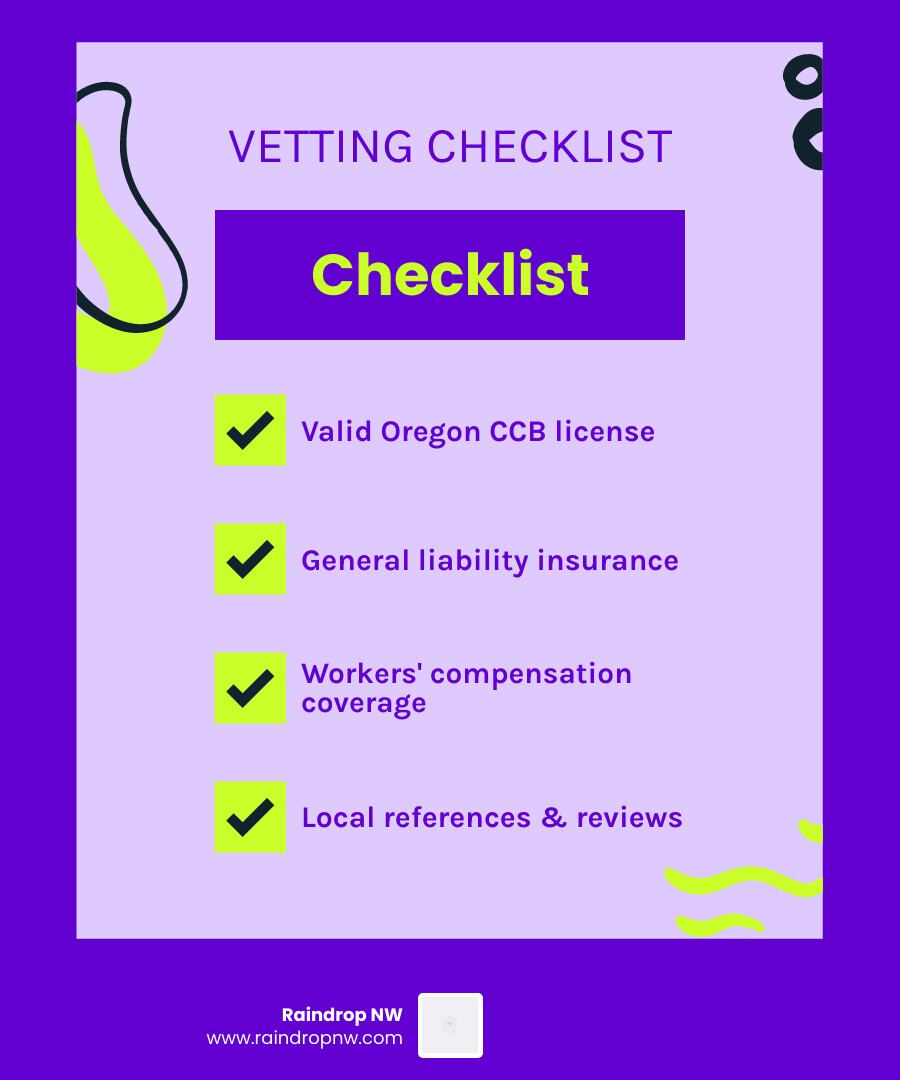
  • Confirm licensing, general liability, and workers’ compensation insurance
  • Look for manufacturer credentials (such as GAF credentials, held by only 2% of roofers)
  • Read recent reviews on Google and BBB — patterns matter more than averages
  • Get at least three written, line-item proposals before committing
  • Avoid companies with high-pressure tactics, no physical address, or vague contracts

Too many Oregon homeowners have been through this: they hire a roofing company that seemed solid, only to find out months later that the business was bought out by an out-of-state investment firm. The crew changes. The warranty becomes impossible to claim. The local contact number stops working. The roofing industry is, as one industry guide put it, “one of the most complained-about home improvement trades” — and corporate consolidation is making that problem worse, not better.

This isn’t just about customer service. It’s about what happens when a significant investment in your home — your roof — is backed by a company that has no real stake in your community, your neighborhood, or your long-term satisfaction.

I’m Torrey Yungeberg, owner of Raindrop Roofing NW, a family-owned business based in Beaverton, Oregon, and I’ve built this company around the belief that choosing a roofing company that won’t sell out starts with choosing one that was never for sale in the first place. In this guide, I’ll walk you through exactly what to look for, what to avoid, and how to protect your home investment for the long haul.

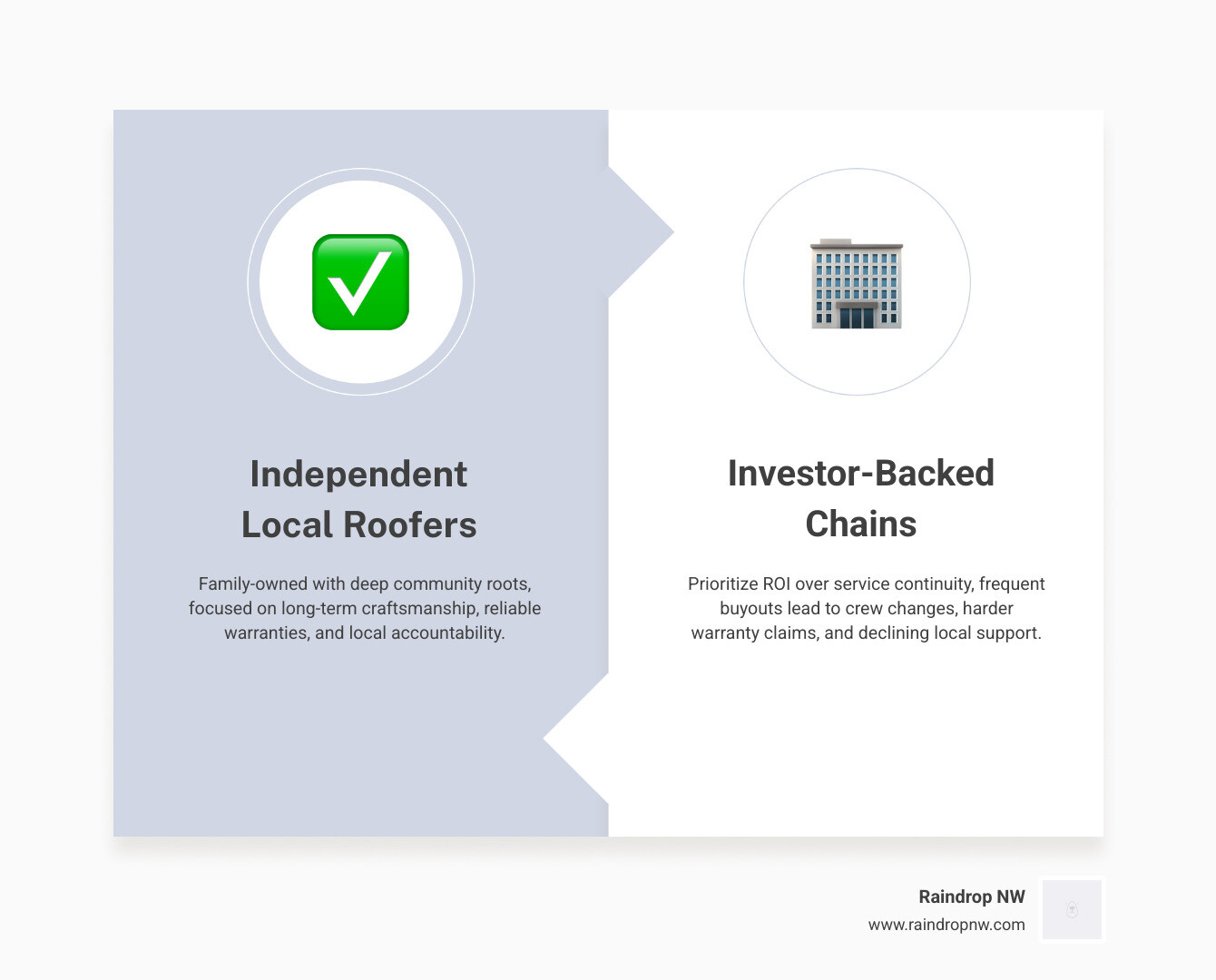
Infographic comparing independent local roofers vs. investor-backed corporate roofing chains - choosing a roofing company

Why choosing a roofing company that wont sell out Matters in 2026

As we move through April 2026, the roofing landscape in the Pacific Northwest has shifted. Private equity firms and out-of-state investment groups are buying up local contractors at a record pace. While this might look like “growth” on a balance sheet, for you as a homeowner in Beaverton or Portland, it often means a decline in service continuity.

When a local company sells out, the primary goal shifts from craftsmanship to “Return on Investment” (ROI). The multi-generational expertise that built the brand is often replaced by standardized corporate processes designed to maximize profit. This matters because a roof isn’t just a product; it’s a long-term commitment. If your contractor is sold to a firm in another state, who is accountable when a leak appears three years from now?

Independent companies maintain a deep community commitment. We live where we work. Our reputation isn’t managed by a corporate PR team in a different time zone; it’s built at the local grocery store and through word-of-mouth in our neighborhoods. Choosing an independent roofer ensures that the person who stands behind the warranty today will still be there to honor it tomorrow.

More info about residential roofing services

Spotting the Red Flags of Corporate-Owned Roofing Chains

Identifying a corporate-owned chain isn’t always easy—they often keep the original local name to maintain a “hometown” feel. However, their internal culture usually gives them away through high-pressure sales and aggressive closing techniques.

If a salesperson sits at your kitchen table and refuses to leave without a signed contract, or offers a “today-only” discount that expires the moment they walk out the door, you are likely dealing with a corporate entity focused on volume over value. These companies often use commission-based sales reps who may not have any actual roofing experience. Their job is to sell, not to solve your roof’s specific problems.

Another red flag is the “vague proposal.” A corporate chain might give you a lump-sum price with very few details. This lack of transparency is often intentional, allowing them to swap in cheaper materials or skip critical steps like replacing old flashing to protect their profit margins.

More info about new roof replacement

Common Corporate Upselling Tactics

  • The “Free” Upgrade Myth: Offering a “free” upgrade to a specific brand of underlayment that actually costs the company very little, while ignoring more expensive needs like attic ventilation.
  • Minimizing Real Issues: Downplaying signs of attic mold or structural rot because addressing them would slow down their high-speed installation schedule.
  • Brand Obsession: Pushing one specific manufacturer’s shingle without explaining why it’s right for the NW Oregon climate, usually because they get a corporate kickback for high-volume orders.
  • The Deductible Waiver: Claiming they can “waive” or “absorb” your insurance deductible. This is not only a red flag for fraud but can also jeopardize your entire insurance claim.

Red Flags When choosing a roofing company that wont sell out

High-pressure sales presentation showing aggressive tactics - choosing a roofing company that wont sell out

When you are choosing a roofing company that won’t sell out, keep a sharp eye out for these structural red flags:

  1. No Physical Address: If the company only lists a P.O. Box or a virtual office, they lack the local roots required for accountability. A legitimate roofer has a yard, a warehouse, and a local office you can visit.
  2. Lack of Local References: A company that has “sold out” might have thousands of generic online reviews, but can they give you the addresses of three roofs they replaced in Beaverton or Hillsboro in the last six months?
  3. Subcontracting Risks: Many national chains sell the job and then “flip” it to the lowest-bidding subcontractor. This creates a massive gap in quality control. You want a company that uses consistent, vetted crews who follow the same high standards on every job.
  4. The “Storm Chaser” Profile: These are companies that move into an area after a major Oregon wind or hail storm, use aggressive sales tactics to grab insurance checks, and disappear before the first rainy season hits.

The Benefits of Local, Independent Craftsmanship in NW Oregon

In the Pacific Northwest, roofing is a specialized craft. Our weather—ranging from relentless winter rain to scorching summer sun—requires a specific approach to ventilation and moisture barriers. A corporate office in the Midwest might use the same “standard” installation manual for a house in Portland as they do for one in Phoenix. That is a recipe for disaster.

Local, independent roofers in Beaverton and the Portland-Metro area understand regional building codes and weather challenges intimately. We know that in our climate, underlayment and ventilation are actually more critical to your roof’s lifespan than the shingles themselves.

Multi-generational expertise means we’ve seen how different materials perform over 20 or 30 years in this specific environment. We aren’t just following a corporate script; we are applying decades of local knowledge to ensure your home stays dry.

More info about roof types and products

How to Verify Legitimacy and Protect Your Investment

Don’t take a salesperson’s word for it. Protecting your investment requires active verification. In the roofing industry—which can be unfortunately scam-heavy—due diligence is your best defense.

Start with the basics: Licensing and Insurance. A reputable contractor must carry general liability insurance and workers’ compensation. Without these, you as the homeowner could be held liable for injuries that happen on your property. Don’t just look at a piece of paper; call the insurance provider directly to verify the policy is active and has adequate coverage (typically at least $1 million).

Next, look for manufacturer certifications. For example, only 2% of roofers nationwide qualify for GAF’s top-tier certifications. These credentials aren’t just badges; they indicate the company has undergone rigorous training and can offer enhanced warranties that non-certified installers simply cannot provide.

More info about roof inspections and certifications

Verification Steps for choosing a roofing company that wont sell out

  • State License Lookup: Visit the Oregon Construction Contractors Board (CCB) website and enter the contractor’s license number. Ensure it is active and check for any history of complaints or legal actions.
  • Verify the “Local” in Local: Google the physical address. Is it a real office/warehouse or a UPS Store?
  • Check Recent Patterns: When reading reviews, don’t just look at the star rating. Look at the last six months. If you see a sudden shift in tone—complaints about “lack of communication” or “different crews than promised”—it may be a sign the company has recently changed ownership.
  • Ask About the Crew: Ask point-blank: “Will the people on my roof be employees of your company or subcontractors?” An independent company is much more likely to have long-term, loyal employees.

Essential Components of a Transparent Roofing Proposal

A proposal should be a roadmap, not a mystery. If a contractor hands you a one-page document with a single price at the bottom, walk away. A transparent proposal from an independent roofer should be a detailed, line-item breakdown.

This transparency ensures you know exactly what you are paying for and prevents “hidden costs” from surfacing halfway through the project. It also serves as a quality control document. If the proposal specifies that they will replace all lead jacks and flashing, you can verify that work was actually done before you make the final payment.

More info about roof repairs and maintenance

Comparing Independent vs. Corporate Proposals

Feature Independent Local Proposal Corporate Chain Proposal
Material Detail Specific brands/grades for every layer Generic “architectural shingle”
Ventilation Plan Custom plan based on your attic’s needs Standard “one size fits all”
Flashing Line-item for full replacement Often “inspect and reuse” (to save cost)
Cleanup Detailed daily and final cleanup plan Vague “site will be cleared”
Payment Terms Reasonable deposit (e.g., 30%) with final payment after inspection Often demands high upfront or full payment
Accountability Direct access to the owner or local manager Call center or regional manager

Frequently Asked Questions about Independent Roofers

How many proposals should I compare?

We always recommend getting at least three written proposals. This isn’t just about finding the lowest price—in fact, the lowest bid is often a red flag for skipped steps or uninsured labor. Comparing three bids allows you to see the “average” market price and identify which contractors are being the most thorough in their inspections.

Why are local workmanship warranties more reliable?

A manufacturer warranty covers the shingles, but a workmanship warranty covers the installation. If a national company goes bankrupt or closes its local branch, that workmanship warranty often vanishes. A local, independent company with 10+ years in the community relies on their reputation, making them much more likely to return and fix a minor issue quickly.

How do I identify a storm chaser?

Storm chasers usually appear right after a weather event. They often have out-of-state license plates, use high-pressure “sign now” tactics, and offer to “pay your deductible.” They rarely have a local office and often use inexperienced subcontractors to maximize speed. If they can’t show you a local address they’ve occupied for at least five years, be extremely cautious.

Conclusion

At the end of the day, your roof is the most important protector of your home’s value and your family’s safety. Choosing a roofing company that won’t sell out means choosing a partner who views your home as a part of their own community.

At Raindrop NW, we take pride in our “Independent Edge.” We aren’t answering to a board of directors or an out-of-state investment firm. We answer to you—our neighbors in Beaverton, Portland, Hillsboro, and across the metro area. Our family-owned values mean that we prioritize craftsmanship over volume and accountability over quick profits.

When you work with a truly local team, you get more than just a new roof; you get the peace of mind that comes from knowing exactly who is standing behind the work. We’ve been here for years, and we’ll be here for many more.

Schedule a professional roof inspection with a local expert

https://www.raindropnw.com/wp-content/uploads/2026/05/pexels-photo-33404080.jpeg 627 940 SEO Stats https://www.raindropnw.com/wp-content/uploads/2024/05/logo-raindrop-space-300x92.png SEO Stats2026-05-22 13:24:102026-05-22 13:24:10The Independent Edge: What It Means to Say No to Investor Buyouts

What to Look for in a Roofing Company Before You Sign

Roofing

Why Knowing How to Choose the Right Roofing Contractor Could Be the Most Important Decision You Make for Your Home

Knowing how to choose the right roofing contractor can mean the difference between a roof that protects your family for decades and one that fails within a few years — taking your warranty and your money with it. With an estimated 98,980 roofing businesses operating across the U.S., and only a fraction of them meeting basic professional standards, the choice is anything but simple.

Here in the Portland metro and greater NW Oregon, homeowners face an added layer of concern: roofing companies are increasingly being bought out by investment firms, leaving customers with little local accountability when something goes wrong. For a project this significant, you deserve a contractor who will still be answering your calls five years from now.

Before you dive into the full guide, here’s a quick overview of what to look for:

  1. Verify credentials — valid Oregon license, general liability insurance, and workers’ compensation
  2. Check local reputation — Google reviews, BBB record, and direct references from recent clients
  3. Get at least three written estimates — compare scope, materials, warranties, and payment terms
  4. Ask the right questions — about subcontractors, permits, property protection, and project timelines
  5. Review the contract carefully — look for lien waivers, cleanup details, and warranty documentation
  6. Watch for red flags — pressure sales tactics, cash-only requests, no physical address, or unsolicited door knocking
  7. Prioritize long-term support — choose a contractor who offers transferable warranties and ongoing maintenance

I’m Torrey Yungeberg, owner of Raindrop Roofing NW and a multi-generational roofing professional with deep roots in the Beaverton community — and I’ve made it my mission to help homeowners understand exactly how to choose the right roofing contractor so they never have to learn the hard way. In this guide, I’ll walk you through every step of the process, from vetting credentials to reviewing your final contract.

Infographic showing a 7-step roofing contractor vetting process for Oregon homeowners - how to choose the right roofing

Essential Credentials for Every Roofing Professional

professional roofing certifications and documentation for a Beaverton contractor - how to choose the right roofing contractor

When you begin your search, the first filter should always be legal and professional legitimacy. It doesn’t matter how friendly a contractor seems over coffee; if they lack the proper paperwork, you are the one taking the risk. In Oregon, the Construction Contractors Board (CCB) regulates our industry, and verifying a license is your first line of defense.

State Licensing and Local Registration

In Oregon, every roofing contractor must have an active CCB license. This isn’t just a formality—it ensures the business has a bond and insurance to protect you. You can easily check a company’s status on the Oregon CCB website. If they aren’t listed, or their license is expired, stop the conversation immediately. Beyond the state level, reputable firms should have a local business registration in cities like Portland, Hillsboro, or Beaverton.

Insurance: General Liability and Workers’ Compensation

This is where many homeowners accidentally put their property at risk. You must verify two types of insurance:

  • General Liability: This covers damage to your home. If a ladder falls and smashes a window or a heavy rainstorm hits while the roof is open, this insurance pays for the repairs.
  • Workers’ Compensation: Roofing is dangerous work. If a worker is injured on your property and the contractor doesn’t have workers’ comp, you could be held liable for their medical bills.

Always ask for a Certificate of Insurance (COI) sent directly from the insurance agency to you. A photocopy provided by a contractor could be outdated or canceled.

Professional Affiliations and Certifications

While only 21 states require specific roofing licenses, professional excellence is often signaled by voluntary memberships. For example, less than 10% of U.S. roofing contractors are members of the National Roofing Contractors Association (NRCA). Membership indicates a commitment to high industry standards and ongoing education.

Furthermore, look for manufacturer certifications. Companies that are “Master Elite” or “Preferred” by major shingle brands have undergone rigorous training. These certifications often allow the contractor to offer enhanced warranties that uncertified installers simply cannot provide. For more on what these professional standards look like during a visit, see our page on roof inspections and certifications.

How to Choose the Right Roofing Contractor Through Strategic Interviews

Once you have a shortlist of credentialed pros, it’s time to sit down and talk. Think of this as a job interview where you are the boss. The way a contractor communicates during the consultation is a direct preview of how they will handle your project.

Local Experience and Portland-Metro Expertise

The NW Oregon climate is unique. We deal with persistent rain, moss growth, and occasional windstorms that can cause over $1 billion in regional losses. A contractor from out of state might not understand the specific flashing requirements needed for our damp environment. Ask how long they have been operating under their current name in the Portland-Metro area. Longevity in the local community is a strong indicator of accountability.

Subcontractor Policies and Project Management

Many large roofing firms act as “middle-men,” selling the job and then hiring a crew of subcontractors they’ve never met to do the work. This can lead to a lack of supervision and quality control. We believe it is vital to ask: “Who will be on my roof, and who is the dedicated project manager?” Knowing you have a consistent point of contact ensures that our residential roofing services meet the high standards you expect.

Property Protection and Attic Ventilation

A roof isn’t just about shingles; it’s a system. A professional roofer will always inspect your attic to check for adequate ventilation. Without proper airflow, your new roof will bake from the inside out, leading to mold and premature failure. Additionally, ask how they plan to protect your landscaping, gutters, and driveway from falling debris. A quality team uses specialized tarps and equipment to ensure your home looks better when they leave than when they arrived.

Key Questions for Your Potential Roofer

To help you narrow it down, here are the “must-ask” questions:

  • Business Longevity: How many years have you been in business in Oregon?
  • Local References: Can you provide 10 references from projects completed in the last year? (And actually call a few!)
  • Safety Protocols: What fall-arrest equipment will your crew use to comply with OSHA?
  • Material Recommendations: Why are you recommending this specific shingle for my roof’s pitch?
  • Disposal Plans: Is the cost of the dumpster and debris removal included in the bid?

If you are planning a full replacement, these questions become even more critical. You can learn more about the specifics of new replacement roofs to better prepare for these interviews.

How to Choose the Right Roofing Contractor by Spotting Red Flags

Over 75% of homeowners report feeling stressed when hiring contractors, often because they sense something is “off” but can’t put their finger on it. Watch out for these warning signs:

  • Storm Chasers: These are out-of-state companies that show up after a hail or wind event. They often lack a permanent local address and disappear once the “easy” insurance money is collected.
  • Pressure Sales: If a “special price” is only available if you sign right this second, walk away.
  • Cash-Only Deals: This is a major red flag for lack of a paper trail and usually means no warranty support.
  • Missing Written Contracts: Never allow work to begin based on a handshake or a vague one-page “estimate.”

Evaluating Bids and Understanding Your Roofing Contract

Comparing bids is one of the most confusing parts of learning how to choose the right roofing contractor. You might receive three quotes that vary by thousands of dollars. The key is to look past the bottom-line number and analyze the scope of work.

Feature Comprehensive Professional Bid Vague/Risky Bid
Scope of Work Detailed line items (tear-off, flashing, venting) “Replace roof”
Material Specs Specific brands, weights, and underlayment types “Standard shingles”
Payment Schedule Deposit, progress, and final payment Large upfront cash payment
Cleanup Daily magnet sweeps and debris removal included Not mentioned
Lien Waiver Provided upon final payment Not mentioned

Scope of Work and Material Specifications

A professional bid should specify exactly what is being installed. This includes the type of underlayment (synthetic is preferred over felt), the specific brand of shingles, and the replacement of all pipe jacks and vents. If one bid is significantly lower, they might be planning to reuse old, rusty flashing or skip the starter shingles. For a better understanding of the components involved, check our guide on roof types and products.

Payment Schedules and Lien Waivers

Never pay the full amount upfront. A standard schedule involves a small deposit to get on the calendar, a payment when materials arrive, and a final payment only after the job is finished and inspected. Most importantly, insist on a lien waiver. This legal document protects you if the contractor fails to pay their material suppliers. Without it, a supplier could technically place a lien on your home even if you paid your roofer in full.

The Critical Role of Warranties and Post-Project Steps

A roof is a long-term investment, and the “after-care” is just as important as the installation. Once the shingles are nailed down, your relationship with the contractor shouldn’t end.

Manufacturer vs. Workmanship Warranties

There are two types of protection you need:

  1. Manufacturer Warranty: This covers defects in the shingles themselves (e.g., they start shedding granules prematurely). These can last 20 to 50 years.
  2. Workmanship Warranty: This is provided by the contractor and covers installation errors (e.g., a leak because a valley wasn’t flashed correctly). A reputable local contractor should offer at least 5 to 10 years of workmanship coverage.

Final Inspections and Documentation

Before you hand over that final check, perform a walkthrough. Are the gutters clear of debris? Is the yard free of nails? Did they install the ridge vents as promised? You should also receive a packet containing your permit sign-off, warranty registration, and a receipt. Keeping these in your owner resources file is essential for future home sales. Regular repairs and maintenance can also extend the life of these warranties.

How to Choose the Right Roofing Contractor for Long-Term Support

In the Portland area, we see many “fly-by-night” operations that change names every few years to avoid warranty claims. When choosing, look for:

  • Transferable Warranties: This adds significant value if you decide to sell your home.
  • Local Accountability: A physical office in Beaverton or Portland means you know where to find them.
  • Multi-Generational Service: A company with deep family roots is more likely to value their community reputation over a quick profit.

Frequently Asked Questions about Selecting a Roofer

How many estimates should I get for my roof?

We recommend getting at least three detailed, written estimates. This gives you a solid baseline for what the project should cost in the current Oregon market. It also allows you to compare the professionalism and knowledge of different estimators. If two bids are similar and one is an extreme outlier, you’ll know to ask more questions.

Why is the lowest bid often a risky choice?

The “cheapest” bid is often the most expensive in the long run. A low price usually means the contractor is cutting corners—perhaps by using uninsured labor, skipping the permit process, or using “seconds” (defective materials). Since the average roof repair costs $1,152 and a full replacement can be a major investment, saving a few hundred dollars now isn’t worth a $20,000 failure three years from now.

Do I need a permit for my roofing project in Oregon?

Yes. In almost every jurisdiction in the Portland metro area, a permit is required for a roof replacement. This ensures that a city inspector verifies the work meets local building codes. A reputable contractor will always handle the permit process for you; if they ask you to pull the permit as a “homeowner,” it’s often because they aren’t properly licensed or insured.

Conclusion

Choosing the right partner for your home isn’t just about finding someone who can swing a hammer; it’s about finding a team that values your home as much as you do. At Raindrop NW, we take pride in being a truly local, family-owned business. We aren’t managed by an out-of-state investment firm—we are members of the Beaverton community, and our multi-generational craftsmanship is built on a foundation of honesty and transparency.

If you’re ready to experience a different kind of roofing service—one focused on long-term reliability and clear communication—we invite you to learn more about our residential roofing options. Let’s protect your home together, the right way, the first time.

https://www.raindropnw.com/wp-content/uploads/2026/05/pexels-photo-33501308.jpeg 627 940 SEO Stats https://www.raindropnw.com/wp-content/uploads/2024/05/logo-raindrop-space-300x92.png SEO Stats2026-05-21 09:11:322026-05-21 09:11:32What to Look for in a Roofing Company Before You Sign

The Homegrown Advantage: Benefits of Choosing a Truly Local Independent Roofer

Roofing

Why the Benefits of Choosing a Truly Local Independent Roofer Matter More Than Ever

The benefits of choosing a truly local independent roofer go far beyond just getting your shingles replaced — they touch on trust, accountability, and what happens to your home and your money long after the crew drives away. If you’re an Oregon homeowner, you’ve probably noticed more roofing companies popping up with polished websites and big promises. But not all of them are what they appear to be. A growing number are owned by out-of-state investment firms, operating under a local-sounding name while the real decision-makers are hundreds of makers away.

Here’s a quick look at the core benefits:

  • Local accountability – A truly local roofer has their reputation on the line in your neighborhood, not in a boardroom across the country
  • Faster emergency response – Local companies respond up to 4.2x faster than national chains when storms hit
  • Deep regional expertise – Knowledge of Oregon’s specific weather patterns, building codes, and permit requirements
  • Personalized service – Direct access to the owner or project manager, not a call center script
  • Stronger warranties – A local company will still be here in five years to honor their work
  • Community economic impact – 68% more of your money stays in the local economy when you hire local
  • Long-term relationship – Your roofer knows your home, your neighborhood, and your HOA rules

For Oregon homeowners making a major investment in their property, this distinction isn’t small — it’s everything.

I’m Torrey Yungeberg, owner of Raindrop Roofing NW, a family-owned business rooted in Boring, Oregon, and I’ve spent years in the trades understanding what the benefits of choosing a truly local independent roofer mean for real families protecting real homes. Let me walk you through exactly what sets a genuinely local, independent roofer apart — and why it matters for your roof, your wallet, and your community.

infographic showing local multiplier effect, emergency response stats, and community economic impact of hiring a local

Defining the Truly Local Independent Roofer vs. National Chains

When we talk about the benefits of choosing a truly local independent roofer, we first have to define what “truly local” actually means in April 2026. The roofing industry has seen a massive wave of consolidation. Many names you recognize in the Portland metro area have been quietly bought out by private equity firms or out-of-state investment groups.

A “truly local” roofer is independently owned and operated. This means the person who owns the company likely lives in a community like Damascus, Sherwood, or Oregon City. They aren’t reporting to a board of directors in another time zone; they are reporting to you.

National chains often rely on corporate bureaucracy. If you have a problem, you might end up talking to a call center representative reading from a script. With an independent roofer, you get direct communication. When you look into residential roofing services, you want to know that the person making the final call on your project is someone with community roots.

Independent roofers provide personalized care because their business lives or dies by word-of-mouth in the neighborhood. They don’t have a multi-million dollar national advertising budget to “drown out” a bad reputation. They have to do it right every single time.

a welcoming local roofing office in an Oregon town with a visible physical address - benefits of choosing a truly local

Unmatched Expertise in Regional Weather and Building Codes

Oregon weather is unique, and our roofs take a beating that a contractor from a different climate might not fully grasp. From the persistent mist of a Portland winter to the heavy snow loads in the foothills of Sandy or Boring, your roof needs to be built for the Pacific Northwest.

One of the primary benefits of choosing a truly local independent roofer is their intimate knowledge of regional rain patterns and wind resistance needs. We know exactly where the wind whips through the Columbia River Gorge and how it affects shingles in Camas or Washougal. We understand that a roof in Lake Oswego has different architectural and HOA requirements than a historic home in Westmoreland.

Furthermore, local building codes are not suggestions; they are legal requirements that vary by municipality. Whether you are in Beaverton, Hillsboro, or Vancouver, a local expert understands the specific permit compliance and inspection processes required. They know where ice shields are mandatory and how to ensure your attic ventilation is optimized for our high-humidity environment to prevent mold and rot.

If you are looking for roof inspections and certifications, a local pro will know exactly what the local inspectors are looking for, preventing costly delays or failed approvals.

Why Choosing a Truly Local Independent Roofer Ensures Faster Response

Imagine it’s a Tuesday night in Gresham or Tualatin, and a sudden storm sends a tree limb through your shingles. Who do you want to call? A national corporation with an automated phone tree, or a neighbor who can be there in hours?

Research shows that local roofing companies offer 4.2x faster emergency response times. Because we are physically located in the communities we serve—like Tigard, Wilsonville, and West Linn—our crews are already nearby. We don’t have to wait for “regional approval” to dispatch a team.

Accessibility is a major factor in roof repairs and maintenance. A local independent roofer offers scheduling flexibility that big-box stores simply can’t match. We aren’t trying to squeeze you into a rigid national database; we’re looking at the local forecast and moving our crews to where the need is most urgent. When you have a leak in your kitchen ceiling, you don’t want a “case number”—you want a roofer.

The Economic and Community Impact of Hiring Local

Choosing a local roofer isn’t just a home improvement decision; it’s an investment in the local economy. There is a concept known as the “local multiplier effect.” When you spend $100 with a local business, approximately $68 stays in the community. Compare that to a national chain, where only about $14 stays local.

Local vs. National Economic Impact

Feature Truly Local Independent Roofer National Chain / Private Equity
Money Staying Local 68% (Approx. $68 per $100) 14% (Approx. $14 per $100)
Job Creation Local skilled trades and office staff Often uses out-of-state subcontractors
Economic Recirculation Dollars cycle 2-4x through local shops Profits exit to out-of-state headquarters
Community Support Local sponsorships and charities Minimal local community investment
Supplier Relations Supports local lumber and supply yards National bulk contracts with distant firms

When you invest in new replacement roofs through a local company, that money goes toward paying the mortgage of a family in Clackamas, buying supplies from a yard in Hillsboro, and supporting local schools and parks. Small businesses account for 64% of new jobs created in the U.S., and by hiring local, you are ensuring those jobs remain right here in the Portland and Vancouver metro areas.

Frequently Asked Questions about Local Roofing

Identifying a Truly Local Independent Roofer in Your Neighborhood

With so many companies “marketing local” but being owned by distant corporations, how do you spot the real deal? A truly local independent roofer will have a permanent physical office you can actually visit. They won’t just have a “virtual suite” or a PO Box. Look for a long history of service in specific areas like Oregon City, Gladstone, or Battle Ground.

Ask if the people answering the phone are in the same zip code as you. If you’re speaking to a call center in a different state, that’s a red flag. A local roofer’s staff will know the local landmarks and the specific quirks of neighborhood HOAs in places like Charbonneau or Ridgefield.

How do I verify if a roofer is a truly local independent roofer?

To verify independence, ask point-blank: “Who owns this company?” A truly local owner will be proud to tell you their name and their connection to the area. You can also check the “About Us” page on their website. If it’s generic and lacks photos of actual local staff or owners, it might be a corporate outpost.

Another trick is to check the physical address on Google Maps. Does it look like an established local business with trucks and equipment, or is it a shared executive suite? Truly independent companies usually have direct access to the owner or a senior manager if a problem arises.

Why do local roofers handle insurance claims more effectively?

Local roofers have spent years working with the same insurance adjusters who cover the Portland and Vancouver regions. They know the documentation required by local offices and understand the “language” adjusters use in our area.

Because they provide honest, upfront assessments, they have built a level of trust with adjusters that “storm chasers” (contractors who follow hail or wind storms from state to state) simply don’t have. This local rapport can often lead to a smoother, faster claims process for the homeowner. They also understand the specific neighborhood requirements that might influence the cost of a claim, ensuring nothing is missed in the initial estimate.

Conclusion

At Raindrop NW, we believe the benefits of choosing a truly local independent roofer are the foundation of a safe, long-lasting home. We aren’t just a business; we are your neighbors in the Beaverton and Portland community. Our commitment to long-term service and accountability stems from the fact that we live here, work here, and see our customers at the grocery store.

Unlike companies that have been bought out by out-of-state investment firms focused on quarterly margins, our focus is on the next thirty years of your roof’s life. We offer community-rooted expertise, independent ownership, and the peace of mind that comes with knowing your roofer will still be here if you ever need a follow-up.

Don’t leave your home’s most important defense to a distant corporation. Protect your home with a local expert and experience the homegrown advantage for yourself.

https://www.raindropnw.com/wp-content/uploads/2026/05/photo-1634750006909-3258af95e257.jpeg 720 1080 SEO Stats https://www.raindropnw.com/wp-content/uploads/2024/05/logo-raindrop-space-300x92.png SEO Stats2026-05-20 12:38:422026-05-20 12:38:42The Homegrown Advantage: Benefits of Choosing a Truly Local Independent Roofer

How much does a new roof really cost

Roofing

National Trends and the Roof Replacement Cost Guide for Homeowners

When you begin researching the roof replacement cost guide for homeowners, the first thing you will notice is the wide range of project requirements. Nationally, roof replacements vary based on material choice, home size, roof shape, and the condition of the existing roofing system. A simple single-story home with an easy-to-access roof is a very different project from a taller home with multiple valleys, dormers, skylights, or aging decking beneath the shingles. For high-end materials like slate or custom tile, projects also involve specialized installation techniques, additional planning, and longer timelines.

To understand these projects, it helps to understand how roofing measurements work. In the roofing industry, we do not just talk about total square footage; we use “squares.” One roofing square equals 100 square feet. If your home has a 2,000-square-foot roof, that is 20 squares. Most standard homes in the U.S. fall between 13 and 18 squares, but roof complexity can make two homes of similar size very different in terms of labor and material needs.

Just as important, the visible roof surface is only one part of the system. A full replacement may also include underlayment, flashing around chimneys and walls, ridge ventilation components, pipe boots, starter shingles, and ridge cap shingles. In some cases, the roof deck itself needs spot repairs before the new system can be installed. Looking at the roof as a complete system gives homeowners a more realistic understanding of what the project involves.

Material Type Average Lifespan Performance Category
Asphalt Shingles (3-Tab) 15-20 Years Standard
Architectural Shingles 25-30 Years Enhanced / Most Popular
Metal (Standing Seam) 40-70 Years High Durability
Clay / Concrete Tile 50-100 Years Premium / Heavy Weight
Natural Slate 60-150+ Years Luxury

How to use a roof replacement cost guide for homeowners to plan

Planning for a new roof requires looking beyond the shingles themselves. While materials are a significant portion of the project, labor, disposal, and structural prep work are also key factors. When we provide new replacement roofs, we always advise homeowners to plan for potential scope adjustments.

A good rule of thumb is to account for “surprises.” These are things that cannot be seen until the old roof is stripped away, such as rotted plywood decking, damaged fascia boards, or attic ventilation issues that should be addressed during the project. This kind of planning helps homeowners avoid frustration and make informed decisions if hidden damage is uncovered once work begins.

It is also smart to think about timing. Many homeowners begin the process only after a leak appears, but roof replacement planning is often smoother when it starts earlier. If your roof is showing age, losing granules, or requiring repeated repairs, gathering information ahead of time allows you to review material options, understand the scope of work, and prepare your home and schedule for installation.

Why a roof replacement cost guide for homeowners varies by region

Location is a massive driver of project requirements. In the Pacific Northwest, specifically around Beaverton, Portland, and Vancouver, our climate dictates specific needs. We deal with heavy rainfall, moss growth, wind exposure, and long damp seasons. That means roofs in this region often depend on durable underlayment, carefully installed flashing, and strong ventilation details that help moisture escape from the attic.

Regional building requirements also shape the project. Oregon and Washington each have permit and code considerations that affect how roof systems are installed. These standards are there to help ensure the roof performs well through wet winters, changing temperatures, and local weather patterns. Labor needs can also vary between urban and suburban areas based on access, disposal logistics, and scheduling.

This is why roof inspections and certifications are so valuable. An inspection helps determine the true condition of your current roof, identify moisture-related concerns, and confirm whether a repair is still practical or whether a replacement would better protect the home over the long term. For homeowners in Beaverton and surrounding communities, a region-specific evaluation is one of the best ways to make a confident decision.

Factors Influencing Labor and Installation Complexity

roofers wearing safety harnesses working on a steep residential roof pitch - roof replacement cost guide for homeowners

Labor is a significant component of the installation, and several factors can influence the complexity of the work.

First is the pitch (the steepness of the roof). A “walkable” roof is more straightforward to install because the crew can move quickly and safely. Once a roof reaches a certain steepness (usually a 7/12 pitch or higher), it becomes “non-walkable.” This requires specialized safety equipment, scaffolding, and more time for every shingle laid.

Other complexity factors include:

  • Height: A two-story or three-story home requires more effort to move materials up and debris down.
  • Complexity: Roofs with multiple gables, valleys, dormers, and chimneys require significantly more flashing work and detail than a simple “up-and-over” gable roof.
  • Crew Size: Larger, more experienced crews can complete a job in a fraction of the time, reducing the days your home is “open” to the elements.

Our residential roofing services prioritize safety and precision, ensuring that even the most complex rooflines are handled with the right equipment and expertise.

Material Selection and Long-Term Value

Choosing the right material is a balance between your current needs and how long you plan to stay in the home. Appearance matters, but so do climate performance, maintenance expectations, roof weight, and how well a product fits the design of your home.

  • Asphalt Shingles: These remain a popular choice for many homeowners. Architectural shingles are widely selected because they offer an attractive dimensional look and dependable durability. They work well on many home styles and are available in a broad range of colors.
  • Metal Roofing: Metal is often viewed as a long-term roofing solution. It reflects solar heat, can support energy efficiency goals, and is highly recyclable. It also performs well in many weather conditions and requires precise installation details.
  • Slate and Tile: These are premium options that offer standout curb appeal and very long service lives. However, they are heavy and may require structural reinforcement before installation.

When exploring roof types and products, it helps to think beyond appearance alone. The right material should match your home’s structure, your maintenance preferences, and the environmental demands of the Pacific Northwest. Moss resistance, water shedding ability, and compatibility with proper attic ventilation all play a role in long-term performance.

Homeowners should also consider how visible the roof is from the street. Because the roof is such a large part of a home’s exterior, the material and color can significantly influence curb appeal. A well-matched roofing product can complement siding, trim, stonework, and landscaping while also helping preserve the home’s overall condition.

A new roof also supports long-term property value in practical ways. It helps defend the home against moisture intrusion, protects insulation and attic spaces, and reduces the likelihood of recurring leak-related repairs. You can see examples of different styles and materials in completed projects by browsing our roof gallery.

Repair vs. Replacement: Making the Right Choice

One of the most common questions we hear is: “Can I just fix the leak, or do I need the whole thing replaced?”

We often use a comprehensive assessment: If the extent of damage is widespread, it is usually wiser to invest in the new roof. Patching an old, brittle roof is often a temporary fix that leads to recurring issues for years.

Signs it’s time for a full replacement include:

  • Age: If your asphalt roof is over 20 years old, it’s nearing the end of its functional life.
  • Granule Loss: Finding “sand” in your gutters is a sign the shingles are losing their UV protection.
  • Widespread Damage: Curling, buckling, or missing shingles across multiple sections of the roof.
  • Interior Leaks: If you see yellow or brown stains on your ceiling, water is already bypassing your shingles and underlayment.

Whether you need minor repairs and maintenance or a total overhaul, catching issues early prevents structural sagging and mold growth in your attic.

Project Planning, Warranties, and Insurance

A new roof is a major capital improvement, so planning matters just as much as product selection. We offer various roof financing options to help make the process more manageable for Beaverton and Portland families.

Before installation begins, homeowners should ask what the job timeline will look like, how the property will be protected during tear-off, where materials will be staged, and what cleanup procedures will be followed at the end of each day. These details help set expectations and make the process less stressful for everyone in the home.

Warranties are equally important. There are two types:

  1. Manufacturer Warranty: Covers defects in the materials themselves.
  2. Workmanship Warranty: Provided by us, covering the actual installation.

As a manufacturer certified roofing contractor, we can often provide access to stronger warranty protection tied to approved installation methods and product systems. Understanding the difference between material coverage and installation coverage helps homeowners know exactly what is protected after the project is complete.

Lastly, do not forget to review your coverage. If your roof was damaged by a covered event, such as a windstorm or a fallen tree limb, your homeowners insurance may assist with the replacement. It is important to review your policy language carefully and document visible damage as soon as possible. Taking photos, saving inspection notes, and understanding your deductible can make the claims process easier to navigate.

Good project planning also includes thinking about the period after installation. Homeowners should ask about recommended maintenance, safe gutter cleaning practices, and whether periodic inspections are advised after severe weather. These simple steps can help protect the performance of the roof for years to come.

Frequently Asked Questions

How long does a typical roof replacement take?

For most residential homes, the process takes 1 to 3 days. A simple asphalt shingle job on a ranch-style home can often be done in a single day. Larger, more complex roofs or those using materials like tile or metal may take 5 to 7 days. Weather is the biggest variable—we won’t open your roof if there’s a high chance of a downpour!

What additional factors should I expect?

Beyond the materials and labor, you should factor in tear-off and disposal. Removing old shingles and managing debris are part of the process. There are also permits, which vary by city (Portland, Beaverton, or Vancouver). If you are combining your roof work with other home improvements, like remodels and additions, those elements will be integrated into your overall project plan.

Does a new roof increase home value?

Absolutely. A new roof provides significant value for any home improvement. It boosts curb appeal instantly and gives potential buyers peace of mind. A new roof is often the key to a successful home sale.

Conclusion

At Raindrop NW, we know that looking at a roof replacement cost guide for homeowners can feel overwhelming. That’s why we focus on transparency and local accountability. We are independently owned and deeply rooted in the Beaverton and Portland communities.

When you choose us for your residential roofing needs, you’re getting a team that will be here for the long haul—to stand by our warranties and provide the service you deserve. If you’re ready to protect your home with a roof built for the Pacific Northwest, we’re here to help.

https://www.raindropnw.com/wp-content/uploads/2026/05/photo-1503484294853-e44accfbd868.jpeg 639 1080 SEO Stats https://www.raindropnw.com/wp-content/uploads/2024/05/logo-raindrop-space-300x92.png SEO Stats2026-05-15 10:48:032026-05-15 10:48:03How much does a new roof really cost

Don’t Wait for the Drip to Spot These Commercial Roof Warning Signs

Roofing

Why Knowing the Signs Your Commercial Roof Needs Attention Can Save You Thousands

Signs your commercial roof needs attention include the following:

  • Water stains or discoloration on interior ceilings or walls
  • Ponding water that remains on the roof surface for more than 48 hours after rain
  • Blisters, bubbles, or cracks in the roofing membrane
  • Damaged, loose, or corroded flashing around penetrations and edges
  • Sagging or soft spots on the roof deck
  • Musty odors or visible mold growth inside the building
  • Rising energy bills without another clear explanation
  • Recurring leaks, even after previous repairs
  • Visible surface erosion, granule loss, or alligatoring
  • A roof that is approaching or past its expected service life

Most commercial roofs don’t fail all at once. They send signals first — often for months before a single drop of water ever hits your floor. The trouble is, those signals are easy to miss when your roof is out of sight and out of mind. By the time a ceiling stain shows up or your energy bills spike, the underlying problem has usually been building for a while. For commercial property owners in Oregon and Southwest Washington, catching these warning signs early is the difference between a manageable repair and a costly, disruptive failure.

I’m Torrey Yungeberg, owner of Raindrop Roofing NW, and after years of inspecting and restoring commercial roofs across the region, I’ve seen how the signs your commercial roof needs attention are almost always visible long before the damage becomes serious. Let’s walk through exactly what to look for so you can stay ahead of the problem.

Infographic showing commercial roof warning signs from membrane damage to ponding water to interior leaks - signs your

Visible Exterior Signs Your Commercial Roof Needs Attention

When we step onto a roof for a commercial roofing assessment, we aren’t just looking for holes. We are looking for the story the roof is telling us about its structural health. Most commercial buildings use flat or low-slope designs, which means they face unique challenges compared to residential homes.

One of the most immediate visual red flags is damage to the flashing. Flashing consists of the metal strips or sealants used to bridge the gap between the roof membrane and various penetrations—like HVAC units, vents, chimneys, or the building’s perimeter edges. If these seals are cracked, rusted, or pulling away, water has a direct highway into your building’s skeleton.

We also pay close attention to the drainage components. Scuppers and gutters are the unsung heroes of a commercial roof. If scuppers are blocked by debris or if gutters are sagging, water cannot leave the roof. This leads to surface erosion and “alligatoring”—a pattern of small cracks that look like reptile skin—which indicates that the protective top layer of your roof is drying out and failing due to UV exposure and standing water.

pond of water sitting on a flat commercial roof membrane - signs your commercial roof needs attention

Identifying Membrane Deterioration and Cracks

The “skin” of your building—the roofing membrane—is its primary defense. Whether your building uses TPO (Thermoplastic Polyolefin), EPDM (Ethylene Propylene Diene Terpolymer), or Modified Bitumen, the membrane must remain flexible and intact.

Common membrane failure types include:

  • Seam Separation: This is where the sheets of roofing material meet. Over time, heat and cold cause these materials to expand and contract. If the adhesive or heat-weld fails, the seams “pop,” creating an opening.
  • Punctures: These often happen during routine maintenance of HVAC equipment. A dropped tool or a heavy foot can easily pierce an aging membrane.
  • UV Damage: Constant sun exposure eventually makes membranes brittle. Once the material loses its elasticity, it begins to crack under the stress of temperature changes.
  • Alligatoring: On asphalt-based roofs, this cracking pattern shows that the bitumen has lost its oils and can no longer repel water effectively.

Why Ponding Water is a Major Sign Your Commercial Roof Needs Attention

In the roofing industry, we live by the “48-hour rule.” If you see standing water on your roof more than two days after the last rainfall, you have a “ponding” problem. This isn’t just an aesthetic issue; it’s a structural threat.

Water is incredibly heavy—about 62.4 pounds per cubic foot. When water accumulates in one spot because of a compressed insulation board or a structural dip, it creates a “bowl” effect. The weight of the water causes the roof to sag further, which catches even more water. This cycle of structural weight can eventually lead to deck stress or even a collapse. Furthermore, standing water acts like a magnifying glass for UV rays, accelerating the deterioration of the membrane underneath and encouraging algae growth, which further eats away at the roof’s surface.

Interior Red Flags and Structural Warnings

Sometimes the most obvious signs your commercial roof needs attention aren’t on the roof at all—they are inside your workspace. If you notice bubbling paint on the walls or ceiling, that is often trapped water trying to find a way out.

Water stains are the classic “drip” scenario, but water rarely travels in a straight line. Because of the way commercial buildings are constructed, a leak might enter the roof on the north side but travel along a support beam or through fiberglass insulation before finally dripping onto a desk on the south side. If you see a stain, the insulation in that area is likely already “damp,” meaning it has lost its ability to keep your building warm or cool.

Structural failure is the ultimate nightmare. If you notice uneven roof lines from the ground or sagging areas in the ceiling inside, the roof deck itself may be compromised. This happens when persistent leaks rot the wood or rust the metal decking that supports the entire roofing system. For more information on how we identify these deep-seated issues, you can explore our roof inspections and certifications page.

How Odors and Mold Signal Your Commercial Roof Needs Attention

If your employees are complaining about a musty smell or if you’ve noticed an uptick in respiratory issues or “sick building syndrome,” your roof might be the culprit. Mold and mildew thrive in the dark, damp spaces between your roof membrane and your interior ceiling.

Hidden leaks can saturate the insulation and the “plenum” space (the area used for air circulation). Once moisture is trapped, it becomes a breeding ground for mold. This isn’t just a maintenance issue; it’s a health risk. Mold spores in the HVAC system can degrade air quality throughout the entire facility. If you smell mildew, don’t just buy an air freshener—check the roof.

Performance, Age, and Repair History

A roof’s performance isn’t just about keeping water out; it’s about keeping energy in. Have you noticed your energy bills creeping up? When roof insulation gets wet, its “R-value” (resistance to heat flow) plummets. This forces your HVAC system to work significantly harder to maintain temperatures, leading to higher costs and more frequent equipment repairs.

Age is another critical factor. While some materials like metal can last 40 years, most flat roof systems have a much shorter prime. Here is a general comparison of common commercial material lifespans:

Material Type Average Lifespan (Years)
TPO / PVC 15 – 25
EPDM (Rubber) 20 – 30
Modified Bitumen 15 – 20
Metal Roofing 30 – 45+
Built-Up Roofing (BUR) 20 – 30

The year 2025 was particularly brutal for infrastructure. In the first six months of 2025 alone, the United States experienced 14 separate billion-dollar weather and climate disasters, totaling over $101.4 billion in damage. Many of these events involved high winds and heavy rain that accelerated the aging process of roofs in our region. If your roof was already 15 years old before the recent storm seasons, it is likely entering a high-risk phase.

If you find yourself calling for repairs and maintenance more than twice a year for the same leak, your roof is trying to tell you that it has reached the end of its life. Patching a systemic failure is like putting a band-aid on a broken leg. At a certain point, a new roof replacement becomes the more financially sound decision.

Frequently Asked Questions about Commercial Roof Damage

How often should I schedule a professional inspection?

We recommend a professional inspection at least twice a year—once in the spring and once in the fall. This allows us to clear out winter debris before the summer heat and prepare the drainage systems for the heavy Pacific Northwest rains. You should also schedule a check-up after any major weather event. Keeping detailed maintenance records isn’t just good for your building’s health; it’s often a requirement to keep your manufacturer’s warranty valid.

What causes roof blisters and bubbles?

Blisters usually occur when moisture or air gets trapped between the layers of the roofing membrane or between the membrane and the insulation. As the sun heats the roof, that trapped pocket expands, creating a bubble. If you step on these, they can pop, creating an immediate leak. They are often a sign of poor initial installation or “thermal cycling,” where the roof expands and contracts so much that the adhesive bond begins to fail.

How do weather events in 2025 affect my roof’s current condition?

The extreme weather patterns we saw in 2025—including high-wind events and record-breaking rainfall—have put unprecedented cumulative stress on commercial structures. Wind uplift can loosen the fasteners holding your roof down, while heavy hail can create “hidden fractures” in the membrane. These fractures might not leak today, but as they go through freeze-thaw cycles, they expand until they become major problems.

Conclusion: Trust a Local Partner for Your Commercial Roof

Your commercial roof is a massive investment, and it deserves more than a “patch and forget” approach. At Raindrop NW, we take pride in being a truly local, independently owned company based in Beaverton. Unlike many roofing firms that have been bought out by out-of-state investment groups, we live and work in the same communities we serve—from Portland and Hillsboro to Tigard and Vancouver.

We believe in long-term accountability. When we inspect your roof, we aren’t just looking for a quick sale; we’re looking to build a relationship that keeps your business protected for the next twenty years. Don’t wait for the ceiling to start dripping to take action. If you’ve noticed any of the signs your commercial roof needs attention, reach out to us today.

Get a professional commercial roofing inspection from the team that knows Oregon and Washington roofing best.

https://www.raindropnw.com/wp-content/uploads/2026/05/photo-1440986014351-670bdeda7b03-1.jpeg 720 1080 SEO Stats https://www.raindropnw.com/wp-content/uploads/2024/05/logo-raindrop-space-300x92.png SEO Stats2026-05-12 10:11:332026-05-12 10:11:33Don’t Wait for the Drip to Spot These Commercial Roof Warning Signs

Roof Protection 101: Keeping the Rain Where It Belongs

Roofing

Why Knowing How to Protect Your Home from Water Damage Through Your Roof Could Save You Thousands

Knowing how to protect your home from water damage through your roof starts with a few key habits: scheduling twice-yearly roof inspections, keeping gutters clear, maintaining proper attic ventilation, addressing damaged shingles and flashing promptly, and ensuring your roof overhangs and downspouts direct water well away from your foundation. Do these consistently, and you stop most water intrusion before it ever becomes a problem.

Water damage is one of the most common causes of property loss — and the roof is almost always where the story begins. It rarely announces itself loudly. More often, it’s a slow drip that travels along a rafter for weeks before showing up as a tea-colored stain on your ceiling, or a patch of moss quietly holding moisture against your shingles through an Oregon winter. By the time most homeowners notice something is wrong, the damage has already been building for months.

What makes this especially frustrating is that nearly a third of homeowners assume their insurance will cover whatever goes wrong — including damage caused by ordinary wear and gradual neglect. In reality, most policies only step in for sudden, accidental events. The rest falls squarely on your shoulders as a homeowner.

The good news? Most serious roof water damage is entirely preventable with the right knowledge and a little proactive care.

I’m Torrey Yungeberg, owner of Raindrop Roofing NW and a roofing professional with deep roots in Oregon’s wet climate — where understanding how to protect your home from water damage through your roof isn’t just useful knowledge, it’s essential. I’ll walk you through everything you need to know to keep your home dry, your structure sound, and your peace of mind intact.

Infographic showing the path of water from roof surface through gutters, siding, and foundation with protection checkpoints

Common Causes and Early Signs of Roof-Related Water Damage

In our neck of the woods—stretching from Hillsboro and Beaverton over to Gresham and down to Lake Oswego—rain isn’t just a weather report; it’s a way of life. Because we deal with so much moisture, our roofs face constant pressure. Understanding the common culprits of water intrusion is the first step in defense.

The most frequent causes of roof-related water damage include:

  • Damaged or Missing Shingles: High winds or simple age can cause shingles to curl, crack, or blow away entirely, leaving the underlayment vulnerable.
  • Cracked Flashing: Flashing is the metal material installed around “interruptions” in your roof—like chimneys, dormers, and vents. When this seals crack or the metal corrodes, water flows directly into your home’s skeletal structure.
  • Moss and Algae Growth: In the Pacific Northwest, moss is a major enemy. It acts like a sponge, holding water against the shingles and eventually lifting them up, allowing water to seep underneath.
  • Clogged Gutters: When water can’t flow off the roof, it backs up. This standing water can rot the fascia boards and seep under the edge of your shingles.

Early signs aren’t always a puddle on the floor. You should keep an eye out for “tea-colored” water stains on your ceiling or walls. These indicate a slow, persistent leak. Musty smells in the attic or upper floors often signal that mold is already beginning to take hold in damp insulation. Even peeling paint near the roofline can be a sign that moisture is trapped behind the walls.

If you are noticing these signs, it may be time to look into residential roofing services to catch the issue before it requires a total overhaul.

tea colored water stain on a white ceiling indicating a roof leak - how to protect your home from water damage through your

How to protect your home from water damage through your roof by spotting leaks early

The best way to find a leak is to look where most people don’t: the attic. We recommend performing an attic inspection at least twice a year. If you can safely access your attic during a heavy rainstorm, bring a flashlight. Look for damp spots on the rafters or insulation.

One of the most telling signs of a compromised roof is seeing “daylight” where you shouldn’t. If you turn off the lights in your attic and see gaps of sunlight peeking through the roof boards, water is definitely getting in when it rains. You should also check for sagging sections of the ceiling. This often means water has pooled on top of the drywall or plaster, creating a heavy, sodden mess that could collapse at any moment. Detecting these internal moisture cues early is the difference between a simple patch and a massive restoration project.

Essential Components: How to Protect Your Home from Water Damage Through Your Roof

When we talk about how to protect your home from water damage through your roof, we have to look beyond just the shingles. A roof is a system, and every part needs to work in harmony to keep your home dry.

One of the most underappreciated heroes of water management is the roof overhang. Most homes have overhangs between 18 to 24 inches. There are two main types:

  • Eave Overhangs: These project horizontally from the lower edges of the roof. They are essential for supporting your gutter system and keeping water away from the fascia.
  • Gable Overhangs: These run along the sloped edges of the roof. They prevent “dirty runoff” from streaking down your siding and entering vulnerable points like window frames.

Properly sized overhangs provide a physical buffer that protects your siding and reduces the amount of water that ever reaches your foundation. If you’re considering new replacement roofs, ensuring your overhangs are structurally sound and correctly sized is a top priority.

The role of gutters and downspouts in water management

Think of your gutters as the “plumbing” for your roof. Their job is to collect every drop of rain and whisk it safely away. If your gutters are clogged with leaves and Pacific Northwest moss, they will sag and eventually fail.

We recommend seamless gutters to minimize leak points. However, the gutters are only half the battle; the downspouts must do their part. A downspout should extend at least 3 feet away from your home’s foundation. If water pools at the base of your house, it can lead to foundation cracks and basement flooding. Using splash blocks or yard runoff drainage pipes can help direct that water even further into safe zones.

For homeowners in areas like Tualatin or West Linn, where the terrain can be hilly, managing this runoff is crucial to prevent erosion around your property. Our repairs and maintenance team often finds that simply fixing a disconnected downspout can solve a “leaky basement” problem overnight.

Proactive Maintenance and Seasonal Waterproofing Strategies

In April 2026, we are seeing more “extreme” weather cycles in the Portland metro area—heavy rains followed by sudden freezes. This makes proactive maintenance more important than ever. We suggest a “Spring and Fall” inspection schedule.

Before the heavy winter rains hit, you should:

  1. Clear Debris: Remove leaves and needles from roof valleys where they trap moisture.
  2. Trim Trees: Ensure no branches are overhanging the roof. Wind-blown branches can scrape off the protective granules of your shingles or even puncture the roof surface.
  3. Check for Ice Dams: In colder months, poor insulation can cause snow to melt and refreeze at the roof edge, creating a “dam” that forces water back up under the shingles.

Advanced waterproofing: How to protect your home from water damage through your roof

For certain roof types, especially flat or low-slope roofs common in some Beaverton and Portland modern designs, traditional shingles aren’t enough. This is where advanced waterproofing methods come in.

  • Silicone Coatings: These are fantastic for restoration. Silicone is highly reflective (helping with energy bills) and creates a seamless, flexible membrane that is completely waterproof. It’s particularly good at handling “ponding water” that might sit on a flat roof for days.
  • Liquid Membranes: These are applied like paint but dry into a heavy-duty rubberized layer. They are ideal for oddly shaped roofs with lots of vents or pipes.
  • EPDM and TPO: These are single-ply membranes often used on commercial buildings but increasingly popular for residential flat sections. They are durable, eco-friendly, and very resistant to leaks.

If you have a balcony or a flat section over a living space, you might also want to look into waterproof deck surfaces to ensure your outdoor living space isn’t leaking into the kitchen below.

Regularly scheduled roof inspections and certifications can help determine which of these advanced methods is right for your specific home.

Navigating Insurance Claims and Professional Mitigation

If the worst happens and a storm damages your roof, how you respond in the first 24 hours can determine whether your insurance claim is approved or denied.

First, document everything. Use your smartphone to take “before-during-after” photos. Take wide shots of the whole roof, close-ups of the damage, and photos of any interior water stains. This builds a clear narrative for the insurance adjuster.

That insurance typically covers “sudden and accidental” damage—like a tree falling on your roof during a windstorm. It usually excludes damage caused by lack of maintenance. If your roof leaks because it’s 30 years old and you haven’t cleaned the gutters in a decade, the insurance company may deny the claim based on “maintenance neglect.”

For more tips on being a prepared homeowner, check out our owner resources.

Attic ventilation and insulation as moisture barriers

It sounds counterintuitive, but sometimes the “water damage” in your roof is actually coming from inside the house. This happens when hot, moist air from your showers and cooking rises into the attic and hits the cold underside of the roof deck. Without proper ventilation, this moisture condenses into water droplets, leading to mold and wood rot.

A healthy roof needs:

  • Ridge Vents: Located at the very peak of the roof to let hot air out.
  • Soffit Vents: Located under the eaves to draw cool, fresh air in.
  • Proper Insulation: This keeps the heat in your living space and prevents “thermal expansion” and contraction of the roof materials, which can stress the seals over time.

If you are planning remodels and additions, always make sure your contractor is calculating the correct “ventilation-to-square-footage” ratio to prevent these hidden moisture traps.

Frequently Asked Questions about Roof Water Protection

How often should I schedule a professional roof inspection?

We recommend a professional inspection at least once a year, though twice (Spring and Fall) is ideal for the Pacific Northwest. You should also call for an inspection immediately after any major weather event, such as a hail storm or high-wind event. A professional assessment can catch small issues—like a single backed-out nail or a cracked vent boot—that a homeowner might miss from the ground.

What should I do immediately if I discover a roof leak?

Don’t panic, but act fast!

  1. Contain the water: Put a bucket under the drip.
  2. Relieve pressure: If you see a “bubble” forming in your ceiling paint, use a small nail to puncture it. This allows the water to drain into your bucket rather than spreading horizontally and rotting more of your ceiling.
  3. Tarp if possible: If it’s safe and you have the supplies, a temporary tarp can stop further intrusion.
  4. Call a pro: Contact a local roofer to perform a permanent repair.

Does homeowners insurance cover water damage from an old roof?

Generally, no. Most policies are designed to cover “perils” (sudden events like fire or wind). Ordinary “wear and tear” is considered a maintenance responsibility of the homeowner. If your roof is at the end of its 20-to-30-year lifespan and begins to leak due to age, you will likely be responsible for the repair or replacement. This is why documenting your regular maintenance is so important—it proves to the insurance company that you’ve done your part.

Conclusion

Protecting your home from water damage through your roof isn’t just about shingles and nails; it’s about a commitment to your home’s long-term health. From the gutters in Tigard to the ridge vents in Camas, every detail matters.

At Raindrop NW, we take pride in being a truly local, independently owned company based right here in Beaverton. We aren’t an out-of-state investment firm looking for a quick payout; we are your neighbors, and we’re committed to the accountability and service that our community deserves.

Whether you need a minor repair, a seasonal inspection, or a full replacement, we’re here to help you keep the rain where it belongs—outside. For all your residential roofing needs, reach out to us today. Let’s make sure your home is ready for whatever the Oregon sky decides to drop next.

https://www.raindropnw.com/wp-content/uploads/2026/05/photo-1743903765946-db4b82ba0803.jpeg 720 1080 SEO Stats https://www.raindropnw.com/wp-content/uploads/2024/05/logo-raindrop-space-300x92.png SEO Stats2026-05-04 06:52:072026-05-04 06:52:07Roof Protection 101: Keeping the Rain Where It Belongs

Why Pacific Northwest Homes Need a Special Inspection Schedule

Roofing

Determining the Ideal Roof Inspection Frequency for Pacific Northwest Homes

When we talk about roof inspection frequency for pacific northwest homes, we aren’t just following a generic maintenance manual. We are reacting to a climate that is actively trying to reclaim your house. Because our region doesn’t have a true “dry season” that lasts long enough to bake out deep-seated moisture, a biannual schedule is the gold standard for protection.

The Spring and Fall Transitions

Scheduling inspections during the transition between seasons is the most effective way to stay ahead of damage.

  • The Spring Inspection: This is your “recovery” check. After a winter of heavy rain, occasional snow loads, and wind, we look for shingles that may have been lifted by ice or debris that has accumulated in valleys.
  • The Fall Inspection: This is your “preparation” check. Before the relentless “Big Dark” begins in late October or November, you need to ensure that your seals are tight, your gutters are clear, and no new moss has taken root during the humid summer mornings.

Weather-Related Inspection Triggers

Beyond the calendar, certain events should trigger an immediate call to a professional. If you experience any of the following, don’t wait for your scheduled biannual visit:

  • High Wind Events: Any storm with gusts exceeding 40-50 mph can break the seal on older shingles.
  • Heavy Hail: Even small hail can bruise shingles and knock off the protective granules that shield the asphalt from UV rays.
  • Atmospheric Rivers: Prolonged, heavy downpours can overwhelm drainage systems and expose “slow leaks” that don’t show up during light drizzle.
  • Large Branch Falls: Even if a branch doesn’t puncture the roof, the impact can crack the underlying decking or displace flashing.

For more detailed information, you can explore our roof inspection and certification services.

Factors That Increase Frequency

Not every home in Beaverton or Vancouver is the same. Your specific roof inspection frequency for pacific northwest homes might need to be higher if your roof is over 15 years old. As materials age, they become brittle and less “self-healing.” Similarly, if you want to remain in compliance with your manufacturer’s warranty, many brands require documented annual or biannual professional oversight to keep the coverage valid.

Why the PNW Climate Demands More Frequent Oversight

Our climate is unique. While homeowners in the Southwest worry about sun damage and those in the Midwest worry about tornadoes, we deal with the “slow soak.” With an average of 150 rainy days a year in the Portland-Metro area, your roof is essentially wet for six months straight. This persistent dampness creates a laboratory for decay.

PNW vs. National Roof Lifespans

The data shows a startling trend: roofs in our region simply do not last as long as the national average without aggressive maintenance.

Material National Average Lifespan PNW Average Lifespan (Unmaintained)
Asphalt Shingles 20–30 Years 15–20 Years
Cedar Shakes 30–40 Years 20–25 Years
Flat Roofs (TPO/EPDM) 20–35 Years 15–25 Years

This “lifespan gap” is caused by wind-driven rain that finds its way into the smallest capillary openings and temperature swings that cause materials to expand and contract. In late spring, we often see “freeze-thaw” cycles where water gets under a shingle, freezes overnight, expands, and physically pries the shingle away from the roof.

Keeping up with residential roof repairs is the only way to close this gap. By catching a small leak in year 12, we can often push an asphalt roof to year 22 or 25, effectively saving you thousands of dollars in premature replacement costs.

Impact of Moss and Algae on Roof Inspection Frequency for Pacific Northwest Homes

Close-up of moss roots lifting the edge of an asphalt shingle - roof inspection frequency for pacific northwest homes

If there is one “villain” in the story of Pacific Northwest roofing, it’s moss. Moss isn’t just a cosmetic issue; it’s a structural threat. Unlike grass, moss doesn’t have traditional roots; it has “rhizoids” that latch onto the granules of your shingles.

As the moss grows, it lifts the edge of the shingle. This creates a “damming” effect where water can no longer flow down the roof. Instead, the water is wicked upward and under the shingle, where it hits the underlayment and eventually the wood decking. This leads to wood rot, which can compromise the structural integrity of your home.

To combat this, we often recommend:

  • Zinc and Copper Strips: These are installed near the ridge. When it rains, metallic ions wash down the roof, creating an environment where moss cannot survive.
  • Soft Washing: Never let anyone “pressure wash” your roof. It blasts away the protective granules. We use gentle, chemical-based soft washing to kill moss at the root.

To see which materials handle these conditions best, check out our guide on roof types and products.

Micro-climates and Their Effect on Roof Inspection Frequency for Pacific Northwest Homes

The Pacific Northwest is a land of micro-climates. A home in the “rain shadow” of the Olympic Peninsula faces different threats than a home in the wind-swept hills of Tualatin or the salt-air environments near the Puget Sound.

  • Wind and Gusts: In areas like Gresham and the Columbia River Gorge, wind is the primary enemy. These homes need more frequent checks of the “starter strips” and ridge caps.
  • Salt Air: For homes closer to the coast or the Sound, salt air can accelerate the corrosion of metal flashing and fasteners.
  • UV Degradation: It sounds counterintuitive, but south-facing slopes on PNW roofs often fail first. They endure the most intense sun during our hot summers, which dries out the oils in the asphalt, making them more susceptible to cracking when the rain returns.

Understanding these local nuances is why we emphasize new roof replacement strategies tailored to your specific neighborhood.

What a Comprehensive Professional Inspection Includes

A professional inspection is much more than just glancing at the shingles from the driveway with a pair of binoculars. When we perform an inspection, we follow a rigorous 10-point process to ensure every “system” of the roof is functioning.

  1. Flashing Seals: We check the metal transitions around chimneys, dormers, and valleys. These are the #1 source of leaks in the PNW.
  2. Gutter Flow: We ensure gutters aren’t just clean, but properly sloped so water doesn’t pool and back up under the fascia boards.
  3. Chimney Counter-Flashing: We look for cracked mortar or loose metal that allows water to seep behind the brick.
  4. Pipe Boot Integrity: The rubber seals around plumbing vents usually dry out and crack years before the shingles fail.
  5. Shingle Granule Retention: We check the gutters for “sand.” Excessive granule loss means your shingles have lost their UV protection.
  6. Decking Stability: We look for “soft spots” or sagging that indicate the wood underneath is beginning to rot.
  7. Attic Ventilation: A roof that can’t “breathe” will cook from the inside out, leading to mold and shingle blistering.
  8. Soffit and Fascia: We check the perimeter for signs of “wicking” moisture or pest entry.
  9. Valley Debris: Pine needles and maple seeds love to collect in roof valleys, creating mini-compost piles that hold moisture against your roof.
  10. Fastener Check: We look for “nail pops” where the nails have backed out, creating a direct straw for water to enter the home.

Adhering to high residential roofing standards ensures that these small details don’t turn into catastrophic failures.

Warning Signs and DIY Maintenance Between Visits

While we don’t recommend homeowners climb onto their roofs (it’s slippery and dangerous!), there are several safe “ground-level” checks you can do to monitor your roof inspection frequency for pacific northwest homes.

Safe DIY Checkpoints:

  • The Attic Flashlight Test: During a heavy rain, go into your attic with a flashlight. Look for damp insulation, dark stains on the rafters, or the smell of mildew.
  • The Gutter “Sand” Check: When you clean your gutters, look for an inch of shingle granules. If it looks like a beach in there, your roof is nearing the end of its life.
  • The Ridgeline Squint: Stand back from your house and look at the peak of the roof. Does it look straight, or is there a “swayback” dip? Sagging ridgelines are a sign of structural moisture damage.
  • Tree Branch Clearance: Ensure no branches are within 6 to 10 feet of your roof. In the PNW, branches act as “highways” for squirrels and bridges for moss spores.

For more tips on what to look for, visit our homeowner resources.

Frequently Asked Questions about PNW Roof Inspections

Do new roofs in the Pacific Northwest need annual inspections?

Yes, absolutely. Many homeowners think a new roof means “zero maintenance” for a decade. However, most manufacturer warranties require a professional inspection at least once a year to stay in effect. Furthermore, an inspection in the first year can catch “settling” issues or minor installation errors before they cause damage. It also establishes a baseline document that is incredibly valuable if you ever need to file an insurance claim for storm damage later. Check out more on roofing warranties to see why documentation matters.

What is the best time of year for a roof inspection in Oregon or Washington?

While we inspect roofs year-round, the “sweet spots” are late spring (May/June) and early fall (September/October). Spring is ideal because we can see exactly what the winter storms did and clear out the spring “blossom” debris. Fall is critical because it’s your last chance to seal up leaks before the freeze-thaw cycles of winter begin. You can see the results of well-timed maintenance in our roof gallery examples.

How does inspection frequency impact insurance claims?

Insurance companies are increasingly looking for reasons to deny claims based on “homeowner negligence.” If you have a leak caused by a storm, but your roof is covered in five years of moss growth, the adjuster may argue that the moss caused the damage, not the wind. Having a record of annual or biannual inspections proves you have exercised “due diligence” in maintaining your property, making it much harder for insurance companies to deny a legitimate claim. We provide roof certifications that can serve as this vital proof.

Conclusion

In the Pacific Northwest, your roof isn’t just a part of your house; it’s a shield that is under constant attack from moisture, wind, and biology. Setting a consistent roof inspection frequency for pacific northwest homes is the single most effective thing you can do to protect your investment and avoid the stress of emergency repairs.

At Raindrop NW, we pride ourselves on being a truly local, independently owned company. Based right here in Beaverton, we aren’t some out-of-state corporation looking for a quick fix. We live in the same rain you do, and we are committed to the long-term health of our community’s homes. We believe in accountability and service that lasts as long as the roofs we install.

Don’t wait for a ceiling stain to tell you there’s a problem. Schedule your professional inspection with Raindrop NW today and let us give your roof the local expertise it deserves.

https://www.raindropnw.com/wp-content/uploads/2026/05/photo-1633759593085-1eaeb724fc88.jpeg 720 1080 SEO Stats https://www.raindropnw.com/wp-content/uploads/2024/05/logo-raindrop-space-300x92.png SEO Stats2026-05-01 09:55:452026-05-01 09:55:45Why Pacific Northwest Homes Need a Special Inspection Schedule
Page 6 of 12«‹45678›»
Search Search
  • Plant & PlantJuly 15, 2015 - 3:40 pm

Categories

  • Chimneys
  • general
  • Gutter Cleaning
  • Gutter Maintenance
  • Gutters
  • Low Slope Roofing
  • News
  • Personal
  • Residential Roofing
  • Roof Inspections
  • Roof Leak Repair
  • Roof Maintenance
  • Roof Replacement
  • Roofing
  • Roofing Services
  • Shingle Roofing
  • Uncategorized

CLICK FOR A FREE ESTIMATE

CLICK NOW

Phone: (503)526-3887
Email:
info@raindropnw.com

Mon–Fri: 9:00am – 5:00pm
8305 SW Cirrus Dr.
Beaverton, OR 97008

Raindrop Roofing NW LLC BBB Business Review

 
Previous Previous Previous Next Next Next

©2026 Copyright - RAINDROP ROOFING NW | PORTLAND, OR
  • Link to X
  • Link to Instagram
  • Link to Youtube
  • Link to Facebook
  • Link to WhatsApp
Scroll to top Scroll to top Scroll to top

This site uses cookies. By continuing to browse the site, you are agreeing to our use of cookies.

AcceptDecline

Cookie and Privacy Settings


How we use cookies

We may request cookies to be set on your device. We use cookies to let us know when you visit our websites, how you interact with us, to enrich your user experience, and to customize your relationship with our website.

Click on the different category headings to find out more. You can also change some of your preferences. Note that blocking some types of cookies may impact your experience on our websites and the services we are able to offer.

Essential Website Cookies

These cookies are strictly necessary to provide you with services available through our website and to use some of its features.

Because these cookies are strictly necessary to deliver the website, refusing them will have impact how our site functions. You always can block or delete cookies by changing your browser settings and force blocking all cookies on this website. But this will always prompt you to accept/refuse cookies when revisiting our site.

We fully respect if you want to refuse cookies but to avoid asking you again and again kindly allow us to store a cookie for that. You are free to opt out any time or opt in for other cookies to get a better experience. If you refuse cookies we will remove all set cookies in our domain.

We provide you with a list of stored cookies on your computer in our domain so you can check what we stored. Due to security reasons we are not able to show or modify cookies from other domains. You can check these in your browser security settings.

Analytics & Advertising Cookies

These cookies help us understand how visitors use our website (Google Analytics) and measure how well our advertising works, including the Meta (Facebook/Instagram) Pixel. They are only used if you allow them.

You can turn analytics and advertising cookies on or off here:

Other external services

We also use different external services like Google Webfonts, Google Maps, and external Video providers. Since these providers may collect personal data like your IP address we allow you to block them here. Please be aware that this might heavily reduce the functionality and appearance of our site. Changes will take effect once you reload the page.

Google Webfont Settings:

Google Map Settings:

Google reCaptcha Settings:

Vimeo and Youtube video embeds:

Privacy Policy

You can read about our cookies and privacy settings in detail on our Privacy Policy Page.

Footer
Accept settingsDecline