
A Quick Start Guide to Metal Roof Durability vs Shingle in Oregon Rain
Why Metal Roof Durability vs Shingle in Oregon Rain Is the Right Question to Ask Before Your Next Roof
When it comes to metal roof durability vs shingle in Oregon rain, the short answer is this: metal roofs last longer and handle moisture better, but asphalt shingles remain a solid, budget-friendly option for many homeowners.
Here’s a quick side-by-side to help you decide:
| Factor | Metal Roof | Asphalt Shingle |
|---|---|---|
| Lifespan | 40–70 years | 20–30 years |
| Wind resistance | 140+ mph | 110–130 mph |
| Moss/algae risk | Very low | Moderate to high |
| Rain shedding | Excellent (smooth, non-porous) | Good (when properly installed) |
| Maintenance needs | Low | Moderate (moss treatments, cleaning) |
| Best for | Long-term homeowners | Budget-conscious or short-term owners |
Oregon’s climate doesn’t forgive a weak roof. The Willamette Valley averages months of persistent rain, coastal storms push wind-driven moisture into every seam and gap, and the damp, shaded conditions that make Oregon so green also make it a paradise for moss and algae. Portland alone receives 36 to 40 inches of rain per year — and that moisture doesn’t just fall straight down. It lingers. It seeps. It finds every vulnerability in a roofing system and exploits it slowly over time.
That’s why choosing the right roofing material here isn’t just about price or curb appeal. It’s about understanding how each material behaves when it’s wet — which in Oregon is most of the year.
I’m Torrey Yungeberg, owner of Raindrop Roofing NW, a family-owned company rooted right here in Boring, Oregon, and I’ve spent years helping homeowners across the Portland metro navigate exactly this decision — metal roof durability vs shingle in Oregon rain — with honest guidance built on real local experience. In the sections ahead, I’ll walk you through everything you need to know to make a confident, informed choice for your home.
Metal Roof Durability vs Shingle in Oregon Rain: The Lifespan Factor
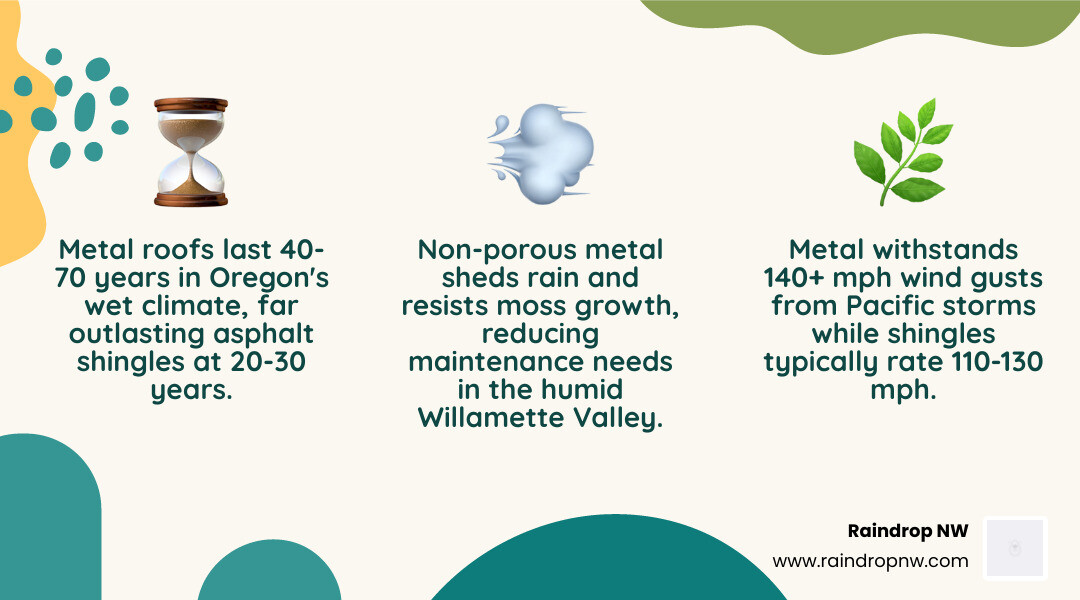
In the roofing world, “durability” is often just another word for “how many Oregon winters can this thing survive before I have to pay for a new one?” When we look at metal roof durability vs shingle in Oregon rain, the timeline difference is staggering.
For many of our neighbors in places like Lake Oswego and West Linn, a roof isn’t just a purchase; it’s a legacy investment. Metal roofs in the Pacific Northwest typically last between 40 and 70 years. Some high-end systems, like stone-coated metal, can easily sail past the 50-year mark with minimal fuss. This is why many call it a “forever roof.” If you install a metal roof in your 40s, there is a very good chance you will never have to worry about a roof replacement again in your lifetime.
Asphalt shingles, on the other hand, are the most common choice for a reason: they are reliable and cost-effective. However, their lifespan is shorter. In our wet climate, even Premium Shingle Options for Pacific Northwest Homes generally top out at 20 to 30 years. Standard architectural shingles might start showing their age around year 18 or 20 if they haven’t been meticulously maintained.
Why the gap? It comes down to material composition. Asphalt shingles are petroleum-based and covered in granules. Over time, Oregon’s constant cycle of rain followed by summer sun (thermal expansion) causes the oils in the shingles to dry out. They become brittle, the granules wash away into your gutters, and the “structural shield” begins to crack.
Metal doesn’t have that problem. Whether it’s a standing seam system or Ultimate Metal Roofing First Addition OR, the material is impervious to the rot and warping that can plague organic materials. While shingles are a great choice for homeowners who plan to move in 5 to 10 years, metal is the clear winner for those playing the long game.
Weathering the Storm: Wind Resistance and Rain Shedding
If you’ve lived through a November gale in the Tualatin Valley, you know that Oregon rain rarely falls straight down. It’s often pushed sideways by gusts that can reach 60 or 70 mph even in the metro area, and much higher near the coast.
When comparing metal roof durability vs shingle in Oregon rain, we have to look at how these materials handle “wind-driven rain.”
| Performance Metric | Metal Roofing | Asphalt Shingles |
|---|---|---|
| Wind Speed Rating | 140+ mph | 110–130 mph |
| Water Shedding | Superior (Smooth surface) | Good (Textured surface) |
| Primary Risk | Fastener backing (rare) | Shingle blow-off or uplift |
| Seam Vulnerability | Minimal (Interlocking) | High (Thousands of edges) |
Metal roofs are the heavyweight champions of wind resistance. Most residential metal systems are rated for winds exceeding 140 mph. Because the panels are large and often interlocked (especially in standing seam systems), there are fewer “edges” for the wind to catch. When the wind can’t lift the material, the rain can’t get underneath it.
Asphalt shingles have a different profile. While high-quality architectural shingles are rated for 110–130 mph, they consist of thousands of individual pieces. If a single shingle becomes loose or the sealant strip fails, a strong wind can lift it, creating a “catch” that allows rain to be driven directly onto your roof deck. This is why we always emphasize How to Extend the Life of Your Roof by checking for loose tabs after a major storm.
Rain shedding is another area where metal shines. Metal is non-porous and smooth. Water hits it and immediately slides off. In contrast, shingles have a rough, granular texture. While they are waterproof, they hold onto moisture longer. In a state where it can rain for thirty days straight, that “dwell time” matters. The longer a roof stays damp, the higher the risk of moisture-related issues like rot in the underlying wood deck.
Managing Moss and Algae in the Pacific Northwest
If there is one thing that keeps Oregon homeowners up at night (besides the Blazers’ playoff chances), it’s moss. Our damp, shaded neighborhoods in areas like Beaverton and Hillsboro are the perfect breeding ground for Gloeocapsa magma (the algae that causes black streaks) and thick, green moss.
In the battle of metal roof durability vs shingle in Oregon rain, moss is the “silent killer” of asphalt. Asphalt shingles often use limestone as a filler. Unfortunately, algae and moss view limestone as a delicious snack. As they grow, they root into the shingles, lifting the edges and holding moisture against the surface. This accelerates the breakdown of the asphalt and can lead to premature leaks.
To combat this, many homeowners look at an Architectural vs Designer Shingle Comparison to find shingles infused with copper or zinc granules, which act as a natural pesticide against moss. You can also install zinc strips at the ridge, but these require regular maintenance and replacement.
Metal roofs, conversely, are naturally resistant to moss and algae. Moss has a very hard time “taking root” on a smooth, non-porous metal surface. Furthermore, metal doesn’t contain the organic nutrients that these organisms need to thrive. While you might get some debris buildup in the valleys or a bit of “leaf sludge” if you live under heavy Douglas Firs, a simple annual rinse is usually enough to keep a metal roof looking brand new. For homeowners tired of the “scrape and treat” cycle every two years, metal is a game-changer.
Practical Considerations: Pitch, Style, and Efficiency
Choosing a roof isn’t just about survival; it’s about how the roof fits your home’s “lifestyle.” We often talk to homeowners in Damascus or Sandy who are worried that a metal roof will make their house look like a barn, or that it won’t be allowed by their HOA.
The truth is that modern roofing has come a long way. You can now get stone-coated metal that mimics the look of traditional shingles or even wood shakes, providing the durability of steel with the aesthetic of a classic Oregon home. Understanding How Shingle Grade Affects Lifespan and Appearance is vital here, because sometimes a high-end designer shingle can provide the look you want while still offering improved weather resistance.
How metal roof durability vs shingle in Oregon rain affects energy efficiency
Most people think of roofs only in terms of keeping rain out, but in May 2026, we’re seeing more homeowners prioritize energy efficiency. Oregon summers are getting hotter, and your roof is your primary defense against solar heat gain.
Metal roofs are “cool roofs” by nature. They have high solar reflectivity, meaning they bounce a significant portion of the sun’s rays back into the atmosphere rather than absorbing them into your attic. They also have high thermal emittance, meaning they shed heat quickly once the sun goes down. This can lower your summer cooling costs by 10% to 25%.
Asphalt shingles, being darker and more dense, tend to absorb heat and hold it, acting like a radiator that keeps your house warm long after sunset. While some modern shingles use reflective granules, they generally can’t match the thermal performance of a Best Metal Roofing Company in Raleigh Hills OR‘s metal installation.
Choosing the right pitch for metal roof durability vs shingle in Oregon rain
The “pitch” or slope of your roof heavily influences which material you should choose. Asphalt shingles generally require a minimum pitch of 2:12 to ensure water drains properly. If your roof is flatter than that, shingles are a recipe for disaster in Oregon rain because water can “back up” under the tabs.
For low-slope sections or modern homes with flat rooflines, standing seam metal is superior. The interlocking seams are practically watertight, and because there are no horizontal breaks, there is nowhere for water to pool. When we perform a drainage analysis for a home in Gresham or Clackamas, we often find that a “hybrid” approach—shingles on the steep parts and metal on the low-slope porch or addition—is the most effective way to manage water.
Frequently Asked Questions
Do metal roofs rust in Oregon’s wet climate?
This is a common concern, but modern technology has largely solved it. Most residential metal roofs are made from G-90 galvanized steel or “Galvalume,” which is steel coated with an aluminum-zinc alloy. These materials are incredibly rust-resistant. For our friends in coastal-influenced areas or those worried about salt spray, aluminum roofing is an even better option as it is naturally non-corrosive. With professional installation and protective finishes, rust is almost never an issue during the roof’s 50-year lifespan.
Are metal roofs louder than asphalt shingles during heavy rain?
The “pinging” sound of rain on a tin roof is a nostalgic memory for some, but it’s not the reality for a modern home. When a metal roof is installed over a solid wood deck with high-quality synthetic underlayment and standard attic insulation, it is no louder than an asphalt shingle roof. In fact, research shows that a properly insulated metal roof only adds about 8 decibels of sound during a heavy downpour—a difference that is virtually imperceptible to the human ear inside the house.
Can I install a metal roof over my existing asphalt shingles?
Technically, local building codes in many parts of Oregon allow for one “recover” (installing a new roof over an old one). Because metal is so lightweight, it doesn’t add much structural stress. However, as a local family-owned business, we almost always recommend a full tear-off. Why? Because you can’t see dry rot, mold, or deck damage through a layer of old shingles. In Oregon’s wet climate, it is vital to inspect the “bones” of your roof to ensure the new investment has a solid foundation.
Conclusion: Making the Best Choice for Your NW Home
At the end of the day, the choice between metal roof durability vs shingle in Oregon rain comes down to your budget, your aesthetic preferences, and how long you plan to call your current house “home.”
If you want the absolute best in longevity, moss resistance, and wind protection—and you plan to stay in your home for decades—metal is the clear winner. If you need a reliable, beautiful, and more immediate solution that fits a tighter budget, modern architectural shingles are a fantastic choice that we stand behind every day.
At Raindrop NW, we aren’t some out-of-state corporation. We are a multi-generational, family-owned team based in Beaverton, and we live under the same rainy skies you do. Whether you’re in Portland, Tigard, or Oregon City, we’re here to provide the local expertise and honest accountability you deserve.
Ready to upgrade your home’s protection? Explore our new replacement roof services today.




Leave a Reply
Want to join the discussion?Feel free to contribute!