
Step-by-Step Guide to Flat Roof Challenges in the Pacific Northwest
Why Flat Roof Challenges in the Pacific Northwest Catch Homeowners Off Guard
The flat roof challenges in the Pacific Northwest are some of the most demanding roofing problems any homeowner can face — and they often go unnoticed until serious damage has already set in.
Here is a quick look at the biggest challenges flat roofs face in this region:
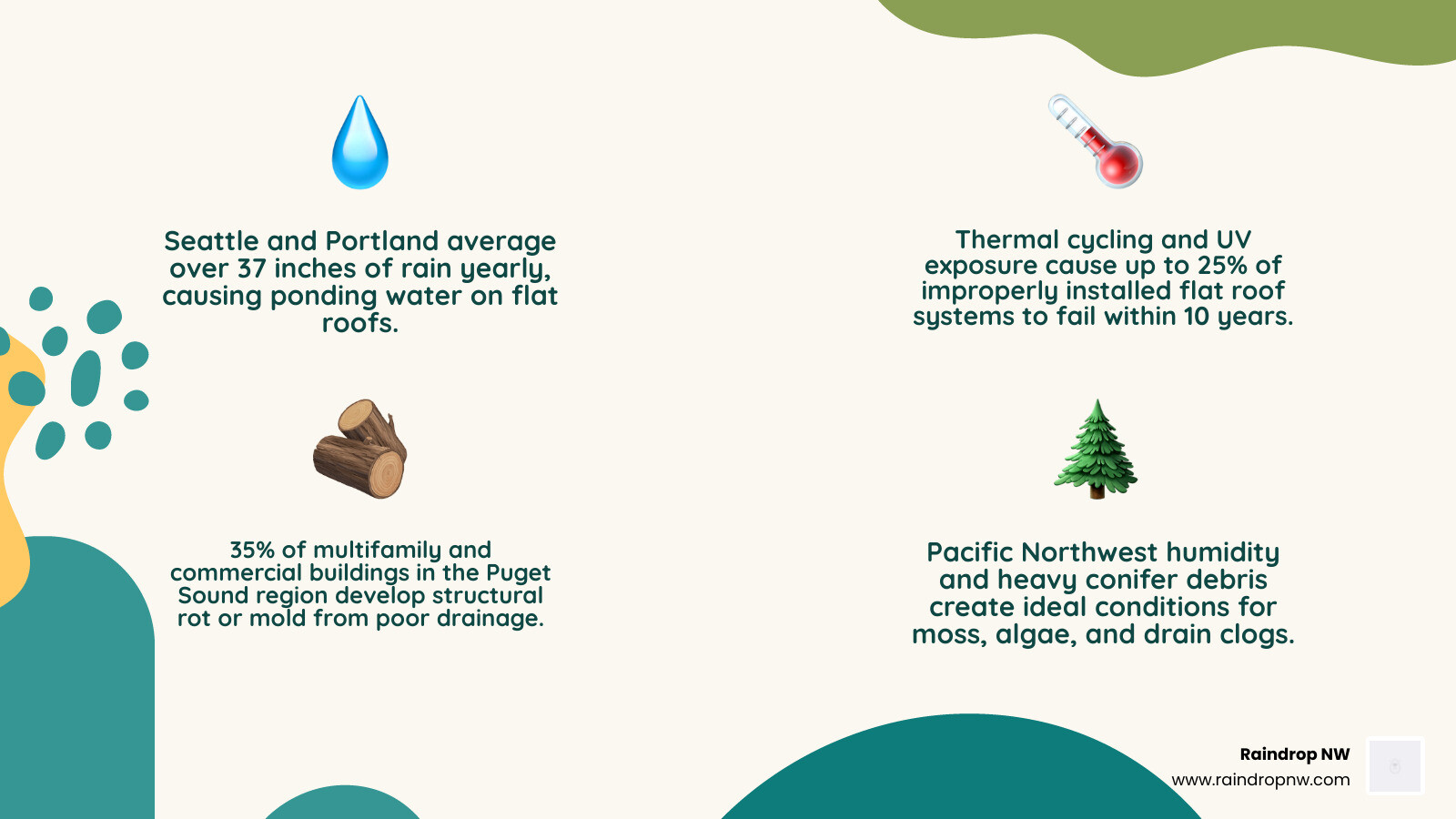
- Ponding water — Flat roofs lack the natural slope to shed rainfall, and Seattle and Portland averages over 37 inches of rain per year means water can sit for days.
- Condensation and rot — Without proper insulation design, warm indoor air hits a cold roof deck and creates hidden moisture that silently destroys structural wood.
- Seam separation — Thermal cycling and UV exposure cause membrane seams to pull apart, with up to 25% of improperly installed systems failing within 10 years.
- Moss, algae, and debris buildup — Pacific Northwest humidity and tree canopy create ideal conditions for organic growth that traps moisture and clogs drains.
- Poor drainage design — Approximately 35% of multifamily and commercial buildings in the Puget Sound region develop structural rot or mold linked directly to inadequate drainage.
- Membrane degradation — Even in overcast conditions, UV radiation breaks down roofing membranes at a molecular level, shortening lifespan significantly.
Flat roofs are common on modern homes, commercial buildings, garages, and additions across Oregon and Southwest Washington. They offer real advantages — rooftop equipment access, clean architectural lines, and straightforward installation. But in a climate defined by persistent rain, high humidity, mild but constant temperature swings, and heavy conifer debris, a flat roof demands far more precision than most people expect. One small installation error or a clogged drain after a storm can quietly trigger severe structural damage.
I’m Torrey Yungeberg, owner of Raindrop Roofing NW, and I’ve spent years helping Oregon and Southwest Washington homeowners navigate flat roof challenges in the Pacific Northwest — from diagnosing hidden condensation rot to selecting the right membrane material for our wet winters. In the sections ahead, I’ll walk you through everything you need to know to protect your home.
Flat Roof vs. Pitched Roof: The Battle Against PNW Rain

When choosing between roof styles in the Pacific Northwest, the fundamental battle is against water. Gravity is a pitched roof’s best friend; rainwater hits the slopes and immediately runs down into the gutters. On a low-slope or flat surface, water moves slowly, if at all.
Understanding how these two designs handle our relentless rain is essential for long-term property protection. You can read a detailed breakdown of these structural differences in our Flat Roof vs Pitched Roof Comparison.
Drainage and Ponding Water Risks
On a flat roof, “flat” is actually a misnomer. To function correctly, every flat roof must have a slight pitch—at least a 1/4-inch drop per foot—to guide water toward the drains. When a roof lacks this subtle slope, or if the framing sags over time, water pools in low areas. This is known as ponding water.
Building codes generally define acceptable ponding as water that remains on a flat roof for up to 48 hours after rainfall before evaporating or draining. In our damp, overcast winters, evaporation is virtually nonexistent. When water sits on a membrane for days or weeks, it exerts constant hydrostatic pressure on the seams.
Over time, this standing water accelerates membrane breakdown, dissolves adhesives, and finds even the microscopic gaps in your roof’s armor. Furthermore, the immense weight of ponding water can cause the roof deck to bow, creating a deeper depression that collects even more water. To safeguard your home, check out our Water Damage Prevention Tips for Pacific Northwest Homeowners.
Lifespan and Maintenance Realities
Because flat roofs must work significantly harder to keep water out, they naturally have a higher failure rate and shorter average lifespans than pitched roofs. In fact, flat roofs in the Pacific Northwest experience a 30-40% higher failure rate due to ponding water compared to pitched systems.
While a high-quality architectural shingle or metal pitched roof can easily last 30 to 50 years with minimal care, flat roofs require a much more hands-on approach. The combination of standing water, organic debris, and constant dampness creates a perfect breeding ground for moss and algae.
Douglas Fir needles and deciduous leaves easily accumulate on flat surfaces, forming a wet, heavy blanket that clogs scuppers and drains, trapping moisture directly against the membrane. You can explore how regional weather patterns specifically influence these timelines in our guide on How Portland Weather Affects Roof Lifespan.
Understanding Flat Roof Challenges in the Pacific Northwest
To truly understand why low-slope roofs struggle in places like Beaverton, Portland, and Vancouver, we have to look at the science of how these systems age under our unique environmental conditions.
Condensation and Flat Roof Challenges in the Pacific Northwest
One of the most insidious flat roof challenges in the Pacific Northwest is interior condensation. Traditional pitched roofs feature an attic space that acts as a buffer zone. Warm, moist air rising from your living spaces is vented out of the attic before it can cause trouble.
Most flat roofs do not have this attic buffer. Instead, they consist of a “compact” or “closed” cavity design. If the insulation is installed incorrectly, warm, humid indoor air rises and strikes the underside of the cold roof deck. Because the waterproof membrane on top acts as a vapor barrier, this moisture has nowhere to escape. It condenses back into liquid water, saturating the plywood decking, insulation, and joists.
To prevent this hidden rot, we highly recommend a “warm roof design.” This engineering approach places rigid Polyisocyanurate (PolyISO) insulation directly on top of the roof deck, beneath the waterproof membrane. This keeps the structural wood deck at a consistent, warm temperature, preventing the dew point from ever forming inside the wood cavity. You can learn more about how proper air movement protects your home in our article on How Ventilation Reduces Moisture Damage.
Mitigating Drainage and Flat Roof Challenges in the Pacific Northwest
Because gravity won’t do the heavy lifting, flat roofs require active, engineered drainage solutions. If a flat roof is built perfectly flat without tapered insulation or sloped joists, structural rot and mold are almost guaranteed. In the Puget Sound and Portland-metro regions, poor drainage design is responsible for structural rot in roughly 35% of low-slope buildings.
To mitigate this, modern installations utilize tapered PolyISO insulation panels. These panels are pre-cut with a built-in slope that is laid out like a puzzle across the roof deck, directing all water toward scuppers, gutters, or internal drains.
Additionally, we always recommend installing secondary (overflow) scuppers. These are emergency drainage outlets placed a couple of inches higher than your primary drains. If a heavy storm dumps leaves and pine needles that clog your main drain, the secondary scupper ensures water can still escape before its weight threatens the structural integrity of your home.
Best Flat Roof Materials for Wet Climates
Choosing the right material is the single most important decision you will make for a flat roof in our wet climate. Here is how the most common flat roof systems stack up:
| Material Type | Typical Lifespan (PNW) | Pros | Cons | Best Suited For |
|---|---|---|---|---|
| PVC (Single-Ply) | 20 – 30 Years | Heat-welded seams, highly chemical/algae resistant, handles ponding water beautifully | Premium material option | Residential flat roofs, commercial buildings, multi-family |
| TPO (Single-Ply) | 15 – 25 Years | Highly reflective, heat-welded seams, efficient installation | Can become brittle over time; harder to weld as it ages | Modern residential additions, light commercial |
| EPDM (Synthetic Rubber) | 15 – 25 Years | Highly flexible, handles thermal expansion well | Seams rely on adhesives/tape which can break down in wet climates | Large commercial structures with minimal penetrations |
| Modified Bitumen (Torch-down) | 15 – 20 Years | Durable, multi-ply thickness, highly puncture-resistant | Seams can separate; open-flame installation hazard | Small residential roofs, garages, detached carports |
| Built-Up Roof (BUR / Hot-Tar) | 10 – 15 Years | Thick, multi-layered protection | Heavy, rigid, loses elasticity quickly in wet climates | Older commercial buildings (largely outdated) |
For a broader look at what to expect when planning a commercial or large-scale low-slope project, check out our guide on Commercial Roofing Options and What to Expect.
Single-Ply Membranes: PVC and TPO
For the vast majority of flat roofs in our region, single-ply synthetic membranes like Polyvinyl Chloride (PVC) and Thermoplastic Polyolefin (TPO) are the superior choice.
Unlike older systems that rely on adhesives or glues at the seams, PVC and TPO seams are fused together using specialized hot-air welding equipment. This process melts the two sheets into one continuous, monolithic barrier. A hot-welded seam is actually stronger than the membrane itself, virtually eliminating the risk of seam separation during thermal movement.
PVC is particularly well-suited for the Pacific Northwest because it is completely impervious to standing water and highly resistant to organic growth like moss, mold, and algae. Furthermore, both PVC and TPO reflect up to 80% of solar radiation. This high reflectivity reduces heat absorption, keeping your home cooler in the summer and extending the overall lifespan of the roof by 5 to 10 years by minimizing UV-induced molecular breakdown.
Asphalt-Based Systems: Torch-Down and Modified Bitumen
Modified bitumen (often called torch-down) is an asphalt-based system that has been a residential default for decades. It consists of multiple layers of asphalt roll roofing modified with rubber (SBS) or plastic (APP) polymers to increase flexibility.
While modified bitumen is tough and highly resistant to punctures from falling branches, it has notable drawbacks in our climate. Because it is asphalt-based, it naturally loses its elasticity over time as it is exposed to UV rays and temperature swings.
Additionally, traditional torch-down installation requires using an open-flame propane torch to melt the asphalt seams together, which carries a fire risk during our increasingly dry summer months. For safer applications, we utilize cold-process modified bitumen, which uses liquid adhesives instead of open flames to seal the layers. However, even well-installed modified bitumen seams are more prone to moisture migration and separation over time than heat-welded PVC.
Common Installation Mistakes and Maintenance Practices
A flat roof is only as good as its installation. Because there is no slope to hide mistakes, even minor shortcuts can lead to catastrophic failures.
Poor Seam Welding and Flashing Failures
The most vulnerable parts of any flat roof are the seams and the flashing. Flashing is the material used to seal transitions—where the roof meets a wall, chimney, skylight, or plumbing pipe.
A common industry mistake is using unreinforced membranes or temporary caulking and sealants at these critical junctions. Standard sealants degrade rapidly under UV exposure and rain, cracking within a few years.
Corners, scuppers, and pipe penetrations are the true “Achilles’ heel” of flat roofs. Professional installers use pre-fabricated, reinforced PVC boots and custom-welded flashings to ensure these high-risk areas remain completely watertight. If you suspect your roof is showing its age, read our list of Signs Your Commercial Roof Needs Attention. To understand how we seal these vulnerable areas, explore How Proper Flashing Prevents Leaks.
Inadequate Slope and Lack of Tapering
When reframing a flat roof or preparing for a replacement, failing to address structural sag is a recipe for disaster. Over decades, wood joists naturally settle and sag. If a roofing contractor simply rolls a new membrane over an uneven, saggy deck without installing tapered insulation or adjusting the framing, water will immediately pool in those low spots. This leads to a spongy roof deck, rot in the underlying plywood, and eventual structural failure.
Routine Inspections and Debris Removal
To get the full 20 to 30 years out of a high-quality PVC or modified bitumen roof, routine maintenance is non-negotiable.
- Clear debris twice a year — Wet leaves and pine needles trap moisture and clog drains. Clean your roof every spring and fall.
- Inspect seams and flashing — Look closely for any signs of peeling, bubbling, or cracking around transitions.
- Check scuppers and drains — Ensure water can flow freely off the roof.
- Treat moss early — Use eco-friendly, roof-safe treatments to prevent roots from degrading the membrane.
Regular professional checkups are the best way to catch minor wear before it turns into a major headache. Learn more about How Inspections Prevent Costly Repairs.
Frequently Asked Questions About Low-Slope Roofs
Navigating flat roof care can raise a lot of questions. Here are some of the most common inquiries we receive from local property owners:
How long does a flat roof last in the Pacific Northwest?
On average, a high-quality single-ply PVC or modified bitumen roof will last 20 to 30 years in our climate, provided it is properly sloped, insulated, and maintained. Traditional hot-tar built-up roofs (BUR) have a much shorter lifespan of only 10 to 15 years due to their rigid nature and vulnerability to moisture retention.
What are the signs that a flat roof is failing?
Keep an eye out for these critical red flags:
- A “spongy” feel when walking on the roof, indicating rotted plywood decking beneath the membrane.
- Interior water stains or mold on your ceilings or upper walls.
- Blistering or bubbling, which means moisture has bypassed the membrane and is trapped underneath, vaporizing in the sun.
- Seam separation or cracking around flashing and scuppers.
Can I convert a flat roof to a pitched roof?
Yes. Converting a flat roof to a pitched roof is entirely possible and is an excellent long-term solution for persistent drainage issues. This process involves building a new truss system directly over the existing flat structure. While it requires structural reframing and more extensive structural work, it permanently eliminates ponding water risks and can significantly boost your home’s curb appeal and resale value.
Conclusion
Managing flat roof challenges in the Pacific Northwest requires a combination of smart engineering, high-quality materials, and experienced local craftsmanship. Whether you are dealing with a historic home in Portland, a modern remodel in Beaverton, or a commercial building in Vancouver, you need a roofing partner who understands how our unique climate impacts low-slope systems.
Raindrop Roofing NW is a truly local, family-owned company committed to long-term accountability. We live, work, and raise our families right here in the Pacific Northwest, bringing decades of hands-on experience to every project. We offer certified workmanship, honest advice, and transparent, detailed inspections.
If you are concerned about ponding water, hidden condensation, or the overall age of your low-slope roof, let our family protect yours. Schedule a Professional Roof Inspection with Raindrop Roofing NW today, and we’ll help you find the perfect, long-lasting solution for your home.




Leave a Reply
Want to join the discussion?Feel free to contribute!