
In-Depth Guide to Understanding Your Insurance Policy and Roofing Coverage

What Your Homeowners Insurance Actually Covers for Your Roof
Understanding your insurance policy and roofing coverage is one of the most important things you can do as a homeowner — especially after a storm rolls through the Portland area and leaves damage behind. Most standard homeowners policies do cover roof damage, but only under specific conditions. Here is a quick summary of what you need to know:
Your roof is covered when:
- Damage is sudden and accidental (wind, hail, falling trees, lightning, fire, weight of ice or snow)
- The damage is caused by a named covered peril in your policy
- The claim amount exceeds your deductible
Your roof is typically NOT covered when:
- Damage results from normal wear and tear or aging
- The roof was already deteriorating before the loss event
- Damage is caused by flooding, earthquakes, or lack of maintenance
- The damage is purely cosmetic with no functional impact
Your payout depends on:
- Whether your policy pays Replacement Cost Value (RCV) or Actual Cash Value (ACV)
- Your roof’s age and condition
- Your deductible type — flat dollar amount or percentage-based
- How thoroughly you document the damage
Most homeowners are surprised to discover that two neighbors with similar storm damage can receive very different insurance payouts — simply because of differences in their policy type, roof age, or how the claim was handled. The average cost of a roof replacement runs around $9,520, so knowing how your policy works before you need it can make a significant financial difference.
I’m Torrey Yungeberg, owner of Raindrop Roofing NW, and after years of helping Oregon and Southwest Washington homeowners navigate the intersection of roofing and insurance, I’ve seen how confusing understanding your insurance policy and roofing coverage can be — and how much money homeowners leave on the table without the right guidance. Let’s walk through everything you need to know, from covered perils to claim payouts, so you can protect your home with confidence.
Understanding Your Insurance Policy and Roofing Coverage: What is Covered?
When you open up your homeowners insurance policy, your roof is protected under what is known as Dwelling Coverage (Coverage A). This portion of your policy safeguards the physical structure of your home, including the walls, foundation, and—most importantly—the roof over your head.
However, insurance is not a maintenance plan. For your coverage to kick in, the damage must be caused by what insurers call a “covered peril.” In the Pacific Northwest, our roofs face a unique gauntlet of weather challenges. Windstorms whip through the Columbia River Gorge, heavy winter snow piles up on our shingles, and fallen Douglas fir branches are a constant hazard in heavily wooded neighborhoods from Lake Oswego to Vancouver, WA.
Standard homeowners policies typically cover roof damage caused by:
- Windstorms and Gale-Force Winds: Strong winds can peel shingles right off the deck, break adhesive seals, or lift entire sections of roofing. Wind and hail claims are incredibly common nationwide; in fact, wind and hail claims occurred at a frequency of 2.80 per 100 insured homes over the 2019-2023 period.
- Fallen Trees and Debris: If a massive pine or oak tree crashes onto your roof during a winter storm, your dwelling coverage will pay to repair the structural damage and replace the ruined roofing materials.
- Weight of Ice, Sleet, or Snow: Heavy winter storms can overload your roof structure, leading to structural sagging or, in extreme cases, a cave-in.
- Lightning and Fire: Direct lightning strikes or house fires are universally covered under standard policies.
- Ice Dams: When snow melts and refreezes at the cold eaves of your roof, it forms an ice dam that traps water behind it. This water can back up under your shingles and rot your roof deck.
While your policy is designed to step in during these sudden disasters, water damage inside your home is often a direct consequence of a compromised roof. To understand how water behaves once it gets past your shingles and how to mitigate these risks, check out our guide on How to Protect Your Home from Water Damage Through Your Roof.
Covered Perils vs. Exclusions
The golden rule of insurance claims is that the damage must be sudden and accidental. This means a single, identifiable event caused the damage. If a windstorm rips away 15 shingles on Tuesday night, that is sudden and accidental.
Conversely, if your roof has been slowly leaking for six years because the shingles are old and brittle, your insurance provider will view this as a maintenance issue and deny the claim. Standard policy exclusions include:
- Wear and Tear: Every roof has a natural expiration date. Standard policies exclude gradual deterioration caused by sun exposure, rain, and age.
- Cosmetic Damage: If a hailstorm leaves tiny, harmless dents on your metal roof or vents but does not compromise their water-shedding ability, your insurer may refuse to pay for a replacement under a cosmetic damage exclusion.
- Maintenance Neglect: If you let moss grow unchecked, fail to clean your gutters, or leave broken shingles unaddressed, the insurer can deny subsequent water damage claims, arguing that the damage was entirely preventable.
- Mold and Rot: Mold is typically excluded unless it is the direct result of an active, sudden water leak from a covered peril (like a tree puncturing the roof).
- Floods and Earthquakes: Standard HO-3 policies do not cover flood or earthquake damage. For flood protection, homeowners must purchase a separate policy through the National Flood Insurance Program (NFIP), which carries an average annual premium of about $888 to $939. For earthquakes—a very real threat here in the Pacific Northwest—a separate earthquake endorsement is required.
RCV vs. ACV: How Your Policy Type Affects Your Payout
When your roof claim is approved, the amount of money you actually receive depends heavily on whether you have a Replacement Cost Value (RCV) policy or an Actual Cash Value (ACV) policy. This distinction is often where homeowners experience the most significant financial surprises.
- Replacement Cost Value (RCV): This is the gold standard of roofing coverage. An RCV policy pays to replace your damaged roof with a brand-new equivalent at today’s market prices, regardless of how old your roof was when the storm hit.
- Actual Cash Value (ACV): An ACV policy only pays what your roof was worth at the exact moment of the loss. The insurer calculates the replacement cost and then subtracts depreciation based on the roof’s age and remaining lifespan.
When you file an RCV claim, the payout usually happens in two stages. First, the insurer sends you an ACV check (the depreciated value). Once we complete the roof replacement and submit proof of completion, the insurer releases the “recoverable depreciation” check to cover the remaining balance of the project. With an ACV policy, that depreciation is unrecoverable, meaning you must pay the difference out of pocket.
To learn more about how these payout structures affect your ability to fund a complete roof replacement, read our detailed article on Does Insurance Cover Roof Replacement?.
Understanding Your Insurance Policy and Roofing Coverage for Older Roofs
Your roof’s age is one of the most critical variables in the insurance equation. As a roof gets older, it becomes a liability for insurance companies. Many homeowners underestimate the age of their roof, which is a massive issue for the industry: inaccurate roof age costs home insurers an estimated $1.31 billion in lost premiums each year.
Because of this, insurance companies in 2026 are highly sensitive to roof age. If your roof is under 10 years old, you will likely receive full RCV coverage. However, once a roof passes the 10- or 15-year mark, carriers often implement the following:
- Automatic Conversion to ACV: Some policies contain clauses that automatically convert your roofing coverage from RCV to ACV once the roof reaches a certain age (often 15 years for architectural shingles).
- Limited Loss Settlement / Roof Payment Schedule: Instead of calculating custom depreciation, the insurer uses a fixed schedule. For example, a 15-year-old roof might only qualify for 30% to 40% of its replacement cost, leaving you to cover the remaining 60% to 70% out of pocket.
- Policy Non-Renewal: If your roof is over 20 years old, your insurance company may threaten to cancel your policy entirely unless you replace the roof out of pocket.
If you suspect your aging roof might complicate an upcoming claim, explore our guide on How Roof Age Affects Your Insurance Claim.
Comparing RCV and ACV Coverage Features
| Feature | Replacement Cost Value (RCV) | Actual Cash Value (ACV) |
|---|---|---|
| Replacement Terms | Pays for a brand-new roof of similar quality at current market prices. | Pays for the depreciated value of the roof at the time of damage. |
| Depreciation Impact | Temporarily withheld but fully recoverable after work is completed. | Permanently deducted; the homeowner must pay the depreciated difference. |
| Premium Differences | Higher annual premiums due to comprehensive coverage. | Lower annual premiums, but much higher out-of-pocket costs during a claim. |
| Payout Calculation | Total Replacement Cost minus Deductible. | (Total Replacement Cost minus Depreciation) minus Deductible. |
Navigating Deductibles and the Decision to File a Claim
Your deductible is the amount of money you must pay out of pocket before your insurance company starts paying. In the past, most homeowners had a simple flat deductible, such as $1,000 or $2,000. Today, however, deductibles have become far more complex.
In areas prone to severe weather, insurers frequently use percentage-based deductibles for wind and hail damage. Instead of a flat fee, your deductible is calculated as a percentage of your home’s total insured dwelling value (usually 1%, 2%, or 5%).
If your home in West Linn or Camas is insured for $500,000 and you have a 2% wind/hail deductible, your out-of-pocket cost is $10,000 before your insurance pays a single dime. Understanding this math is crucial before you initiate a claim.
When to File a Claim vs. Paying Out of Pocket
Just because you have storm damage doesn’t mean you should immediately file an insurance claim. Every claim you file goes into a national database called the Comprehensive Loss Underwriting Exchange (CLUE). Having multiple claims on your record can cause your premiums to skyrocket or make it incredibly difficult to secure coverage in the future.
Before you call your insurance agent, we recommend using this practical decision framework:
- Get a Professional, Independent Inspection First: Have a trusted local contractor inspect the roof to document the exact scope of the damage.
- Do the Deductible Math: If the estimated cost of repairs is $2,500 and your deductible is $2,000, filing a claim to get a $500 payout is a bad financial move. The slight payout is not worth the risk of a premium increase.
- Assess the Damage Type: If the damage is localized to a small area, a targeted repair might be the most cost-effective path. If the damage is widespread, a full replacement is likely necessary.
To help weigh your options between making a minor fix or investing in a new system, check out our decision guide on Should I Repair or Replace My Roof?.
Step-by-Step Guide to the Roof Insurance Claim Process
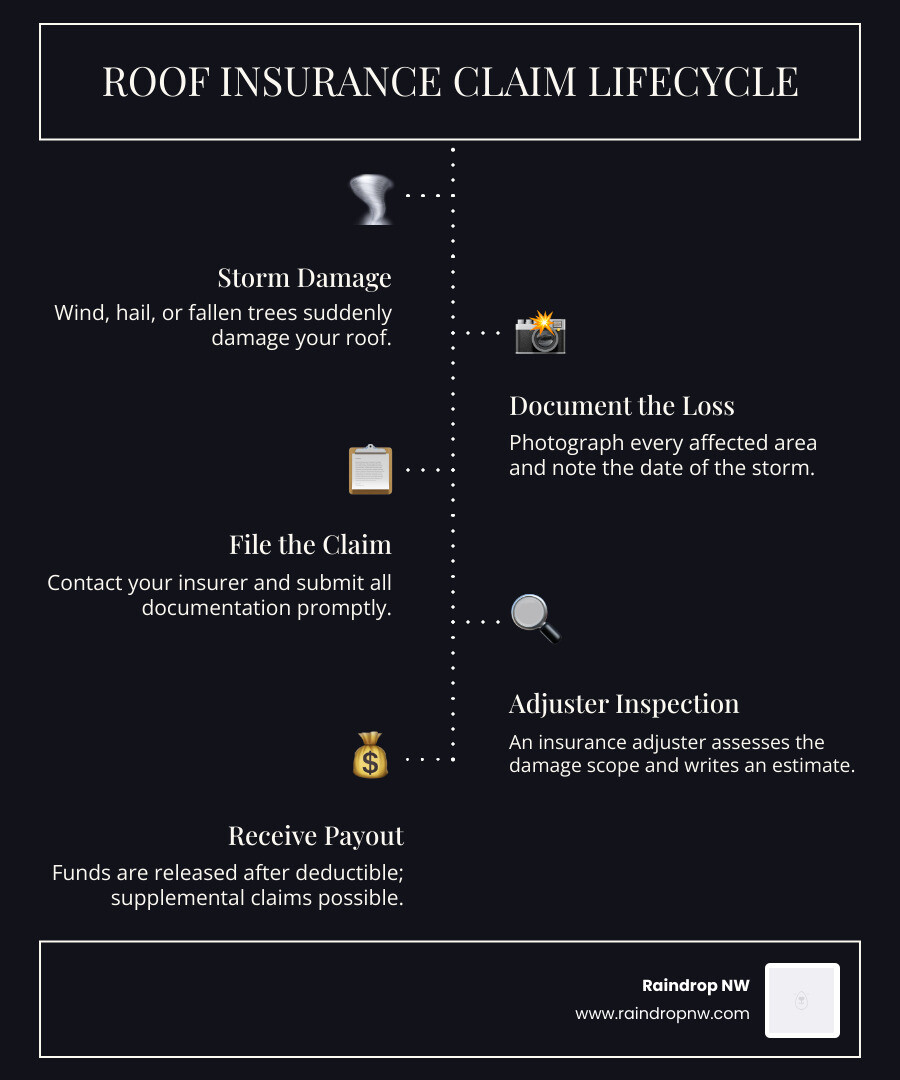
If you have verified that your roof has sustained significant, storm-related damage that comfortably exceeds your deductible, it is time to file a claim. Navigating this process systematically is the best way to ensure you receive a fair settlement.
- Document Everything Immediately: Take clear, date-stamped photos and videos of the roof damage from the ground, any debris in your yard, and any interior water stains on your ceilings.
- Prevent Further Damage (Mitigation): You are contractually obligated by your insurance policy to prevent further damage to your home. If you have an active leak, you must have it temporarily tarped. Keep all receipts for emergency repairs, as your insurer should reimburse you.
- Contact Your Insurer: File the claim promptly. Many policies have strict time limits (often one year from the storm event) for filing weather-related claims.
- Prepare for the Adjuster: The insurance company will send an adjuster to inspect your roof. It is highly beneficial to have your professional roofing contractor present during this inspection. We speak the adjuster’s language and can point out less obvious structural damage, ensuring nothing is missed.
For a detailed, printable walkthrough of this entire process, refer to our comprehensive guide on How to File a Roof Damage Insurance Claim.
Understanding Your Insurance Policy and Roofing Coverage Estimates
Once the adjuster completes their inspection, you will receive an estimate document. Over 90% of insurance adjusters use a standardized estimating software called Xactimate.
When you open a Xactimate estimate, it can look like an alien language. It breaks down the project line by line, calculating the exact quantity of shingles, underlayment, drip edges, starter strips, and ridge caps required. Key elements to look for include:
- Line Items: Ensure the estimate specifies the correct materials. For example, if you have architectural shingles, make sure the adjuster didn’t mistakenly price out cheaper 3-tab shingles.
- Overhead and Profit (O&P): If your project requires multiple trades (e.g., roofing, gutters, and drywall repair), you are typically entitled to an additional 20% markup (10% overhead + 10% profit) to cover the coordination of the work.
- Supplemental Claims: It is very common for a contractor to discover hidden damage—such as rotted plywood decking—only after they tear off the old shingles. When this happens, we document the rot, take photos, and submit a “supplemental claim” to your insurer to cover the extra costs before we proceed.
- Dispute Resolution: If your insurance company’s estimate is far too low to cover a proper installation, do not sign the settlement. You have the right to invoke the Appraisal Clause in your policy, which allows independent appraisers to resolve the pricing dispute.
Frequently Asked Questions About Roof Insurance
Does homeowners insurance cover roof leaks?
Yes, but only if the leak is the direct result of a covered peril, such as a fallen tree limb puncturing the roof or wind ripping away shingles. Insurance will not cover leaks caused by old age, rusted flashing, clogged gutters, or general lack of maintenance.
What is cosmetic damage exclusion?
A cosmetic damage exclusion means your insurer will not pay to repair or replace roofing components if the damage is purely aesthetic. For example, if hail leaves shallow dents on a standing seam metal roof but does not split the metal or compromise its waterproofing, the insurer will deny the claim.
How does roof age affect my policy renewal?
Insurance companies routinely review properties during renewal cycles. If your roof is over 15 to 20 years old, the underwriter may send you a non-renewal notice, stating that they will cancel your coverage unless you replace the roof within a specified timeframe (usually 30 to 60 days).
Conclusion
Understanding your insurance policy and roofing coverage is the ultimate shield against unexpected financial stress when Northwest weather takes a turn for the worse. By knowing the difference between RCV and ACV, keeping a close eye on your roof’s age, and understanding when to file a claim, you can make smart decisions that protect both your home and your wallet.
At Raindrop Roofing NW, we are proud to be a truly local, family-owned, and independently operated company. Unlike many regional competitors who have been bought out by out-of-state investment firms, our multi-generational team lives and works right here in Beaverton and the surrounding Portland metro communities. We are committed to long-term accountability, exceptional craftsmanship, and standing by our neighbors through every storm.
If you suspect your roof has storm damage, or if you simply want a professional, honest evaluation of its condition before the next rainy season hits, we are here to help. Schedule a professional roof inspection with Raindrop Roofing NW today, and let us bring clarity and peace of mind to your roofing needs.




Leave a Reply
Want to join the discussion?Feel free to contribute!