
The Ultimate Guide to How to Extend the Life of Your Roof in Rainy Climates
Why Rainy Climates Are So Hard on Oregon Roofs
If you’re trying to figure out how to extend the life of your roof in rainy climates, here’s the short answer:
- Schedule professional inspections at least once a year — ideally in late summer or early fall before the heavy rain season begins.
- Clean your gutters at least twice a year — more often if you have trees overhanging your roof.
- Control moss and algae growth — treat it annually and consider zinc or copper strips near the ridge line.
- Maintain proper attic ventilation and insulation — this prevents moisture buildup, mold, and premature shingle aging from the inside out.
- Address minor damage immediately — a missing shingle or cracked piece of flashing becomes a much bigger problem after a wet Oregon winter.
- Trim tree branches to at least 6–10 feet from your roof surface — overhanging limbs deposit debris, trap moisture, and scrape away protective granules.
- Choose materials suited for high-rainfall conditions — architectural shingles, metal roofing, and quality underlayments all perform better in persistent wet weather than entry-level alternatives.
Most Oregon roofs don’t fail overnight. They wear out gradually — through skipped maintenance, ignored moss, and gutters that quietly overflow from October through May. In the Portland metro area, where rainfall averages around 36 inches a year and the wet season runs for nearly half the year, that slow, steady moisture exposure puts real stress on every layer of your roof. Asphalt shingles absorb water during extended rain, then dry out and contract — a repeated cycle that creates microscopic cracks over time. Wood decking can begin to decay once its moisture content exceeds 30%, a threshold that’s surprisingly easy to reach here without adequate ventilation or surface protection. And once mold takes hold on a wet surface, it can begin growing within just 24 to 48 hours. The good news? With the right habits and the right local team, most roofing systems can last well beyond their expected lifespan — some homeowners extend roof life by five, ten, or even fifteen years with consistent proactive care.
I’m Torrey Yungeberg, owner of Raindrop Roofing NW, and after years of protecting homes across Beaverton, Portland, and the surrounding Oregon communities, I’ve seen what the Pacific Northwest climate does to roofs that aren’t given the right attention — and I’ve put together everything you need to know about how to extend the life of your roof in rainy climates right here. Let’s walk through it together.
Understanding Roof Lifespan and Rain Damage in the Pacific Northwest
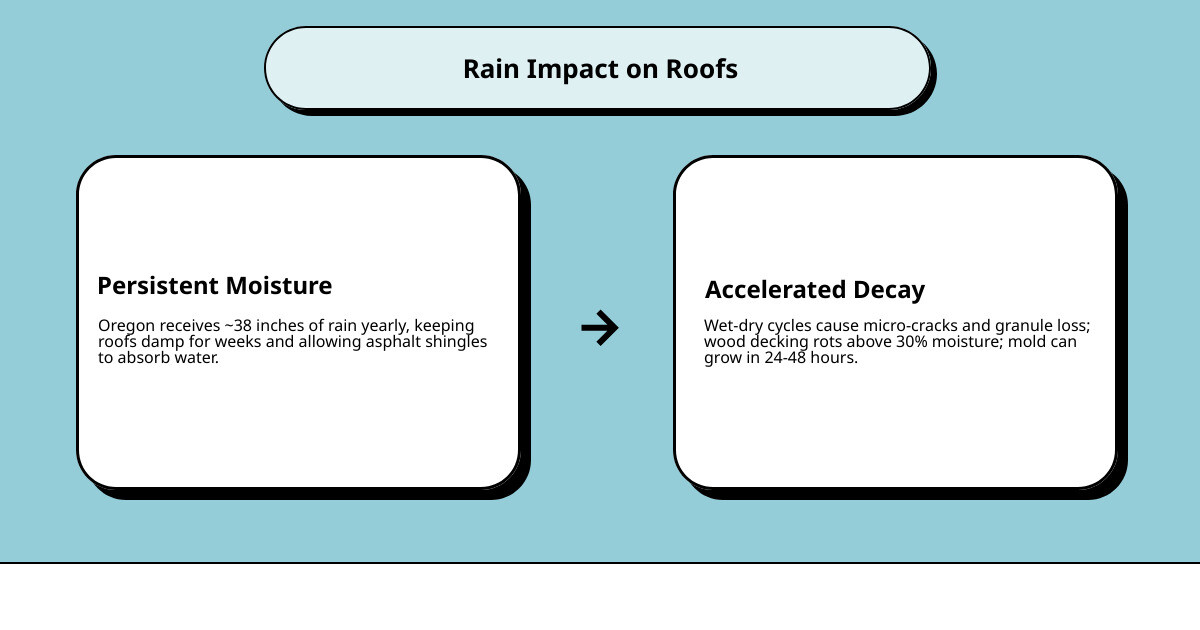
To understand how to protect your roof, we first have to look at what we’re up against. In the Pacific Northwest, we receive an average of approximately 38 inches of precipitation annually, with rainfall concentrated heavily from October through May. This isn’t just a heavy storm here and there; it is a persistent, months-long drizzle that keeps roofs damp for days or weeks on end.
While asphalt shingles are the most common roofing material in Portland and Beaverton, they behave differently under constant moisture than they do in drier climates. Over time, asphalt shingles absorb minute amounts of water. As we transition through our 18 to 36 freeze-thaw events each winter, that absorbed water expands and contracts. This cycle creates microscopic cracks in the shingle body, loosening the protective mineral granules on the surface.
When those granules wash away, the underlying asphalt is exposed directly to UV rays and rain, accelerating the aging process. If water manages to seep past the shingles and underlayment, it hits the plywood or OSB roof sheathing. Wood decays rapidly when its moisture content exceeds 30%. In consistently wet climates, roof sheathing can easily reach this decay threshold during extended rain seasons if there isn’t adequate ventilation to dry it out. Once wood rot begins, the structural integrity of your roof is compromised. Furthermore, because mold begins growing on wet surfaces within 24 to 48 hours, a minor, unaddressed leak can quickly turn into a health hazard for your household. To see a deeper dive into this process, check out our guide on How Portland Weather Affects Roof Lifespan.
How to Extend the Life of Your Roof in Rainy Climates by Spotting Early Warning Signs
You don’t have to wait for water to start dripping into your living room to know your roof is struggling. In fact, if you wait for a visible ceiling stain, the underlying structural wood may have been rotting for months. Spotting early warning signs is the absolute cornerstone of knowing how to extend the life of your roof in rainy climates.
Here is what you should look for from the safety of the ground using a pair of binoculars, or during a quick walk around your property:
- Granule Loss in the Gutters: If you clean your gutters and find piles of dark, sand-like granules, your shingles are losing their protective coating.
- Curling, Cupping, or Clawing Shingles: When shingles absorb too much moisture or suffer from intense attic heat, their edges curl upward or cup downward. This makes them highly vulnerable to being lifted and torn away by seasonal windstorms.
- Dark Streaks and Moss Patches: Dark streaks are usually blue-green algae, which is mostly cosmetic but holds moisture. Moss, on the other hand, is a structural threat. It acts like a sponge, holding water directly against the shingle surface and lifting the shingle edges, allowing wind-driven rain to blow underneath.
- Water Stains on Attic Sheathing: Grab a flashlight and head up to your attic during a heavy rainstorm. Look for damp spots, white mineral tracks, or dark water stains along the rafters and underside of the roof deck.
Catching these issues early is the most cost-effective way to preserve your home. For more tips on identifying hidden moisture pathways, read our article on How to Protect Your Home from Water Damage Through Your Roof.
How to Extend the Life of Your Roof in Rainy Climates Through Proactive Maintenance
Proactive maintenance isn’t just about fixing things when they break; it’s about preventing the conditions that cause failure in the first place. Homeowners who implement regular maintenance programs enjoy 25% to 40% longer roof life compared to those who take a reactive approach. When you consider that a new roof is a major investment, spending a little time and attention on maintenance is incredibly smart.
First, keep your roof clean of organic debris. When autumn leaves, pine needles, and twigs pile up in the valleys of your roof, they create small dams. These dams trap water, forcing it to pool and back up under the shingles.
Second, handle moss with extreme care. Never, under any circumstances, allow someone to pressure wash your asphalt shingle roof. The high-pressure water stream will strip away the protective granules instantly, effectively ruining the shingles and voiding your manufacturer warranty. Instead, use a gentle soft-wash treatment or manual removal with a soft-bristle broom, followed by an eco-friendly moss-preventative treatment. Applying zinc or copper strips near the ridge of your roof is an excellent long-term strategy. When rain runs over these metal strips, it carries trace minerals down the roof slope, creating an environment where moss and algae cannot grow.
Third, manage your trees. Trim back overhanging branches so they maintain at least a 6-to-10-foot clearance from your roof. This prevents branches from scraping against your shingles during high winds and drastically reduces the amount of debris falling onto your roof. For a comprehensive overview of local roof care, explore How to Extend the Life of Your Roof and The Ultimate Guide to Roof Care in Portland Oregon.
The Role of Attic Ventilation and Insulation in Wet Climates
We often focus entirely on what is happening on top of the roof, but what is happening underneath is just as critical for roof longevity. In wet climates, your attic space can easily become a trap for warm, humid air generated by daily household activities like showering, cooking, and washing dishes.
If your attic lacks proper ventilation, this moisture-laden air rises and condenses on the cold underside of your roof deck. This constant condensation leads to wood rot, mold growth, and structural sagging. Proper attic ventilation works on a simple principle: intake vents (usually under the eaves or soffits) draw cool, dry air in, while exhaust vents (along the ridge or roof peaks) allow warm, moist air to escape. The industry standard is the 1:300 rule, which means you need 1 square foot of net free ventilation area for every 300 square feet of attic floor space.
Proper insulation is the partner to good ventilation. If your insulation R-value is too low, warm air from your living space escapes into the attic. During the winter, this heat warms the roof deck, melting the snow on your roof. As the melted water runs down to the colder eaves, it refreezes, forming ice dams. These ice dams trap water on the roof, forcing it to back up under the shingles and leak into your home. To learn how to balance your attic system, read about How Ventilation Reduces Moisture Damage and How Ice Dams Form and What to Do About Them.
Managing Water Smartly: Gutters, Downspouts, and Drainage
Your roof and your gutters are a single, unified water-management system. If your gutters are clogged, damaged, or improperly sloped, even the highest-quality roof will suffer. When water cannot flow freely through your gutters, it backs up under the lower edge of your roof (the eaves), saturating the fascia boards, rotting the roof deck, and eventually finding a path inside your walls.
To keep this water-management system working flawlessly:
- Clean Gutters at Least Twice a Year: Clean them once in the late spring to clear out maple seeds and blossoms, and at least once (often twice) in the late autumn after the leaves have fallen.
- Upgrade to Seamless Gutters: Traditional sectional gutters have seams that collect debris and eventually leak. Seamless gutters, custom-fit to your home, eliminate these weak points entirely.
- Install Downspout Extensions: Ensure your downspouts discharge water at least 3 to 5 feet away from your home’s foundation. This prevents water from pooling around your basement or crawlspace.
- Consider Gutter Guards: If your home is surrounded by Douglas firs or maples, high-quality gutter guards can keep debris out while allowing water to flow freely, reducing your cleaning chores.
By keeping your gutters clear, you protect both your roofline and your foundation. Check out our Gutter Maintenance Tips for Homeowners and learn How Gutter Maintenance Prevents Foundation Damage to keep your home dry.
Choosing the Best Roofing Materials and Coatings for High-Rainfall Areas
If you are planning a roof replacement or looking to protect an existing low-slope roof, selecting the right materials for our wet climate is essential. Traditional 3-tab shingles are budget-friendly but don’t hold up as well to persistent rain and wind as modern alternatives. Modern architectural shingles are thicker, offer better wind resistance, and often feature built-in algae-resistant copper granules.
For flat or low-slope sections of your home, single-ply membranes like PVC or TPO are excellent because their heat-welded seams form a continuous, waterproof barrier. Additionally, silicone roof coatings are outstanding for restoring older low-slope roofs, as they resist ponding water and reflect UV rays.
| Material Type | Average Lifespan in Wet Climates | Key Benefits in Rainy Areas | Maintenance Needs |
|---|---|---|---|
| Architectural Shingles | 20–30 Years | Double-layered thickness, wind-resistant, copper granules inhibit algae growth. | Regular debris removal, annual moss prevention treatments. |
| Metal Roofing (Standing Seam) | 40–80 Years | Sheds water and snow rapidly, highly resistant to moss and rot. | Periodic fastener checks, cleaning of valleys and seams. |
| PVC / TPO Membranes | 20–30+ Years | Heat-welded seams create a completely waterproof barrier; ideal for flat roofs. | Semi-annual drain clearing, inspection of welded seams. |
| Silicone Coatings | Adds 10–15 Years | Seamless application over existing flat roofs; completely resists ponding water. | Occasional washing to maintain reflectivity. |
Professional Inspections: The Key to Catching Problems Early
While ground-level checks are great, there is no substitute for a professional, hands-on roof inspection. A certified roofer has the training and safety equipment to walk your roof and examine the components that are invisible from the ground.
We recommend having your roof professionally inspected once a year, preferably in the late summer or early fall. In our wet climate, inspections should focus heavily on flashing — the metal pieces installed around chimneys, skylights, dormers, and valleys. Flashing is your roof’s primary defense against water intrusion, and if the sealant around it has cracked or rusted, water will find a way in. Inspections also cover pipe boots (the rubber collars around plumbing vents), which tend to crack and fail after 10 to 12 years of UV and rain exposure.
To learn more about what a thorough inspection entails, see How Often Should You Have Your Roof Inspected and explore our guide on Roof Inspection Frequency for Pacific Northwest Homes.
How to Extend the Life of Your Roof in Rainy Climates: Repair vs. Replacement
At some point, every homeowner faces the question: Should I repair my roof, or is it time for a full replacement?
If your roof is relatively young (under 15 years old) and the damage is localized — such as a few shingles damaged by a falling branch or a small leak around a chimney — a professional repair is usually the best and most cost-effective path. We can replace the damaged shingles, install new flashing, and reseal the area to give your roof many more years of service.
However, if your asphalt shingle roof is approaching 20 years of age, has widespread curling or bald spots, or has suffered multiple recurring leaks, a replacement is often the safer, more economical choice in the long run. Continually patching an old, failing roof can end up costing more than a replacement, and it leaves your home vulnerable to sudden water damage. To understand how we catch these issues early, read How Regular Inspections Catch Problems Early and learn How Proper Flashing Prevents Leaks.
The Long-Term Value of Proactive Roof Care
Taking a proactive approach to your roof is one of the most financially rewarding decisions you can make as a homeowner. A few hundred dollars spent on routine gutter cleaning, moss treatments, and minor repairs can postpone a major roof replacement by years.
Furthermore, maintaining a detailed log of your roof’s maintenance history — including professional inspection reports, receipts, and before-and-after photos — is incredibly valuable. If your roof is ever damaged in a major windstorm, having proof of regular maintenance shows your insurance company that the damage was caused by the storm, not by neglect, making the claims process much smoother. A well-maintained roof preserves your home’s equity, improves its energy efficiency, and provides invaluable peace of mind when the winter rains arrive. For additional home protection tips, read our Water Damage Prevention Tips for Pacific Northwest Homeowners and download The Hillsboro Homeowners Handbook to Roof Longevity.
Frequently Asked Questions about Wet Climate Roof Care
How often should I clean my gutters in the Pacific Northwest?
You should clean your gutters at least twice a year: once in the late spring to clear out tree seeds and pollen, and once in the late fall after all the leaves have dropped. If your home is situated directly under heavy tree cover, you may need to clean them three or four times a year to prevent water from backing up under your shingles.
Does moss growth really damage my roof shingles?
Yes, absolutely. Moss is not just a cosmetic issue. It acts like a sponge, holding moisture directly against your shingles and preventing them from drying out. As the moss grows, its roots can lift and loosen the shingles, creating direct pathways for wind-driven rain to leak into your roof deck.
Can poor attic ventilation cause roof leaks?
Yes. Poor ventilation traps warm, moist air inside your attic. During cold weather, this moisture condenses on the underside of your roof deck, leading to wood rot, mold, and structural damage that looks exactly like a roof leak. It can also cause ice dams to form on your eaves, forcing water under your shingles.
Conclusion
Your roof is your home’s primary shield against the relentless Pacific Northwest rain. By understanding how to extend the life of your roof in rainy climates — through consistent gutter cleaning, moss control, attic care, and annual inspections — you can keep your home dry and safe for decades.
At Raindrop Roofing NW, we are proud to be a truly local, family-owned roofing company based right here in Beaverton, Oregon. Unlike companies owned by out-of-state investment firms, we are deeply committed to our local communities, including Portland, Hillsboro, Tigard, Tualatin, and Vancouver. We bring decades of experience, certified craftsmanship, and a transparent, neighborly approach to every home we serve.
Don’t wait for the next heavy rainstorm to find out if your roof is ready. Schedule professional roof maintenance and repairs with Raindrop NW today, and let our family protect yours.




Leave a Reply
Want to join the discussion?Feel free to contribute!