
In Depth Guide to How Portland Weather Affects Roof Lifespan
Why Portland’s Climate Is One of the Hardest Tests a Roof Will Ever Face
Understanding how Portland weather affects roof lifespan is one of the most important things you can do as a homeowner in the Pacific Northwest. Portland’s persistent rain, high humidity, moss-friendly shade, and shifting seasons create a uniquely demanding environment — one that regularly cuts years off a roof’s life compared to drier parts of the country.
Quick answer: How does Portland weather affect roof lifespan?
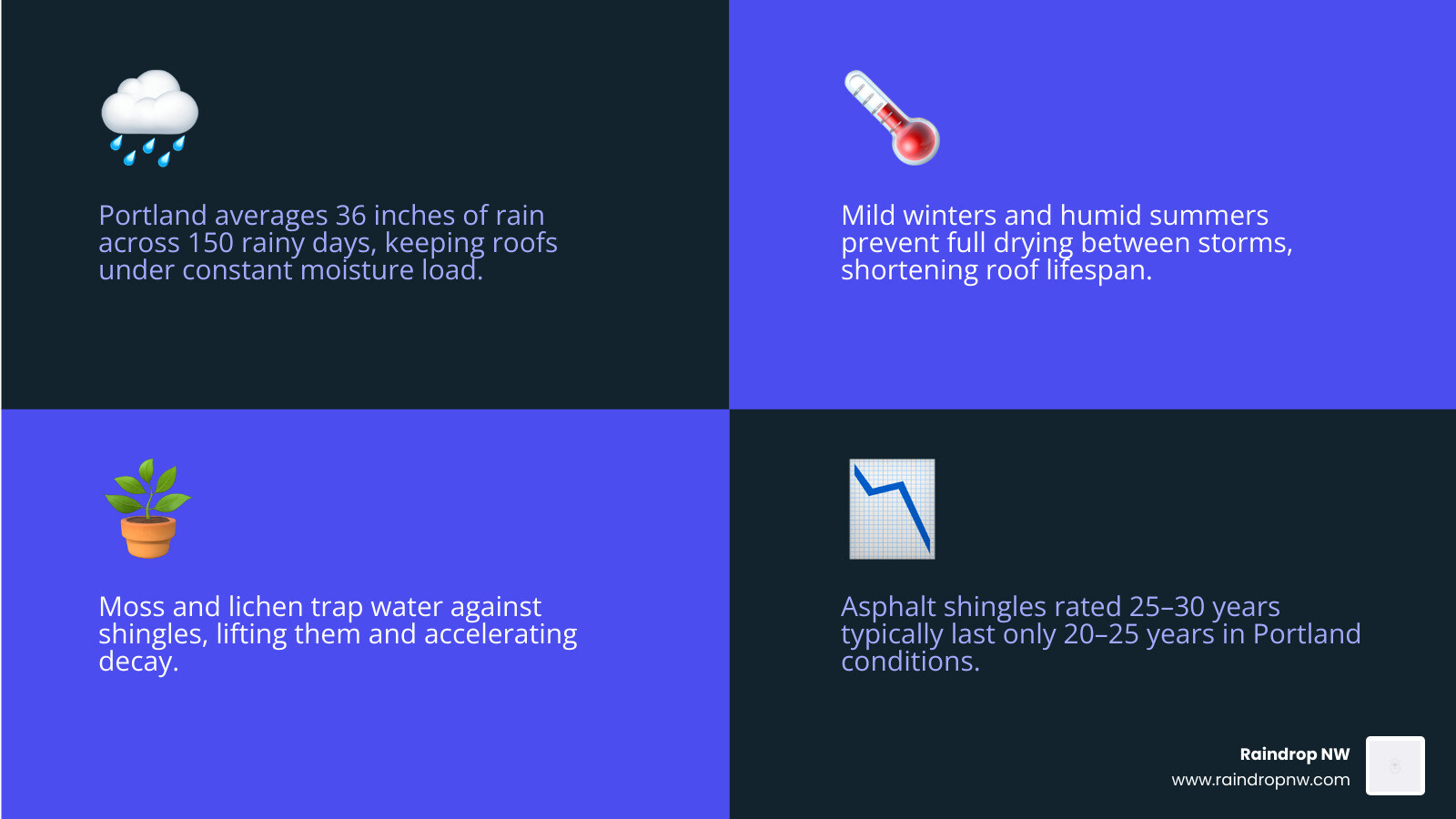
- Persistent rain — Portland averages 36 inches of rainfall and roughly 150 rainy days per year, keeping roofing materials wet for extended periods and slowing drying time
- High humidity — Moisture lingers even between rain events, encouraging moss, algae, and lichen to take hold on shingles and under flashing
- Moss and biological growth — Moss acts like a sponge, trapping water against the roof surface and physically lifting shingles, which accelerates decay
- Tree canopy and shade — Roofs under heavy tree cover stay damp longer; debris clogs gutters and valleys, and biological load can reduce roof lifespan by up to 40%
- Seasonal temperature swings — Cool, wet winters followed by warm, dry summers stress sealants, flashing, and shingle adhesives through repeated expansion and contraction
- Shorter real-world lifespan — Asphalt shingles rated for 25–30 years by manufacturers typically last only 20–25 years in Portland conditions, and less without regular maintenance
The result? Portland roofs age faster than their manufacturer ratings suggest — and homeowners who aren’t paying attention can find themselves facing major damage long before they expected to.
I’m Torrey Yungeberg, owner of Raindrop Roofing NW, a family-owned roofing company based in Boring, Oregon, and I’ve spent years working on roofs across the Portland metro — giving me a clear, ground-level view of exactly how Portland weather affects roof lifespan in ways generic roofing advice simply doesn’t capture. In this guide, I’ll walk you through everything you need to know to protect your home and make smart, informed decisions about your roof.
How Portland Weather Affects Roof Lifespan Year After Year
In May 2026, we are seeing more clearly than ever that our local climate doesn’t just “wet” a roof; it subjects it to a marathon of moisture. Portland averages about 36 to 40 inches of rain annually, spread across 150 rainy days. This means your roof is essentially under a “slow soak” for half the year.
Because our winters are mild and humid rather than freezing and dry, the moisture load stays high. Materials don’t get a chance to dry out completely between storms, creating a constant state of dampness that allows biological growth to thrive and structural components to weaken.
How Portland weather affects roof lifespan compared to drier climates
In a drier climate like Central Oregon or Arizona, a roof’s primary enemy is the sun. In the Portland metro area, it’s the lack of evaporation. Persistent moisture leads to a much higher risk of rot in the roof deck and corrosion of metal components. While a roof in a dry climate might fail because the materials become brittle from UV rays, a Portland roof often fails because moisture has found its way into the substrate, causing the wood to soften and fasteners to lose their grip.
How Portland weather affects roof lifespan through moss, algae, and lichen
If you live in neighborhoods like Lake Oswego, West Linn, or Beaverton, you know that moss is practically our unofficial state flower. But on a roof, moss is a destructive force. Moss uses “rhizoids”—root-like structures—to anchor itself into the granules of your shingles.
As the moss grows, it physically lifts the edges of the shingles. This creates a “damming” effect, where water is wicked upward and under the shingle, reaching the roof deck where it causes rot. Lichen and algae are equally problematic, as they hold moisture against the surface and accelerate the loss of protective granules.

Why seasonal temperature swings in Portland still matter
While we don’t have the extreme cold of the Midwest, our temperature fluctuations are significant. We often experience cool, damp nights followed by warm, sunny days. This creates a cycle of thermal expansion and contraction. Over time, this movement stresses the sealants around your chimney and vents, eventually causing them to crack. Furthermore, the increasing frequency of summer heatwaves in the Willamette Valley can bake shingles from the inside out if the attic isn’t properly ventilated.
Roof Lifespan by Material in Portland’s Wet Climate
When choosing a material, it’s vital to distinguish between “manufacturer ratings” and “Portland reality.” A shingle that is rated for 30 years in a lab might only give you 20 good years in the Pacific Northwest.
| Material Type | Manufacturer Rating | Portland Reality (Maintained) | Portland Reality (Unmaintained) |
|---|---|---|---|
| Asphalt (3-Tab) | 20 Years | 15-18 Years | 10-12 Years |
| Asphalt (Architectural) | 30 Years | 22-25 Years | 15-20 Years |
| Metal (Standing Seam) | 50-70 Years | 50+ Years | 40 Years |
| Wood Shakes/Shingles | 30-40 Years | 25-30 Years | 15-20 Years |
| Clay/Concrete Tile | 50+ Years | 50+ Years | 35-40 Years |
Asphalt shingles: expected lifespan in Portland vs rated lifespan
Asphalt shingles are the most common choice in areas like Tigard and Hillsboro, but they are also the most susceptible to moisture-related aging. In our climate, architectural shingles (which are thicker and more durable) are the gold standard. However, even these high-quality shingles struggle with granule loss and curling due to the constant wet-dry cycles. Without regular cleaning, an architectural roof that should last 30 years will often show signs of total failure by year 22.
Metal, tile, and wood roofs in Portland conditions
Metal roofing is increasingly popular in the Northwest because it sheds water and snow almost instantly and is immune to moss growth. Tile roofs (clay or concrete) offer incredible longevity, often lasting 50+ years, though they require a robust structure to handle the weight. Wood shakes, while beautiful and traditional in the PNW, are high-maintenance. Without specialized treatments, the natural oils in cedar can’t keep up with Portland’s moisture, leading to rot and fungal growth within 20 years.
Which roofing materials perform best in Portland and why
For the best balance of durability and cost-effectiveness in our region, we often recommend high-quality architectural shingles or standing-seam metal. These materials are designed for superior water shedding and can be treated with algae-resistant granules. To see the variety of options available for our local climate, you can check out more on roof types and products.
The Hidden Factors That Shorten Roof Life in Portland Homes
Beyond the rain itself, several “silent” factors can drastically shorten your roof’s life. At Raindrop NW, we often see roofs that should have lasted another decade fail early because of poor planning or neglect.
Why poor attic ventilation speeds up roof failure
Ventilation is just as important as the shingles themselves. In the winter, poor ventilation traps moist air from your bathroom and kitchen in the attic. This moisture condenses on the underside of your roof deck, leading to mold and wood rot. In the summer, a hot attic “bakes” your shingles from underneath, making them brittle. We follow the 1-to-300 rule (1 square foot of ventilation for every 300 square feet of attic space) to prevent this. Learn more about how ventilation reduces moisture damage.
How tree coverage and debris can cut years off a roof
In heavily wooded areas like Damascus, Boring, or the West Hills, tree canopy is a major factor. If your roof is shaded most of the day, it never dries out. Furthermore, falling needles and leaves accumulate in your roof valleys and gutters. This debris acts like a wet rag, holding moisture against the shingles 24/7. We’ve seen biological loads from unmanaged debris reduce a roof’s lifespan by as much as 40 percent.
Installation details that matter most in Portland’s climate
In a wet climate, the “extras” aren’t optional. We use synthetic underlayment instead of traditional felt because it doesn’t absorb water or rot. Proper flashing around chimneys, high-quality pipe boots, and stainless steel fasteners are critical for a roof that survives the Oregon rain. For more details on these critical components, see our guide on how to protect your home from water damage through your roof.
Early Warning Signs Portland Weather Is Damaging Your Roof
You don’t want to wait for a puddle on your living room floor to realize your roof is failing. In Portland, the signs are often subtle at first.
The first signs of moisture damage homeowners often miss
Keep an eye out for “soft spots” when walking on the roof (though we recommend letting a pro do the walking). Inside the house, look for dark streaks on your attic rafters or a faint mildew smell. These indicate that how Portland weather affects roof lifespan is already taking a toll through hidden condensation. You can find out more about what we look for during a professional roof inspection.
When to schedule inspections after Portland storms and rainy seasons
We recommend a professional check-up at least once every two years, but preferably every year for older roofs. The best times are late spring (to assess winter damage) and early fall (to prepare for the coming rains). It’s also wise to check your roof after major wind events or “atmospheric rivers.” Read more about how often you should have your roof inspected and how weather events trigger the need for inspections.
Repair or replace after Portland moisture and moss damage?
If your roof has localized damage—like a single leaky pipe boot or a few missing shingles from a windstorm—a repair is usually the most cost-effective move. However, if you see widespread moss growth, brittle shingles that crack when touched, or sagging areas in the roofline, a full replacement is likely necessary. Replacing an aging roof before it fails completely can save you thousands in interior water damage repairs.
Maintenance Steps That Extend Roof Life in Portland
The good news is that you aren’t helpless against the weather. A little bit of proactive care goes a long way in our damp environment.
The most effective maintenance routine for Portland homeowners
- Gutter Cleaning: Do this at least twice a year—once in late fall after the leaves drop and once in spring.
- Debris Removal: Use a leaf blower or a soft brush to clear valleys. Never use a pressure washer!
- Moss Treatment: Use zinc or copper strips at the ridge, or apply a professional, pH-balanced moss killer.
- Branch Trimming: Keep branches at least 6 to 10 feet away from your roof to prevent shade and physical damage.
For a deeper dive, check out our tips on how to extend the life of your roof and other water damage prevention tips.
Why regular inspections add years to a roof in wet climates
A professional eye can catch a cracked sealant or a loose flashing piece that you might miss from the ground. Catching these “small” issues early prevents them from turning into “big” structural rot problems. This proactive approach is the “gold standard” for Pacific Northwest homeowners. See why regular inspections catch problems early and learn about inspection frequency for PNW homes.
Mistakes to avoid when maintaining a Portland roof
The biggest mistake we see is homeowners using a pressure washer to “clean” moss. This blasts the protective granules off your shingles, effectively aging your roof by 10 years in a single afternoon. Another common error is ignoring “minor” gutter clogs; when gutters overflow, water backs up under the eaves, rotting the fascia boards and roof edge.
Frequently Asked Questions About How Portland Weather Affects Roof Lifespan
Is a 30-year roof really going to last 30 years in Portland?
In the real world of the Portland-Metro area, the answer is usually no. While the manufacturer’s warranty might cover defects for 30 years, the environmental stress of 150 rainy days a year usually limits the functional life of an asphalt roof to 20-25 years. Proper maintenance can push it closer to that 30-year mark, but neglect will drop it much lower.
How often should Portland homeowners have their roof inspected?
We recommend a professional inspection every 12 to 24 months. If you have heavy tree cover or an older roof (15+ years), an annual inspection is the safest bet to ensure you aren’t surprised by a sudden leak during a December downpour.
What time of year is best for roof maintenance in Portland?
September and October are the “golden months” for roof prep. The weather is usually dry enough for repairs and moss treatments to set properly before the heavy rains return in November. May and June are also excellent for clearing away the debris left behind by winter storms.
Conclusion
Planning for the long-term health of your home means respecting the power of the Oregon climate. By choosing the right materials, ensuring proper ventilation, and sticking to a consistent maintenance schedule, you can ensure your roof protects your family for decades to come.
At Raindrop NW, we’ve built our reputation on being a truly local, family-owned company that understands the specific challenges of the Portland metro. We aren’t an out-of-state firm; we live and work in the same rainy weather you do. For more local expertise, read our ultimate guide to roof care in Portland Oregon or explore our residential roofing services.
If you’re concerned about how your roof is holding up, don’t wait for the next atmospheric river to find out. Contact us today for a free, honest inspection and let’s make sure your home stays dry.




Leave a Reply
Want to join the discussion?Feel free to contribute!