
Step-by-Step Guide to Decide Replace or Repair Gutters
Is It Time to Fix or Replace Your Gutters? Here’s How to Decide
Knowing when to replace vs repair your gutters can save you from a costly mistake — either throwing money at a failing system or replacing something that just needs a quick fix.
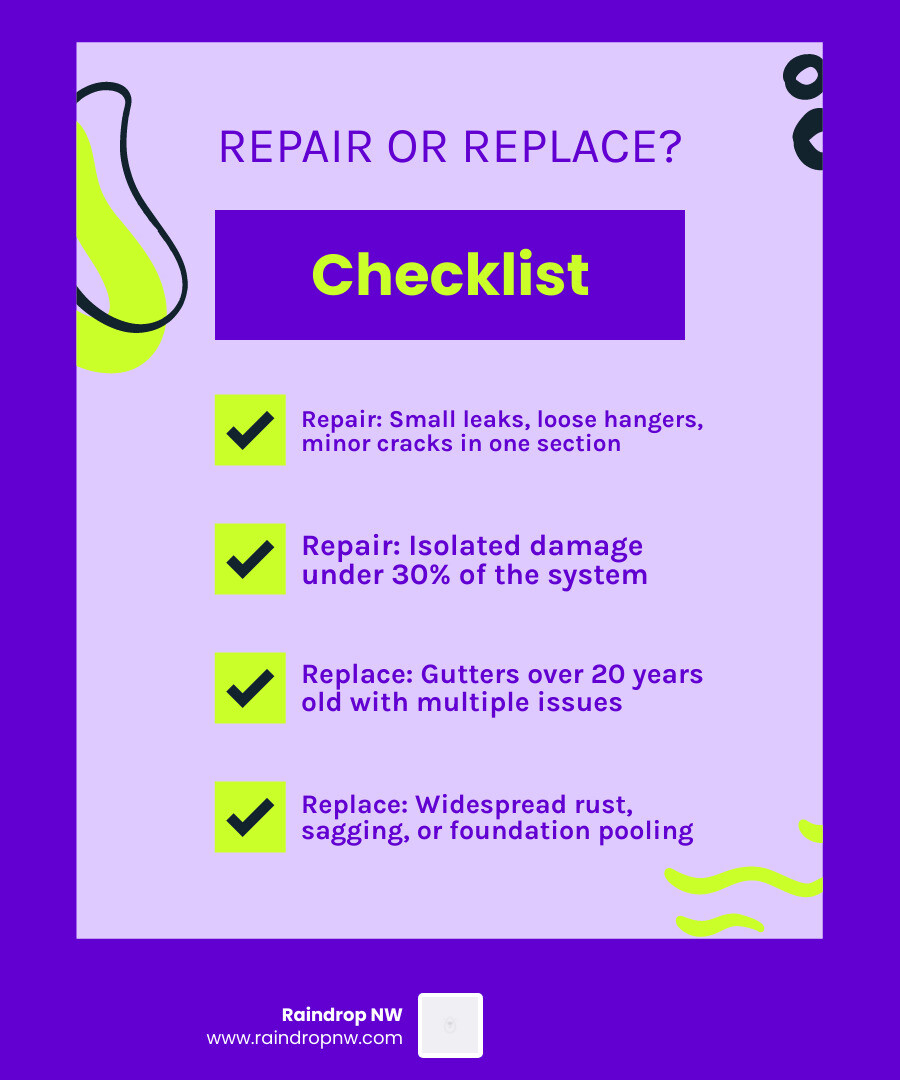
Quick answer: Should you repair or replace your gutters?
| Situation | Recommended Action |
|---|---|
| Small leak at one seam or joint | Repair |
| One or two loose hangers | Repair |
| Minor crack or hole in a single section | Repair |
| Gutters over 20 years old with multiple issues | Replace |
| Widespread rust, sagging, or warping | Replace |
| Water pooling near your foundation | Replace |
| Damage affecting more than 30% of the system | Replace |
| Replacing your roof at the same time | Replace gutters too |
Your gutters do a quiet but critical job. Every time it rains — and in the Pacific Northwest, that’s often — they channel water away from your roof edge, siding, and foundation. When they stop working, that water has to go somewhere, and it usually goes somewhere expensive. The tricky part is figuring out whether a targeted repair will solve the problem or whether you’re patching something that’s already past its useful life.
I’m Torrey Yungeberg, owner of Raindrop Roofing NW, and after years of inspecting gutter systems across the Portland metro area, I’ve seen how the wrong call on when to replace vs repair your gutters leads to avoidable damage and repeat service calls. In this guide, I’ll walk you through a clear, honest decision-making process so you can move forward with confidence.
When to Replace vs Repair Your Gutters: The Core Decision Factors
When evaluating your gutter system, we look at the big picture rather than just the single leak that caught your eye during yesterday’s downpour. Deciding when to replace vs repair your gutters requires looking at three core factors: the overall extent of the damage, the age of the system, and the expected lifespan of the gutter material.
| Decision Factor | Lean Toward Repair | Lean Toward Replacement |
|---|---|---|
| Damage Extent | Localized to one or two sections, minor seam leaks, or a few loose brackets. | Widespread across multiple runs, continuous sagging, or extensive rust. |
| System Age | Well under its expected lifespan (e.g., a 5-year-old aluminum system). | Approaching or exceeding its typical service life (e.g., 20+ years). |
| Fascia & Substrate | Strong, dry, and structurally sound wood behind the gutters. | Rotted, soft, or crumbling fascia boards that cannot hold fasteners. |
| Past Repairs | First or second minor issue in several years. | Recurring leaks and sagging despite multiple previous patching attempts. |
Understanding these variables is essential because your gutters do not operate in a vacuum. They are a fundamental element of your home’s exterior envelope. For a deeper look at how these systems integrate with your shingles and underlayment, you can read about Gutter Systems and Why They Matter for Your Roof.
Understanding When to Replace vs Repair Your Gutters for Small Holes
Small holes and minor cracks are common, especially in older sectional systems. If you notice a tiny drip, you do not necessarily need to budget for an entire new system.
For isolated holes, a targeted repair is highly effective. We typically clean the area thoroughly with alcohol to remove dirt and tar, apply a high-grade, industrial-strength waterproof sealant, and sometimes reinforce the area with a small piece of metal flashing or a specialized patch kit.
However, these patches should be viewed as localized fixes. If your gutters are nearing the end of their remaining lifespan, a patch is merely a temporary delay. If you find yourself patching new holes every autumn, the metal has likely thinned to the point of systemic failure, and patching is no longer a smart use of your time or money.
Evaluating Systemic Failure: When to Replace vs Repair Your Gutters
Systemic failure occurs when the structural integrity of the entire gutter run is compromised. This is where we apply the 50% Rule: if the cumulative cost of repairing various sections, replacing rotted fascia boards, and rehanging sagging runs exceeds 50% of the cost of a brand-new, seamless gutter system, replacement is the more economical decision.

Signs of systemic failure include:
- Widespread Warping: Gutters that have twisted or bent out of shape due to heavy snow, ice, or ladder pressure. Once metal or vinyl wraps, it loses its original structural strength and cannot reliably hold the correct pitch.
- Repeated Repairs: If you are calling a technician out every season to seal the same joints or re-secure the same runs, you are paying for temporary patches on a system that fundamentally needs to be retired.
- Failing Structural Support: When gutters pull away from the home because the wood behind them has rotted, simply putting in larger screws will not solve the problem. The entire run must be taken down so the underlying structure can be rebuilt.
Spotting the Signs: Gutter Repair vs. Full Replacement
Knowing exactly what to look for can help you make a swift, practical decision before the next major Pacific Northwest rainstorm arrives.
Identifying localized leaks, loose hangers, minor cracks, and seam separation early allows you to address issues before they cause rot in your roof deck. For proactive steps you can take to keep your system running smoothly, check out our Gutter Maintenance Tips for Homeowners.
When Localized Repair is Sufficient
In many cases, a professional touch can restore your gutters to perfect working order without requiring a full teardown. Localized repairs are highly successful under the following conditions:
- Tightening and Replacing Hangers: If a heavy snow load or a buildup of wet leaves has caused a few hangers to loosen, we can simply back out the old fasteners and install new, heavy-duty screw-in hangers.
- Sealing Joint and Seam Leaks: Sectional gutters naturally expand and contract with temperature changes, which degrades the sealant at the joints over time. Scraping away the old, dry caulk and applying a fresh layer of commercial-grade elastomeric sealant will usually stop the leak for another three to five years.
- Clearing Downspout Elbows: When water backs up and pours over the sides, it is often just a stubborn clog in the downspout elbow. Clearing the debris and flushing the system with a hose is a simple maintenance fix.
- Isolated Physical Damage: If a fallen tree branch dents a single ten-foot section of a sectional system, we can often replace just that single damaged piece while leaving the rest of the system intact.
Red Flags That Demand Full Replacement
On the other hand, some symptoms indicate your gutter system has reached the end of the road. Ignoring these red flags can lead to severe structural issues.
- Widespread Rust and Corrosion: If you see orange flecks, scaling, or rust holes spreading along the bottom of your steel or older aluminum gutters, the metal is disintegrating from the inside out.
- Sagging Runs That Cannot Be Re-Pitched: Gutters must slope precisely toward the downspouts (typically a quarter-inch drop for every ten feet of run). If the metal has sagged permanently and cannot be adjusted, standing water will pool, accelerate rust, and attract pests.
- Multiple Persistent Leaks: When leaks appear at six, seven, or more points across your home, it means the entire system is failing simultaneously.
- Water Pooling Near the Foundation: If water is consistently overflowing the gutters and pooling next to your basement or crawlspace, the system is failing its primary objective. To understand the severe consequences of leaving this unaddressed, read How Gutter Maintenance Prevents Foundation Damage.
How Gutter Material, Age, and Roofing Projects Influence Your Choice
The materials your gutters are made of, combined with their age, play a massive role in determining whether a repair will hold up over time.
Because your roof and gutters work as a single, cohesive water management system, choices made on one directly impact the other. To learn how to keep your home dry from the shingles down, explore How to Protect Your Home from Water Damage Through Your Roof.
Material Lifespans and Seamless vs. Sectional Performance
Different gutter materials react uniquely to the damp, seasonal climate of the Pacific Northwest:
- Vinyl (Plastic) Gutters: These typically last 10 to 15 years. While they do not rust, they become highly brittle when exposed to cold temperatures and UV light. If your vinyl gutters are cracking, they must be replaced, as patches rarely hold on aged plastic.
- Aluminum Gutters: The industry standard, lasting 20 to 30 years. They are lightweight and rust-resistant, making them excellent candidates for localized repairs if they are under 15 years old.
- Galvanized Steel Gutters: Highly durable but prone to eventual rust. They usually last 15 to 25 years. Once rust begins to eat through the protective zinc coating, replacement is inevitable.
- Copper and Zinc Gutters: Premium materials that can last 50 to 80+ years. Because of their high value, we almost always recommend specialized repairs (such as professional soldering) to preserve the system rather than replacing it.
The style of your gutters also dictates their vulnerability to leaks. Sectional gutters feature joints every 10 to 20 feet, creating multiple potential failure points. Every joint is a spot where sealant can dry out, crack, and leak.
Seamless aluminum gutters, which are custom-fabricated on-site to match the exact dimensions of your home, only have joints at the corners. This design eliminates up to 90% of potential leak points, significantly reducing maintenance needs and extending the system’s active lifespan.
Coordinating Gutter Replacement with Roof Projects
If your roof is nearing the end of its life and you are planning a replacement, it is highly advantageous to coordinate your gutter replacement at the exact same time. Here is why:
- Financial and Labor Efficiency: The roofing crew is already on-site, safety rigging is established, and old materials are being hauled away. Combining the projects reduces overall labor overhead.
- Perfect Drip Edge Integration: The drip edge is a metal flashing installed under the first row of shingles that directs water directly into the center of the gutter. Installing new gutters alongside a new roof ensures these two critical components overlap perfectly, preventing water from slipping behind the gutter and rotting your fascia board.
- Protection of Your Investment: Installing new gutters first, only to have heavy roofing materials and ladders lean against them during a subsequent roof replacement, risks denting or damaging your brand-new gutters. Doing them together, in the correct construction sequence, guarantees a flawless, protected finish.
Frequently Asked Questions About Gutter Care
How often should Pacific Northwest homeowners inspect their gutters?
In the Portland metro and Beaverton areas, we recommend inspecting your gutters at least twice a year — once in the late spring and once in the late autumn.
Because of our dense canopy of Douglas firs, maples, and pine trees, pine needles and leaves can pack down quickly, creating heavy, wet blockages. If your property is heavily wooded, you may need to clear them more frequently to prevent water from backing up under your shingles. For more regional advice on keeping your home dry, check out our Water Damage Prevention Tips for Pacific Northwest Homeowners.
Can sagging gutters be repaired, or must they be replaced?
It depends entirely on the condition of the wood behind them. If the sagging is simply due to loose or bent hangers, we can correct the slope and secure the run with new, heavy-duty hidden hangers.
However, if the gutters are sagging because water has leaked behind them and caused the fascia board to rot, the hangers will no longer have solid wood to bite into. In this scenario, the gutters must be removed, the rotted wood replaced, and a new gutter system installed.
Do gutter guards extend the lifespan of an existing system?
Yes, high-quality leaf protection and micro-mesh gutter guards can significantly extend the lifespan of your gutters. By keeping leaves, twigs, and pine needles out, they prevent the heavy standing clogs that lead to stagnant water, accelerated rust, and sagging runs.
However, gutter guards are not a cure-all for an already failing system. If your gutters are already rusted, warped, or structurally compromised, installing guards will not save them. Guards should be installed on structurally sound systems to protect and preserve your investment.
Conclusion
Deciding when to replace vs repair your gutters does not have to be a guessing game. By looking at the pattern of damage — whether it is a single, isolated leak or a systemic issue affecting multiple areas of your home — you can make a smart, cost-effective decision that protects your property for years to come.
At Raindrop Roofing NW, we have spent decades helping our neighbors in Beaverton, Portland, Hillsboro, Tigard, and throughout the surrounding communities navigate these decisions. As a family-owned, multi-generational local business, we pride ourselves on honesty and craftsmanship. We do not believe in high-pressure sales tactics or recommending a full replacement when a straightforward, professional repair will do the job.
If you are unsure whether your gutters can survive another wet winter, let us take a look. We offer comprehensive, transparent inspections to give you clear answers. Contact us today to schedule your assessment, and visit our Raindrop NW Residential Roofing Repairs and Maintenance page to see how we can keep your home safe, dry, and secure.




Leave a Reply
Want to join the discussion?Feel free to contribute!