
The Definitive Guide to Roofing Budget Planning
What to Include in Your Roofing Budget (And Why It Matters More Than You Think)
What to include in your roofing budget goes well beyond just the shingles on top — and for most Oregon homeowners, the full picture comes as a surprise. Here’s a quick overview of everything that belongs in a complete roofing budget:
Core budget items for a roof replacement:
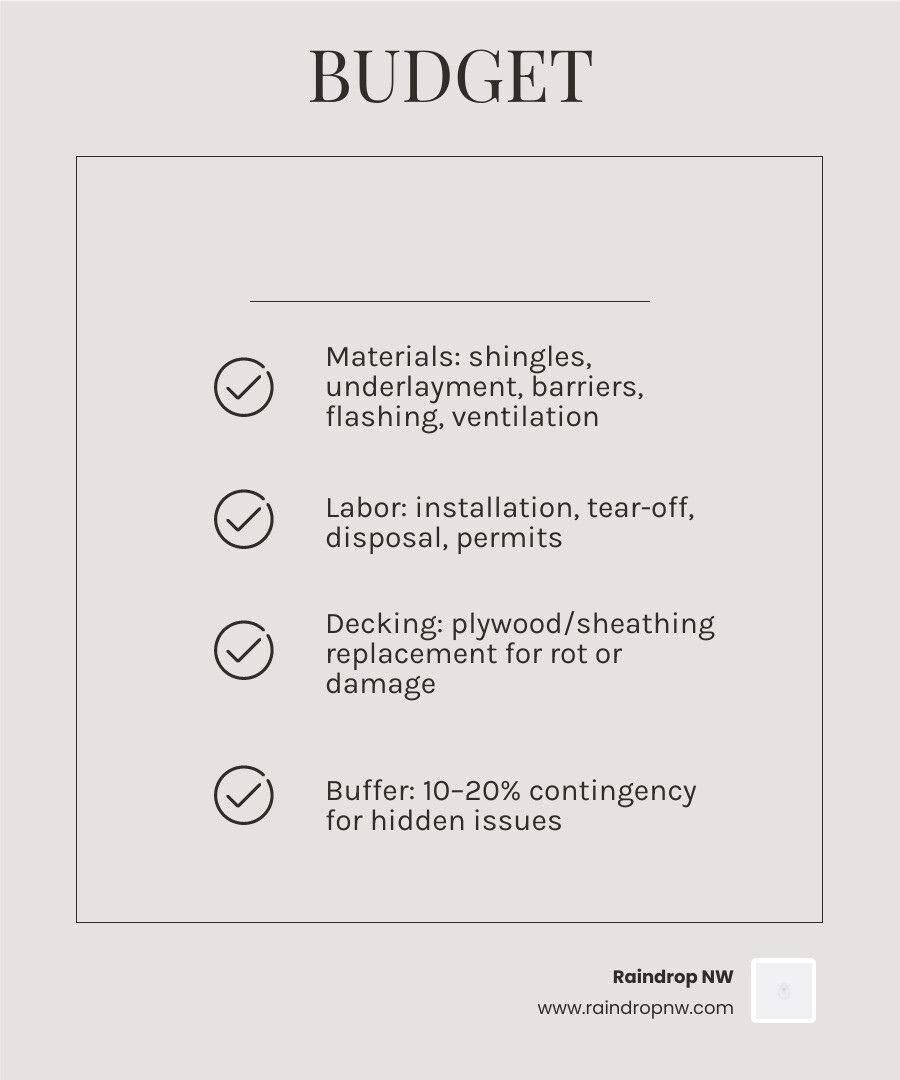
- Roofing materials — shingles, underlayment, ice and water barrier, starter shingles, hip and ridge shingles, flashing, and ventilation components
- Roof decking — assessment and replacement of any damaged plywood or sheathing found during tear-off
- Labor and installation — typically the largest single cost, often accounting for around 60% of the total project
- Tear-off and disposal — removing your old roof and hauling away the debris
- Permits and administrative fees — required by most municipalities in Oregon and Southwest Washington
- Contingency buffer — set aside 10–20% for hidden damage like dry rot that only shows up once the old roof comes off
- Optional upgrades — premium materials, improved ventilation systems, or roof coatings that extend long-term lifespan
Most homeowners focus on the material cost alone — and that’s exactly where budget surprises come from. A roof replacement is one of the most significant investments you’ll make in your home, and the Pacific Northwest’s wet winters and wind-driven rain make getting it right even more important. If your budget doesn’t account for every layer of the system, you’re likely to face unexpected costs mid-project — or worse, a roof that underperforms because corners were quietly cut.
I’m Torrey Yungeberg, owner of Raindrop Roofing NW, and after years of helping Portland-area homeowners navigate full roof replacements, I’ve seen how a clear, complete picture of what to include in your roofing budget protects families from stressful surprises and bad contractor experiences. Let’s walk through everything you need to plan your project with confidence.
Core Components: What to Include in Your Roofing Budget

When planning a project of this scale, it helps to understand that a roof is not a single product. It is a highly engineered, multi-layered system designed to shed water, resist high winds, and keep your attic dry and well-ventilated. When you receive a professional estimate, the final number is divided into two primary categories: materials and labor.
A common misconception is that the physical materials make up the bulk of your invoice. In reality, the material allocation accounts for roughly 40% of your total quote, while the labor ratio represents about 60%. This labor-heavy split reflects the intense physical demands, high risk, and specialized skill required to tear off old materials and install a new, structurally sound system.
To help you visualize how these pieces fit together, we recommend consulting our comprehensive Roof Replacement Cost Guide for Homeowners. Understanding this balance of structural integrity, material choice, and skilled labor ensures you are comparing quotes fairly rather than simply choosing the lowest bid.
Essential Materials: What to Include in Your Roofing Budget
To build a roof that can survive decades of Northwest Oregon rain, wind, and occasional winter ice, your budget must include a variety of essential materials. Each component serves a distinct purpose:
- Roof Decking or Sheathing: This is the structural wooden foundation (typically plywood or OSB sheets) that attaches to your home’s rafters. All other roofing components are nailed into this layer.
- Roof Underlayment: Acting as your second line of defense against wind-driven rain, synthetic or felt underlayment is installed directly over the wood decking. Skipping or using subpar underlayment can void your manufacturer warranties.
- Ice and Water Shield: This self-adhering, rubberized waterproof membrane is non-negotiable in vulnerable areas. It is applied along the eaves, valleys, and around penetrations (like chimneys and pipes) to prevent water from backing up under the shingles due to ice dams or heavy pooling.
- Starter Shingles: Specially designed shingles installed along the eave and rake edges of your roof. They provide the initial sealant line to prevent high winds from lifting the main shingles.
- Main Shingles: The visible outer layer. While asphalt shingles remain the most popular choice due to their balance of performance and value, your choice of style will directly influence your budget. You can learn more about how these decisions shape your estimate in our guide on How Material Choice Impacts Your Roof Cost.
- Hip and Ridge Shingles: These are thicker, pre-bent shingles designed specifically to cover the peaks and ridges of your roof. They seal the joints where different roof planes meet and add a finished, cohesive look.
- Flashing: Custom-shaped metal pieces (usually aluminum or steel) installed in high-risk leak areas such as valleys, chimney bases, skylights, and roof-to-wall intersections.
- Roof Ventilation: A healthy roof needs to breathe. Your system must include intake vents (usually at the soffits) and exhaust vents (such as ridge vents) to keep air moving. This prevents attic heat buildup in the summer and damaging condensation in the winter.
If you are considering upgrading the look and durability of your home, you might also wonder: Are Designer Shingles Worth the Extra Cost? Premium architectural options offer enhanced wind resistance and deeper shadow lines, which can elevate your home’s curb appeal while offering superior protection.
Labor and Installation: What to Include in Your Roofing Budget
Because labor represents the majority of your project’s financial allocation, it is crucial to understand the variables that contractors calculate when pricing the physical installation. It is not just about the square footage of your home’s footprint.
The complexity of your roof’s design plays a massive role. A simple, low-slope ranch home is far easier and faster to roof than a multi-gabled Tudor with a steep roof pitch. Steeper roofs require specialized safety staging, harnesses, and slower, more meticulous footwork, which naturally increases the labor percentage.
Furthermore, roof height and overall accessibility influence the installation timeline. If your home is a multi-story structure with tight access between neighboring properties in Portland or Lake Oswego, getting materials up to the roof and throwing old materials down safely takes extra time and equipment. When we calculate labor, we look at the total “squares” (a roofing square is a standard unit equal to 100 square feet) alongside these unique architectural features. For a deeper dive into regional installation factors, check out our resource on How Much Does a New Roof Cost in the Pacific Northwest?.
Hidden Expenses and Contingencies to Anticipate
If every roof replacement went perfectly according to plan, budgeting would be simple. However, the true condition of your roof’s underlying structure cannot be fully known until the old shingles are completely torn off. This is why we always advise homeowners to prepare for hidden expenses.
Structural Repairs and Decking Contingency
The most common hidden expense during a roof replacement is dry rot or water damage in the roof decking. Over years of slow, unnoticed leaks, water can seep past old underlayment and soften the plywood sheathing underneath.
Statistically, about one in five roofs (20%) require some level of decking replacement once the tear-off phase is complete. If a contractor lays new shingles over rotted wood, the nails will not hold, compromising the structural stability of your entire roof.
To avoid mid-project panic, you should always include a 10% to 20% contingency buffer in your initial budget. This ensures that if we discover rot, we can replace the damaged sheets of plywood immediately without halting construction or causing financial stress. If you are currently trying to decide whether your roof needs immediate attention or if a simple fix will do, take a look at our guide: Should I Repair or Replace My Roof?.
Disposal, Permits, and Administrative Fees
Another set of line items that must be explicitly detailed in your budget includes waste disposal and municipal permits.
Tearing off a roof generates tons of heavy debris. Your budget needs to account for dumpster rental fees, labor to load the waste, and local landfill tipping fees. Additionally, most cities and counties across the Portland metro area—from Hillsboro and Beaverton down to Oregon City and West Linn—require official building permits for a full roof replacement. A professional, licensed contractor should always handle pulling these permits and scheduling the required municipal inspections to ensure your new roof is fully compliant with local building codes.
Material Selection and Long-Term Investment Value
The materials you choose have a direct relationship with both your upfront budget and the long-term value of your home. To help you evaluate your options, we have compiled a relative comparison of the most common roofing materials used in our region.
| Material Type | Relative Lifespan | Maintenance Requirements | Best Suited For |
|---|---|---|---|
| 3-Tab Asphalt Shingles | Standard (Shortest) | Moderate | Budget-conscious projects, temporary fixes |
| Architectural Shingles | Long | Low to Moderate | Standard residential homes, excellent overall value |
| Standing-Seam Metal | Very Long | Very Low | Modern homes, long-term owners, high wind/snow areas |
| Cedar Shakes | Moderate to Long | High | Historic homes, natural aesthetic preference |
| Clay / Concrete Tile | Extremely Long | Low | Mediterranean or custom architectural styles |
Comparing Asphalt Shingles and Premium Alternatives
Asphalt shingles remain the most popular choice across the Pacific Northwest because of their exceptional durability and cost-effectiveness. Modern architectural shingles are engineered with composite materials that resist algae growth and can withstand high winds.
However, if you plan on staying in your home for decades, premium alternatives like standing-seam metal or concrete tile are worth considering. While standing-seam metal requires a larger upfront investment, it offers incredible durability and can easily outlast two or three asphalt shingle lifecycles. Metal also provides excellent fire resistance and sheds heavy Northwest rain and snow effortlessly. For homeowners planning to move within ten years, architectural asphalt shingles usually provide the best return on investment, whereas metal or tile makes the most financial sense for forever homes.
Navigating Insurance Claims and Coverage
If your roof replacement is prompted by sudden storm damage—such as a fallen Douglas fir limb or severe windstorms—your homeowner’s insurance policy may help cover the cost. However, it is essential to understand that standard insurance policies do not cover normal wear and tear or aging.
When filing a claim, the age of your roof plays a major role in how your insurance provider calculates your payout. To understand how this works, we highly recommend reading about How Roof Age Affects Your Insurance Claim.
Navigating the paperwork can be overwhelming, which is why we have put together several resources to guide you through the process step-by-step. Start by reviewing Does Insurance Cover Roof Replacement? and Understanding Your Insurance Policy and Roofing Coverage. Once you are ready to move forward, our guide on How to File a Roof Damage Insurance Claim will help you work smoothly with your adjuster.
Extending Roof Lifespan to Maximize Your Investment
Once your new roof is installed, protecting that investment should be your top priority. Routine maintenance is the single most effective way to extend your roof’s life expectancy from 10–15 years to 25 or more years.
Proactive repairs—such as clearing moss, cleaning gutters, and replacing worn pipe boots—are incredibly cost-effective compared to reactive, emergency repairs. In fact, ignoring minor issues can turn a simple fix into a catastrophic mold or structural issue. Annual inspections and professional roof coatings are excellent tools to keep your system performing at its best. To learn more about keeping your system in peak condition, read our expert tips on How to Extend the Life of Your Roof.
Frequently Asked Questions About Roofing Budgets
How much of a budget buffer should I set aside for unexpected roof damage?
We strongly recommend setting aside a contingency fund of 10% to 20% of your total project estimate. This buffer is specifically designed to cover unexpected dry rot, damaged structural rafters, or ventilation issues that are completely hidden from view until the old shingles are removed. Having this safety net ensures your project continues smoothly without delay.
Does a standard roofing estimate include old roof tear-off and disposal?
A professional, reputable roofing estimate should always explicitly include the tear-off of your existing roof, dumpster rentals, and all environmental disposal fees. Be sure to review your quotes carefully; if a bid seems unusually low, check to make sure the contractor hasn’t left out disposal fees, leaving you with a pile of shingles on your lawn and an unexpected bill.
Can I save money by installing new shingles over my existing roof?
While some local building codes allow for a roof overlay (installing a second layer of shingles over the first), we almost never recommend it. Overlays trap heat, which can reduce the lifespan of your new shingles by 15% to 20% and often void the manufacturer’s warranty. Additionally, an overlay prevents us from inspecting your wooden decking for hidden rot, and the extra structural load can strain your home’s framing.
Conclusion
Planning a roofing budget can feel daunting, but breaking it down into clear, manageable components is the best way to protect your home and your wallet. From the initial tear-off to the final ridge cap shingle, every layer of your roofing system plays a critical role in keeping your family dry.
At Raindrop Roofing NW, we believe in absolute transparency. As a truly local, family-owned business based right here in Beaverton, Oregon, we are deeply committed to serving our neighbors across the Portland metro area with honesty and long-term accountability. Unlike large, out-of-state corporate entities, we live and work in the communities we serve, and we stand behind our certified craftsmanship for decades to come.
Ready to plan your project with a team you can trust? Schedule a professional consultation with Raindrop NW today, and let us help you build a roof that is budget-smart and built to last.




Leave a Reply
Want to join the discussion?Feel free to contribute!