
Bird Deterrents That Actually Protect Your Shingles Without Looking Terrible
When a Flock of Crows Targets Your Brand New Roof
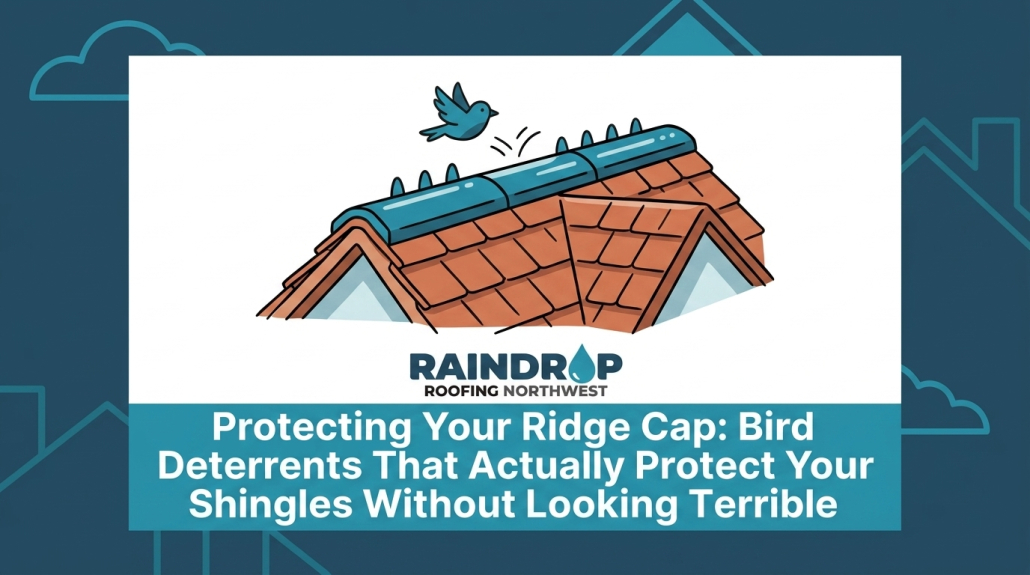
You step outside, look up at your newly updated exterior, and realize a flock of crows has turned your home into their personal lookout tower. Finding bird deterrents that actually protect your shingles without looking terrible is a real challenge for homeowners who want to preserve their property’s structural integrity and its curb appeal. It is a frustrating scenario: you invest heavily in a beautiful new roof, only to watch local wildlife treat the highest peaks of your home as a daily gathering space. The constant scratching, pecking, and droppings are not just a nuisance—they are an active threat to the roofing materials.
If you are dealing with pests or wildlife, understanding the animals that can destroy a roof is the first step before scheduling professional roof repair in Beaverton.
This wildlife traffic tends to surge predictably based on the season. By the time August arrives and Beaverton families begin their back-to-school transition, juvenile crows are fully fledged and local flock sizes reach their peak. At Raindrop Roofing Northwest, our crews consistently notice that as these larger flocks move through residential areas foraging for food and seeking high vantage points, your roof becomes a prime target. The sheer volume of birds landing, taking off, and fighting for position on the ridge creates concentrated wear and tear in very specific areas of the roof structure.
The core dilemma for homeowners:
- Protection: You need an effective barrier to stop the birds from damaging the shingles and leaving highly acidic droppings.
- Aesthetics: You do not want your residential home to look like a commercial warehouse or an industrial facility covered in bright metal spikes.
- Maintenance: The solution cannot create secondary problems, such as trapping debris or causing leaks.
Balancing these needs requires a careful evaluation of the available options. Visual decoys promise a low-impact aesthetic but often fail to deliver long-term results, while physical barriers offer guaranteed protection but require strategic selection to avoid ruining the look of your home. The right approach depends entirely on understanding how these deterrents interact with your specific roofing materials.
Can Crows Damage Your Roof? The Reality for Asphalt Shingles
The short answer is yes—crows and other large birds can cause significant, accelerated damage to your roof. While a single bird landing on a shingle will not cause immediate harm, the cumulative effect of a flock repeatedly using the same area is highly destructive. Crows are intelligent, heavy birds with sharp talons and powerful beaks. As they land, grip, and forage, they physically dislodge the protective mineral granules embedded in the surface of the shingles.
Understanding exactly what happens when crows peck at your roof reveals why proactive protection is so critical. In our years of inspecting Pacific Northwest roofs, we’ve seen first-hand how these birds peck at the shingles to dislodge insects, gather nesting materials, or simply sharpen their beaks. Once the protective granule layer is compromised, the underlying asphalt is exposed to the elements, leading to rapid deterioration.
Because crows prefer the highest possible vantage point to scan for food and predators, asphalt shingle ridge caps are specifically vulnerable. The ridge cap is the specialized row of shingles that folds over the peak of the roof, sealing the joint where the two sloping sides meet. Because it sits at the absolute apex of the home, it absorbs the vast majority of the bird traffic. Ignoring early signs of bird activity on the ridge cap almost always leads to accelerated wear, cracked shingles, and eventual water intrusion at the most critical seam of the roof.
The Impact of Acidic Droppings on Granule Loss
Physical scratching is only half the problem. The biological waste left behind by large flocks of corvids is incredibly harsh on roofing materials.
- Chemical breakdown of the asphalt binder: Bird droppings are highly acidic, typically measuring between a pH of 3 to 4.5. When this acidic waste sits on the roof, it chemically eats away at the asphalt binder that holds the shingle together.
- Loss of UV protection: As the binder degrades, the colored granules wash away in the next rainstorm. These granules are not just for color—they provide essential UV protection. Without them, the late-summer sun bakes the bare asphalt, causing it to turn brittle, blister, and crack.
- Long-term structural implications: Once a shingle becomes brittle and loses its flexibility, it is highly susceptible to wind damage. A ridge cap weakened by acidic droppings is far more likely to tear off during a storm, leaving the roof deck completely exposed to water damage.
Visual Decoys: Do Plastic Owls and Reflective Tape Actually Work?
When homeowners first notice bird activity, they often look for the easiest, least invasive solution. Visual decoys—such as fake plastic owls, reflective spinning discs, and holographic flash tape—are frequently marketed as a quick fix. The appeal is obvious: these items require no permanent installation, they do not penetrate the roofing materials, and they are relatively inexpensive.
However, wildlife behavioral studies and our own field observations consistently show that highly intelligent corvids habituate to static visual decoys incredibly fast. A plastic owl might keep a flock away for the first 48 hours, but once the crows realize the “predator” never moves, never makes a sound, and poses no actual threat, they will completely ignore it. It is not uncommon to see crows comfortably perched directly on top of a plastic owl within a week of its placement. Reflective tape and spinning discs suffer the same fate; once the birds map the pattern of the flashing light, the deterrent effect vanishes entirely.
Beyond their lack of effectiveness, there is a significant aesthetic drawback. In highly maintained Beaverton residential neighborhoods, a roof covered in holographic tape, CD-like discs, and plastic predatory birds looks cluttered and unkempt. Instead of blending into the architecture, these visual deterrents draw the eye directly to the roof, creating a chaotic appearance that detracts heavily from the home’s curb appeal.
Ultimately, visual deterrents are generally a short-term band-aid rather than a permanent protective measure. They might offer a temporary reprieve while you plan a more robust solution, but they will not provide the long-term defense required to protect your ridge cap from sustained flock activity.
Evaluating Bird Spikes for Residential Homes
If visual decoys fail to provide lasting protection, physical barriers are the logical next step. Physical bird spikes work through simple mechanical denial: they create an uneven, inhospitable surface that makes it physically impossible for large birds to land, roost, or walk on the treated area. Because the birds cannot find stable footing, they are forced to move on to a different location.
The primary hesitation homeowners have with physical spikes is the aesthetic impact. Nobody wants their house to look like a commercial parking garage. Fortunately, modern residential deterrents have evolved significantly. Instead of harsh, highly visible industrial metal spikes, homeowners can now opt for low-profile, UV-stabilized polycarbonate spikes. These clear plastic spikes blend into the background sky and the color of the shingles, minimizing the visual footprint from street level.
Strategic placement is the key to balancing aesthetics and effectiveness. You do not need to cover the entire roof in spikes. Because crows predictably target the highest points, you only need to treat the specific asphalt shingle ridge caps where the birds actively congregate. By confining the clear spikes to the very peak of the roof, they remain largely invisible from the ground while providing 100% effectiveness against roosting.
| Deterrent Type | Effectiveness Against Crows | Aesthetic Impact | Long-Term Durability |
|---|---|---|---|
| Plastic Owls / Fake Predators | Very Low (Birds habituate in days) | High (Looks cluttered and unnatural) | Low (Plastics degrade quickly in UV light) |
| Reflective Tape / Discs | Low (Momentary startle effect only) | High (Flashes brightly, highly visible) | Low (Tape peels and tears in high wind) |
| Industrial Metal Spikes | Very High (Complete physical denial) | High (Looks highly commercial/industrial) | Very High (Lasts for decades) |
| Clear Polycarbonate Spikes | Very High (Complete physical denial) | Low (Blends with sky and roofing material) | High (UV-stabilized for long-term use) |

The Hidden Risk of Physical Deterrents in Tree-Heavy Areas
While physical spikes are highly effective at keeping birds away, they introduce a unique set of challenges depending on your surrounding environment. A pattern our team at Raindrop Roofing Northwest sees often is that the dense Pacific Northwest tree canopy provides prime habitat for large crow populations, which is why deterrents are often necessary. However, that same tree canopy drops a massive amount of organic debris throughout the year, and physical deterrents can inadvertently catch it.
The debris trap mechanism:
- Acting as a comb: Bird spikes pointed upward act exactly like a comb, catching falling pine needles, leaves, small twigs, and seed pods that would normally blow right off the roof.
- Moisture retention: Once this organic debris is trapped between the spikes, it forms a dense mat. In a wet climate, this mat acts like a sponge, holding moisture directly against the asphalt shingles long after the rain has stopped.
- Promoting organic growth: Constant moisture combined with decaying organic matter creates the perfect environment for aggressive moss and algae growth on the ridge cap.
Ironically, this moss growth can attract the very birds you are trying to repel. Crows and other wildlife often tear at thick patches of moss to forage for the insects living inside. The resulting damage to the shingles can be just as severe as the original pecking issue. A recent repair our technicians performed on a flat roof illustrates this risk perfectly: after a previous company’s poor work trapped standing water and debris, severe leaks developed. The roof was fully repaired and the leaks eliminated, but the principle holds true for sloped roofs as well—anything that traps organic debris against the roofing material will eventually cause water intrusion.
Navigating these overlapping environmental factors requires deep local expertise. A solution that works perfectly in a dry, treeless environment might cause severe moss issues in a heavily wooded neighborhood. Understanding exactly how local wildlife interacts with PNW-specific roofing systems and environmental factors is essential. If you choose physical deterrents, you must commit to regular maintenance, clearing the deterrent zones of trapped needles and leaves to keep the roof functioning properly.
Protecting Your Shingles During Deterrent Installation
Even the most perfectly selected bird deterrent can become a massive liability if it is installed incorrectly. The structural integrity of your roof relies on a continuous, unpunctured surface to shed water effectively. Unfortunately, many property owners create severe roof damage simply by trying to attach bird spikes using the wrong methodology.
The greatest danger lies in mechanical fastening. Nailing or screwing bird spike tracks directly through the ridge cap shingles is a critical error. Every screw creates a new hole through the shingle and the waterproof underlayment beneath it. Because the ridge cap sits at the peak of the roof, it is exposed to the maximum amount of wind-driven rain. Our repair specialists frequently encounter active leaks and rotting roof decks caused by this exact DIY mistake, eventually requiring comprehensive asphalt shingle roofing repair to fix the structural damage.
The professional standard our installers follow for attaching deterrents to asphalt shingles is the use of specialized, roof-safe exterior adhesives. These industrial-grade sealants secure the polycarbonate tracks directly to the granular surface of the shingle without penetrating the waterproofing layer. When applied correctly, these adhesives can withstand extreme temperature fluctuations and high winds without breaking their bond.
Why Adhesives Outperform Mechanical Fasteners
- Preserves the waterproofing layer: By avoiding nails and screws, the continuous water barrier of the roof remains completely intact, ensuring zero risk of puncture-related leaks.
- Flexes with temperature changes: High-quality roofing adhesives remain pliable. As the roof expands in the late-summer heat and contracts in the winter cold, the adhesive flexes with the movement. Rigid screws, on the other hand, tend to back out over time as the wood deck expands and contracts.
- Complies with manufacturer warranties: Major shingle manufacturers have strict guidelines regarding roof modifications. Driving unsealed screws through a new ridge cap will almost certainly void the manufacturer’s warranty for that section of the roof. Professional adhesive application ensures the warranty remains valid.
Any modifications to the roof surface should be handled by experts. Inadvertently voiding a warranty or creating a leak while trying to solve a bird problem is an expensive mistake that is easily avoided with professional methodology.
Finding the Balance Between Roof Protection and Home Aesthetics
Protecting your roof from aggressive wildlife does not have to mean sacrificing your home’s visual appeal. The key is understanding that different deterrents serve different purposes, and there is no single universal fix. Visual decoys may offer a brief respite, but physical barriers—like low-profile polycarbonate spikes—provide the permanent physical denial necessary to keep crows off your vulnerable ridge caps.
The right solution depends entirely on the specific wildlife pressure in your neighborhood, the surrounding tree canopy, and the exact materials on your roof. Implementing a deterrent that traps moisture or requires puncturing your shingles will only trade a bird problem for a water damage problem.
Before installing any hardware on your roof, consult with a professional who understands both local wildlife habits and proper roofing techniques. An expert assessment ensures you find the ideal balance: a discreet, visually appealing deterrent that protects your shingles, sheds debris properly, and keeps your roof watertight for years to come.
Frequently Asked Questions
Can crows damage your roof?
Yes, crows can cause significant damage to asphalt shingles, particularly along the ridge cap. Their sharp talons and strong beaks dislodge the protective mineral granules as they land and forage. Over time, this repeated physical wear exposes the underlying asphalt to UV damage, while their highly acidic droppings chemically degrade the roofing materials.
Do bird deterrents damage shingles?
Bird deterrents can damage shingles if they are installed incorrectly. Nailing or screwing physical spikes directly into the roof punctures the waterproof underlayment and creates pathways for leaks. However, when installed professionally using specialized, roof-safe adhesives, deterrents will not harm the shingles or void the manufacturer’s warranty.
How do you keep birds off a roof ridge?
The most effective way to keep birds off a roof ridge is by installing physical barriers that prevent them from landing. Low-profile polycarbonate bird spikes create an uneven surface that physically denies the birds a place to roost. Because birds target the highest points, treating just the ridge cap is usually enough to deter them from the entire roof.
What is the best bird deterrent for houses?
The best bird deterrent for a residential home is a low-profile, clear polycarbonate bird spike track applied with professional roofing adhesive. This solution offers the permanent physical denial of industrial metal spikes without the harsh commercial appearance. It blends into the background while providing 100% effectiveness against roosting birds.
Will bird droppings ruin asphalt shingles?
Yes, bird droppings will rapidly deteriorate asphalt shingles if left untreated. The droppings are highly acidic, with a pH level that chemically eats away at the asphalt binder holding the shingle together. As the binder breaks down, the shingle loses its protective granules, becomes brittle, and is far more susceptible to cracking and wind damage.
Do plastic owls actually keep crows away?
Plastic owls and other visual decoys are generally ineffective for long-term bird control. Crows are highly intelligent and will quickly habituate to static predators, often realizing within a few days that the decoy poses no real threat. While an owl might startle a flock initially, it will not provide the sustained protection needed to keep birds off your roof.




Leave a Reply
Want to join the discussion?Feel free to contribute!