
Identifying Wind Damage After a Late Summer Columbia Gorge Blow
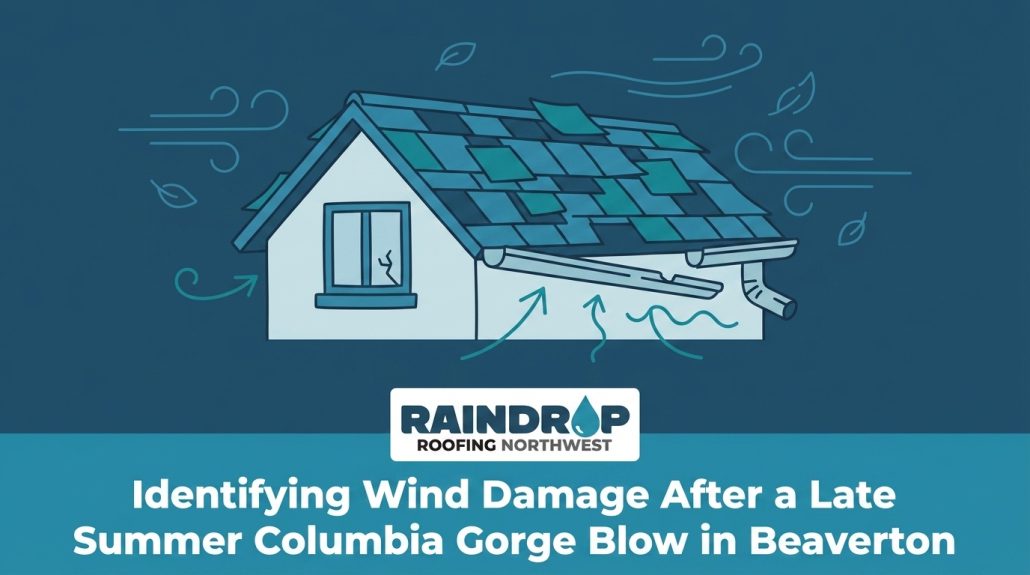
The Hidden Impact of September East Winds on Beaverton Roofs
When late summer arrives, wind speeds frequently exceed 40 to 50 mph across the region, turning a seemingly bright, sunny afternoon into a severe stress test for your home. At Raindrop Roofing Northwest, we’ve found that identifying wind damage after a late summer Columbia Gorge blow starts with understanding that the most severe threats often leave the subtlest clues. These high-velocity, dry gusts are notorious for lifting, flapping, and creasing asphalt shingles on exposed Beaverton homes. The primary challenge for homeowners isn’t just surviving the windstorm; it is knowing exactly what subtle, ground-level signs to look for to determine if an inspection is necessary before the heavy rains arrive. You do not need to take unnecessary risks to protect your property—our team always advises that every visual check discussed here must be done from the ground, keeping you safely off a ladder.
If you suspect recent gusts have compromised your home, scheduling an evaluation for Beaverton roof repair early is the best way to prevent water intrusion.
How Columbia Gorge East Winds Target Local Microclimates
General weather reports often paint the Pacific Northwest with a broad brush, but wind patterns behave very differently depending on exactly where your home sits. Over our years inspecting local roofs, our crews have seen firsthand how Beaverton’s unique topography and its proximity to the Tualatin Valley create a funneling effect. As Columbia Gorge east winds pour out of the canyon and sweep across the Portland metro area, they accelerate down western slopes and into the valley.
Because of this, specific neighborhood orientations bear the brunt of these directional gusts. A home sitting on a west-facing ridge might escape the worst of it, while a house positioned in an east-facing valley basin takes a direct hit. Generic roofing advice often overlooks this localized weather dynamic. Understanding exactly how exposed Beaverton microclimates interact with these wind channels is what separates our deep local expertise at Raindrop Roofing Northwest from generic exterior contracting. National Weather Service (NWS) data consistently shows that late summer wind patterns in the Pacific Northwest create highly localized zones of intense pressure, meaning your roof might sustain damage even if the house one street over is perfectly fine.
The Science of Wind Uplift on Asphalt Roofs
Wind does not simply push against your house; it flows over it, creating complex aerodynamic forces. According to FEMA guidelines on residential construction, sustained gusts interact with roof slopes much like air flowing over an airplane wing.
- Aerodynamic uplift: As fast-moving air travels over the peak of your roof, it creates a zone of negative pressure above the shingles. This pressure differential literally pulls the shingles upward.
- Perimeter vulnerability: Wind uplift forces are significantly stronger at the corners, edges, and ridgelines of your roof. These are the areas where the wind is forced to change direction most abruptly.
- The leverage effect: Once a single leading edge of a shingle is lifted, the wind catches underneath it, using the shingle itself as a lever to pry against the roofing nails and adhesive strips.
If you are planning an end-of-summer roof walk around your property, paying special attention to these high-stress aerodynamic zones is critical for catching early signs of failure.
The Vulnerability of Sun-Baked Shingles in Early Fall
By the time September early fall arrives, your roof has been baking under the intense summer sun for months. This prolonged heat exposure fundamentally changes the physical properties of your roofing materials. Asphalt shingles rely on a specialized sealant strip—a line of thermal adhesive that activates in the sun to glue each shingle to the one below it, creating a unified, wind-resistant barrier.
However, months of relentless UV exposure and surface temperatures that can easily exceed 140 degrees degrade this adhesive. A pattern we see often during early fall inspections is that the volatile oils in the asphalt have begun to dry out, making the shingles more rigid and the sealant strips brittle. When dry, high-velocity Columbia Gorge east winds hit these weakened seals, the adhesive is highly susceptible to failure. The wind breaks the bond, lifts the stiff shingle, and aggressively flaps it backward.
| Damage Factor | Winter Storm Wear-and-Tear | Late Summer Wind Uplift |
|---|---|---|
| Shingle Flexibility | Cold temperatures make shingles brittle and prone to cracking upon impact. | Sun-baked shingles are stiff; adhesive strips are dried out and easily broken. |
| Moisture Presence | Accompanied by heavy rain or ice, making leaks immediately obvious. | Dry winds cause structural damage with no immediate water entry to warn you. |
| Primary Force | Heavy downward pressure from snow/ice, combined with erratic wind. | Intense aerodynamic uplift creating negative pressure on leading edges. |
This creates a unique regional hazard. September marks a critical transition period where dry east winds occur just weeks before the heavy Pacific frontal rains begin. Because the winds are dry, the resulting shingle uplift does not immediately cause a leak inside your home. The damage remains completely hidden until the first major downpour of autumn, making sun-baked shingles highly vulnerable to delayed water intrusion.
Spotting Shingle Uplift and Creasing from the Ground
You do not need to climb onto your roof to identify the aftermath of a severe windstorm. In fact, getting on a potentially compromised roof is dangerous and unnecessary for an initial visual check. At Raindrop Roofing Northwest, we insist that the safest and most effective way to inspect your home is from the ground, using a good pair of binoculars.
Look for creased shingles: When the wind breaks the sealant bond and forces a shingle backward, it bends the fiberglass matting inside the asphalt. Even if the shingle drops back down into its normal position after the gust passes, it leaves behind a distinct horizontal line—a “crease”—near the top of the shingle. These horizontal crease lines are the hallmark of wind damage. A creased shingle has lost its structural integrity and its ability to keep water out, even if it hasn’t completely blown off the roof.
Scan for subtle shadows: Use your binoculars to carefully scan the perimeter edges and ridges of the roof. Shingles may look entirely intact from a quick glance, but if you notice subtle, uneven shadows along the bottom edges of the tabs, it often indicates that the sealant strip is broken and the shingle is resting slightly elevated above the course below it.
Check for missing tabs: The most obvious sign is a missing shingle altogether, exposing the underlayment beneath. Pay special attention to the corners of the roof and the very top ridge, as these areas experience the highest uplift forces.
Following a structured roof maintenance checklist from the safety of your driveway ensures you catch these early warning signs without risking a fall.

Secondary Signs: Granule Loss and Displaced Flashing
Windstorms do more than just lift shingles; they scour the entire exterior of your home. If you cannot spot obvious creasing with your binoculars, we recommend expanding your diagnostic check to include secondary, non-shingle indicators of storm wear.
Inspect your gutters and downspouts: Asphalt shingles are coated with a layer of crushed stone granules that protect the asphalt from UV rays and provide fire resistance. When high winds whip across the roof, especially when carrying dust and debris, they essentially sandblast the surface. Check the splash blocks at the bottom of your downspouts. If you see a sudden, excessive accumulation of these coarse, sand-like granules after a windstorm, it means the protective layer of your roof has been compromised.
Evaluate metal flashing: Flashing is the thin metal material installed around roof penetrations to direct water away from critical seams. Stand in your driveway and look closely at the base of your chimney, the edges of your skylights, and the plumbing vents. Strong gusts can easily bend, lift, or completely displace this metal. Even a slightly lifted piece of flashing creates a direct funnel for rainwater.
Check roof accessories: Wind can dislodge continuous ridge vents or loosen the lag bolts holding satellite dish mounts in place. Any movement in these fixtures breaks the waterproof seal around them.
These secondary issues frequently lead to quiet, slow leaks if left unaddressed. For example, during a recent fall inspection our team conducted on a newly purchased Beaverton home with a 14-year-old roof, a minor leak was discovered shortly after a period of high winds. The issue stemmed from compromised exterior seals. Our response team quickly completed an emergency roof repair, fixing the leak and simultaneously addressing related gutter and caulking issues at no extra charge. Catching these secondary signs early prevents minor wind uplift from turning into severe interior water damage.
Why Timely Diagnostics Matter Before Fall Rains
The Pacific Northwest climate calendar is unforgiving. There is only a very short window between the dry, high-velocity wind events of September early fall and the relentless onset of October’s heavy Pacific frontal rains. This seasonal urgency cannot be overstated. When a roof sustains wind damage during late summer, the lack of immediate rain lulls many homeowners into a false sense of security.
Leaving creased or lifted shingles unaddressed guarantees water intrusion once the wet season begins. A broken sealant strip might not look like a major problem on a sunny Tuesday, but our repair logs show that when days of continuous rain and shifting winds arrive, water will be driven upward underneath that loose shingle, soaking the underlayment and eventually rotting the roof decking.
While ground-level observation is the safest and most critical first step, it has its limits. If you spot any subtle signs—a slight shadow, a horizontal crease, or extra granules in the downspout—a certified professional from a trusted local company like Raindrop Roofing Northwest must perform a comprehensive on-roof evaluation. A trained eye knows how to safely lift and test suspect shingles without causing further damage.
Furthermore, timing is critical for homeowners insurance. Documenting wind damage immediately after a specific storm event makes it much easier to file a successful claim. If you wait until winter weather complicates the timeline and causes secondary interior damage, insurance adjusters may argue that the damage was due to long-term neglect rather than a specific weather event.
Frequently Asked Questions About Roof Wind Damage
What does wind damage look like on shingles?
Wind damage typically appears as horizontal crease lines near the top of the shingle where it has been bent backward. You may also see lifted edges, missing tabs, or areas where the protective surface granules have been completely scoured away. From the ground, these issues often look like dark shadows or uneven lines along the roof’s perimeter. Catching these visual cues early is vital for preventing underlying water damage.
Can 40-50 mph Columbia Gorge winds damage a roof?
Yes, sustained winds in the 40 to 50 mph range are more than capable of causing significant uplift damage, especially on older roofs. When Columbia Gorge east winds hit exposed Beaverton microclimates, the aerodynamic pressure can easily snap the brittle sealant strips on sun-baked shingles. Even if the shingles do not blow completely off, the broken seal leaves the roof vulnerable to future leaks.
How can you tell if a roof has wind damage from the ground?
The safest method is to use a pair of binoculars to slowly scan the edges, corners, and ridges of your roof. Look for horizontal cracking, missing pieces, or shingles that appear to be resting higher than the ones next to them. Additionally, checking your downspouts for a sudden pile-up of roofing granules is a strong ground-level indicator that the roof surface took a beating.
What are creased shingles and why are they a problem?
Creased shingles occur when a strong gust lifts the bottom of the shingle and bends it sharply backward, damaging the internal fiberglass matting. Once a shingle is creased, it loses its structural strength and its ability to lay flat against the roof deck. This creates a permanent entry point for wind-driven rain, leading to wood rot and interior leaks if not replaced.
Should I climb on my roof to check for missing shingles after a storm?
No, you should never climb onto your roof after a severe weather event. Windstorms can loosen decking, make surfaces slippery, and compromise the structural integrity of the roof in ways that aren’t immediately visible. Always perform your initial checks from the safety of the ground, and rely on certified professionals with proper fall-protection gear to conduct any on-roof inspections.
How quickly should I get a roof inspection after a late summer blow?
You should schedule an inspection as soon as you notice any ground-level signs of damage, ideally within a few days of the storm. Because late summer winds often occur just weeks before the heavy fall rains begin, acting quickly ensures your roof is sealed and secured before continuous wet weather arrives. Prompt inspections also make it much easier to tie the damage to a specific weather event for insurance purposes.
Secure Your Roof Before the Heavy Rains Arrive
Spotting subtle signs like creased shingles, displaced flashing, or heavy granule loss from the safety of your driveway is the crucial first step in protecting your home. The transition from September early fall to the rainy season is brief, and the dry winds of late summer often leave behind hidden vulnerabilities that will only reveal themselves when the heavy downpours start.
If your visual check has raised any concerns, the most responsible next step is to get a definitive answer from a local expert. By prioritizing repairing your roof after a storm now with the professionals at Raindrop Roofing Northwest, you ensure that minor uplift issues are fully resolved before they have the chance to turn into major interior leaks, keeping your home safe, dry, and secure all winter long.




Leave a Reply
Want to join the discussion?Feel free to contribute!