
Why Your Roof is the Unsung Hero of Your Business Operations
Why a Well-Maintained Roof Is the First Line of Defense for Your Business
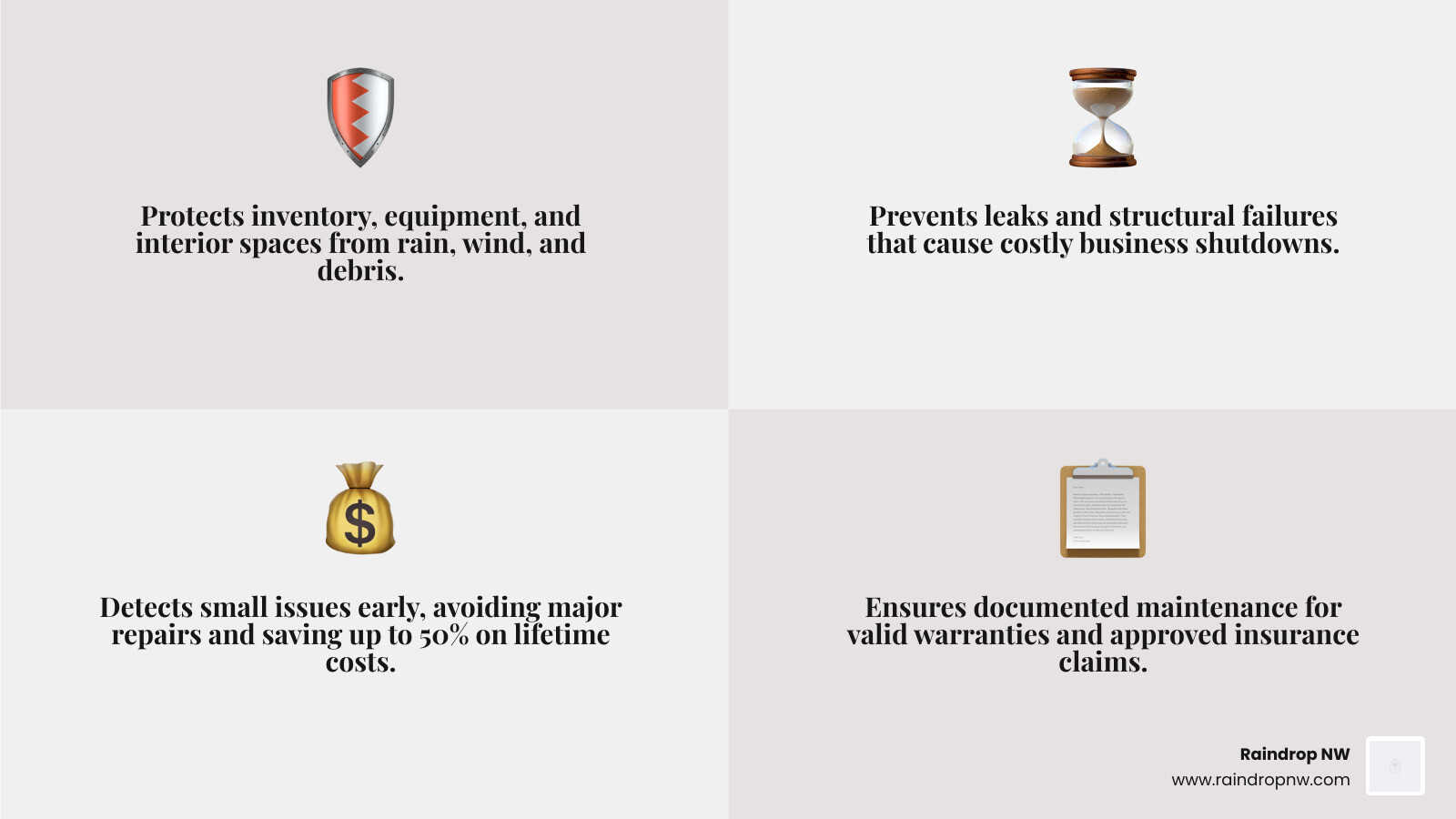
How a well maintained roof protects your business comes down to five core areas:
- Asset protection – Keeps rain, wind, and debris away from your equipment, inventory, and interior spaces
- Business continuity – Prevents leaks and structural failures that force costly shutdowns
- Financial savings – Catches small problems early before they grow into major repairs
- Warranty and insurance compliance – Documented maintenance keeps coverage valid and claims approved
- Energy efficiency – A sound roof reduces HVAC strain and lowers monthly utility costs
Walk into any well-run commercial building and you’ll likely notice the polished lobby, the organized workspaces, the humming equipment. What you won’t notice — unless something has gone seriously wrong — is the roof. Yet it’s working hard every single day, taking the full force of Oregon’s rain, wind, UV exposure, and temperature swings so your business doesn’t have to.
Most business owners don’t think about their roof until there’s a leak dripping onto a server rack or water stains spreading across a ceiling tile. By that point, what could have been a minor maintenance call has turned into an emergency repair, potential inventory loss, and a disruption to daily operations that ripples through the whole business. According to industry data, a neglected commercial roof can cost nearly twice as much over its lifetime compared to one that receives routine professional care.
The good news? Proactive maintenance doesn’t require much — just consistent attention and the right professional partner.
I’m Torrey Yungeberg, owner of Raindrop Roofing NW, and after years in the roofing industry serving Oregon and Southwest Washington businesses, I’ve seen how a well maintained roof protects your business from the kind of expensive, disruptive surprises that catch owners completely off guard. Read on for a practical breakdown of exactly what’s at stake — and what you can do about it.
The Financial Impact: How a Well Maintained Roof Protects Your Business
When we talk about commercial roofing, we aren’t just talking about shingles and membranes; we are talking about asset management. A commercial roof is a massive capital investment. If you treat it like a “set it and forget it” component, you are essentially gambling with your company’s bottom line.
Proactive maintenance is the key to achieving a high Return on Investment (ROI). Research shows that annual roof maintenance typically costs between 5 to 9 cents per square foot. Compare that to the cost of a full replacement or emergency structural repairs, and the math becomes clear. Over a 20-year period, a roof with a consistent maintenance program might cost roughly $11.40 per square foot in total ownership costs, while a neglected roof can soar to $20.00 per square foot because of premature failure and frequent repairs.
By staying ahead of the curve, you gain budget predictability. You won’t be hit with a massive, unbudgeted capital expense because a storm finally pushed a neglected seam over the edge. Instead, you can plan for minor upkeep and know exactly when a replacement will eventually be needed years down the road.

Preventing Interior Asset Damage
The roof is the only thing standing between the Pacific Northwest’s relentless rain and your most valuable internal assets. When a roof fails, the damage is rarely confined to the ceiling.
- Inventory Protection: For retail or wholesale businesses, a single leak can ruin thousands of dollars in stock. Water damage often leads to mold, making products unsalable.
- Equipment Safety: Manufacturing plants and warehouses house expensive machinery. Water dripping into sensitive mechanical parts can cause rust, short circuits, and total equipment failure.
- Electronics and Data: In the modern office, a leak over a server room or a bank of high-end computers is a catastrophe. Data loss and hardware replacement are far more expensive than a simple roof repair.
- Furniture and Interior Finishes: Carpeting, drywall, and office furniture are prone to mold and warping when exposed to moisture.
Avoiding Business Disruptions
In business, time is money. A major roofing failure doesn’t just cost money to fix; it stops money from coming in. If a section of your building is cordoned off because of a ceiling collapse or a mold outbreak, your operational capacity drops.
For those managing commercial properties in areas like Portland or Hillsboro, tenant satisfaction is paramount. Leaky roofs lead to unhappy tenants, lease terminations, and a tarnished reputation. Furthermore, structural instability caused by long-term water intrusion can lead to building “red-tagging,” where the city deems the structure unsafe for occupancy. Maintaining your roof ensures your doors stay open and your revenue continues to flow.
Maximizing Longevity and Preserving Warranties
A standard commercial roof is designed to last about 20 years, but “designed to” and “actually does” are two different things. With a dedicated maintenance program, we often see roofs last 25 years or even 30 years. That is a 30–50% improvement in lifespan just by catching the small stuff.
Think of it like a car. You wouldn’t expect an engine to last 200,000 miles if you never changed the oil. Your roof is no different. It experiences thermal expansion and contraction every single day, which puts immense stress on the seams and flashing.
How a well maintained roof protects your business from warranty voids
One of the most overlooked aspects of how a well maintained roof protects your business involves the fine print in your manufacturer’s warranty. Most major roofing manufacturers (like GAF or Owens Corning) explicitly state that their warranty is only valid if the roof is regularly maintained by a professional.
If you experience a material failure but cannot provide documentation of annual or bi-annual inspections, the manufacturer may deny your claim. We provide our clients with professional documentation and photos that serve as “proof of life” for their roofing system, ensuring that if a warranty claim is ever needed, it is ironclad. You can learn more about commercial warranties to see how these protections work.
Early Detection of Common Damage
Professional inspections catch the “invisible” killers of commercial roofs. By the time you see a drip inside, the damage has likely been happening for months. We look for:
- Ponding Water: If water sits on a flat roof for more than 48 hours, it adds immense weight and begins to degrade the membrane.
- Seam Separation: High winds and UV rays can cause the adhesives or welds at the seams to pull apart.
- UV Degradation: The sun is just as damaging as the rain. Constant UV exposure can make roofing materials brittle and prone to cracking.
- Flashing Failure: Most leaks happen where the roof meets a wall, chimney, or HVAC unit. These transition points (flashing) are the most vulnerable areas.
Regular roof inspections allow us to patch these tiny issues for a few hundred dollars, rather than waiting for them to become a five-figure headache.
Enhancing Operational Safety and Reducing Liability
As a business owner, you have a legal and moral obligation to provide a safe environment for your employees and customers. A neglected roof is a liability waiting to happen.
How a well maintained roof protects your business from liability risks
Liability comes in many forms, and a failing roof touches almost all of them:
- Slip Hazards: A small, unnoticed leak can create a puddle on a polished warehouse or retail floor, leading to slip-and-fall accidents.
- Mold Prevention: Persistent moisture leads to mold growth inside walls and ceiling plenums. This degrades indoor air quality and can lead to “sick building syndrome,” resulting in health claims from employees.
- Structural Collapse: In extreme cases, especially during a heavy Oregon snow event, a roof weakened by rot or ponding water can suffer a partial or total collapse.
- Falling Debris: Loose flashing or deteriorating masonry can fall from the roof edge, posing a significant risk to pedestrians and parked vehicles below.
Energy Efficiency and Climate Control
A well-maintained roof is a key player in your building’s thermal performance. When insulation gets wet from a small leak, it loses its R-value (insulating power). This means your HVAC system has to work twice as hard to keep the building at a comfortable temperature.
| Feature | Maintained Roof | Neglected Roof |
|---|---|---|
| Insulation Integrity | Dry and effective; keeps heat in/out | Wet and compressed; loses R-value |
| HVAC Workload | Optimized; lower monthly bills | Strained; higher energy consumption |
| Reflective Surface | Clean; reflects UV rays to stay cool | Dirty/Degraded; absorbs heat |
| Air Sealing | Tight seals prevent air loss | Gaps at penetrations leak conditioned air |
By utilizing reflective “cool roof” coatings and ensuring your insulation remains bone-dry, you can significantly reduce your operational costs. A sound roof keeps your employees productive and your utility bills manageable.
Frequently Asked Questions about Commercial Roof Upkeep
How often should a commercial roof be inspected?
In the Pacific Northwest, we recommend a biannual schedule — once in the Spring and once in the Fall.
- Spring: To assess any damage caused by winter storms, ice, or heavy rain.
- Fall: To clear debris (like needles and leaves that clog drains) and ensure the roof is sealed tight before the rainy season begins.
- Post-Storm: You should also call for a check-up after any major weather event involving high winds or hail.
What are the signs that a roof needs immediate attention?
Keep an eye out for these “red flags”:
- Water Stains: Discolored patches on ceiling tiles or walls.
- Musty Odors: A sign that mold is growing somewhere out of sight.
- Sagging: Any visible dip in the roofline or ceiling is a sign of structural distress.
- Clogged Drainage: If you see “lakes” forming on your roof or downspouts that aren’t flowing, you have a drainage crisis.
- Visible Cracks or Bubbles: In the roofing membrane, these are clear entry points for water.
Why hire a professional instead of using in-house maintenance?
While your janitorial or general maintenance staff are great at what they do, roofing requires specialized knowledge.
- Safety Protocols: Walking on a commercial roof is dangerous. Professionals have the OSHA-compliant harnesses and training to do the job safely.
- Specialized Equipment: We use infrared thermography to find moisture trapped under the membrane that the naked eye can’t see.
- Warranty Compliance: As mentioned, most manufacturers require a licensed professional to perform the work for the warranty to remain valid.
- Expertise: A professional roofer knows the difference between a cosmetic scuff and a structural seam failure.
Conclusion: Partnering with Raindrop NW
At Raindrop NW, we understand the unique challenges of maintaining a business in the Beaverton and Portland Metro area. We’ve seen how the local climate can turn a tiny oversight into a major operational hurdle.
Our commitment to our community is what sets us apart. We aren’t an out-of-state firm looking for a quick fix; we are a truly local, independently owned company. When you work with us, you are getting long-term accountability. We don’t just want to fix your roof today; we want to be the partner that helps you manage your building’s most important asset for the next thirty years.
Whether you need a routine check-up to ensure your warranty stays valid or you’re looking to upgrade to a more energy-efficient system, our team is here to help. How a well maintained roof protects your business is a story of prevention, and we’d love to help you write the next chapter for your facility.
Protect your business with professional commercial roofing — contact us today to schedule your comprehensive roof assessment.




Leave a Reply
Want to join the discussion?Feel free to contribute!