
EPDM vs. TPO for Flat Residential Roofs in the Pacific Northwest
Why Modern Homes Demand Specialized Flat Roofing
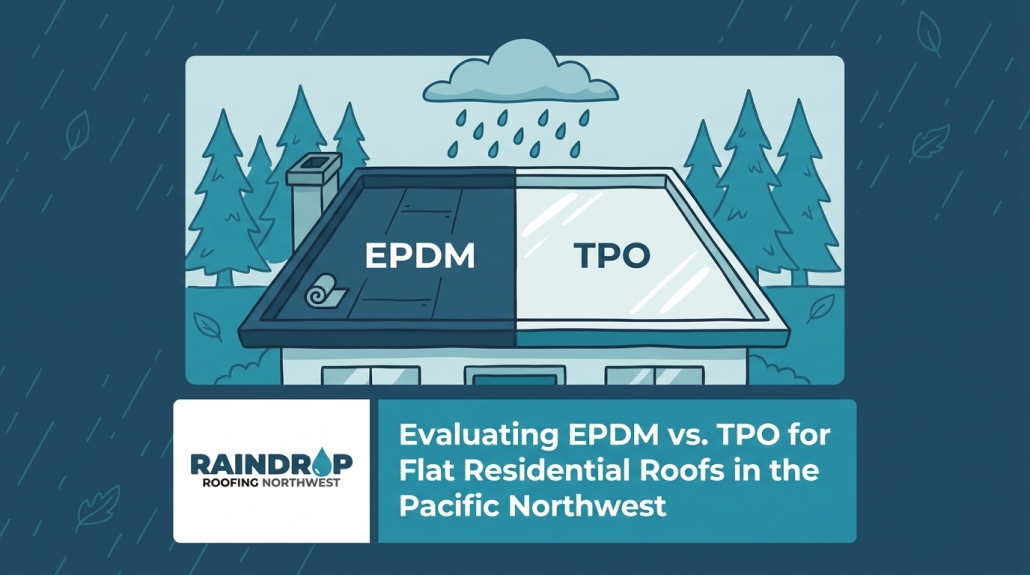
At Raindrop Roofing Northwest, we’ve seen firsthand how the persistent myth that flat roofing membranes are exclusively designed for sprawling commercial warehouses is finally fading, especially when evaluating EPDM vs. TPO for Flat Residential Roofs in the Pacific Northwest. For decades, homeowners assumed that industrial-grade materials would look out of place on a residential property or fail to integrate with standard home architecture. In reality, the clean lines and geometric profiles of today’s residential designs require highly specialized waterproofing solutions that traditional sloped-roof materials simply cannot provide. In our experience, deciding between these two leading single-ply membranes comes down to a critical decision point: weighing the superior puncture resistance of EPDM against the advanced heat reflection capabilities of TPO.
Standard asphalt shingles rely on gravity to shed water quickly. On a flat or low-slope surface, water moves much slower, and minor imperfections can lead to standing water. This makes a seamless, impermeable membrane absolutely mandatory. For homeowners upgrading or building new properties, we always emphasize that the focus shifts from basic water-shedding to complete water exclusion. When our crews are working with flat decks in Portland and surrounding areas, the materials chosen must be capable of handling structural shifts, temperature fluctuations, and significant moisture without losing their seal.
The Architectural Shift in Local Neighborhoods
Throughout the region, our team frequently works on Beaverton modern homes featuring unique architectural elements such as extended parapet walls, hidden internal gutters, and rooftop patio spaces. These design choices create distinct challenges for roofing systems. The membrane must not only keep the interior dry but also integrate flawlessly with metal flashings, skylights, and HVAC penetrations. A residential flat roof requires a tailored approach to installation, prioritizing clean edge details and aesthetic harmony just as much as raw durability.
Key residential flat roof requirements include:
- Seamless integration: The ability to wrap around complex residential roof features like skylights and custom chimneys without vulnerable joints.
- Aesthetic compatibility: Providing a clean, uniform look that complements modern, minimalist exterior designs.
- Structural flexibility: Expanding and contracting with the home’s wood framing during seasonal temperature shifts without cracking.
The Dual Environmental Threats of the Pacific Northwest
Establishing the right material for a low-slope roof requires looking closely at the specific regional climate factors that drive wear and tear. The Pacific Northwest presents a unique duality of environmental threats that we help homeowners carefully evaluate based on their specific micro-environment. The region’s heavy, prolonged seasonal rains make seamless moisture management non-negotiable. A roof must withstand weeks of continuous precipitation without a single weak point in its seams or flashing details.
However, we constantly remind our clients that water is only half the battle. The true deciding factor often lies in the immediate surroundings of the property. Homeowners must contrast the threat of dense Douglas fir tree canopies dropping acidic needles and heavy branches against the rising cooling demands of exposed modern homes. The specific micro-environment of your lot—whether it sits under heavy tree cover requiring intense debris protection or out in full sun exposure requiring advanced UV management—dictates the performance requirements of the membrane.
Navigating Micro-Climates and Changing Seasons
For properties heavily shaded by mature evergreens, the constant shedding of pine needles creates a highly acidic layer of debris that traps moisture against the roof surface. This biological buildup can degrade inferior materials rapidly. Conversely, properties with clear sightlines to the sky face a different challenge. In recent years, as August late-summer heatwaves have intensified, we’ve noticed a fundamental shift in the way homeowners approach flat roof energy efficiency. Extended periods of intense solar radiation can cause dark-colored roofs to absorb massive amounts of heat, driving up indoor temperatures and forcing air conditioning systems to work overtime.
If you are designing outdoor living spaces, such as EPDM flat decks and patios, understanding these dual threats is critical. A shaded deck needs protection from organic decay and impact damage, while a sun-drenched balcony needs materials that will not degrade under heavy UV exposure. Identifying which of these two environmental extremes affects your property most directly is the first step our team takes in selecting the right membrane.
EPDM Rubber Roofing: The Tree Canopy Defender
When a property is nestled under a dense canopy of mature trees, our roofers consistently recommend EPDM (Ethylene Propylene Diene Monomer) as the clear frontrunner. EPDM is a highly durable synthetic rubber membrane recognized for its exceptional elasticity and resilience. For Beaverton modern homes situated in heavily wooded neighborhoods, this material acts as a heavy-duty shield. Its primary advantage is superior puncture resistance, allowing it to absorb the impact of falling branches, pinecones, and heavy debris without tearing or compromising the waterproof layer.
Furthermore, EPDM is uniquely equipped to withstand the constant buildup of acidic pine needles common in the Pacific Northwest. Unlike some plastics or asphalt-based products that can become brittle or chemically degrade when exposed to organic acids and trapped moisture, EPDM rubber maintains its structural integrity. It remains flexible even in near-freezing winter temperatures, ensuring that the roof can expand and contract naturally without stressing the seams.
Resolving Persistent Moisture Issues
Because of its robust nature, our crews at Raindrop Roofing Northwest have a strong track record for resolving persistent leaks caused by previous substandard materials or poor installations. One local scenario we handled recently highlights this perfectly: a flat roof developed persistent leaks after previous poor initial workmanship failed to account for standing water. Our team’s professional repair using high-quality EPDM membrane successfully sealed the vulnerable areas. The resulting surface provided excellent waterproofing, and the home has experienced no leaks since the job was finished.
Why we find EPDM excels in wooded areas:
- Impact absorption: The rubberized nature of the membrane flexes under the weight of falling branches rather than puncturing.
- Chemical resistance: Naturally resists degradation from the tannic acids found in wet leaves and pine needles.
- Cold-weather flexibility: Remains pliable during freezing rain and snow, preventing winter cracking.
For homeowners looking to integrate usable outdoor space, understanding why EPDM makes sense for walkable flat decks in the PNW often comes down to this unmatched durability under physical stress.
TPO Roofing: Reflecting Heat During Intense Summer Sun
On the opposite end of the environmental spectrum are homes with little to no tree cover, bearing the full brunt of the sun. For these exposed modern roofs, we find TPO (Thermoplastic Polyolefin) to be the superior choice. TPO is a single-ply roofing membrane that features a white, highly reflective surface. This reflectivity plays a massive role in modern energy efficiency by actively bouncing ultraviolet and infrared solar radiation away from the building rather than absorbing it into the attic space.
During August late-summer heatwaves, a dark-colored roof can reach temperatures well over 150°F, radiating that heat directly into the living spaces below. TPO significantly reduces these cooling demands. By keeping the roof surface closer to the ambient air temperature, the HVAC system does not have to work nearly as hard to maintain a comfortable indoor climate. Because of these distinct energy-saving properties, properly installed, energy-efficient flat roof systems may qualify for generic local utility rebates or federal tax credits (we always advise homeowners to verify current eligibility with their local utility providers or a tax professional).
Upgrading Aesthetics and Functionality
Beyond thermal management, TPO features heat-welded seams. Instead of relying on adhesives or tapes, the overlapping edges of the TPO membrane are melted together using specialized hot-air tools, creating a single, monolithic layer of waterproof protection that is incredibly resistant to wind uplift and water intrusion.
The visual transformation is also significant. In a recent late-summer project we completed, a homeowner replaced an aging, heavy tar and gravel roof with a sleek, modern TPO system. Despite unique architectural challenges and complex rooflines, our installation team ensured the final product was a good-looking, uniform surface. The transition provided a substantial aesthetic and functional upgrade, resulting in an excellent exterior finish that actively protects the home from solar degradation.
Side-by-Side Material Comparison for Residential Use
To make the best decision for Beaverton modern homes, we find it helps to view the strengths of each material side-by-side. Both EPDM and TPO provide exceptional waterproofing when installed by experienced professionals, but their distinct chemical compositions make them suited for very different micro-environments.
While EPDM acts like a heavy-duty rubber shock absorber, TPO acts like a thermal mirror. Choosing between them means evaluating what your roof faces on a daily basis: physical impact from the environment, or thermal stress from the sun.
| Feature / Characteristic | EPDM (Rubber Membrane) | TPO (Thermoplastic) |
|---|---|---|
| Primary Strength | Superior puncture and impact resistance. | High UV reflectivity and energy efficiency. |
| Ideal PNW Micro-Environment | Heavy tree canopy, high debris, shaded lots. | Full sun exposure, zero shade, high summer heat. |
| Seam Construction | Bonded with specialized roofing adhesives/tapes. | Hot-air welded for a monolithic, fused seam. |
| Aesthetic Profile | Typically matte black; excellent for hiding dirt/debris. | Typically bright white; clean, modern appearance. |
| Lifespan Expectancy | Highly durable, often exceeding 25+ years. | Excellent longevity, typically 20-25 years. |
The right choice ultimately aligns with the specific environmental pressures your property faces year-round, ensuring that your investment provides decades of reliable protection.

Considerations for Walkable Decks and Outdoor Living
One of the most significant trends we see in modern residential architecture is the utilization of flat roof space for outdoor living. Balconies, rooftop patios, and elevated decks offer incredible views and maximize the usable footprint of the property. However, converting a standard waterproofed roof into a surface meant for foot traffic requires careful planning. The membrane you choose plays a foundational role in how that walkable deck is constructed.
When designing walkable spaces for Beaverton modern homes, we frequently utilize EPDM as the membrane of choice for the underlying waterproofing layer. Because EPDM is highly flexible and resistant to punctures, it serves as an excellent base beneath floating deck systems. When building flat decks in Beaverton, contractors cannot simply nail decking boards through the roof membrane—doing so would instantly destroy the watertight seal. Instead, the deck must “float” above the roof.
Protecting the Membrane Under Foot Traffic
Whether you choose EPDM or TPO, we always warn homeowners that the membrane itself is never meant to be walked on directly as a finished patio surface. Regular foot traffic, patio furniture, and dropped items will eventually wear through any exposed single-ply roofing material.
To create a safe, durable walkable deck, our systems typically require:
- A protective slip sheet: A heavy-duty layer placed directly over the EPDM or TPO to prevent friction.
- Adjustable deck pedestals: Engineered supports that sit on top of the membrane without piercing it, allowing water to flow freely underneath.
- Surface pavers or decking: The actual walkable surface (wood tiles, concrete pavers, or composite boards) that rests on the pedestals.
Because EPDM handles the compression of these pedestals exceptionally well and resists damage from organic debris that might wash underneath the deck boards, it is often preferred for these specific outdoor living applications.
Common Questions About Flat Roofing Materials in the PNW
Is TPO or EPDM better for a flat residential roof?
In our experience at Raindrop Roofing Northwest, the short answer is that neither is universally better; it depends entirely on your lot’s environment. We recommend EPDM for homes surrounded by large trees because its rubber composition resists punctures from falling branches and withstands acidic pine needles. We recommend TPO for homes in full sun because its white surface reflects UV rays and significantly lowers cooling costs during hot summer months.
How long does a TPO roof last in the Pacific Northwest?
We generally see a properly installed TPO roof last between 20 and 25 years in the Pacific Northwest. The longevity of the system relies heavily on the quality of the heat-welded seams and how well the roof is maintained. Regular clearing of organic debris and annual inspections can help ensure the membrane reaches its maximum expected lifespan.
Does TPO reflect heat better than EPDM during summer months?
Yes, TPO reflects heat significantly better than standard EPDM. TPO is manufactured with a bright white, highly reflective surface that bounces solar radiation away from the building, which our clients find highly beneficial during August late-summer heatwaves. Standard EPDM is black and naturally absorbs heat, though white-coated EPDM options do exist at a premium.
Can you walk on an EPDM roof?
While an EPDM roof can handle occasional, careful foot traffic for maintenance or gutter cleaning, we advise that it should never be used as a primary walking surface. If you intend to use the space as a patio or balcony, the EPDM membrane must be protected by a specialized floating deck system or heavy-duty pavers to prevent the rubber from tearing under the stress of regular use.
How do pine needles and tree debris affect flat roofing materials?
Pine needles trap moisture against the roof surface and release tannic acids as they decay, which can slowly eat away at certain roofing materials. EPDM rubber is highly resistant to these organic acids, making it our preferred choice for wooded lots. Regardless of the material, allowing thick layers of debris to accumulate will eventually cause water to pool and back up under flashings, making regular maintenance essential.
Secure Your Modern Home with the Right Material
Ultimately, the best choice between these two premium materials depends entirely on your property’s specific sun exposure and tree coverage. If your home sits beneath a canopy of Douglas firs, EPDM provides the rugged, puncture-resistant defense you need against falling branches and acidic debris. If your property is exposed to the open sky, TPO offers the advanced UV reflection necessary to keep your interior comfortable during August late-summer heatwaves.
Working with our team at Raindrop Roofing Northwest brings real-world local experience applying both EPDM and TPO to modern residential flat roofs in the Beaverton area, ensuring your property receives a solution tailored to its exact micro-climate. Don’t wait for a minor pooling issue to turn into a major structural leak. For Beaverton modern homes, proactive protection is the key to longevity. Schedule a professional assessment with us today to determine which membrane will provide the highest level of security and performance before the next major weather shift arrives.




Trackbacks & Pingbacks
[…] while the roof is still dry enough to accept new adhesives and sealants. If you are comparing EPDM vs. TPO for flat residential roofs, know that both require this pre-winter attention to thrive in […]
Leave a Reply
Want to join the discussion?Feel free to contribute!