
Does Moss Void Your 10-Year Roofing Warranty in Portland, OR? Asphalt vs. Metal Comparisons
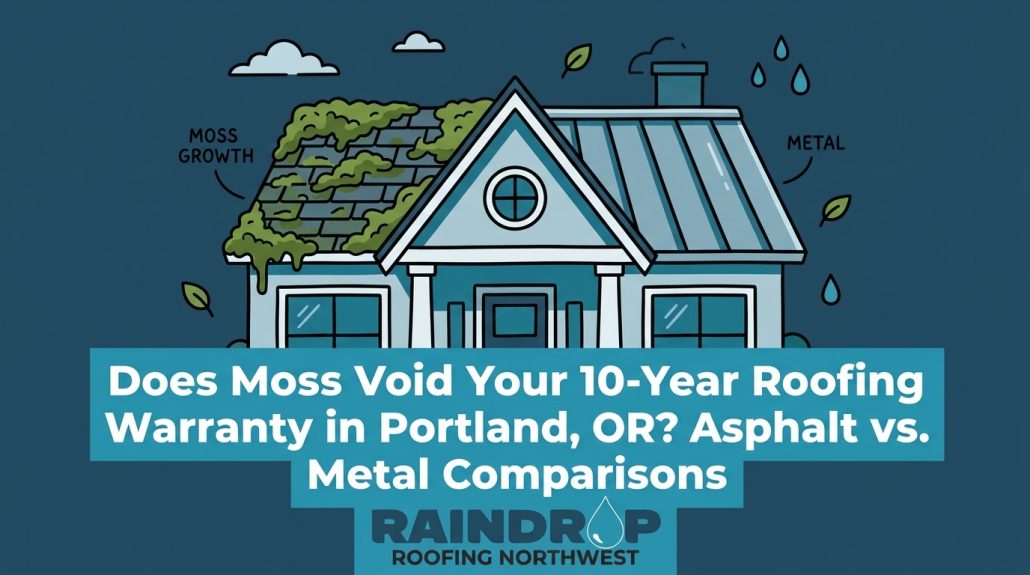
The 40-Inch Rain Reality: How Beaverton Weather Tests Roofing Materials
The Beaverton/Portland metro area averages 36 to 40 inches of rain annually, creating a uniquely punishing environment for exterior building materials. When you are evaluating options comparisons for homeowners, that single statistic changes everything about how you should approach a roof replacement. That volume of water does not just test the physical limits of your underlayment and flashing; it tests the fine print of standard national warranties. Homeowners with aging roofs must make a critical material choice before the heavy winter weather hits, balancing upfront durability against long-term maintenance obligations.
Protecting your home starts with understanding the importance of a workmanship warranty and how local weather conditions affect your coverage.
In the Pacific Northwest, our prolonged damp environment creates the perfect, undisturbed breeding ground for biological growth. Moss, algae, and lichen thrive in the constant moisture and overcast conditions typical of our region. This isn’t just an aesthetic issue that makes your house look unkempt; it is a structural threat. Moss acts like a sponge, holding moisture directly against your roofing materials long after the rain has stopped. Over time, this constant dampness accelerates the degradation of standard materials, lifting shingles and allowing water to seep into the vulnerable layers below. Understanding how different materials respond to this relentless moisture is the first step in making a sound structural investment for your property.
Why Standard Metrics Fall Short in the Pacific Northwest
If you look at generic national roofing guides, they often focus on wind resistance or hail ratings. While those factors matter, they are not the primary threats in our specific region. Here, the true test of a roof is its ability to shed water quickly and resist biological colonization over a decade of wet, gray winters. A roof that performs brilliantly in the dry heat of the Southwest might fail prematurely under the constant, low-intensity rainfall and heavy tree canopy common in Beaverton neighborhoods.
The Hidden ‘Moss Loophole’ in Standard 10-Year Warranties
When you purchase a new roof, it typically comes with a manufacturer’s warranty promising a decade or more of protection against material defects. However, standard “acts of God” clauses and maintenance requirements in these national warranties often ignore our local microclimate realities. Many homeowners are shocked to discover that untreated moss growth can actively void a 10-year roofing warranty if it leads to moisture damage. Because national manufacturers build their warranty terms for the average American climate, they place the burden of dealing with extreme regional challenges squarely on the homeowner’s shoulders.
If you are planning a roof replacement in Portland, you need to read the fine print regarding homeowner responsibilities. Our team at Raindrop Roofing Northwest has spent years replacing roofs in Beaverton and the greater Portland area, and we see this pattern constantly: homeowners are caught off guard by the one-size-fits-all expectations of national brands that simply don’t understand our heavy-rain region.
What National Manufacturers Expect from Homeowners
National roofing manufacturers write their warranties to protect themselves from liability caused by neglect. When our crews inspect aging roofs, we often find that homeowners are completely unaware of these fine-print clauses stating that the homeowner is responsible for keeping the roof clear of debris, overhanging branches, and biological growth.
- Routine debris clearing: Failing to remove accumulated pine needles or leaves can trap moisture and void coverage for the affected areas.
- Biological growth management: Manufacturers expect you to actively prevent and remove moss or algae before it lifts the shingle edges.
- Maintenance documentation: If a leak occurs, the manufacturer may request proof that you have performed regular, professional maintenance.
If moisture penetrates the underlayment because moss lifted the shingles, and you cannot provide documentation of proper, ongoing maintenance, the manufacturer will likely deny your claim. They will categorize the failure as a maintenance issue rather than a material defect. This creates a significant, ongoing burden for homeowners in the Beaverton and Portland metro areas, where moss is a relentless, year-round adversary.
Architectural Asphalt Shingles: Performance vs. Maintenance Burdens
High-grade architectural asphalt shingles are incredibly popular across the country, and for good reason. They offer a traditional aesthetic, come in a wide variety of colors, and provide excellent dimensional depth that enhances curb appeal. However, when evaluating roofing options comparisons for homeowners in the Pacific Northwest, you must weigh that visual appeal against the strict maintenance required to keep their warranties intact.
Because asphalt shingles have a textured, porous surface covered in protective granules, they provide an ideal anchor for moss spores to take root. Once those roots establish themselves, removing the moss becomes a delicate operation. The Asphalt Roofing Manufacturers Association (ARMA) issues very specific recommendations for cleaning moss and algae from asphalt shingles. They explicitly warn against abrasive cleaning methods, which presents a frustrating catch-22 for homeowners trying to satisfy warranty requirements.
The most critical risk involves how the roof is cleaned. Improper cleaning techniques—specifically high-pressure washing—will strip the protective granules right off the fiberglass mat. Losing these granules compromises the shingle’s UV resistance, drastically shortens its lifespan, and instantly voids the manufacturer’s warranty. Therefore, you cannot simply blast the moss away. You must rely on chemical treatments and gentle brushing, which requires a significant ongoing commitment.
The True Cost of Asphalt Upkeep
Maintaining an asphalt roof in a heavy tree-canopy neighborhood requires regular vigilance. You must proactively remove moss and algae from your roofing shingles using approved, low-pressure soft-wash methods. For most homeowners, this means hiring specialized professionals every year or two to apply zinc or copper-based treatments that kill the spores without damaging the asphalt substrate. If you skip this maintenance, the moss will lift the shingle edges, water will blow underneath during the next winter storm, and your warranty will offer zero protection against the resulting rot. We have repaired countless roofs where this exact scenario played out after just a few years of neglect.
Standing Seam Metal Roofs: Naturally Defying PNW Elements
If you want to step off the continuous treadmill of moss removal and warranty anxiety, we frequently recommend metal roofing because it offers a fundamentally different approach to handling Pacific Northwest weather. In our experience installing these systems across Beaverton, standing seam metal roofs interact with heavy rain and biological growth in a way that naturally protects your home and preserves your long-term warranty validity.
Unlike porous asphalt, standing seam metal features a smooth, impermeable surface. Water does not soak in; it sheds immediately. More importantly, moss, algae, and lichen cannot easily anchor their roots to the slick metal finish. Data from the Metal Roofing Alliance (MRA) consistently highlights the superior durability of metal in high-moisture environments. Because the material itself is hostile to biological growth, the risk of moss-induced damage drops to near zero.
This natural resistance significantly reduces the maintenance burden required to satisfy warranty conditions. You do not have to worry about scheduling annual chemical treatments or stressing over whether a cleaning crew is using too much pressure. Furthermore, because there are no granules to lose, the primary cause of voided asphalt warranties—improper cleaning damage—is completely eliminated from the equation.
Handling the Winter Transitions
Beyond just shedding water, standing seam metal roofs excel during the wet-to-freezing transitions typical of local winters. When water seeps under moss-covered asphalt shingles and freezes, it expands, cracking the material and widening the gaps. Metal roofs, engineered with concealed fasteners and interlocking seams, accommodate thermal expansion and contraction seamlessly. The continuous panels lock out moisture entirely, ensuring that when the pre-winter heavy rain season (October) transitions into freezing January nights, your roof remains an impenetrable barrier.
Comparing the Maintenance Reality for Beaverton Homeowners
When choosing between these two materials, the decision rarely comes down to which one looks better; it comes down to how much time and energy you are willing to invest in upkeep over the next decade. Both high-grade asphalt and standing seam metal can protect your home, but they demand vastly different levels of homeowner involvement to keep their warranties active.
Architectural asphalt requires frequent, gentle cleanings. You must stay on top of gutter clearing to prevent water from backing up under the eaves, and you will likely need professional moss treatments applied regularly. Standing seam metal, conversely, requires infrequent visual inspections and simple debris removal. If pine needles accumulate in a valley on a metal roof, they can usually be swept away easily without risking damage to the underlying material.
Here is a clear breakdown of what it takes to protect your investment and maintain warranty compliance for both materials in our local climate.
| Maintenance Factor | Architectural Asphalt Shingles | Standing Seam Metal |
|---|---|---|
| Moss Vulnerability | High. Porous surface and granules trap moisture and spores. | Low. Smooth surface prevents roots from anchoring. |
| Cleaning Requirements | Strict ARMA guidelines. Requires gentle soft-washing and chemical treatments. | Simple debris removal. Can be rinsed easily with a standard garden hose. |
| Warranty Risks | High risk. Pressure washing or ignoring moss growth instantly voids coverage. | Low risk. Minimal maintenance required to keep standard warranties active. |
| Inspection Frequency | Bi-annually (Spring and Fall) to catch early biological growth. | Annually, primarily to check sealants around penetrations (vents, pipes). |
Regardless of which material you choose, there is one universal rule: never use DIY pressure washing on your roof. Even on metal, high-pressure water can force moisture under flashings or damage the protective paint finish. Always follow professional roofing maintenance tips to ensure your actions don’t inadvertently destroy the coverage you paid for.

Why October is the Critical Window for Roof Upgrades
Understanding the material differences is only half the battle; timing your installation is equally crucial. At Raindrop Roofing Northwest, our fall schedule always fills up quickly because in the Beaverton and Portland areas, mid-fall is the last reliable window for major exterior construction. The pre-winter heavy rain season (October) serves as a strict deadline for homeowners with aging, vulnerable roofs.
Once November arrives, the weather patterns shift dramatically. The relentless rain makes tearing off an old roof incredibly risky, as exposing the roof deck to sudden downpours can cause extensive interior water damage. Furthermore, the freeze-thaw cycles that begin in late November exacerbate existing vulnerabilities in aging roofs. A small crack in a brittle asphalt shingle in October can become a major leak by December when trapped water freezes and expands.
Securing a new roof—and an active, fully valid warranty—before winter provides immediate protection during our heaviest precipitation months. If you are considering an upgrade, you need to set your timeline expectations accordingly. Quality roofing contractors book up quickly in the fall as homeowners rush to beat the weather. Scheduling a late-fall assessment early ensures you have time to review your options, select the right material, and complete the installation while the weather still permits safe, dry construction.
Understanding why local warranties matter more than national brands during this critical window can save you from making a rushed decision that leaves you unprotected when the winter storms inevitably roll in.
Making an Informed Choice for Your Next Roof
Both high-grade architectural asphalt and standing seam metal are viable options for protecting your home, but they carry vastly different warranty maintenance requirements in the Pacific Northwest. Asphalt offers traditional beauty but demands strict, ongoing moss management to keep the warranty intact. Metal requires a larger initial investment but provides natural resistance to the elements and drastically reduces your long-term maintenance burdens.
Because every home’s exposure to wind, rain, and tree canopy is unique, making the right choice requires localized expertise. We encourage homeowners to consult with a professional who understands exactly how regional weather impacts material performance over time. When you are ready to finalize your options comparisons for homeowners, scheduling a professional assessment of your current roof’s condition is the smartest next step. If you are preparing for a roof replacement in Portland, securing the right material before winter hits ensures you get a clear, climate-specific solution that provides lasting peace of mind.
Frequently Asked Questions
Does moss void a roof warranty?
Yes, untreated moss can actively void a standard roofing warranty. Manufacturers typically include clauses requiring homeowners to perform routine maintenance and keep the roof clear of biological growth. If moss is allowed to lift the shingles and cause water intrusion, the manufacturer will likely deny the claim, citing homeowner neglect rather than a defect in the material itself.
What is the difference between asphalt and metal roof warranties?
The primary difference lies in the maintenance required to keep the warranty valid. Asphalt shingle warranties mandate strict adherence to cleaning protocols to prevent moss and algae damage without stripping the protective granules. Metal roof warranties generally require far less maintenance, as the smooth surface naturally resists biological growth and is not susceptible to granule loss.
Is metal roofing better for rainy climates like the Pacific Northwest?
Metal roofing is highly advantageous in rainy, damp climates due to its impermeable surface. It sheds water instantly and provides no porous texture for moss or algae roots to anchor into. This natural resistance makes it uniquely suited to handle the constant moisture and freeze-thaw cycles typical of Pacific Northwest winters.
What voids a 10-year roofing warranty?
Several common actions can void a 10-year warranty, including improper installation, inadequate attic ventilation, and failure to perform required maintenance. In our region, the most common culprits are allowing moss to severely degrade the shingles or using destructive cleaning methods, like high-pressure washing, which strips the protective granules from the roofing material.
Can I pressure wash my roof to keep my warranty valid?
No, you should never use a pressure washer on an asphalt roof. High-pressure water blasts away the UV-protective granules embedded in the shingles, instantly ruining the material and explicitly voiding the manufacturer’s warranty. Cleaning must be done using approved, low-pressure soft-wash chemical treatments and gentle brushing.
How often should a Portland roof be inspected to maintain warranty compliance?
Most experts recommend inspecting your roof at least twice a year, typically in the spring and fall. These bi-annual checks allow you to spot early signs of moss growth, clear accumulated debris from valleys, and ensure that flashings remain secure before the heavy winter rain season begins, keeping you fully compliant with standard warranty terms.




Leave a Reply
Want to join the discussion?Feel free to contribute!