
Why Moss and Pine Needles Can Void Your 10-Year Roofing Warranty in Portland, OR
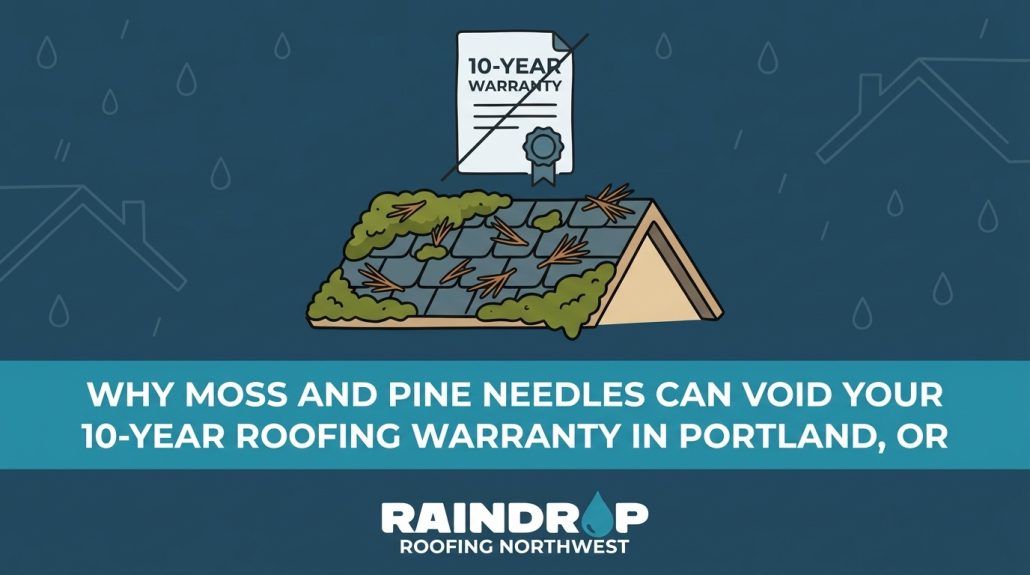
The Hidden Threat to Your Roof as Heavy Fall Rains Begin
If you are searching for reliable home maintenance tips and troubleshooting advice this season, there is one critical area you cannot afford to ignore: the debris piling up on your roof. You might have cleared your gutters, but a glance up at your shingles often reveals a growing blanket of pine needles and the faint green hue of early moss. As October arrives in the Pacific Northwest, our team at Raindrop Roofing Northwest sees firsthand how the transition into our heavy rain season brings an immediate and severe risk to your home. Moisture gets trapped under this organic debris, creating a damp environment that begins breaking down your roofing materials long before their expected lifespan expires.
The specific danger lies in how water interacts with these blockages during heavy seasonal downpours. Shingles are designed to shed water quickly, but trapped debris slows that process down, forcing water to pool and seep into places it should never reach. Ignoring this accumulation does not just risk interior leaks; it actively threatens the validity of the national warranties homeowners rely on to protect their investments. Before you assume your roof is fully covered for the next decade, you need to understand how manufacturer policies view environmental wear and tear. If you are considering a Portland roof replacement, protecting that investment means securing a robust workmanship warranty and understanding exactly what maintenance is required to keep it active.
How National Manufacturer Warranties Define Lack of Maintenance
Many homeowners operate under a dangerous misconception about what a standard 10-year manufacturer warranty actually covers. These national policies are primarily designed to protect against factory defects—errors in how the shingles were produced at the plant. They are rarely designed to cover environmental wear, and they almost universally include rigid “neglect” clauses. If a manufacturer determines that a roof failed because the homeowner did not maintain it properly, they have the legal right to void the coverage entirely.
This lack of maintenance clause is particularly problematic for homeowners in the Pacific Northwest. National warranty policies are written for average climates, rarely accounting for the aggressive nature of environmental factors in a region that averages over 36 inches of rain annually. According to guidelines from the Asphalt Roofing Manufacturers Association (ARMA), allowing debris accumulation and organic growth to remain on a roof traps moisture and accelerates shingle deterioration. Because ARMA sets the industry standards, warranty providers use these exact guidelines to deny claims.
The Fine Print on Environmental Damage
When you read the fine print of most national roofing warranties, you will find specific exclusions for damage caused by organic growth and accumulated debris. Manufacturers view moss, algae, and trapped pine needles as preventable issues. If a leak occurs because a pile of wet leaves degraded the asphalt, the manufacturer will categorize that as homeowner neglect, not a product failure.
The burden of proof: If you file a warranty claim for premature shingle failure, the warranty provider will likely request maintenance records or send an inspector. The burden of proof falls entirely on you, the homeowner, to demonstrate that you performed adequate, regular upkeep. If the inspector finds thick moss or clogged roof valleys, your claim will be denied instantly, leaving you entirely responsible for the repair costs.

The Danger of Pine Needles in Your Roof Valleys
To understand why a few scattered pine needles can trigger a warranty denial, you have to look at how your roof manages water. The roof valleys—the V-shaped internal angles where two sloping roof planes meet—act as the primary drainage system for the entire structure. During a heavy Portland rainstorm, these valleys funnel hundreds of gallons of water down into your gutters. They are the hardest-working sections of your roof, which also makes them the most vulnerable to debris.
When pine needles fall, they naturally wash down into these valleys. Because of their long, thin shape, pine needles interlock easily, creating dense, semi-permeable physical dams. These dams restrict water flow during heavy downpours. Instead of rushing cleanly off the roof, the rainwater hits the pine needle dam and begins to pool. Because asphalt shingles are designed to shed water downward—not resist standing water—this pooling creates a massive problem.
The mechanics of water intrusion:
- Hydrostatic pressure: As water backs up behind the pine needle dam, the weight of the water pushes against the edges of the shingles.
- Capillary action: The trapped water is forced upward and sideways, creeping under the overlapping shingles and reaching the vulnerable underlayment below.
- Material degradation: The constant presence of wet, decaying pine needles eats away at the asphalt and fiberglass base of the shingles.
By mid-fall, our roofing specialists frequently find these dams fully formed just as the heaviest rains begin. Water damage resulting from uncleared valleys is universally classified as homeowner neglect by warranty providers. Because the failure started with preventable debris buildup rather than a defective shingle, the manufacturer will void the warranty for that section of the roof, leaving you unprotected against the resulting water damage.
Why Pacific Northwest Moss Growth Triggers Neglect Clauses
While pine needles cause immediate drainage issues, moss presents a slower, more destructive threat to your roofing warranty. The persistent dampness of our regional climate creates the ideal breeding ground for rapid moss development. In tree-heavy Beaverton neighborhoods, where our crews perform countless roof inspections, tall evergreens provide constant shade and drop organic matter onto the roof surface, meaning shingles can stay damp for weeks at a time during the winter months.
Moss does not just sit harmlessly on top of your roof; it actively anchors itself into the materials. Moss lacks a traditional root system, but it uses tiny appendages called rhizoids to grip the rough surface of asphalt shingles. As the moss grows and thickens, these rhizoids dig deeper into the granules.
How moss destroys your coverage:
- Lifting the edges: As moss grows along the bottom edge of a shingle, it physically lifts the material. This breaks the factory adhesive seal that binds the shingles together, exposing the underlayment to wind-driven rain.
- Trapping moisture: Moss acts like a sponge, holding rainwater against the roof surface long after a storm has passed. This constant moisture accelerates the loss of protective granules.
- Freezing and expanding: When temperatures drop, the water trapped inside the moss freezes and expands, causing further physical damage to the asphalt base.
Reiterating ARMA data, organic growth traps moisture and degrades roofing materials prematurely. Warranty providers are acutely aware of this data. Failing to treat moss proactively gives manufacturers an immediate loophole to deny coverage. If an inspector sees moss growing out of the shingle joints, they will conclude that the roof was neglected, voiding your warranty protections entirely.
Gutter Cleaning vs. Comprehensive Roof Maintenance
A common pattern our team at Raindrop Roofing Northwest sees is homeowners mistakenly believing that standard gutter clearing fulfills all their fall maintenance requirements. While keeping your gutters flowing is absolutely necessary, it is only one piece of the puzzle. Clearing the perimeter of your roof does nothing to address the debris and organic growth threatening the main surface area and the critical roof valleys.
The critical difference between clearing gutters and performing comprehensive roof maintenance comes down to protecting the actual water-shedding surfaces of your home. Gutters manage the water after it leaves the roof; comprehensive maintenance ensures the water can actually get to the gutters without penetrating your home first.
| Maintenance Task | What It Accomplishes | Impact on Roof Warranty |
|---|---|---|
| Standard Gutter Cleaning | Prevents water from overflowing at the roofline and damaging the fascia boards or foundation. | Required, but insufficient on its own to maintain shingle warranties. |
| Valley Clearing | Removes pine needle dams, allowing heavy rain to flow freely off the roof planes. | Critical for preventing neglect clauses related to water backing up under shingles. |
| Moss Treatment | Kills organic growth before rhizoids can lift shingle edges and break waterproof seals. | Mandatory for keeping manufacturer warranties active in damp climates. |
| Surface Inspection | Identifies missing granules, cracked sealants, and early signs of material fatigue. | Provides the documentation needed to prove routine upkeep if a claim is filed. |
Comprehensive maintenance includes professional moss treatment, safe debris removal, and a thorough inspection of your shingles and flashing. If you spot early signs of damage—like lifted shingles or heavy moss accumulation—it is time to seek professional help. Addressing these issues early with proper roof repair in Beaverton ensures your home remains watertight and your warranty remains in good standing before the winter storms arrive.
The Risk of Unauthorized DIY Repairs and Pressure Washing
When homeowners realize that moss and debris threaten their warranty, the first instinct is often to head to the hardware store or pull out the pressure washer. However, unauthorized DIY repairs and aggressive cleaning methods are among the fastest ways to permanently void your roofing warranty. Attempting to blast away moss or scrub the shingles usually causes more damage than the organic growth itself.
The destructive nature of pressure washing:
- Granule loss: Asphalt shingles are coated in tiny ceramic granules that protect the underlying asphalt from UV rays and physical damage. High-pressure water instantly strips these granules away, leaving the shingle completely unprotected.
- Water intrusion: Pressure washers force water upward at high velocities. This easily blasts past the adhesive seals, driving water directly into your attic space and soaking your insulation.
- Instant warranty void: Every major roofing manufacturer explicitly states that pressure washing asphalt shingles will instantly void the warranty.
Beyond pressure washing, homeowners often turn to harsh, unapproved chemicals to kill moss. Many off-the-shelf bleach solutions or acidic cleaners can dry out the asphalt, causing the shingles to become brittle and crack prematurely. To maintain your warranty compliance, any physical repairs, debris clearing on steep pitches, or moss treatments must be left to licensed professionals who use manufacturer-approved soft-wash methods and specialized treatments.
The Advantage of Workmanship Coverage Built for Local Weather
Navigating the strict rules of national manufacturer warranties can be frustrating, especially when those policies fail to account for the realities of living in the Pacific Northwest. This is where the difference between a manufacturer’s material warranty and a local workmanship warranty becomes incredibly important for your home’s long-term protection.
A manufacturer’s warranty only covers the physical shingles. If the factory made a mistake, they will replace the materials. However, a workmanship warranty covers the actual installation—the skill and precision used to attach those materials to your home. At Raindrop Roofing Northwest, our team understands the specific challenges of our regional weather. We know exactly how much ventilation is required to keep an attic dry during a damp winter, and we know the precise nailing patterns needed to withstand high winds.
Robust local workmanship warranties offer much more practical protection against the installation issues that are tested by severe local storms. Unlike rigid national policies that look for loopholes to deny claims based on environmental wear, a strong workmanship guarantee stands behind the quality of the labor. Working with a local team that knows how to properly ventilate, flash, and protect roofs in this specific climate provides a level of security that a generic national material warranty simply cannot match.
Frequently Asked Questions About Roof Warranties and Maintenance
Does moss void a roof warranty?
Yes, if left untreated, moss falls directly under the lack of maintenance clause found in almost all national roofing warranties. Manufacturers consider moss growth a preventable environmental issue, not a product defect. If moss rhizoids lift the shingles or trap moisture that degrades the asphalt, any resulting leak claims will be denied due to homeowner neglect.
What is considered lack of maintenance on a roof?
Lack of maintenance generally includes allowing debris to accumulate in valleys, ignoring moss or algae growth, and failing to keep gutters flowing freely. It also covers neglecting basic repairs, such as failing to replace cracked sealant around pipe boots or ignoring missing shingles after a windstorm. Warranty providers expect homeowners to keep the roof surface clean and functional year-round.
How do I maintain my roof warranty?
You maintain your warranty by scheduling regular professional inspections, clearing debris safely, and treating organic growth promptly. Keep detailed records and invoices from licensed professionals who perform your maintenance. This documentation proves to the manufacturer that you have fulfilled your obligations if you ever need to file a claim for defective materials.
Is professional roof cleaning covered by warranty?
No, professional roof cleaning is considered routine homeowner maintenance, not a manufacturer defect. Just like changing the oil in your car is your responsibility to keep the engine warranty valid, keeping the roof clean of pine needles and moss is your financial responsibility. Paying for professional, soft-wash cleaning protects your warranty status.
Why do pine needles cause roof leaks?
Pine needles cause leaks because they create dense dams that block water flow in the roof valleys. During heavy rain, these dams stop water from running down into the gutters, forcing the rainwater to pool backward. This standing water is then pushed up under the overlapping shingles via capillary action, eventually soaking through the underlayment and into your home.
Protect Your Coverage Before Winter Storms Hit
Keeping a 10-year roofing warranty valid requires proactive attention to the seasonal debris that plagues our region. While standard manufacturer policies offer important baseline protection, they demand that you keep your roof free of the moss and pine needles that accelerate wear and tear. Addressing clogged valleys and early organic growth before the heavy winter rains arrive is the most effective way to prevent costly water intrusion.
If you have noticed debris building up on your shingles this October, do not wait for a leak to reveal a problem. Schedule a professional inspection and clearing to ensure your home remains fully protected. Taking action now guarantees that your roof functions exactly as intended, keeping your family dry and your warranty completely intact through the worst of the winter weather.




Trackbacks & Pingbacks
[…] how moss and pine needles void roofing warranties is the first step toward better home maintenance. You must clear these valleys and ensure your […]
Leave a Reply
Want to join the discussion?Feel free to contribute!