
The Ins and Outs of How Certified Contractors Ensure Quality Installation
Why Understanding How Certified Contractors Ensure Quality Installation Matters for Your Roof
Understanding how certified contractors ensure quality installation comes down to a few core practices that separate a roof that lasts 30 years from one that fails in five. Here is a quick overview:
- Manufacturer certifications — Certified contractors complete rigorous training, hands-on workshops, and ongoing education to install specific products correctly and protect your warranty.
- Quality assurance (QA) — Standardized processes and pre-installation planning that prevent defects before work begins.
- Quality control (QC) — Physical inspections, checklists, and testing during and after installation that catch errors before they become your problem.
- Supervision frameworks — Matching the skill level of each crew member to the complexity of the job, with a designated technical supervisor accountable for the outcome.
- Documentation and verification — Inspection records, commissioning reports, and as-built drawings that prove the work meets industry standards — not just a contractor’s word.
Poor installation quality is not a small risk. According to the Construction Industry Institute, rework from quality failures typically accounts for 4 to 12 percent of total project costs. For a roofing project, that can mean leaks, structural damage, and voided warranties — all avoidable with the right contractor and the right process.
At Raindrop NW, we hear the same concern from homeowners across the Beaverton and Portland metro area: “How do I actually know the work was done right?” This guide answers that question in plain language, so you can make a confident, informed decision about who you trust with one of your home’s most critical systems.
I’m Torrey Yungeberg, owner of Raindrop Roofing NW and a second-generation roofing professional with a front-row seat to what separates truly quality installations from ones that cut corners — and I’ve built our entire operation around the standards we’ll walk through here. Understanding how certified contractors ensure quality installation is not just something I write about; it’s the foundation of every project my team takes on.
Understanding Quality Assurance vs. Quality Control in Construction
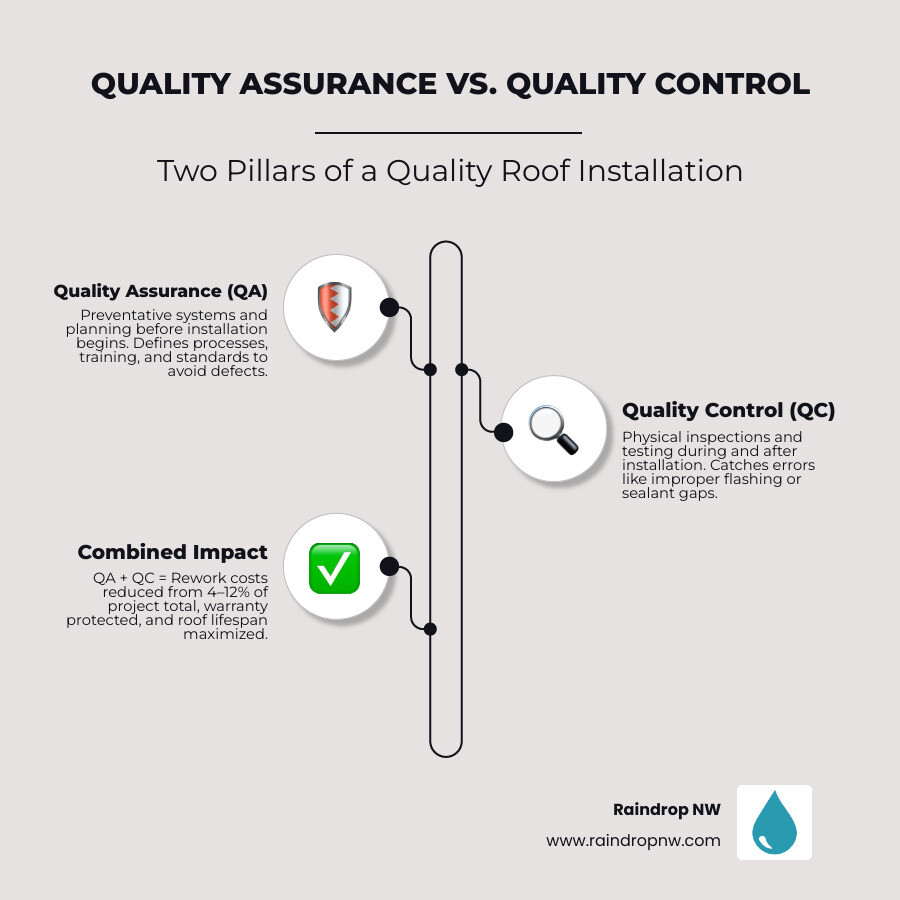
In the construction world, people often use the terms “quality assurance” (QA) and “quality control” (QC) interchangeably. However, they represent two entirely different pillars of a successful project. To get a high-performing roof over your head, a contractor must master both.
Think of Quality Assurance as the defensive game plan. It is a proactive, process-oriented system designed to prevent defects before they ever happen. QA happens behind the scenes. It includes the structured training of our crews, the careful selection of premium materials, the creation of standardized installation guides, and the pre-construction planning sessions where we look at your roof’s unique geometry and plan for our wet Pacific Northwest weather.
Quality Control, on the other hand, is the offensive play. It is a reactive, product-oriented process focused on identifying and correcting defects during and immediately after the installation. When a supervisor climbs up a ladder in Beaverton to physically inspect the nailing pattern on a shingle, verify the depth of a flashing channel, or check that a valley is completely watertight, they are performing quality control.
By separating these two functions, we dramatically lower the risk of rework. Rework is not just a headache for the contractor; it is a massive disruption for you. When a team has to tear up completed work because of an installation error, it compromises the structural integrity of the surrounding materials and drags out the project timeline.
To help visualize how these two systems work together on your home, here is a breakdown of how we apply QA and QC to a standard residential roofing project:
| Quality Assurance (Preventative) | Quality Control (Corrective/Verification) |
|---|---|
| Focus: The process of installing the roof. | Focus: The actual finished roof itself. |
| Goal: Prevent defects from occurring in the first place. | Goal: Identify and fix defects before the job is signed off. |
| Examples: – Crew training and manufacturer certifications. – Selecting materials rated for high wind and heavy rain. – Checking local weather forecasts before tearing off a roof. |
Examples: – Pull-testing fasteners to verify holding power. – Inspecting attic ventilation paths after deck installation. – Water-testing complex flashing assemblies. |
| When it happens: Before the tools ever touch your roof. | When it happens: During the installation and at final handover. |
Applying this dual-layer framework keeps projects running smoothly and ensures that every layer of your roof — from the ice and water barrier to the final ridge cap — is installed to perform for decades.
How Certified Contractors Ensure Quality Installation Through Manufacturer Standards
When you hire a contractor, their credentials tell a story. While basic licensing is the absolute minimum requirement to operate in Oregon, manufacturer certifications serve as the true benchmark for installation quality and technical expertise.
Major manufacturers like GAF or Owens Corning do not hand out certifications to just anyone. They establish strict requirements that act as a pre-qualification filter. To hold these credentials, a roofing company must prove they are financially stable, carry robust insurance, maintain an excellent local reputation, and — most importantly — submit their crews to rigorous technical training.
By choosing a certified installer, you are leveraging their manufacturer-backed credentials to mitigate risks. When installers know exactly how a specific shingle or underlayment is designed to lock together, they make fewer mistakes. This translates directly to a massive reduction in callbacks.
In our industry, callbacks are a silent killer of contractor margins and homeowner trust. A single residential callback to address a small leak or a loose piece of flashing can cost a contractor anywhere from $500 to $1,500 in labor, truck rolls, and replacement materials. If an installer completes 200 jobs a year in the Portland-Metro area and prevents just five callbacks through better quality practices, they save a direct cost of $6,000 — savings that are passed down to homeowners through better service, stable operations, and reliable warranties.
Understanding How Manufacturer Certifications Indicate Quality helps you see that certified contractors are not just paying for a badge; they are investing in a system that guarantees a better result for your home.

The Role of Manufacturer Training in How Certified Contractors Ensure Quality Installation
The training required to maintain manufacturer certifications is intense. It is not a one-time online slideshow. Instead, it involves structured, hands-on workshops where installers work directly with the materials under the watchful eye of manufacturer representatives.
These workshops cover the fine details of technical proficiency, such as:
- The exact temperature ranges required for self-adhering membranes to seal properly.
- Crucial nailing zones to ensure shingles do not blow off during stormy winter winds in West Linn or Tigard.
- Advanced flashing techniques around chimneys, skylights, and dormers — the most common places for a roof to leak.
Furthermore, these training programs require mandatory continuing education. Manufacturers are constantly updating their product lines, chemical compositions, and installation specifications. If a contractor does not stay up to date on these product updates, they will quickly lose their certified status. Continuing education ensures our crews are always using the absolute best, most modern practices on your home.
How Certified Contractors Ensure Quality Installation to Protect Your Warranty
One of the biggest misconceptions in home improvement is that a “lifetime product warranty” covers everything, no matter who installs it. In reality, manufacturer warranties are highly contingent on the quality of the installation.
If a non-certified contractor makes a mistake — such as using the wrong nails, spacing them incorrectly, or failing to install the proper underlayment — the manufacturer can, and often will, void your warranty. If your roof fails three years down the road due to an installation error, the manufacturer will not pay for the replacement materials, and you will be left holding the bill.
Certified contractors are authorized to offer enhanced, extended warranties that cover both the materials and the workmanship. Because the manufacturer trusts the certified contractor’s training and expertise, they are willing to stand behind the installation.
Understanding How Independent Ownership Protects Your Warranty is another piece of this puzzle. Locally owned, independent contractors have a direct, personal stake in making sure your warranty remains fully intact. Unlike massive, private-equity-backed corporate chains that might change hands every few years, a local business relies on its reputation in Beaverton, Hillsboro, and Lake Oswego to survive. We make sure the job is done perfectly the first time so your warranty is ironclad.
Core Components of an Effective Quality Control Plan
A professional roofing project does not run on hope and good intentions. It runs on a structured, written Quality Control Plan (QCP). This plan outlines exactly who is responsible for what, how the work will be inspected, and what steps will be taken to verify that the final product meets our high standards.
An effective QCP contains several core elements:
- Clear Standards and Specifications: Translating complex building codes and manufacturer manuals into clear, visual instructions for the crew on the roof.
- Qualified Personnel: Ensuring every worker has the training required for their specific task.
- Systematic Inspection and Testing: Scheduling mandatory stop-points during the project to inspect critical layers (like the wood deck or the underlayment) before they are covered up.
- Documentation: Keeping a detailed physical and digital record of every check, measurement, and sign-off.
Standardized Checklists and Risk-Competency Supervision
Just like pilots use a pre-flight checklist to keep passengers safe, certified contractors use standardized checklists to ensure no detail is missed during an installation.
In other industries, standardized checklists are famous for protecting performance. For example, in the HVAC industry, not following the rigorous requirements of the ACCA 5 Quality Installation (QI) Standard can increase a system’s annual energy consumption by 30% or more due to minor installation faults. In roofing, skipping a single step on a checklist — like failing to seal a joint or misaligning a starter strip — can have similarly disastrous consequences, leading to premature roof failure and water intrusion.
To prevent these errors, we use a structured supervision model based on a Risk-Competency Matrix. We do not just send a crew to your house and hope for the best. We analyze the risk level of the project and match it to the competency of our team:
- Operative Competence Tiers: We categorize our field staff into three distinct levels: Supervised (apprentices/trainees), Skilled (experienced installers), and Skilled & Qualified (lead technicians with specialized manufacturer certifications).
- Project Risk Levels: We evaluate the complexity of each job. A straightforward, single-story shingle replacement in Sherwood might be classified as Low-to-Medium Risk. A steep, multi-gabled roof with custom metal valleys and skylights in the hills of Portland is classified as High Risk.
- The Supervision Matrix: By cross-referencing these two factors, our Technical Supervisor determines exactly how much direct, physical oversight is required on-site. High-risk areas of the installation are hard-locked, meaning the crew cannot proceed until the Technical Supervisor physically inspects and signs off on the work.
Documentation, Testing, and Verification Procedures
A quality installation is not complete without proof. That is why certified contractors rely on a rigorous process of documentation, testing, and verification.
This process includes several critical documents:
- Inspection and Test Plans (ITPs): A scheduled document that outlines exactly when and how different parts of the roof will be tested (such as conducting a water-spray test on a low-slope roof membrane to verify it is 100% watertight).
- Commissioning Reports: A final, comprehensive review of the entire roofing system, confirming that all components — including ventilation vents, gutters, and flashing — are functioning together as a cohesive unit.
- As-Built Drawings: Documenting any adjustments made during the installation to account for unique structural features of your home.
This level of documentation creates a permanent, reliable record of your roof’s quality. It protects you, proves the work was done to code, and serves as valuable evidence should you ever decide to sell your home.
Before you hire any team to work on your property, it is also essential to make sure their legal credentials are in order. Learning How to Verify a Roofer’s License and Insurance is a vital step in protecting your home and ensuring you are working with a legitimate, professional business.
Leveraging Technology and Digital Tools to Enforce Quality Standards
We live in a digital age, and the best contractors leverage modern technology to enforce quality standards on every job site. Gone are the days of crumpled paper checklists lost in the back of a truck. Today, we use mobile checklists and integrated CRM (Customer Relationship Management) platforms to streamline our workflows and maintain absolute accountability.
Here is how digital tools keep your roofing project on track:
- Mandatory Photo Uploads: Our field software can hard-lock a job, preventing a technician from moving to the next step or closing out the project until they upload clear, high-resolution photos of critical steps (like the ice and water shield installation or the flashing around a chimney).
- Real-Time Quality Tracking: Supervisors and project managers can monitor the progress of your roof in real-time from our main office in Beaverton, catching potential issues on a digital dashboard before the crew leaves the job site.
- Seamless Communication: Any notes, photos, or test results are instantly synced to your customer profile, giving our entire team a single source of truth and allowing us to send you a complete, transparent photo gallery of your finished roof.
By using these digital tools, we eliminate guesswork, reduce human error, and ensure that the high standards we promise in our office are executed perfectly on your roof.
Frequently Asked Questions About Contractor Quality
What is the difference between QA and QC in construction?
Quality Assurance (QA) is the preventative system focused on the processes used to build your roof. It includes training, material selection, and planning to prevent defects before they happen. Quality Control (QC) is the inspection and testing process used to identify and correct any defects during and after the installation.
How do manufacturer certifications protect my roof’s warranty?
Manufacturers trust certified contractors because they have completed specialized training. Because of this trust, manufacturers allow certified installers to offer extended warranties that cover both materials and workmanship. If a non-certified installer makes a mistake, the manufacturer can void your product warranty completely.
Why are standardized checklists important for home installations?
Standardized checklists ensure that every single step of your installation is completed consistently and correctly, regardless of which crew is on your roof. They act as an execution layer that prevents human error, reduces costly callbacks, and provides a documented record of quality compliance.
Conclusion
At the end of the day, your roof is your home’s first line of defense against the elements. Ensuring it is installed correctly requires more than just a hammer and some shingles — it takes a dedicated commitment to certified quality, rigorous supervision, and transparent documentation.
At Raindrop NW, we are proud to be a truly local, independent, family-owned roofing company serving Beaverton, Portland, Tigard, Hillsboro, and the surrounding communities. We do not answer to out-of-state investment firms or corporate shareholders; we answer to you, our neighbors. That independence allows us to focus on what matters most: exceptional craftsmanship, honest communication, and long-term accountability.
If you are looking for a team that takes quality seriously from the first inspection to the final sign-off, we would love to help. Explore our residential roofing services today to learn more about how we can protect your home with a beautiful, certified roof built to last.




Leave a Reply
Want to join the discussion?Feel free to contribute!