
Architectural vs. 3-Tab Shingles: Why We Rarely Install 3-Tab Anymore
The Myth of the ‘Good Enough’ Roof Before Winter Hits
Standard asphalt shingles all offer the exact same basic protection, right? Actually, believing that common myth is exactly why so many roofs fail prematurely when the weather turns harsh. When local homeowners are comparing architectural vs. 3-tab shingles: why we rarely install 3-tab anymore is a question our team at Raindrop Roofing Northwest answers almost daily. The reality is that material choice dictates whether your home survives high winds or suffers sudden, stressful leaks. As you evaluate your options, understanding the long-term value of investing in high-quality roofing shingles is the most critical step you can take.
Many homeowners assume that if a shingle is sold on the market, it must be “good enough” to protect their home. Decades ago, traditional 3-tab shingles were the industry standard. They covered millions of homes and did an adequate job for the weather patterns of the time. However, building science has evolved, and the demands placed on residential roofing have intensified. Today, in our experience, settling for “good enough” often means setting yourself up for failure.
In our years of climbing roofs across Beaverton and the greater Portland area, our team has seen firsthand how the specific seasonal realities of Pacific Northwest weather destroy inadequate materials. Standard building materials that might hold up perfectly fine in a mild, dry climate frequently fall short here. We face a unique combination of relentless horizontal rain, sudden wind gusts, and continuous moisture loads. Evaluating traditional 3-tab shingles against these demands reveals significant structural weaknesses.
As you tackle your September pre-winter storm preparation, you face a crucial decision point. Upgrading to architectural shingles is no longer just about improving your home’s curb appeal; it is a necessary defense strategy for superior wind resistance and durability. The flat, single-layer design of a 3-tab roof simply lacks the physical mass to withstand the aggressive storm season ahead. Let’s look at exactly why the structural differences between these materials matter so much for your home’s safety.
Side-by-Side: The Structural Reality of 3-Tab vs. Architectural Shingles
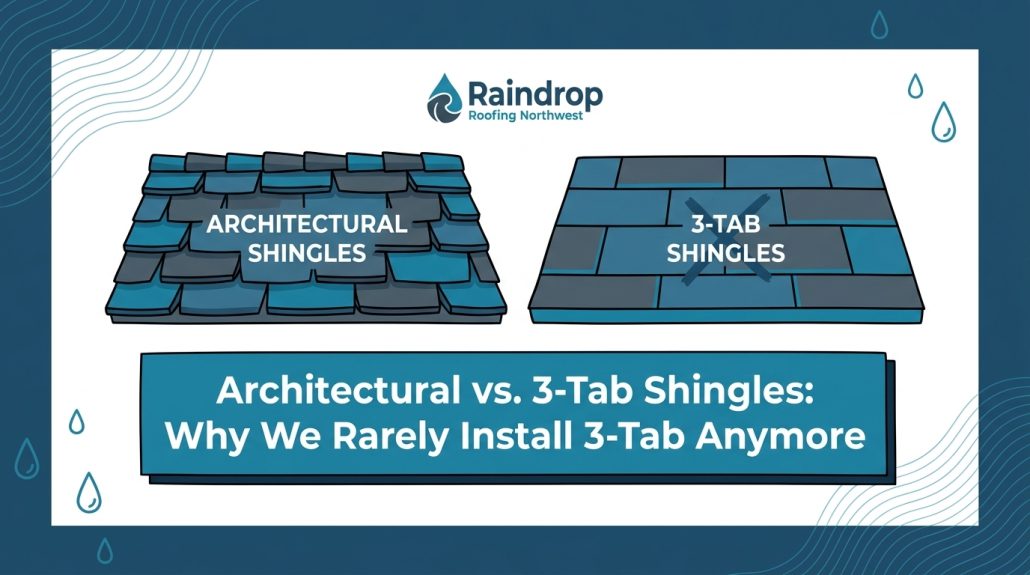
When our installation crews tear off an old, failed roof, the structural differences are undeniable. To understand why one shingle fails while another holds strong, you have to look at how they are built from the inside out. Standard 3-tab shingles are manufactured as a single, flat layer of fiberglass mat coated in asphalt and granules. They are cut with two slits to create three distinct “tabs” along the lower edge. This design makes them lightweight, easy to produce, and entirely two-dimensional.
Architectural shingles, on the other hand, feature a multi-layered, dimensional build. Manufacturers laminate two or more layers of fiberglass mat together, creating a thicker, heavier, and far more robust physical barrier. This extra mass is not just for looks; it provides the crucial structural integrity needed to endure heavy impacts and resist tearing. The dimensional profile also mimics the textured appearance of premium materials like wood shake or slate, which is a major factor when choosing the right shingle color and style for your property.
Material Thickness and Weight Differences
The physical weight of your roofing material plays a massive role in its performance. Because 3-tab shingles are so lightweight, they are highly prone to tearing, creasing, and snapping off entirely when subjected to stress. They rely heavily on a single strip of adhesive to stay anchored.
Conversely, architectural shingles are significantly heavier. This added weight allows them to sit tightly against the roof deck, providing a rigid, unyielding shield against the elements. Our roofing specialists at Raindrop Roofing Northwest consider this physical density non-negotiable for long-term survival on homes across Beaverton and the surrounding Pacific Northwest.
| Feature | Traditional 3-Tab Shingles | Architectural Shingles |
|---|---|---|
| Wind Rating | Typically rated for 60 MPH gusts | Rated for 110-130 MPH gusts |
| Thickness | Single layer, thin profile | Multi-layer, heavy dimensional build |
| Lifespan Expectancy | Shorter (often fails before warranty) | Significantly longer (robust longevity) |
| PNW Suitability | Poor/Vulnerable to local storms | Highly Recommended for wind/rain |

Wind Uplift Ratings: Why 60 MPH Protection Isn’t Enough
If you look at the fine print on a bundle of standard 3-tab shingles, you will typically see a wind rating of around 60 miles per hour. While 60 mph sounds like a substantial number, it is dangerously inadequate for our region. Our repair teams are dispatched every fall and winter across the Beaverton and Portland areas to deal with the aftermath of significant winter windstorms that generate powerful gusts, easily exploiting the weaknesses of single-layer roofing.
Architectural shingles are engineered to meet entirely different standards, typically carrying wind ratings of 110 to 130 mph. This massive jump in protection is validated by FEMA guidelines on wind-resistant roofing materials, which strongly recommend heavier, multi-layered shingle usage in storm-prone regions.
The Mechanics of Wind Uplift
Understanding how wind destroys a roof helps clarify why 3-tab shingles fail so frequently. Wind damage rarely happens all at once; it is a progressive failure driven by a phenomenon called wind uplift.
- The initial catch: High winds sweep over the roof, creating a vacuum effect (negative pressure) just above the surface.
- The lift: Because 3-tab shingles have distinct vertical slits and lie completely flat, the wind easily catches the edges of the individual tabs.
- The adhesive failure: As the wind pulls upward, it breaks the factory sealant strip holding the thin tab down.
- The crease and snap: Once the tab lifts, the wind bends it backward. The thin fiberglass mat creases, weakens, and eventually snaps off entirely, leaving the underlayment exposed.
At Raindrop Roofing Northwest, we see the aftermath of this process constantly. We recently helped a local homeowner during a particularly harsh winter after severe windstorms ripped several shingles right off their roof. They were dealing with missing shingles, exposed roof decking, and failing flashing that created a high potential for immediate interior leaks. Our team replaced the compromised sections, secured the flashing, and patched a vulnerable area where an old satellite dish used to be. Upgrading the materials ensured that the roof looked excellent and, more importantly, that no shingles were left out of place despite the continuing winter gales. If you are comparing Malarkey and Owens Corning shingles, you will find that both manufacturers heavily emphasize the superior wind resistance of their architectural lines for exactly this reason.
Defeating Persistent Moisture and Horizontal Rain
The Problem: Wind is only half the battle. The Pacific Northwest is famous for its relentless, driving rain. During heavy storm cycles, rain doesn’t just fall straight down; high winds push it horizontally across your roof. This horizontal moisture easily penetrates the flatter, less layered profile of 3-tab shingles. Because the material is thin and features cut-out tabs, water is easily driven upward and underneath the shingle layers.
The Cause: Persistent moisture defense requires physical thickness and overlapping mass, not just surface-level waterproof treatments. When horizontal rain breaches a 3-tab roof, it introduces water directly to the underlayment and the wooden roof decking. Over time, this trapped moisture leads to extensive secondary damage. Our inspectors frequently encounter Beaverton-area homes built in the late 1950s and early 60s suffering from severe moss damage and trapped moisture under the eaves. During a recent early fall roof replacement, our team helped a homeowner battling these exact issues, likely stemming from an old, failing 3-tab roof that could no longer shed water properly. By replacing the roof with thick, dimensional materials and installing new composite vent covers, we resolved the moisture intrusion entirely and drastically reduced exterior noise.
The Solution: Architectural shingles defeat horizontal rain through their continuous, overlapping, multi-layer design. There are no vertical cut-outs for water to easily travel through. The heavy, laminated layers create a superior watertight seal that forces driving rain to shed downward, exactly as intended. Connecting material thickness directly to defending against the persistent heavy rain typical of our area proves that architectural shingles are built to handle the realities of Beaverton’s climate.
The ‘Budget’ Illusion: Long-Term Value vs. Premature Failure
One of the most persistent misconceptions we hear in home improvement is that 3-tab shingles are a “budget-friendly” option. While the upfront material cost of a single-layer shingle is lower, framing it as a money-saving choice is a dangerous illusion. In reality, installing a 3-tab roof in a storm-prone region is a poor investment that almost always costs more over the lifespan of the home.
When you evaluate the long-term value of a roof, you must factor in the frequency of repairs. A roof that requires constant maintenance—replacing blown-off tabs, resealing lifted edges, and treating secondary moisture damage—quickly erases any initial material savings. Every time one of our technicians has to climb onto your roof to patch a blowout after a November gale, your “budget” roof becomes more expensive.
Furthermore, there is a stark difference in manufacturer warranty lengths. Because architectural shingles are physically stronger, manufacturers stand behind them with significantly longer, more robust warranties. 3-tab shingles carry much shorter coverage windows because the manufacturers know the thin material will deteriorate faster under UV exposure and weather stress.
The bottom line: Doing the job right the first time with durable, heavy-duty materials is always more economical than replacing a failed roof prematurely. If you are preparing for September pre-winter storm preparation, taking the time to understand the benefits of a full roof replacement with architectural materials will save you from the endless cycle of emergency patching and structural anxiety.
Contractor Integrity: Why We Refuse to Compromise on Quality
At Raindrop Roofing Northwest, our refusal to install 3-tab shingles is rooted in a commitment to quality and integrity, protecting homeowners from premature roof failure. This is not a sales tactic; it is a hardline ethical stance. As local professionals, we know exactly what the weather in Beaverton and the surrounding Pacific Northwest does to homes.
Installing a product that is known to fail prematurely in our local weather conditions presents a massive ethical dilemma. If we know that a 60-mph rated shingle will likely tear off during a typical January gale, installing it anyway would be a disservice to the homeowner relying on us to keep their family dry. We refuse to put our name on a roof that we cannot confidently guarantee will survive the environment it was built for.
We maintain strict quality and integrity standards for all materials used on local homes. By insisting on architectural shingles, we ensure that every roof we build meets the rigorous demands of our climate. Prioritizing structural integrity over cheap shortcuts results in long-lasting peace of mind. When you hire a contractor, you are trusting them to be the expert. Part of that expertise is guiding you toward proper roof shingle installation practices and refusing to compromise on the materials that shield your biggest asset.
Secure Your Home’s Defense Before the Next Big Storm
The evidence is clear: when facing the high winds and heavy, driving rain of the Pacific Northwest, architectural shingles are the only logical choice for long-term protection. The thin, single-layer construction of 3-tab shingles simply cannot provide the structural defense your home requires.
With September pre-winter storm preparation underway, the urgency to secure a wind-resistant roof before the harsh winter gales arrive has never been higher. Don’t wait for a heavy storm to reveal the hidden weaknesses in your current roofing system. Reach out to Raindrop Roofing Northwest today to schedule a comprehensive evaluation, and let our local team provide you with a durable, architectural roof replacement that delivers absolute confidence and peace of mind for decades to come.
Frequently Asked Questions
Are architectural shingles worth the upgrade?
Yes, our team considers them absolutely worth the upgrade due to their superior durability and weather resistance. Architectural shingles feature multiple layers of fiberglass and asphalt, making them significantly heavier and more resistant to tearing. This added mass translates to a longer lifespan, better warranties, and far fewer repair calls after major storms.
What is the wind rating of 3-tab shingles?
Standard 3-tab shingles are typically rated to withstand wind gusts up to 60 miles per hour. Because they are lightweight and feature vertical slits that wind can easily catch, they are highly susceptible to wind uplift. In regions that experience severe winter gales, this 60 mph rating is often inadequate to prevent shingle blow-off.
Do roofers still install 3-tab shingles?
While some contractors still offer them as a baseline option, many reputable roofing companies, including ours, refuse to install 3-tab shingles. The high failure rate in storm-prone climates makes them a liability for both the homeowner and the contractor. Quality-focused roofers prefer to install materials they know will last without requiring constant emergency patching.
How much longer do architectural shingles last?
Architectural shingles generally outlast traditional 3-tab shingles by a significant margin, often providing decades of reliable protection. Their thick, laminated construction resists UV degradation, thermal shock, and physical weathering much better than single-layer materials. Consequently, manufacturers back them with much longer, more comprehensive warranties.
Why do roofing contractors prefer architectural shingles?
Contractors prefer architectural shingles because they provide a vastly superior, reliable product that protects their clients’ homes effectively. They are easier to install correctly, lay flatter against the roof deck, and dramatically reduce the number of warranty callbacks for blown-off shingles. It comes down to professional integrity and delivering a roof that actually performs.
Can my existing roof structure support the extra weight of architectural shingles?
In almost all cases, a standard residential roof structure is more than capable of supporting the weight of architectural shingles. While they are heavier than 3-tab shingles, they are still well within the load-bearing limits of modern building codes. A professional roofing contractor will inspect your roof decking during the replacement process to ensure the underlying structure is sound.
How do architectural shingles perform against horizontal rain?
Architectural shingles excel at defending against horizontal rain because of their continuous, overlapping design. Unlike 3-tab shingles, which have vertical cut-outs that allow water to be driven upward by the wind, architectural shingles create a solid, watertight barrier. Their heavy mass keeps them sealed tightly to the roof, forcing driving rain to shed safely into the gutters.




Leave a Reply
Want to join the discussion?Feel free to contribute!