
Why Seamless Aluminum Gutters Outperform Vinyl in Heavy Oregon Downpours
The Hidden Threat to Your Home’s Drainage This August
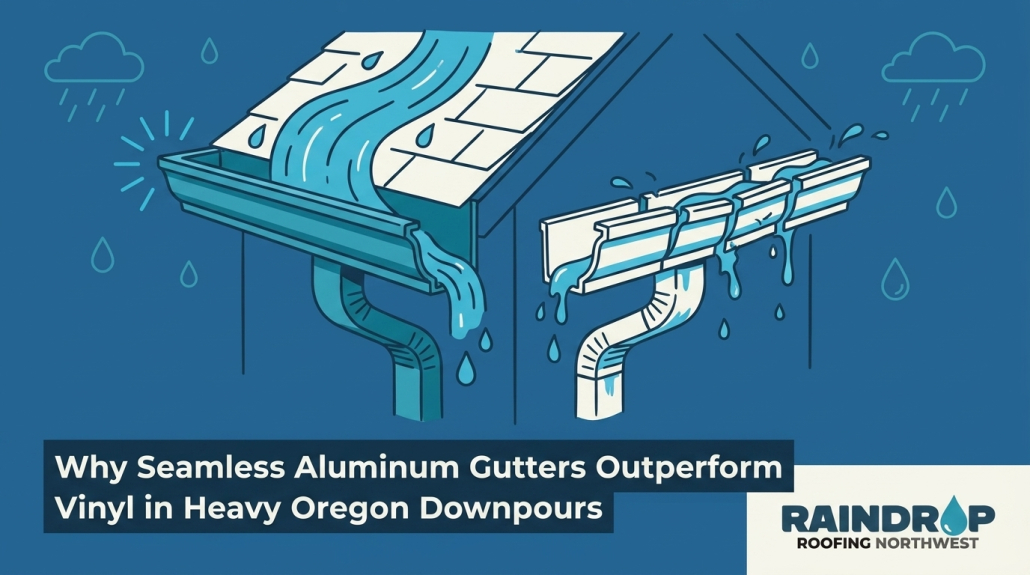
You look up at your roofline and notice the joints on your drainage system are sagging, leaving you wondering exactly why seamless aluminum gutters outperform vinyl in heavy Oregon downpours. Those failing seams are a quiet threat building up right above your head. Late summer and August debris accumulation puts immense stress on standard, sectioned PVC channels. At Raindrop Roofing Northwest, our team typically sees this exact scenario play out as homeowners face a critical decision: keep climbing a ladder to patch and re-seal those failing joints, or invest in a structurally sound upgrade before the relentless fall weather arrives.
While investing in a top-tier exterior upgrade like a Portland roof replacement keeps your home safe from top-down moisture, your drainage system is the exact mechanism that prevents foundation damage caused by failing gutters.
The Anatomy of a Failing Drainage System
Most homeowners do not realize that a drainage system acts as the unsung hero of their property’s structural integrity. When rainwater flows off your shingles, it carries momentum. The channels attached to your fascia boards are responsible for catching that heavy, moving water and redirecting it safely away from your siding, landscaping, and concrete slab. However, when you rely on sectioned plastic to do this heavy lifting, you introduce a mechanical vulnerability right at the edge of your roof.
The underlying issue: Standard vinyl systems are sold in short, manageable pieces. To cover a standard roofline, an installer must connect dozens of these sections using plastic connectors and chemical sealants. Every single one of these connections represents a break in the structural integrity of the channel. When late summer debris begins to collect in these troughs, the weight does not distribute evenly. Instead, it pulls directly on the weakest points—the joined seams.
In our years of serving Beaverton OR and surrounding Pacific Northwest areas, we’ve seen how this mechanical flaw becomes a serious liability. The regional environment throws a combination of heavy organic debris and massive water volume at your home. When a seam snaps or sags under this combined weight, the water no longer flows to the downspout. It spills directly over the edge, pooling around your foundation and threatening the structural stability of your entire house.
Understanding the Structural Weak Points of Vinyl Gutter Systems
The Problem: Vinyl systems look clean and functional on the day they are installed, but they carry an inherent material flaw. Because they are pieced together in sections, every joint acts as a weak point waiting to fail under environmental stress.
The Cause: In the Pacific Northwest, the temperature swings between intense summer heat and cool nights accelerate the expansion and contraction of PVC. This daily thermal cycling forces the plastic sections to push against each other during the day and pull apart at night. Over time, this constant movement grinds away at the sealant holding the joints together. Furthermore, prolonged UV exposure bakes the plastic, draining its flexibility and making it highly brittle. This creates what our roofing specialists at Raindrop Roofing Northwest call the “seam vulnerability.” Every connected piece creates a natural breaking point where structural integrity is severely compromised.
The Solution: The permanent fix involves moving away from sectioned plastics entirely. Embracing continuous materials that distribute stress evenly across the entire fascia board eliminates the expansion and contraction failures inherent to pieced-together PVC.
Comparing Material Behaviors Under Stress
To understand why sections fail, it helps to look at how different materials respond to the daily grind of weather exposure. Here is a breakdown of how pieced vinyl compares to continuous metal:
| Material Characteristic | Sectioned Vinyl (PVC) | Seamless Aluminum |
|---|---|---|
| Thermal Expansion | High movement; pushes and pulls at seams. | Minimal movement; continuous length absorbs shifts. |
| UV Degradation | Becomes brittle, chalky, and prone to cracking. | Highly resistant; maintains structural flexibility. |
| Load Distribution | Weight concentrates heavily on plastic connectors. | Weight distributes evenly across the entire channel. |
| Joint Integrity | Relies on temporary caulking and plastic clips. | No mid-run joints; custom-formed to exact length. |
When you look at the data, the mechanical reality becomes clear. A system built from dozens of brittle, expanding plastic pieces simply cannot offer the long-term reliability required to protect a home in a demanding climate. The sealant will eventually crack, the plastic will eventually warp, and the joints will inevitably leak.
The Crushing Weight of Wet Pine Needles
Understanding the physics of environmental load is crucial for protecting your home. Water is remarkably heavy, weighing roughly 8.34 pounds per gallon. During a standard rainstorm, a clogged system can hold hundreds of pounds of static pressure suspended right at the edge of your roofline.
The situation escalates dramatically during late summer / August debris accumulation. As the dry season peaks, trees drop a massive volume of dry pine needles, leaves, and twigs directly into your roof’s drainage channels. At first glance, this dry debris seems harmless and lightweight. But this dry organic matter acts like a sponge waiting for moisture.
The Transformation from Dry Debris to Dense Sludge
As soon as the first early fall rains hit, those light pine needles absorb water and begin to break down, transforming into a dense, heavy sludge. This sludge creates a dam inside the channel, trapping gallons of heavy rainwater behind it. The combined weight of the water and the saturated organic matter concentrates immense force directly onto the weakened vinyl seams.
The compounding weight problem:
- Dry accumulation: Leaves and needles fill the channel, blocking the path to the downspout.
- Water retention: The first rains soak the debris, tripling its weight instantly.
- Static pressure: Blocked water pools behind the debris dam, adding 8.34 pounds of downward force per gallon.
- Seam failure: The concentrated weight pulls downward on the plastic joint until the sealant tears and the seam separates.
It is important to remember that proactive maintenance is always the first line of defense. Taking the time for clearing heavy debris from your drainage system is critical for keeping water flowing. However, structurally weak gutters will still sag under sudden downpours even if they are perfectly clean. The sheer volume of water rushing off a roof during a storm requires a channel strong enough to hold it without buckling.

How Oregon Downpours Push Seams to the Breaking Point
The Problem: The material weaknesses of vinyl and the crushing weight of wet debris are magnified by the specific reality of our regional weather. The transition from dry August weather to the relentless heavy rain of an Oregon October creates a perfect storm for drainage failure.
The Cause: Beaverton and Portland average over 36 inches of rain annually, with the vast majority concentrated between October and April. When high-volume runoff hits a sagging vinyl seam, the water cannot bridge the gap. Instead, it creates a waterfall effect directly against the home’s exterior. Older homes built with pieced-together plastic drainage systems frequently experience these catastrophic failures during heavy rain events if the channels are not proactively upgraded.
The Solution: Upgrading to a continuous system designed specifically for high-capacity flow prevents the waterfall effect. Deep local expertise in Pacific Northwest weather challenges ensures installations are designed for this specific environmental stress. Working with professionals who understand the local climate means you get a system built to handle the unique demands of heavy regional rainfall.
The True Cost of the Waterfall Effect
When a seam separates and water cascades down your siding, the damage extends far beyond a broken piece of plastic. This constant overflow leads to severe secondary damage across your property.
- Fascia Board Rot: Water curling back under the sagging gutter soaks into the wooden fascia board, causing deep structural rot that is expensive to repair.
- Siding Degradation: Continuous water splashing against the side of your house forces moisture behind the siding panels, inviting mold and structural decay.
- Landscape Erosion: A concentrated waterfall washes away topsoil, drowns expensive landscaping, and creates muddy trenches around your home.
Handling complex exterior issues requires a team that takes responsibility for the whole property. At Raindrop Roofing Northwest, one local homeowner experienced our level of accountability firsthand during a fall roof installation. When an unseen water pipe was accidentally hit late on a Saturday, our installation crew immediately dispatched a plumber to fix the pipe, ensuring the entire exterior upgrade was completed to high standards without leaving the homeowner stranded. That is the difference between a generic contractor and a dedicated team that understands how to protect a home in the Pacific Northwest.
The Structural Superiority of Seamless Aluminum
When you are tired of climbing a ladder to push separated plastic joints back together, the mechanical solution is clear. Continuous aluminum safely handles the massive environmental loads that destroy standard vinyl. The structural superiority comes down to material science and modern fabrication techniques.
Aluminum boasts a significantly higher tensile strength compared to PVC. While plastic becomes brittle and chalky after a few years of sun exposure, high-grade aluminum maintains its structural integrity and flexibility for decades. It can bear significantly more downward weight without warping, bowing, or snapping.
The Mechanics of a Continuous Upgrade
The true advantage lies in the “seamless” fabrication process. Instead of snapping pre-cut pieces together, professionals bring specialized roll-forming machinery directly to your driveway.
- On-Site Custom Fabrication: A solid coil of flat aluminum is fed through a machine that shapes it into a perfectly formed channel, cut to the exact millimeter of your roofline.
- Elimination of Weak Points: Because the channel is formed as a single, unbroken piece, there are no mid-run joints to separate, no plastic connectors to snap, and no caulked seams to leak.
- Unbroken Load Distribution: When heavy water and pine needle sludge fill the channel, the continuous metal distributes that weight evenly across the entire mounting system, utilizing the full strength of the fascia board.
Furthermore, aluminum provides incredible long-term durability. It is naturally resistant to rust and corrosion, making it the definitive upgrade for heavy-rain regions. For homes in Beaverton OR and surrounding Pacific Northwest areas, this structural resilience means peace of mind when the heavy storms roll in.
Preparing for Fall: The August Upgrade Window
Timing is everything when it comes to exterior home maintenance. Right now, there is a brief, critical window between the late summer debris drop and the onset of heavy fall downpours. Waiting for the first major storm to reveal a broken seam usually means dealing with water damage while scrambling to book an emergency repair.
Taking action now is the smartest move a homeowner can make. Our team at Raindrop Roofing Northwest knows firsthand that fixing sagging gutters before fall is significantly easier, less stressful, and less invasive than trying to manage emergency repairs during a torrential rainstorm.
Your Late Summer Inspection Checklist
Before the weather turns, take a walk around your property and look for these telltale signs of impending failure:
- Visible separation: Look closely at the joints where two pieces of vinyl meet. If you can see daylight or a widening gap, the sealant has failed.
- Sagging sections: Step back from your house and look at the roofline. If the channel dips in the middle or pulls away from the wood, the fasteners are failing under the weight.
- Tiger striping: Look for dark, dirty water stains running down the outside of the channel or your siding. This indicates water is already overflowing or leaking through micro-cracks.
- Cracked plastic: Inspect the end caps and connectors for spiderweb cracks caused by UV degradation and thermal expansion.
If you spot any of these warning signs, your system is already compromised. Upgrading to seamless aluminum now prevents the catastrophic drainage failures that lead to costly exterior water damage. Secure your home’s perimeter today so you can stay dry and stress-free all season long.
Frequently Asked Questions
Why do vinyl gutters leak at the seams?
Vinyl gutters leak because they rely on chemical sealants and plastic connectors to join short sections together. Over time, daily temperature changes cause the plastic to expand and contract, which grinds away the caulking and breaks the watertight seal. Once the sealant fails, water easily escapes through the joint.
Can gutters collapse from heavy rain and debris?
Yes, a drainage system can easily collapse if it becomes clogged and overwhelmed by weight. Water weighs over eight pounds per gallon, and when combined with dense, wet pine needles, it creates massive static pressure. If the fasteners or the material itself cannot handle the load, the entire channel will tear away from the fascia board.
Are seamless aluminum gutters stronger than vinyl?
Seamless aluminum is significantly stronger and more durable than standard vinyl. Aluminum has a much higher tensile strength, meaning it resists bending and breaking under heavy loads. Because seamless systems are formed from a single continuous piece of metal, they eliminate the brittle joints that cause plastic systems to fail.
How much weight can aluminum gutters hold?
When properly installed with heavy-duty hidden hangers spaced closely together, continuous aluminum systems can hold hundreds of pounds of static weight. The continuous design distributes the load evenly across the entire roofline. This structural integrity allows them to safely manage torrential downpours and heavy debris loads without sagging.
Why do vinyl gutters sag over time?
Vinyl sags because prolonged exposure to the sun’s UV rays bakes the plastic, draining its flexibility and making it brittle. As the material weakens, it loses its ability to support the weight of sitting water and debris. The plastic bows downward between the mounting brackets, creating permanent low spots where water pools.
What is the best gutter material for homes with heavy pine needle drop?
Seamless aluminum is the superior choice for homes dealing with heavy organic debris. The continuous metal safely supports the dense, heavy sludge that forms when pine needles get wet, without snapping at the seams. Pairing a seamless aluminum system with a high-quality, fine-mesh guard provides the ultimate protection against clogs and weight failures.




Trackbacks & Pingbacks
[…] fortifying it against the elements. If you are curious about material differences, you can explore why seamless aluminum gutters outperform vinyl for long-term residential […]
Leave a Reply
Want to join the discussion?Feel free to contribute!