
In-Depth Guide to Manufacturer Certifications and Quality
Why Manufacturer Certifications Matter When Choosing Roofing Materials
How manufacturer certifications indicate quality comes down to one simple idea: a certified manufacturer has had their processes independently verified by a third party — not just their finished product, but the entire system behind it.
Here is a quick breakdown of what certifications actually signal:
- ISO 9001 — The manufacturer follows a documented, audited quality management system from raw materials through to delivery
- ISO 14001 — Environmental practices are controlled and verified, including material sourcing and waste management
- ISO 45001 — Worker safety is managed through formal, audited protocols, not just internal promises
- Product-specific certifications — Such as CE marks or industry compliance marks, confirm a product meets defined safety and performance thresholds
- Third-party audits — Unlike self-declarations, certified manufacturers must prove their claims to an independent auditor on a regular cycle
The short answer: certifications replace guesswork with documented proof. When a roofing manufacturer holds recognized certifications, it means their quality is not a marketing claim — it is a verified, repeatable process.
When you are choosing roofing materials for your home in Beaverton or anywhere in the Portland metro, you want to know that what goes on your roof was built to last. A roofing company can promise quality all day long — but if the materials themselves came from an uncertified manufacturer with no documented quality controls, that promise is only as strong as the salesperson’s word.
That gap between claims and verification is exactly where manufacturer certifications come in. According to research from NSF, 72% of consumers are more likely to purchase products that carry certification marks. And it is not hard to understand why — when investment-backed roofing companies come and go, and warranties get passed around like paperwork, homeowners are right to ask harder questions about where their materials actually come from and how they were made.
The good news is that certifications give you a real, checkable answer to those questions.
I’m Torrey Yungeberg, owner of Raindrop Roofing NW, and after years of working with certified manufacturers across Oregon and Southwest Washington, I have seen how manufacturer certifications indicate quality at every stage of a roofing project — from the shingle rolling off the production line to the finished roof protecting your family. In the sections below, I will walk you through exactly what these certifications mean, how to verify them, and what to watch out for.
The Core Standards: How Manufacturer Certifications Indicate Quality
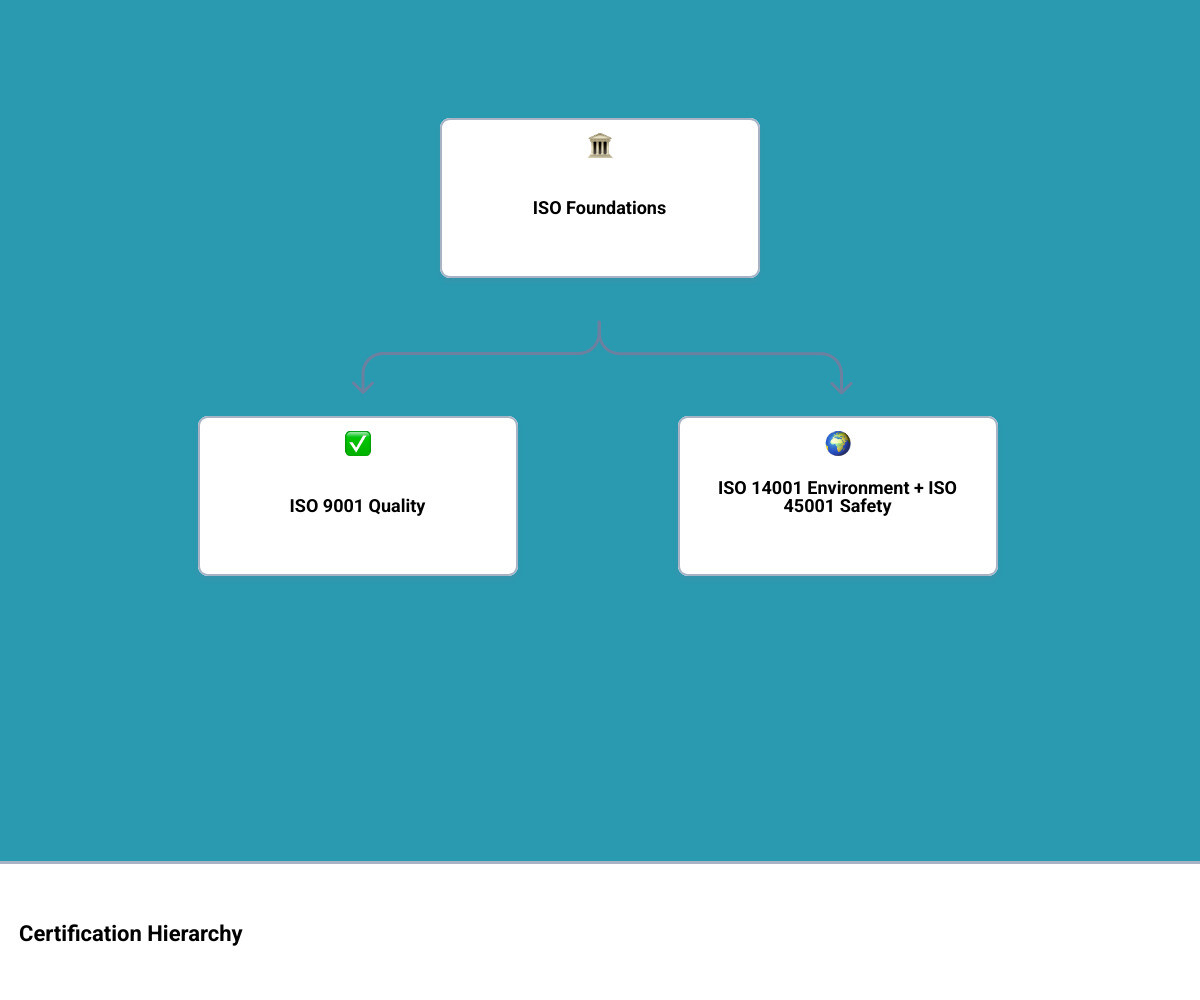
When we talk about manufacturing standards, we are looking at the backbone of global quality control. For a factory producing asphalt shingles, metal panels, or synthetic underlayment, standardizing their operations is the only way to prevent defects. In the manufacturing world, three primary standards from the International Organization for Standardization (ISO) act as the foundation for this consistency: ISO 9001, ISO 14001:2026, and ISO 45001.
ISO 9001: The Quality Management System (QMS)
ISO 9001 is the most universal quality certification in the world, held by over one million organizations globally. It does not certify that a product is “good” in a subjective sense; instead, it certifies that the manufacturer has a rigorous quality management system in place to ensure that every single item leaving the factory meets the exact same specifications.
For roofing materials, this means that the shingle manufactured on a rainy Tuesday in Beaverton has the exact same asphalt thickness, granule adhesion, and tear strength as the one produced on a dry Thursday. ISO 9001 requires the manufacturer to document every single process, maintain strict calibration of their machinery, and implement continuous improvement loops based on customer feedback and internal audits.
ISO 14001:2026: Environmental Management
Published on April 15, 2026, to replace the older 2015 standard, ISO 14001:2026 introduces updated requirements focusing heavily on climate change resilience, biodiversity, and formal change management (specifically under Clause 6.3).
For modern roofing manufacturers, this standard indicates that they actively manage their environmental footprints. It covers everything from how they source raw materials to how they handle manufacturing waste. When a manufacturer is certified to ISO 14001:2026, you know they are reducing harmful emissions and optimizing resource consumption during production.
ISO 45001: Occupational Health and Safety
A safe factory floor is a productive, high-quality factory floor. ISO 45001 provides a structured framework for identifying workplace hazards, reducing risks, and protecting workers. In roofing manufacturing, where heavy machinery, high temperatures, and chemical processing are common, ISO 45001 ensures that the factory operates under strict safety protocols.
When workers are protected and safety is prioritized, operational disruptions are minimized, leading to a much more stable and reliable supply chain. To understand how these manufacturer-level standards translate directly to the local installation on your home, you can read The Ultimate Beaverton Roof Certification Handbook Companies Contractors and Warranties for an in-depth look at how factory standards and contractor certifications work hand-in-hand.
Understanding How Manufacturer Certifications Indicate Quality in Material Production
How do these high-level management systems impact the physical shingles or metal panels delivered to your driveway in Hillsboro or Tigard? It comes down to the control of raw materials, rigorous testing, and process consistency.
A certified manufacturer cannot simply buy cheap, unverified raw materials on the open market. Under ISO 9001, they must evaluate and monitor all external providers based on their ability to supply conforming inputs. Every batch of asphalt, fiberglass mat, or steel coil must come with a verified Certificate of Analysis (CoA).
Once those materials enter the production line, the manufacturing process is subjected to continuous, automated, and manual testing. For example, in a certified shingle plant:
- Tear strength testing is conducted at regular intervals to ensure the fiberglass mat can withstand high winds.
- Granule loss testing is performed to verify that the protective ceramic granules will not easily wash away into your gutters during a heavy Portland downpour.
- Dimensional stability checks ensure that every shingle is perfectly square and matches the exact measurements required for proper installation.
This process consistency ensures that human error is minimized. If a machine drifts out of calibration, automated sensors flag the issue immediately, preventing nonconforming products from ever being packaged and shipped. If you are looking to understand how these material certifications protect your home during local roof inspections, check out our guide on Finding the Best Roof Certification Services in Hillsboro OR A Comprehensive Guide.
Industry-Specific Standards That Build on ISO 9001
While ISO 9001 provides the baseline for general manufacturing, highly specialized industries require even more stringent quality controls. These industry-specific standards build directly on top of ISO 9001, adding layers of specialized requirements:
- AS9100 (Aerospace): Used by aviation and defense manufacturers, AS9100 adds strict requirements for configuration management, counterfeit part prevention, and first-article inspections. The stakes are incredibly high in aerospace; a single component failure can be catastrophic. Because of this, AS9100 recertification audits are intensive and expensive, often ranging from $10,000 to upwards of $25,000 depending on the size of the facility.
- ISO 13485 (Medical Devices): This standard focuses heavily on cleanroom environments, risk management (aligned with ISO 14971), and regulatory compliance rather than just customer satisfaction. It ensures that medical devices are designed and manufactured under sterile, highly controlled conditions to guarantee patient safety.
- IATF 16949 (Automotive): Developed by the International Automotive Task Force, this standard is mandatory for Tier 1 and Tier 2 automotive suppliers. It builds on ISO 9001 by requiring advanced quality planning (APQP), failure mode and effects analysis (FMEA), and statistical process control (SPC) to eliminate defects and reduce variation in the automotive supply chain.
While your residential roof does not require aerospace-grade AS9100 certification, knowing that the manufacturing world uses these highly structured frameworks shows how much weight a standard like ISO 9001 carries. When a roofing manufacturer applies these same foundational principles to their shingle or metal production lines, they are utilizing the exact same quality-control philosophy that keeps airplanes in the sky and medical devices operating safely.
Legally Required vs. Commercially Required Standards
In the business of manufacturing and construction, there is a major difference between what is “legally required” by local building codes and what is “commercially required” by the market, contracts, or reputable contractors.
Legally required standards are established by government regulations and local building codes to ensure basic safety. In Oregon, for example, roofing materials must meet specific fire ratings (such as Class A fire resistance) and wind uplift ratings to be legally installed on a home. These are the absolute minimum baselines. If a product does not meet these legal requirements, it cannot be sold or installed.
Commercially required standards, on the other hand, are driven by customer expectations, supply chain demands, and contract specifications. No law states that a roofing manufacturer must be ISO 9001 certified to sell shingles in Portland. However, major distributors, high-quality roofing contractors, and commercial developers often refuse to buy from manufacturers who lack these certifications.
For these buyers, demanding ISO certification is a commercial requirement that acts as an immediate trust signal, drastically reducing their risk of dealing with product failures, warranty claims, or supply chain delays.
To help visualize this distinction, here is a quick comparison:
| Feature / Aspect | Legally Required Standards | Commercially Required Standards |
|---|---|---|
| Primary Driver | Government regulations, local building codes, safety laws. | Customer expectations, supply chain demands, contract specs. |
| Enforcement | Building inspectors, code enforcement officers, legal penalties. | Purchasing managers, contractors, market competition. |
| Scope of Focus | Minimum life-safety baselines, basic structural integrity. | Process consistency, environmental care, long-term reliability. |
| Examples | Class A fire ratings, local wind-uplift compliance. | ISO 9001, ISO 14001:2026, manufacturer-certified installer status. |
| Consequence of Non-Compliance | Fines, stop-work orders, illegal installation status. | Loss of business, exclusion from high-quality project bids. |
Understanding these standards is highly beneficial because it directly impacts consumer protection. When a manufacturer commits to both legal and commercial standards, they are demonstrating a deep commitment to quality. You can learn more about how local compliance and professional standards protect you by reading about How Consistent Licensing Protects Past and Future Customers.
How Buyers Can Verify Authenticity and Avoid Red Flags
Unfortunately, the rise of global sourcing has also seen a rise in fraudulent, expired, or misleading manufacturer certifications. It is incredibly easy for an uncertified factory to copy a logo, put it on a PDF in a default font, and claim they are “certified.” If you are a homeowner or a commercial property owner investing in a new roof, you must know how to verify these claims.
The Verification Workflow
- Request the Full Certificate: Never accept a simple text claim like “ISO 9001 Certified” on a website or brochure. Ask for a copy of the actual certificate.
- Check the Issuing Body: A legitimate certificate must be issued by an accredited, independent certification body (such as SGS, Bureau Veritas, Intertek, or NSF).
- Verify via Public Registries: You can check the validity of ISO certificates globally using databases like IAF CertSearch (the International Accreditation Forum’s registry) or by visiting the direct verification portal of the specific issuing body. This lookup typically takes only 3 to 10 minutes and is the single highest-ROI action in verifying a supplier.
- Confirm the Scope: Read the “Scope of Certification” on the document. A factory may hold an ISO 9001 certificate, but the scope might only cover their administrative offices or a completely different product line — not the specific shingles or metal panels you are buying.
- Verify the Physical Address: Ensure that the physical address of the manufacturing plant producing your materials matches the exact address listed on the certificate.
Common Red Flags to Watch Out For
- Expired Certificates: ISO certifications run on a strict three-year cycle with annual surveillance audits. If the certificate’s expiration date has passed, the certification is invalid.
- Unknown Certification Bodies: If the certificate was issued by an obscure organization with no trace of accreditation, treat it as a major red flag.
- Vague Claims: Watch out for terms like “designed in accordance with ISO standards” or “built to ISO quality levels.” This almost always means the factory has never actually undergone a third-party audit.
- Mismatched Company Names: If the name on the certificate does not match the manufacturer’s actual name, the document may have been copied or borrowed from another supplier.
Taking the time to verify these details ensures that you are getting real, certified protection. For more information on verifying local roofing certifications in the Portland area, read our guide on Portland Roof Certifications A 5 Year Guarantee for Your Peace of Mind.
Beyond the Paperwork: Verifying Real-World Quality
While a valid certificate is an excellent starting point, a piece of paper alone cannot guarantee that a factory is following its own rules every single day. A manufacturer might have passed their audit three months ago, but if they recently fired their quality manager or started cutting corners to save money, their real-world quality can slip.
To confirm that a manufacturer is actually living up to their certifications, buyers and reputable contractors look for additional real-world evidence:
- Recent Audit Reports: Truly certified manufacturers who are proud of their operations will willingly share redacted copies of their latest third-party audit reports, showing that they have successfully closed any minor nonconformances.
- Batch Records and Traceability: A high-quality manufacturer maintains complete traceability. If a shingle fails on a roof, they should be able to look at the batch code stamped on the back of the shingle and trace it all the way back to the exact day, machine, and raw material batch used to make it.
- In-House Lab Capability: Ask if the manufacturer maintains their own testing laboratory on-site to perform daily quality checks, rather than relying solely on occasional external testing.
- Corrective Action History: Every manufacturer will occasionally experience a defect. What separates a high-quality certified manufacturer from a poor one is how they handle it. A robust corrective and preventive action (CAPA) system ensures that when a defect is found, the root cause is investigated and permanent changes are made to prevent it from happening again.
Frequently Asked Questions About Manufacturing Standards
Why do buyers trust third-party certifications over self-declarations?
Self-declarations are simply a manufacturer’s promise that they are doing things correctly. Unfortunately, research shows that voluntary, self-declared claims are highly untrusted; for example, only 9% of U.S. consumers trust voluntary organic labels without third-party validation.
Third-party certifications, however, require independent, objective verification. An accredited auditor must physically visit the factory, interview workers, inspect records, and verify that the documented processes are actually being followed. This independent oversight dramatically reduces risk for both the contractor and the end consumer.
How do manufacturer certifications indicate quality to the end consumer?
They serve as an immediate trust signal. When 72% of consumers state they are more likely to purchase products with certification marks, it is because these marks represent verified safety, durability, and ethical production. For a homeowner, a certified roofing material means peace of mind, knowing that the product has undergone rigorous testing and is backed by a manufacturer with a documented commitment to quality.
What is an Integrated Management System (IMS)?
An Integrated Management System (IMS) is a single, streamlined system that merges multiple standards — such as ISO 9001 (Quality), ISO 14001:2026 (Environment), and ISO 45001 (Safety) — into one cohesive framework.
Instead of running three separate programs with redundant paperwork, a manufacturer with an IMS can manage all three areas simultaneously. This integrated implementation is highly efficient; while implementing all three standards sequentially can take up to 26 months, an integrated IMS can often be implemented in 6 to 12 months, cutting administrative costs and audit times in half while driving much stronger operational consistency.
Conclusion
At the end of the day, how manufacturer certifications indicate quality is about removing uncertainty from your home improvement decisions. When you invest in a new roof for your home in Beaverton, Hillsboro, Lake Oswego, or Tigard, you deserve to know that the materials protecting your family were built under the highest standards of quality, safety, and environmental care.
But even the best, most certified materials in the world will fail if they are installed incorrectly. That is why matching certified materials with a certified, local contractor is so important.
Here at Raindrop Roofing NW, we are proud to be a truly local, family-owned, and independently operated roofing company. Unlike many regional roofing companies that have recently been bought out by out-of-state private equity firms, we remain deeply rooted right here in Beaverton. Our multi-generational craftsmanship and local accountability mean we don’t just install a roof and disappear — we are here to stand behind our work for decades to come.
We invite you to learn more about how our independent ownership and local commitment protect your home and your warranty by exploring our resources:
- Find out How Independent Ownership Protects Your Warranty over the long haul.
- Read our guide on Choosing a Roofing Company That Wont Sell Out to out-of-state corporations.
- Discover the many Benefits of Choosing a Truly Local Independent Roofer who understands Pacific Northwest weather.
Ready to protect your home with certified materials and trusted local craftsmanship? Contact us today to schedule a free inspection and estimate, and check out our specialized Raindrop NW Manufacturer Certified Roofing Contractor Services to see how we bring verified quality straight to your rooftop.




Trackbacks & Pingbacks
[…] is where understanding How Manufacturer Certifications Indicate Quality becomes a […]
[…] How Manufacturer Certifications Indicate Quality helps you see that certified contractors are not just paying for a badge; they are investing in a […]
Leave a Reply
Want to join the discussion?Feel free to contribute!