• Link to X
  • Link to Instagram
  • Link to Youtube
  • Link to Facebook
  • Link to WhatsApp
CALL: (503)526-3887 or EMAIL: info@raindropnw.com
RAINDROP ROOFING NW | PORTLAND, OR
  • Home
  • About Us
    • About Raindrop Roofing NW
    • Our Team
    • Areas We Serve
    • Who We Support
    • Our Commitment to a Greener Future
    • Careers
    • Blog
  • Residential Roofing
    • Services
      • New / Replacement Roofs
      • Repairs and Maintenance
      • Remodels and Additions
      • Balconies, Patios, and Flat Decks
      • Roof Inspections and Certifications
    • Financing
    • Roof Gallery
    • Roof Types and Products
    • Manufacturer-Certified Roofing Contractor
    • Owner Resources
  • Commercial Roofing
    • Services
      • New and Replacement Roofs
      • Estimates and Inspections
      • Warranties
      • Real Estate Partnerships
      • Roof Certifications
    • Commercial Gallery
    • Roof Types and Products
    • Featured Project
  • Reviews
  • Contact Us
  • Menu Menu
You are here: Home1 / Emergency Roof Repair in Beaverton, OR2 / 2026

What to Do When You Need Emergency Roof Maintenance in Aloha

Roof Maintenance

When Your Roof Can’t Wait: Emergency Roof Maintenance in Aloha, OR

Emergency roof maintenance in aloha, or is something no homeowner wants to deal with — but when Aloha’s relentless rain, wind, and moss-friendly humidity do their worst, waiting even a few hours can turn a manageable problem into a costly disaster.

Here’s what to do right now if your roof is in trouble:

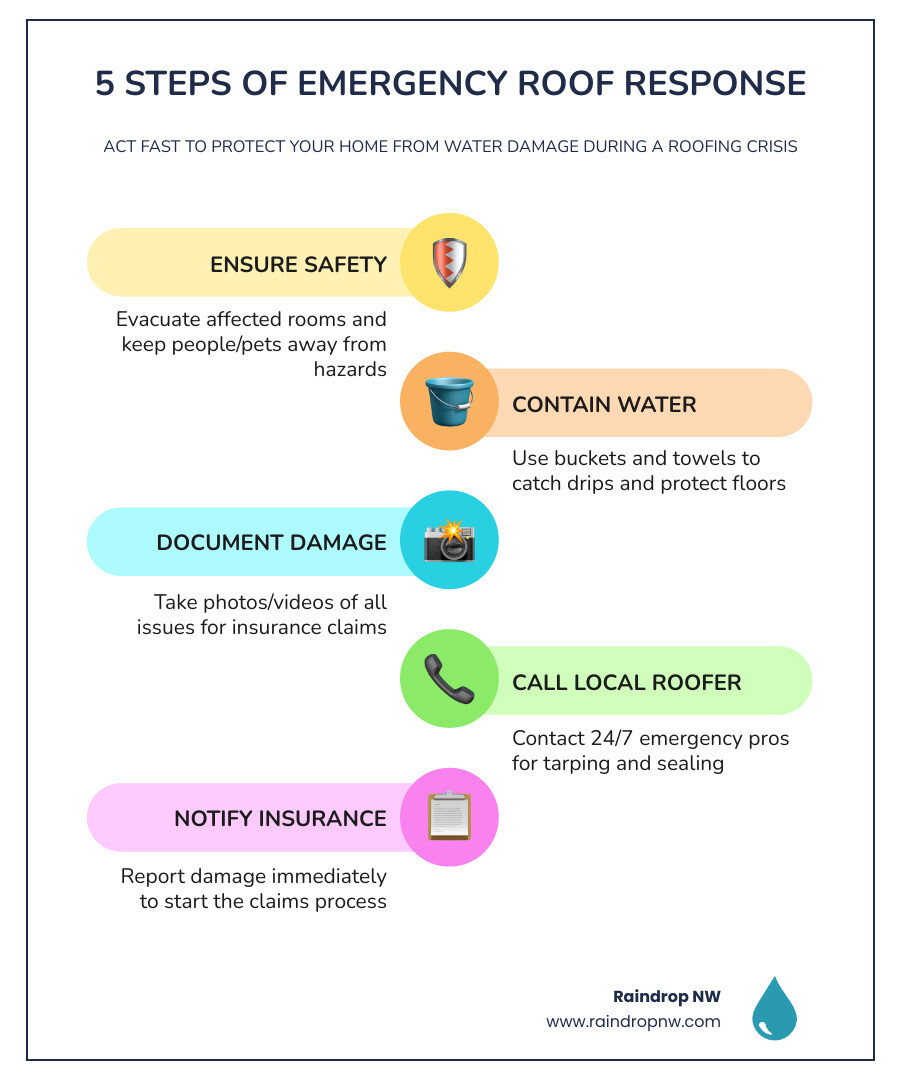
  1. Stay safe — keep everyone away from areas with ceiling bulges, sagging, or active dripping
  2. Contain interior water water damage — place buckets and move valuables away from the affected area
  3. Document everything — take photos and video of all visible damage for your insurance claim
  4. Do a ground-level visual check — look for missing shingles, debris, or damaged flashing without climbing up
  5. Call a local, licensed emergency roofer — a CCB-licensed contractor can assess damage and apply temporary tarping to stop further water intrusion

Aloha’s wet winters and unpredictable storms mean roof damage can escalate fast. A small leak ignored overnight can soak insulation, rot structural wood, and invite mold — turning a repair into a full replacement. The sooner you act, the better your outcome.

I’m Torrey Yungeberg, owner of Raindrop Roofing NW, and I’ve spent years helping Oregon homeowners navigate exactly these kinds of urgent roofing situations — including emergency roof maintenance in Aloha, OR — with honest assessments and dependable, family-owned service. In the sections ahead, I’ll walk you through everything you need to know to protect your home right now and prevent the next emergency before it starts.
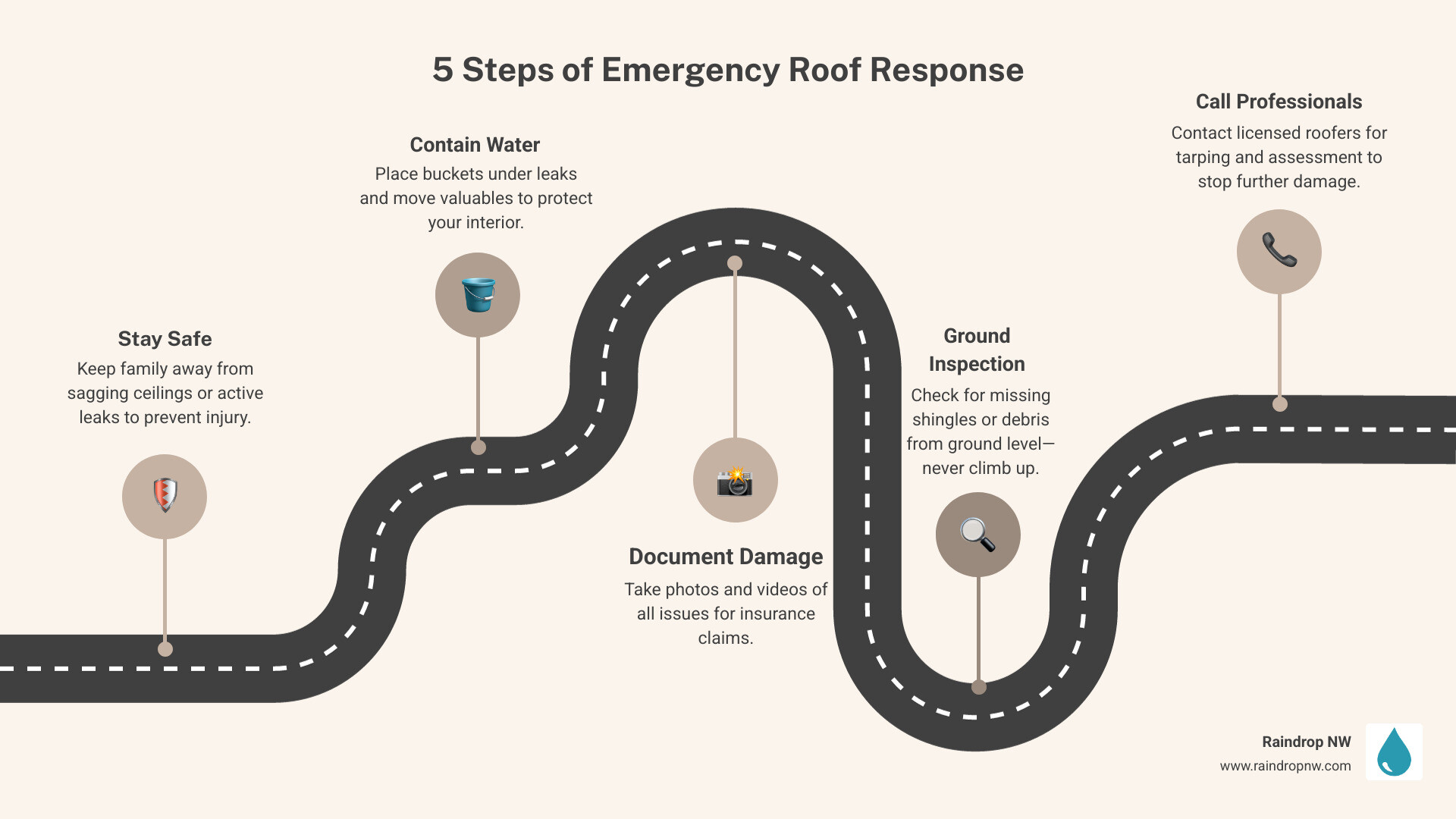
5 steps of emergency roof response infographic for Aloha OR homeowners - emergency roof maintenance in aloha, or infographic

Identifying an Emergency Roof Maintenance Situation in Aloha, OR

Not every missing shingle is an immediate catastrophe, but in the Tualatin Valley, the line between “minor repair” and “emergency” is thinner than a layer of felt paper. Identifying a true emergency is the first step in protecting your property. Generally, an emergency is any situation where the structural integrity of the roof is compromised or water is actively entering the living space.

If you see water dripping from a light fixture, a ceiling sagging under the weight of trapped moisture, or daylight peeking through your attic rafters, you are in the middle of a roofing crisis. Other clear indicators include large sections of shingles being ripped away by wind or a tree limb puncturing the roof deck. For a deeper look at what qualifies as an urgent fix, check out our emergency roof repair beaverton or guide which covers the specific criteria we use to prioritize calls.

In some cases, the damage is more subtle but no less dangerous. Damaged flashing around chimneys or skylights can allow water to seep behind siding and into wall cavities long before you see a puddle on the floor. This is why specialized attention is required; our specialty roofing/emergency roof repair beaverton or services focus on these technical failure points that often go unnoticed during a casual glance.

Common Causes of Urgent Roof Failure

In Aloha, our roofs face a unique set of environmental “bullies.” Understanding these can help you spot trouble before it’s an emergency:

  • Heavy Rainfall: We all know the Oregon “mist,” but it’s the torrential downpours that test a roof’s drainage system. If gutters are clogged, water backs up under the shingles.
  • High Winds: The Willamette Valley can see significant wind gusts that catch the edges of aging shingles, peeling them back like an orange skin.
  • Moss Accumulation: This isn’t just an aesthetic issue. Moss acts like a sponge, holding moisture against the shingles and roots can actually lift them, allowing water to bypass the primary barrier.
  • Aging Materials: Most roofs have a lifespan of 20-30 years. As they age, they lose granules and become brittle, making them far more susceptible to storm damage.
  • Pest Infestation: Local critters like squirrels or raccoons can chew through softened wood or plastic vents, creating entry points for rain.

Learning about repairing your roof after a storm and preventing future damage is essential for every homeowner in the 97003 and 97006 zip codes.

Why You Shouldn’t Delay Emergency Roof Maintenance in Aloha, OR

The “I’ll deal with it when it stops raining” mentality is the most expensive mistake an Aloha homeowner can make. Because our humidity stays high throughout the winter, a wet roof never truly dries out.

Delaying a repair leads to:

  1. Mold and Mildew: Mold can begin to grow within 24 to 48 hours of water exposure, leading to respiratory issues and expensive remediation.
  2. Electrical Hazards: Water traveling along rafters often finds its way to junction boxes or recessed lighting, creating a significant fire risk.
  3. Structural Rot: Constant moisture turns sturdy plywood and rafters into soft, “punky” wood that can no longer support the weight of the roof.
  4. Insulation Failure: Once fiberglass or cellulose insulation gets soaked, it loses its R-value (insulating power) and often has to be completely removed and replaced.

If the damage is severe enough, you might find yourself looking at an emergency roof replacement in portland or rather than a simple patch job.

Immediate Steps to Take During a Roofing Emergency

When the rain is coming down and your ceiling is leaking, panic is natural. However, a systematic approach can save you thousands of dollars in interior damage. Your first priority is safety. Never walk on a wet, steep, or damaged roof yourself. The risk of a fall or a structural collapse is too high.

Inside the house, your goal is “containment.” If you see a bulge in the ceiling, it’s often helpful to poke a small hole in the center with a screwdriver to let the water drain into a bucket. This prevents the weight of the water from bringing down the entire sheetrock ceiling. Move furniture, electronics, and heirlooms to a dry room.

Next, you need to document the situation. Before the repair crew arrives, take clear photos of the leak, any fallen debris, and the interior damage. This documentation is gold when dealing with insurance adjusters. For more detailed instructions on managing these moments, our roof repair in beaverton or guide provides a comprehensive checklist.

Once you’ve stabilized the interior, call for professional help. We provide residential roofing/services/repairs and maintenance that include emergency tarping. A heavy-duty, professionally secured tarp can protect your home for days or even weeks while a permanent repair is scheduled and insurance claims are processed.

Assessing Storm Damage Safely

We always tell our neighbors in Aloha: Keep your feet on the ground. You can perform a very effective damage assessment using a pair of binoculars from the sidewalk or backyard.

Look for:

  • Shingle “Shadows”: Dark patches where shingles used to be.
  • Granule Piles: Large amounts of sand-like granules at the base of your downspouts.
  • Lifted Flashing: Metal strips around the chimney that look bent or loose.
  • Debris: Tree branches or even neighbors’ shingles that have landed on your roof.

By avoiding ladders during a storm, you prevent personal injury while still gathering the information needed for our residential roofing/roof repair beaverton or team to give you an accurate assessment.

How Aloha’s Climate Contributes to Urgent Roof Issues

Aloha sits in a geographic “sweet spot” for roof wear and tear. We experience rainy, temperate winters followed by scorching summers. This cycle causes roofing materials to expand and contract constantly. Over time, this “thermal shock” loosens nails and cracks sealants.

Our high humidity also means that moss and algae thrive here. Unlike drier climates, a roof in Aloha can stay damp for weeks at a time during the winter months. This constant moisture softens the asphalt in shingles and can lead to rot in the roof deck. We often see this damage extending to other exterior surfaces, such as balconies patios and flat decks damaged in aloha or, where standing water becomes a major structural threat.

Being a local company, we understand the specific micro-climates of the locations/aloha or area. From the wind-prone hills near Cooper Mountain to the older, tree-heavy neighborhoods near Tualatin Hills Nature Park, we know exactly what challenges your roof is up against.

Essential Questions for Emergency Roof Maintenance in Aloha, OR

When you’re calling for help, ask these critical questions to make sure you’re working with a qualified professional:

  1. Are you CCB Licensed, Bonded, and Insured? In Oregon, this is non-negotiable for your protection.
  2. How quickly can you get a crew here for a temporary seal? In an emergency, hours matter.
  3. Do you provide a written warranty for the repair work? Even emergency work should be backed by a guarantee.
  4. Do you have experience with commercial properties? If you own a business, you’ll need someone familiar with the aloha or commercial roof replacement guide standards.
  5. What is your cleanup protocol? You don’t want to find roofing nails in your driveway for the next six months.

Preventing Future Emergencies Through Routine Care

The best way to handle emergency roof maintenance in aloha, or is to prevent the emergency from ever happening. We recommend a “proactive” rather than “reactive” approach. A typical roof inspection takes only about 15-20 minutes, but it can identify a cracked pipe boot or a loose shingle that would have caused a major leak in the next storm.

Regular maintenance should include clearing debris from “valleys” (where two roof planes meet), cleaning gutters to prevent water backup, and treating for moss. If you have an older home, checking the attic ventilation is also key; poor airflow can cause heat to build up, “cooking” your shingles from the inside out and making them brittle.

For business owners, we provide ultimate commercial estimates inspections aloha to ensure your inventory and operations stay dry. We also handle peripheral structures, so if you’re wondering my patio was damaged who can i call to fix balconies patios and flat decks in aloha or, the answer is a comprehensive roofing and exterior specialist.

Comparison: Reactive vs. Proactive Maintenance

Feature Reactive Repair (Emergency) Proactive Maintenance (Scheduled)
Timing During a storm / After a leak On a clear day / Twice a year
Stress Level Extremely High Very Low
Collateral Damage Ceiling, drywall, floors, mold None
Documentation Urgent / Insurance focused Detailed health reports / Photos
Lifespan Shortens roof life due to rot Extends roof life by years

Frequently Asked Questions about Aloha Roofing

How long does a typical roof inspection take?

A professional inspection usually takes between 15 and 20 minutes for a standard residential home. During this time, we look at the shingle condition, flashing, gutters, and chimney seals. If there is an active leak, we may also need access to your attic to trace the water path, which can add a few minutes to the process.

Can commercial properties access emergency services?

Absolutely. Commercial roofs, especially flat TPO or EPDM systems, often face different emergency issues like ponding water or membrane punctures. We understand that a leak in a retail space or warehouse can disrupt operations, so rapid response is important to help protect the building and limit further damage.

What should I look for in an emergency roofer?

Look for a roofing company with a CCB license, strong local reviews, and a clear presence in the community. It’s also important to confirm they are insured, experienced with emergency repairs, and able to communicate clearly about the condition of your roof and the next steps.

Conclusion

When it comes to emergency roof maintenance in aloha, or, time is your biggest enemy. Whether you are dealing with a sudden tree fall or a persistent drip that finally broke through the ceiling, taking immediate action is the only way to safeguard your home. At Raindrop NW, we pride ourselves on being a truly local, independently owned company. We don’t answer to out-of-state investors; we answer to you, our neighbors in Aloha, Beaverton, and the surrounding areas.

We believe in long-term accountability and providing service that lasts well beyond the next rainstorm. If you’re facing a roofing crisis or just want to make sure your home is ready for the next Oregon winter, don’t wait for the water to start falling inside. Contact our Aloha roofing experts for immediate assistance and let us provide the peace of mind you deserve.
https://www.raindropnw.com/wp-content/uploads/2026/04/45665ce3599d5538a5034deac5a943e906c5bd5f.jpg 1024 1536 SEO Stats https://www.raindropnw.com/wp-content/uploads/2024/05/logo-raindrop-space-300x92.png SEO Stats2026-04-15 01:40:212026-04-15 01:40:21What to Do When You Need Emergency Roof Maintenance in Aloha

Emergency Roof Maintenance in Newberg for Stormy Situations

Roof Maintenance

When Your Roof Can’t Wait: Emergency Roof Maintenance in Newberg, OR

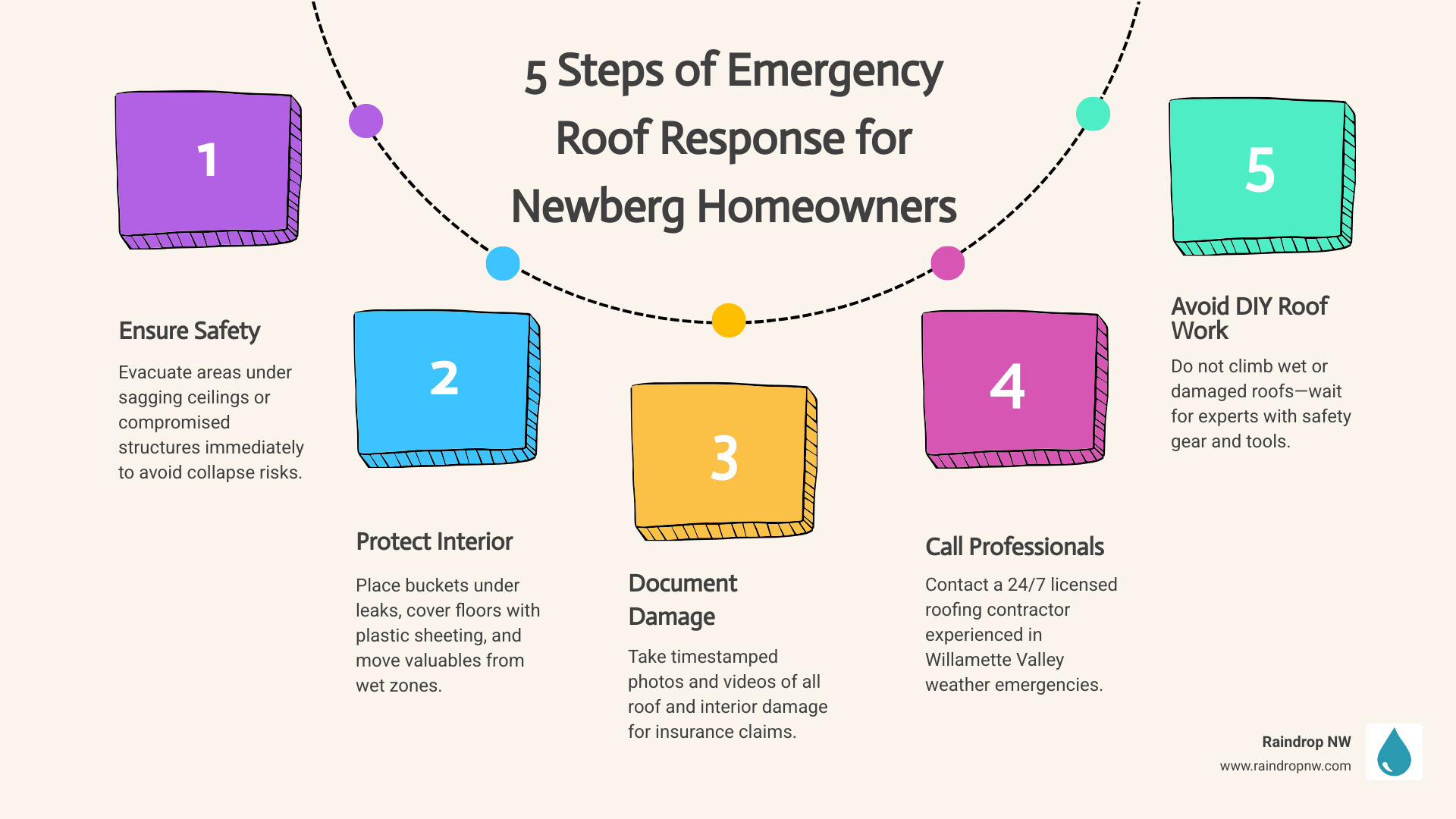
Emergency roof maintenance in Newberg, OR means acting fast when storms, fallen trees, or sudden leaks put your home at risk. Here’s what to do right now:

  1. Get everyone to safety – Move away from sagging ceilings or structurally compromised areas immediately.
  2. Protect the interior – Place buckets under active drips and move valuables away from wet areas.
  3. Document everything – Take clear photos of all visible damage before any cleanup.
  4. Call a licensed local roofer – Contact a 24/7 emergency roofing contractor serving Newberg as soon as possible.
  5. Do not climb the roof yourself – Wet or damaged roofs are extremely dangerous without proper equipment.

Newberg sits in the Willamette Valley, where heavy rainfall, strong winds, and occasional ice events are a normal part of life. That combination puts real, year-round stress on residential roofs. When something goes wrong – a shingle tears off in a windstorm, a tree limb punches through the decking, or a slow leak suddenly turns into a waterfall – waiting even a few hours can turn a manageable repair into a much bigger structural problem. Water doesn’t wait, and neither should you.

I’m Torrey Yungeberg, owner of Raindrop Roofing NW, and with years of hands-on experience handling emergency roof maintenance in Newberg, OR and across the Pacific Northwest, I’ve seen how quickly a small breach can spiral into costly damage when left unaddressed. Read on for a full breakdown of exactly what to do, what to expect, and how to protect your home when a roofing emergency strikes.

5 steps of emergency roof response infographic for Newberg OR homeowners - emergency roof maintenance in newberg, or

Identifying a Roofing Emergency in Newberg, OR

Not every missing shingle is a “drop everything” emergency, but in the rainy climate of the Willamette Valley, the line between a minor repair and a crisis is thin. A roofing emergency is generally defined as any situation where the structural integrity of your home is compromised or where water is actively entering the living space.

In Newberg, we frequently see emergencies caused by fallen trees or heavy limbs. With our lush canopy of Douglas firs and oaks, a high-wind event can easily send debris crashing onto a roof. This doesn’t just damage shingles; it can crack rafters and create massive holes that let in gallons of rainwater. Other critical situations include wind-lifted shingles—where entire sections of your roof are peeled back like a sardine can—and severe, localized leaks that threaten electrical systems or ceilings.

Safety is the absolute priority. If you see a sagging ceiling or hear creaking after a structural impact, evacuate that area of the home. For a deeper look at how to handle these high-stress moments, our Emergency Roof Repair Beaverton OR Guide offers universal principles that apply perfectly to Newberg residents facing sudden damage.

Common Signs of Urgent Damage

Sometimes the signs of an emergency are subtle before they become catastrophic. Keep an eye out for these “red alert” symptoms:

  • Sudden Water Stains: Large, dark spots appearing on your ceiling or walls during a rainstorm indicate an active breach.
  • Sagging Ceilings: This is a sign that water is pooling on top of your drywall. This is a collapse hazard and requires immediate drainage.
  • Missing Flashing: If the metal strips around your chimney or vents have been torn away, your roof is wide open to leaks.
  • Daylight in the Attic: If you can see the sky from inside your attic, water can definitely see your insulation.

When these issues arise, specialized knowledge is required to navigate the different materials involved, whether you have a standard shingle roof or Specialty Roofing.

When to Call for Emergency Roof Maintenance in Newberg, OR

You should call for emergency roof maintenance in Newberg, OR the moment you realize the damage cannot wait for a clear, sunny day. If there is an active leak that buckets can’t keep up with, or if your roof decking is exposed to the elements, you need a 24/7 response.

Post-storm assessments are also critical. Even if you don’t see water dripping in your kitchen, a quick look from the ground might reveal significant shingle loss. We provide rapid response through our Specialty Roofing / Emergency Roof Repair Beaverton OR services to ensure Newberg homeowners aren’t left exposed. Our team is available around the clock because we know that Oregon weather doesn’t stick to a 9-to-5 schedule.

Immediate Steps for Homeowners During a Roof Crisis

While you wait for the professionals to arrive, there are several things you can do to minimize the damage to your property. First, prioritize interior protection. Move furniture, electronics, and heirlooms out of the affected room. If a ceiling is bulging with water, you can carefully poke a small hole in the center of the bulge with a screwdriver to drain the water into a bucket; this prevents the entire ceiling from collapsing under the weight of the trapped water.

Documentation is your best friend when it comes to insurance. Take photos of the damage from multiple angles, but do so from the ground or from inside. Never attempt to climb onto a roof during a storm or after a structural impact. The surface will be slick, and the structure may be unstable. For a full list of how we handle these situations, check out our Residential Roofing / Services page.

Homeowner Emergency Kit Checklist

  • Heavy-duty buckets: To catch active leaks.
  • Plastic sheeting or tarps: To cover furniture inside.
  • Flashlight with extra batteries: For inspecting dark attics safely.
  • Contact info for your roofer and insurance agent: Keep these on the fridge.
  • Duct tape: For securing plastic sheeting over interior items.

Temporary Mitigation Strategies

If it is safe to do so, you can perform minor mitigation from the ground. Clearing debris from downspouts can help water flow off the roof rather than backing up under the shingles. However, most mitigation—like tarp installation—should be left to pros. Tarping a roof in the wind and rain is incredibly dangerous. A professional crew has the harnesses and specialized “roof boots” necessary to secure a tarp without becoming a casualty of the storm themselves.

Essential Emergency Services and Repairs

When we arrive for an emergency call in Newberg, our goal is “stabilization first.” This usually involves:

  1. Leak Detection: Using moisture tracing to find where the water is actually entering (it’s rarely directly above the drip).
  2. Emergency Tarping: Securing a heavy-duty, UV-resistant tarp over the damaged area to stop water entry immediately.
  3. Shingle and Flashing Repair: Replacing missing components if the weather allows for a quick permanent fix.
  4. Gutter Stabilization: Ensuring heavy, water-logged gutters don’t pull away from the fascia and cause further damage.

Our Storm Damage Repair Beaverton OR expertise ensures that these temporary fixes are done correctly so they don’t blow off in the next gust of wind.

Navigating Newberg’s Unique Weather Risks

Newberg homeowners face a specific set of environmental challenges. We don’t just deal with rain; we deal with “atmospheric rivers” that can dump inches of water in a matter of hours. This volume of water tests every seam and seal on your roof. High winds in the valley can also cause “shingle uplift,” where the seal between shingles is broken, allowing water to be blown upward underneath the roofing material.

Then there are ice dams. While rare, when Newberg gets a silver thaw or a sudden freeze, ice can build up at the eaves, preventing melting snow from draining. This water then backs up under the shingles and into your walls. Moss growth is another “slow-motion emergency.” Moss acts like a sponge, holding moisture against the shingles and roots into the granules, eventually causing premature failure that leads to emergency leaks.

To help you understand the path forward, here is a comparison of how we handle different repair needs:

Fix Type Purpose Duration When to Use
Emergency Tarping Stop active water entry Temporary (weeks) During active storms or until materials arrive
Sealant/Mastic Plug small holes/flashing gaps Short-term Minor leaks or as a stop-gap
Shingle Replacement Restore shedding capability Permanent After storm passes and roof is dry
Flashing Re-installation Protect roof penetrations Permanent When metal is warped or missing

For ongoing protection against these local risks, our Roof Maintenance Beaverton OR services are designed to catch these issues before the clouds turn grey.

Winter and Bad Weather Repair Protocols

Can you repair a roof in the middle of a Newberg winter? Yes, but it requires a different approach. Modern asphalt shingles are designed to be flexible, but in near-freezing temperatures, they can become brittle. We use specialized cold-weather techniques, such as hand-sealing shingles with roofing cement because the standard sun-activated adhesive strips won’t bond in the cold.

Safety protocols are also ramped up. We use extra fall protection and monitor weather windows closely to ensure we aren’t opening up a roof right as a squall hits. Maintaining your roof during these months is part of our Residential Roof Maintenance Beaverton OR commitment to local homeowners.

Preventing Future Emergencies with Routine Care

The best way to handle emergency roof maintenance in Newberg, OR is to prevent the emergency from happening in the first place. Most “sudden” leaks are actually the result of long-term neglect. A small crack in a pipe boot or a bit of moss lifting a shingle might not leak in a light drizzle, but it will fail during a major storm.

We recommend annual inspections to clear debris from valleys and check the integrity of all penetrations. For more DIY-friendly advice, see our Roofing Maintenance Tips Every Homeowner Should Know or download The Ultimate Roof Maintenance Checklist for Homeowners.

What to Expect During an Emergency Inspection

When a Raindrop NW technician arrives at your Newberg home, they won’t just glance at the roof. We perform a comprehensive assessment to ensure we aren’t just treating a symptom.

We use moisture tracing and sometimes thermal scanning to see where water has traveled behind the walls. This helps us determine if there’s a risk of mold or structural rot that needs to be addressed alongside the roof repair. We provide a detailed damage assessment that you can provide to your insurance company. Our Roof Inspections and Certifications process is thorough, and for those worried about their roof’s health after a big storm, we offer a Free Roof Inspection Beaverton OR to give you peace of mind.

The Repair Process and Timelines

The timeline for an emergency repair usually follows two phases:

  1. Phase One: Stabilization (1-4 hours): We secure the site, stop the leak with tarps or temporary sealants, and ensure the home is safe.
  2. Phase Two: Permanent Repair (1-3 days): Once the weather clears and materials are staged, we perform the final fix.

During this process, we adhere strictly to Newberg building codes. For minor repairs, permits are often not required, but for larger structural fixes or full replacements, we handle all the paperwork and inspections required by the city. You can learn more about what we look for during our Roof Inspection Beaverton OR visits.

Frequently Asked Questions about Emergency Roof Maintenance

Can repairs be done during active rain or snow?

While we can’t perform a full roof replacement or complex shingle work in a downpour, we absolutely can perform emergency tarping and sealing. We use “wet-patch” sealants that are designed to bond even under standing water. Our goal is to stop the damage immediately and return for the permanent fix when it’s dry. For a broader look at seasonal care, see The Ultimate Guide to Roof Care in Portland Oregon.

Does insurance cover emergency roof maintenance in Newberg, OR?

In most cases, yes—provided the damage was caused by a “sudden and accidental” event like a storm or a fallen tree. Insurance companies actually require you to take “reasonable steps” to prevent further damage, which includes hiring a professional for emergency tarping. We assist with the claims process by providing photo evidence and detailed documentation of the storm damage to help your adjuster understand the scope of the work.

How long do emergency repairs typically take to complete?

Stabilization is almost always a same-day service. We aim to have a crew on-site within hours of your call to secure the roof. The permanent restoration timeline depends on material availability and weather windows, but most residential repairs are completed within 24 to 48 hours after the storm subsides.

Reliable Local Care for Newberg Homeowners

When your roof is failing, you don’t want a “storm chaser” or an out-of-state corporation that sees you as just another number. You want a neighbor. At Raindrop NW, we are a truly local, independently owned company. We live and work in the same communities we serve, from Newberg to the rest of the areas we serve.

Our commitment is to long-term accountability. We don’t just want to fix your leak today; we want to ensure your home is protected for the next twenty years. If you’re facing a roofing crisis or just want to make sure your home is ready for the next Oregon winter, give us a call. We’re here to help you weather the storm.

https://www.raindropnw.com/wp-content/uploads/2026/04/pexels-photo-4170441.jpeg 528 940 SEO Stats https://www.raindropnw.com/wp-content/uploads/2024/05/logo-raindrop-space-300x92.png SEO Stats2026-04-15 01:38:292026-04-15 01:38:29Emergency Roof Maintenance in Newberg for Stormy Situations

Tigard Emergency Roof Maintenance Fast Fixes for Sudden Leaks

Roof Maintenance

What to Do When Your Roof Fails in Tigard, OR

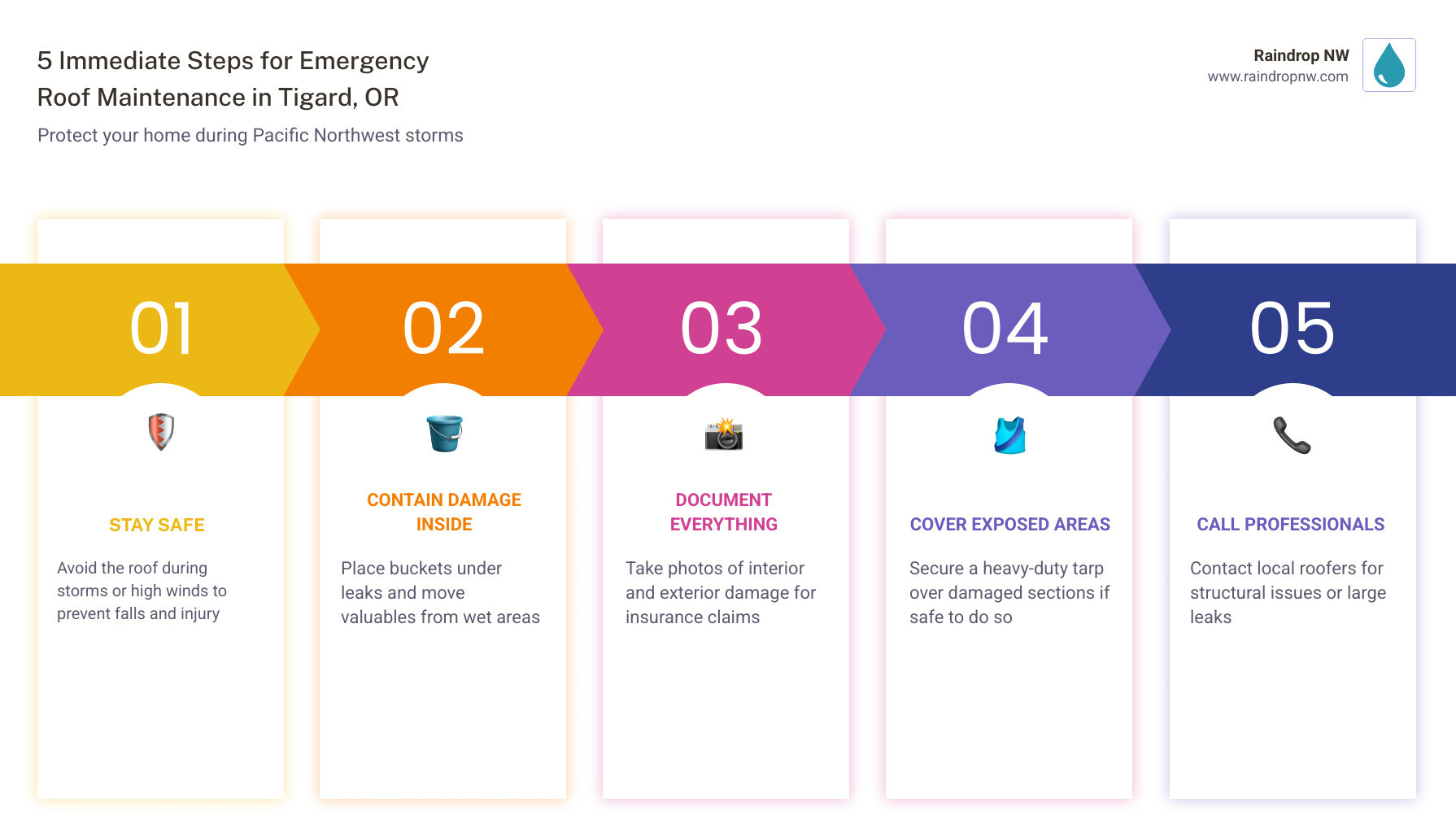
Emergency roof maintenance in tigard, or is something no homeowner wants to face — but Tigard’s Pacific Northwest weather makes it more common than you’d think. Here’s what to do right now if your roof is failing:

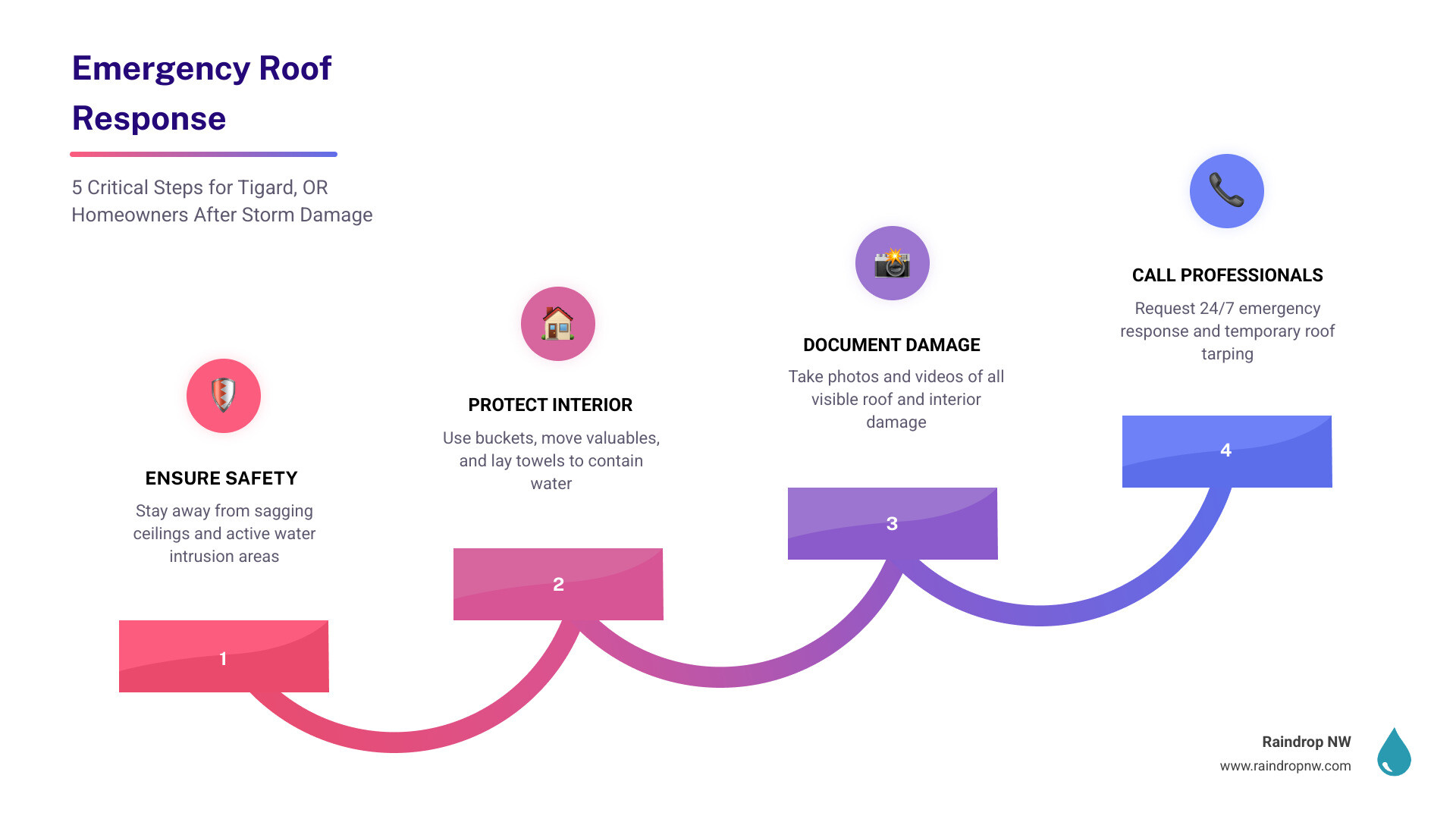
  1. Stay safe — stay off the roof during active storms or high winds
  2. Contain the damage inside — place buckets under leaks and move valuables away from wet areas
  3. Document everything — take photos of visible damage inside and out for your insurance claim
  4. Cover exposed areas if safe to do so — a heavy-duty tarp can slow water intrusion until a pro arrives
  5. Call a local roofing professional — especially for structural damage, large leaks, or fallen debris

Tigard’s heavy winter rains, gusty winds, and freeze-thaw cycles put real stress on roofs year-round. A small leak or a few missing shingles can escalate into a much bigger problem within hours when a storm is actively moving through. Acting fast — and knowing what to do — makes all the difference.

I’m Torrey Yungeberg, owner of Raindrop Roofing NW and a lifelong Oregon trades professional with deep roots in the Pacific Northwest roofing industry — including hands-on experience with emergency roof maintenance in Tigard, OR and the specific weather conditions that cause it. Read on for a step-by-step guide to protecting your home when it matters most.

Infographic showing 5 immediate steps for emergency roof maintenance in Tigard OR during a storm - emergency roof

Identifying an Emergency Roof Maintenance Situation in Tigard, OR

Not every drip from a ceiling requires a midnight call to a roofing crew, but in the 97223 area, certain situations demand immediate intervention. An emergency is generally defined as any event that compromises the structural integrity of your home or poses an immediate threat to the safety of its inhabitants.

In Tigard, we frequently see emergencies triggered by severe Pacific Northwest storms. These weather events bring heavy downpours that can overwhelm aging drainage systems or exploit tiny cracks in your flashing. When a tree limb falls or high winds peel back several rows of shingles, your home’s “envelope” is broken. This allows water to pour into the attic, saturating insulation and eventually causing ceilings to collapse.

If you are dealing with storm damage repair, time is your biggest enemy. Water doesn’t just sit; it travels along rafters and down wall studs, potentially damaging electrical systems and sparking mold growth within 24 to 48 hours. Identifying the crisis early is the first step toward a successful “fast fix.”

Common Signs of Urgent Roof Damage

Recognizing the early warning signs of a roofing crisis can save you thousands of dollars in interior repairs. Keep an eye out for these red flags:

  • Active Water Intrusion: If you see water dripping from a light fixture or a dark, spreading stain on your ceiling, you have an active leak that needs immediate attention.
  • Daylight Through Rafters: If you go into your attic during the day and see “stars” (points of light) coming through the roof deck, your shingles or underlayment are compromised.
  • Sagging Roofline: A visible dip in the ridge or the slope of your roof suggests structural failure, often caused by long-term water damage or excessive weight from snow or fallen debris.
  • Granule Loss: Finding a “sandcastle” of asphalt granules at the base of your downspouts after a storm indicates that your shingles have lost their protective layer and are prone to cracking.

How PNW Weather Triggers Emergency Roof Maintenance in Tigard, OR

Tigard’s climate is unique, and our roofs bear the brunt of it. The constant moisture of the Pacific Northwest creates a breeding ground for moss. While it might look charmingly “Oregon,” moss holds moisture against shingles, causing them to rot and lift. Once lifted, high winds can easily catch the edge of the shingle and rip it away.

Ice dams are another culprit. During our occasional deep freezes, snow melts on the upper parts of the roof and refreezes at the cold eaves. This creates a dam that forces liquid water back up under the shingles. Understanding why annual roof maintenance is cost-effective is crucial here; a well-maintained roof with clear gutters and zinc treatments is far less likely to succumb to these weather-related emergencies.

Immediate DIY Steps for Temporary Roof Fixes

If you discover a leak in the middle of a storm, your goal isn’t a permanent repair—it’s damage control. First, manage the water inside. Use a screwdriver to poke a small hole in the center of a sagging ceiling “bubble” to drain the water into a bucket; this prevents the entire ceiling from collapsing under the weight.

For the exterior, tarping is the gold standard for temporary fixes. If the rain has paused and it is safe to climb up, a heavy-duty woven plastic tarp can bridge the gap until a professional arrives. Ensure the tarp extends over the ridge of the roof so water cannot run underneath the top edge. Use wooden “furring strips” to nail the edges of the tarp down, rather than nailing through the tarp alone, which can tear in high winds.

While you’re up there, check for clogged valleys. Sometimes an “emergency” leak is simply caused by a pile of pine needles and leaves backing up water. Clearing this debris can often stop a leak instantly. For more tips on keeping your roof in top shape, check out the ultimate roof maintenance checklist for homeowners.

Essential Safety Precautions for Homeowners

We cannot stress this enough: your safety is worth more than your roof. Every year, homeowners in the Tigard and Beaverton area are injured in falls. If you must attempt a temporary fix, follow these rules:

  1. Never go on a roof during a storm: Wind and wet shingles are a lethal combination. Wait for the weather to clear.
  2. Use the right gear: Wear non-slip, rubber-soled shoes and a safety harness if you have one.
  3. Ladder safety: Ensure your ladder extends at least three feet above the roof edge and is set on firm, level ground. Always maintain three points of contact.
  4. Watch for power lines: In Tigard’s older neighborhoods with mature trees, power lines often run close to roofs. A metal ladder touching a line is a fatal mistake.
  5. Work with a partner: Never climb onto a roof alone. Have someone on the ground to steady the ladder and call for help if needed.

When to Call a Professional for Urgent Repairs

While DIY tarping is a great stopgap, it is not a solution. You should call for professional emergency roof maintenance in tigard, or if you encounter structural damage, such as a roof deck that feels “spongy” or visible cracks in the rafters. Steep pitches or multi-story homes also require professional equipment and training to navigate safely.

If you have persistent leaks that you can’t locate, or if large sections of shingles are missing, it’s time to consult an emergency roof repair guide and get an expert on-site. Professionals have thermal imaging cameras and moisture meters that can find hidden water paths that the naked eye misses.

Professional Solutions for Emergency Roof Maintenance in Tigard, OR

When we arrive for an emergency call, our first priority is stabilization. We provide rapid response tarping and “shrink-wrap” services that are far more durable than DIY methods. Our team uses specialized residential roof maintenance services to identify the root cause of the failure.

For those dealing with roof leak repair, we offer comprehensive solutions including:

  • Leak Detection: Finding the “entry point” which is often far from where the drip appears inside.
  • Debris Removal: Safely clearing fallen trees or heavy branches that could cause further collapse.
  • Structural Bracing: If a tree has impacted the home, we can provide temporary bracing to keep the structure safe.
  • Insurance Documentation: We provide the detailed reports and photos your adjuster will need to process your claim.

Preventing Future Roofing Emergencies in Tigard

The best emergency is the one that never happens. In Tigard, “winterizing” your roof should be an annual tradition. This includes cleaning gutters to prevent backups and applying zinc treatments to stop moss in its tracks.

Trimming overhanging tree limbs is perhaps the most effective way to prevent storm damage. A heavy Douglas fir limb over your bedroom is a liability during an Oregon windstorm. Keeping these branches at least 10 feet away from your roofline significantly reduces the risk of impact damage. You can find more annual roof maintenance benefits by staying proactive with your home’s exterior.

Proactive Maintenance Strategies

A proactive approach involves more than just a quick glance from the driveway. We recommend a “ground-up” inspection after every major wind event. Look for shingles in the yard or “tabs” that look slightly out of alignment. Check your flashing — the metal bits around chimneys and vents — as these are the most common failure points in Pacific Northwest homes.

For a deeper dive into long-term protection, read the ultimate guide to residential roofing in Tigard, OR. Regular professional inspections every 2-3 years can identify “soft spots” or aging sealant before they turn into a 2:00 AM emergency.

Frequently Asked Questions about Emergency Roof Maintenance in Tigard, OR

What should I do first if my roof starts leaking during a storm?

Prioritize safety. Move furniture and electronics away from the leak and use buckets to catch the water. If the leak is causing the ceiling to bulge, carefully poke a small hole to release the pressure and prevent a large-scale collapse. Do not attempt to go on the roof until the wind and rain have subsided.

How can I tell if a fallen branch caused structural damage?

Look for cracks in the ceiling drywall, doors that suddenly won’t close or stick in their frames, or a visible “sag” in the roofline from the outside. If you hear creaking or popping sounds coming from the attic, the structural integrity may be compromised, and you should evacuate that area of the house immediately.

Does homeowners insurance cover emergency roof repairs?

In most cases, yes—if the damage was caused by a “sudden and accidental” event like a windstorm or a fallen tree. However, insurance typically does not cover leaks caused by lack of maintenance (like moss rot or old age). This is why documenting the storm damage with photos is essential for your claim.

Conclusion

When the clouds gather over Bull Mountain or the Tigard Triangle, you shouldn’t have to worry if your roof will hold. At Raindrop NW, we believe in the power of local expertise. We aren’t a massive corporation run by out-of-state investors; we are your neighbors, committed to long-term accountability and the highest standards of craftsmanship.

Whether you need a fast fix for a sudden leak or a comprehensive plan to avoid future crises, we are here to help. Our deep understanding of the local climate and building codes ensures that your repairs aren’t just fast—they’re right. Protect your Tigard home with expert maintenance and give yourself the peace of mind you deserve.

https://www.raindropnw.com/wp-content/uploads/2026/04/pexels-photo-6904530.webp 627 940 SEO Stats https://www.raindropnw.com/wp-content/uploads/2024/05/logo-raindrop-space-300x92.png SEO Stats2026-04-15 01:36:492026-04-15 01:36:49Tigard Emergency Roof Maintenance Fast Fixes for Sudden Leaks

How to Handle a Hillsboro Roofing Emergency Without Losing Your Cool

Roofing

What to Do When You Need Emergency Roof Maintenance in Hillsboro, OR

Emergency roof maintenance in Hillsboro, OR is something no homeowner wants to face — but with 42 inches of rain falling on this city every year, plus seasonal windstorms and relentless moss growth, a roofing crisis can happen fast. When it does, the clock starts immediately. Water doesn’t wait, and even a small breach can lead to mold, insulation damage, and structural deterioration within days. Knowing what to do in those first critical hours can mean the difference between a manageable repair and a much bigger problem.

If you’re dealing with a roof emergency right now, here’s what to do first:

  1. Stay inside — do not climb onto your roof
  2. Move valuables and furniture away from any active leak areas
  3. Place buckets to catch dripping water
  4. Take photos of all visible damage from safe locations indoors
  5. Call a professional roofing contractor for same-day or next-day emergency response
  6. Notify your insurance provider and document everything in writing

I’m Torrey Yungeberg, owner of Raindrop Roofing NW, and I’ve spent years helping Oregon homeowners navigate emergency roof maintenance in Hillsboro, OR — from sudden storm damage to slow leaks that finally reach a breaking point. Growing up in the trades and running a family-owned roofing business here in the Pacific Northwest means I understand exactly what’s at stake when your roof fails in this climate.

Identifying the Need for Emergency Roof Maintenance in Hillsboro, OR

Not every missing shingle is a five-alarm fire, but in Hillsboro’s wet climate, “minor” issues can escalate into full-blown emergencies during a weekend downpour. Identifying the signs early can save your home’s structural integrity.

Active Leaks and Water Intrusion

If you see water dripping from a ceiling light fixture or notice dark, spreading stains on your drywall, you are in the middle of a roofing emergency. In Hillsboro, where we see 42 inches of annual precipitation, an active leak isn’t just a nuisance; it’s a threat to your electrical system and attic insulation. Once insulation gets wet, it loses its R-value and becomes a breeding ground for mold.

Structural Sagging

If you step outside and notice your roofline looks like a swayback horse, stop what you’re doing. A sagging roof deck indicates that the internal structure is compromised, often due to long-term water damage or the sheer weight of saturated materials. This is a severe safety hazard that requires immediate professional intervention.

Fallen Tree Limbs and Storm Debris

Hillsboro is known for its beautiful greenery, but during a severe wind event — like the 19 severe wind events recorded in the Portland-Hillsboro area in 2023 — those trees can become liabilities. If a large limb has punctured your roof, you need perfect residential solutions to stabilize the area before the next rain cloud rolls in.

Missing Shingle Clusters and Daylight

Finding one shingle in your yard after a breeze is a repair; finding a dozen shingles or seeing actual daylight through your roof boards from the attic is an emergency. If you can see the sky from inside your house, so can the rain.

If you suspect your roof is on the verge of failure but aren’t sure, it is best to find top roof inspection services in Hillsboro to get a professional verdict before the next storm hits.

Why DIY Emergency Roof Maintenance in Hillsboro, OR is Dangerous

We know Hillsboro homeowners are a handy bunch. Whether you’re a DIY enthusiast or just trying to save time, the urge to grab a ladder and a tube of caulk is strong. However, attempting your own emergency roof maintenance in Hillsboro, OR is incredibly risky for several reasons.

  • Slippery Surfaces: Hillsboro’s humidity and rain create a thin film of moisture on shingles that is nearly invisible but incredibly slick. Add a little bit of local moss into the mix, and your roof becomes a skating rink.
  • Structural Collapse Risks: If your roof is leaking because of structural damage or a fallen limb, the weight of a person walking on it could be the “final straw” that causes a section to cave in.
  • Voiding Warranties: Many roofing material manufacturers and insurance policies require repairs to be performed by licensed professionals. A “quick fix” you do yourself could void your long-term warranty or lead to an insurance claim denial.
  • Improper Sealing: In an emergency, homeowners often use the wrong sealants or heavy-duty staples that actually cause more holes.

Professionals follow strict OSHA safety standards, using harnesses and specialized equipment to ensure the job is done without a trip to the emergency room. For business owners, we even provide a commercial inspection guide to help navigate the complexities of large-scale roof safety and maintenance.

Immediate Steps for Hillsboro Homeowners During a Crisis

When the rain is pouring and your ceiling is dripping, it’s easy to panic. Take a deep breath. Your primary goal is “damage manifest” — keeping the water from spreading until we can get a crew to your door.

Safety First

If water is leaking near electrical outlets, light switches, or your breaker box, do not touch them. If necessary, turn off the power to that specific zone of the house. Your safety and the safety of your family come before the carpet.

Interior Protection

Move furniture, electronics, and heirlooms out of the room. If a piece of furniture is too heavy to move, cover it with plastic sheeting or heavy-duty trash bags.

The Bucket Brigade

Place a bucket or plastic bin under the leak. If the water is splashing out of the bucket and onto the floor, tie a piece of string to the ceiling (near the leak) and let it hang down into the bucket. The water will follow the string, eliminating the “splash” and keeping your floors drier.

Documentation for Insurance

Before the repairs begin, take clear photos and videos. Document the hole in the roof (from the ground), the water dripping into the attic, and any damage to your interior walls or belongings. This is vital for your insurance claim. For more tips on managing your home’s exterior, check out The Hillsboro homeowners handbook to roof longevity.

The Role of Hillsboro’s Climate in Roof Failures

Hillsboro sits in a unique “Marine West Coast” climate. While we don’t get the extreme hurricanes of the East Coast, our roofs face a “slow-motion emergency” every year.

The Impact of 42 Inches of Rain

Rain is the primary driver of emergency roof maintenance in Hillsboro, OR. Constant moisture keeps roofing materials soft and susceptible to rot. When we see 36 to 40 inches of rainfall annually in the broader Portland area, it means your roof never truly has a chance to dry out for months at a time during the winter.

The Moss Factor

Moss isn’t just an aesthetic issue; it’s a roofing predator. Moss acts like a sponge, holding water against your shingles and eventually lifting them up. Once a shingle is lifted, wind can catch it and tear it off, leading to a sudden leak.

Temperature Swings and Ice Dams

While Hillsboro is generally temperate, we do see winter lows around 34°F. When snow or ice accumulates and then melts due to heat escaping from your attic, it can refreeze at the gutters. This creates an “ice dam” that forces water back up under your shingles.

Climate Factor Impact on Roof Risk Level
Rain (42″ annually) Rot, mold, and persistent leaks High
Wind (Severe Events) Shingle uplift and debris damage Medium-High
Moss Growth Shingle degradation and water trapping High (Long-term)
Ice Dams Back-up water under shingles Seasonal

This climate also affects other parts of your home’s exterior. If you have outdoor living spaces, you might need professional balconies and flat decks service to ensure water is draining away from your foundation. Our local balcony expertise ensures that every part of your home’s “shell” is ready for the Oregon winter.

Seasonal Peaks for Emergency Roof Maintenance in Hillsboro, OR

In Hillsboro, we see distinct “seasons” of roofing emergencies.

  • Late Autumn: As the leaves fall, they clog gutters. When the first heavy rains of November arrive, those clogged gutters overflow, causing water to back up into the fascia and soffits.
  • Winter Storms: This is peak season for wind damage. In 2023, our region recorded 4 tornadoes and 19 severe wind events. These storms can affect over 1.3 million homeowners in the Portland-Vancouver-Hillsboro area.
  • Spring Surges: As we transition out of winter, the “April showers” often reveal leaks that started as small cracks during the freeze-thaw cycles of January.

If you’re planning upgrades to your home during these seasons, it’s worth looking into the best balcony companies in Hillsboro to make sure your additions are built to withstand these seasonal peaks.

What to Expect During a Professional Emergency Visit

When you call us for emergency roof maintenance in Hillsboro, OR, we don’t just show up with a ladder; we show up with a plan to stabilize your home immediately.

Rapid Response and Triage

We prioritize a rapid response for active leaks, typically arriving the same day or the next day. When we arrive, the first step is “triage.” We identify the source of the water and stop it. This often involves emergency tarping — using heavy-duty, UV-resistant tarps to cover the damaged area and divert water away from the breach.

Advanced Leak Detection

Sometimes the source of a leak isn’t obvious. We may use specialized moisture meters or leak detection cameras to find where water is traveling behind your walls. This ensures we aren’t just patching a symptom, but fixing the actual problem.

From Temporary to Permanent

An emergency visit is usually about stabilization. Once the “bleeding” has stopped, we will provide a detailed assessment for a permanent repair. This might involve a new roof installation guide if the damage is extensive, or perhaps simple shingle replacement.

If you were already considering expanding your home, an emergency repair can sometimes be the right time to discuss roof additions in Hillsboro. We can help coordinate the repair with your future goals for the property.

Frequently Asked Questions about Hillsboro Roof Emergencies

How quickly should a professional respond to an active leak?

In Hillsboro, an active leak should be addressed within 24 hours. Because of our high humidity, mold can begin to colonize damp drywall and wood within 24 to 48 hours. A same-day response is ideal to minimize the extent of interior damage.

Does homeowners insurance cover emergency roof repairs?

Generally, yes — provided the damage was caused by a “sudden and accidental” event like a windstorm, hail, or a fallen tree. Insurance typically does not cover damage caused by neglect (like letting moss grow for 10 years) or normal wear and tear. Always keep your maintenance records to prove you’ve been taking care of the roof.

How does temporary tarping protect my home?

Tarping is a highly effective way to “buy time.” A professionally installed tarp is tucked under the ridge shingles and weighed down or battened with wooden strips. This creates a waterproof barrier that sheds rain just like shingles would, allowing the attic and interior to dry out before permanent repairs begin.

Conclusion

Handling a roofing emergency in Hillsboro doesn’t have to be a nightmare. By staying calm, prioritizing safety, and acting quickly to stop water intrusion, you can protect your biggest investment. At Raindrop NW, we take pride in being a truly local, independently owned company. We are your neighbors who live in the same rain we work in, and we believe in long-term accountability.

Whether you need a quick tarping after a windstorm or a full emergency roof additions guide to help you rebuild, we are here to help. Don’t let a leak turn into a catastrophe.

If you’re seeing spots on your ceiling or shingles in your yard, don’t wait for the next storm. Contact our Hillsboro experts today for a professional inspection and peace of mind.

https://www.raindropnw.com/wp-content/uploads/2026/04/efd00c0b9b8f41f1970c082aef021750.jpg 896 1200 SEO Stats https://www.raindropnw.com/wp-content/uploads/2024/05/logo-raindrop-space-300x92.png SEO Stats2026-04-15 01:34:542026-04-15 01:34:54How to Handle a Hillsboro Roofing Emergency Without Losing Your Cool

From Local Experts to Lasting Roofs: Choosing the Best Remodelers in Portland

Roofing

Your Guide to a Successful Portland Roof Remodel

Roof remodels contractors in portland, or are essential partners when your home’s protective shell needs serious attention. Whether you’re dealing with decades of Pacific Northwest rain, persistent leaks, or want to boost your home’s value, finding the right contractor makes all the difference.

Quick Answer: How to Find Quality Roof Remodel Contractors in Portland

  1. Verify Oregon CCB licensing – All contractors must be licensed and bonded.
  2. Check for manufacturer certifications – Look for credentials like GAF Master Elite.
  3. Confirm insurance coverage – Require proof of liability and worker’s compensation.
  4. Read local reviews – Focus on Google, HomeAdvisor, and BBB ratings.
  5. Ask about warranties – Quality contractors offer workmanship warranties plus manufacturer coverage.
  6. Prioritize local businesses – Local companies demonstrate stability and accountability.

Portland’s unique climate demands more than just new shingles. Between our wet winters, moss growth, and occasional ice storms, your roof system needs proper ventilation, quality underlayment, and materials built for moisture resistance. Many homeowners find that what seemed like a simple repair actually requires a complete system overhaul, especially if the roof is approaching 20 years old or showing widespread granule loss.

Finding a truly local, accountable partner is more important than ever. You need a contractor who will be around to honor warranties and stand behind their work for years to come.

I’m Torrey Yungeberg, owner of Raindrop Roofing NW. I’ve spent years helping Oregon homeowners steer roof remodels contractors in portland, or, from material selection to finding professionals who treat your home with care. My goal is to help you make informed decisions that protect your investment for decades.

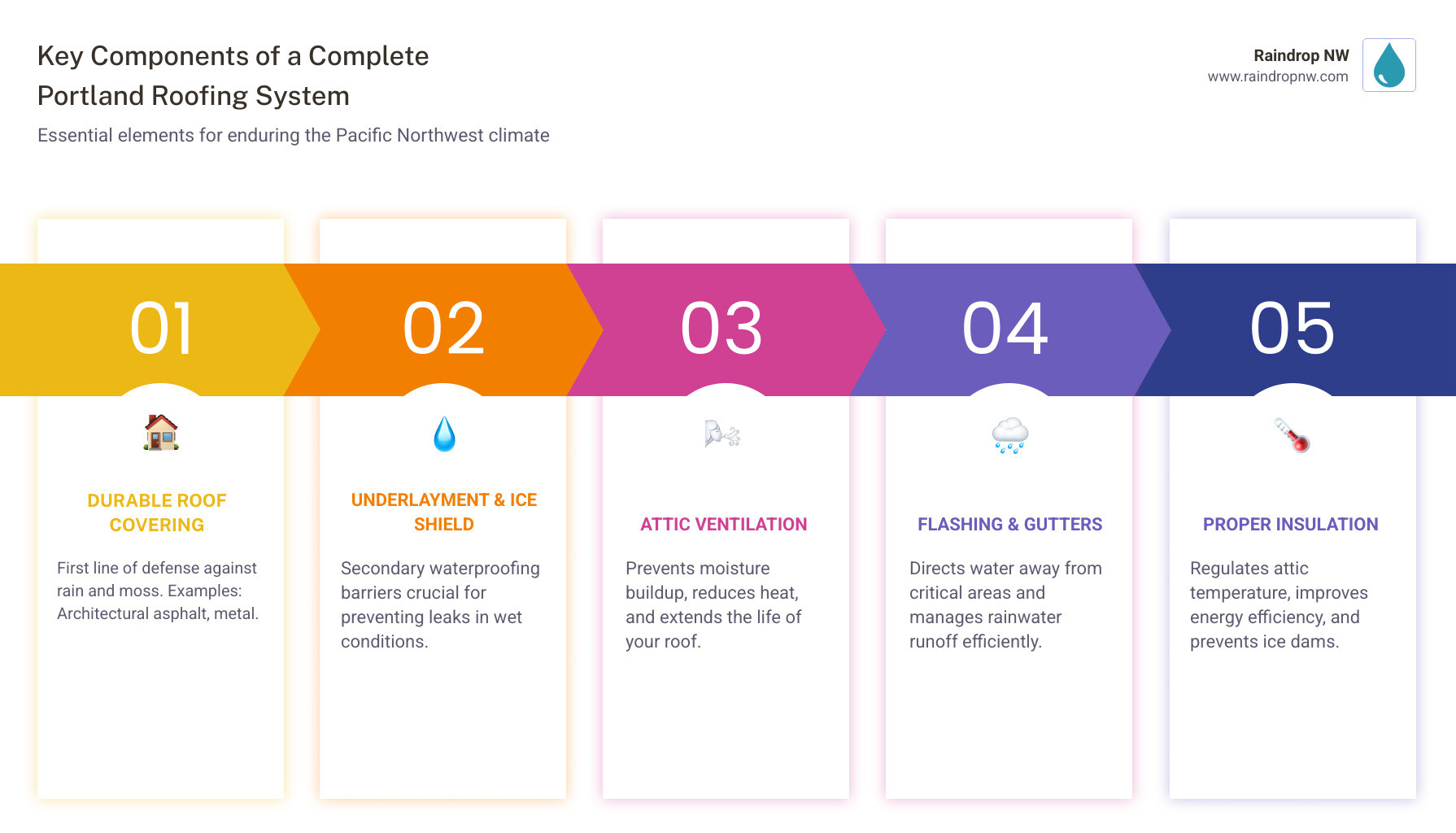
Infographic showing the complete roofing system including shingles, underlayment, ice and water shield, proper ventilation, insulation, flashing, and gutter integration with notes on why each component matters for Portland's rainy climate - roof remodels contractors in portland, or infographic pillar-5-steps

Roof remodels contractors in portland, or vocab explained:

  • emergency roof remodels in portland, or
  • roof remodels in portland, or

Why Portland Homeowners Consider a Roof Remodel

The decision to remodel a roof in Portland is often driven by necessity and a desire for improvement, with our climate playing a significant role.

  • Age-Related Wear: Roofs have a limited lifespan. For common asphalt roofing, this is typically 15 to 25 years. Beyond this, materials break down, leaving homes vulnerable.
  • Storm Damage and Leaks: Heavy rains, strong winds, and ice can compromise a roof’s integrity. Even minor damage can lead to persistent leaks, which may cause structural issues, mold, and interior damage if not addressed.
  • Moss and Algae Growth: The Pacific Northwest’s moist environment encourages moss and algae. While algae primarily affects curb appeal, moss can lift shingles and trap moisture, causing direct damage.
  • Energy Efficiency: An aging roof with poor insulation and ventilation can lead to heat loss in winter and heat gain in summer. Upgrading to modern materials and ensuring proper attic ventilation can improve home comfort and reduce energy consumption.
  • Preparing a Home for Sale: A new roof boosts curb appeal and addresses potential buyer concerns, making a home more attractive on the real estate market and signaling good maintenance.

For a deeper dive into the specifics of roof remodels custom for our region, you can explore our Roof Remodels Portland, OR Guide.

Repair vs. Replacement: Making the Right Call

Deciding between a roof repair and a full replacement is a critical decision for any Portland homeowner. The choice depends on the roof’s overall condition, age, and the extent of the damage.

When to Consider a Repair: A repair may be sufficient for isolated issues on a relatively new roof.

  • Missing Shingles: If strong winds have removed a few shingles but the rest of the roof is sound, a simple replacement can solve the problem.
  • Minor Leaks: A single, small leak can often be traced to loose flashing or a damaged shingle and repaired without extensive work.
  • Localized Damage: Damage from a fallen branch or other incident that affects only a small area can typically be repaired.

When to Consider a Replacement: A full replacement is often the best long-term solution when signs of widespread failure appear.

  • Advanced Age (20+ years): Most asphalt roofs last 15-25 years. If your roof is in or beyond this age range, it’s likely nearing the end of its life.
  • Widespread Granule Loss: Finding significant amounts of shingle granules in your gutters indicates that the shingles are losing their protective layer and deteriorating.
  • Sagging Roof Deck: A visible dip in the roofline or a sagging ceiling points to structural issues that require a full replacement to ensure your home’s safety.
  • Curled or Decaying Shingles: If shingles across the roof are curling, cracking, or showing signs of decay, the material has lost its integrity.
  • Multiple Leaks: Leaks in several different areas suggest systemic failure, making a replacement the most effective solution.

To help you visualize the distinction, here’s a quick comparison:

Sign of Roof Problem Indication for Repair Indication for Full Roof Replacement
Missing Shingles Isolated, due to wind or impact. Widespread, indicating shingle brittleness or age.
Leaks Single, localized leak near a penetration or specific damage. Multiple leaks in various areas, suggesting general failure.
Granule Loss Minimal, from one or two damaged shingles. Significant amounts in gutters, bare spots on many shingles.
Shingle Condition Minor cracks or curling on a few shingles. Widespread cracking, curling, or decaying across the roof.
Roof Age Roof is relatively young (under 15 years). Roof is 20+ years old and showing signs of wear.
Roof Deck/Structure No visible sagging or structural compromise. Visible sagging of the roofline or ceiling.
Moss/Algae Growth Manageable, surface-level growth. Deeply embedded, causing shingle lifting or deterioration.

A professional inspection by experienced roof remodels contractors in portland, or is the best way to determine the most appropriate course of action for your home.

Finding and Vetting Premier Roof Remodels Contractors in Portland, OR

Choosing the right roof remodels contractors in portland, or is paramount to the success and longevity of your project. In a city like Portland, you need a partner who understands the unique challenges of our climate and delivers quality. The benefits of choosing a local expert include a deep understanding of local building codes, experience with the Pacific Northwest climate, and a commitment to community accountability.

Our vetting process is designed to ensure you’re working with a contractor who is not only skilled but also reliable and trustworthy. This involves checking credentials, scrutinizing reviews, and understanding the warranties they offer.

Must-Have Credentials for Portland Contractors

When you’re entrusting your home’s protection to a contractor, their credentials speak volumes about their professionalism. Here’s what we recommend looking for:

  • Oregon Construction Contractors Board (CCB) license: This is non-negotiable. Any legitimate contractor operating in Oregon must be licensed with the CCB. This license ensures they meet state-mandated requirements. Always verify their license number.
  • Proof of insurance: A reputable contractor should carry both liability insurance and worker’s compensation insurance. Liability insurance protects your property from accidental damage, while worker’s compensation covers their employees if an injury occurs.
  • Manufacturer certifications (e.g., GAF Master Elite): These certifications are a strong indicator of a contractor’s expertise. For instance, the GAF Master Elite® certification is awarded to less than 2% of North American contractors, signifying a commitment to the highest standards in sales, service, and installation. Certified contractors can also offer improved manufacturer warranties.

For more insights into selecting the right professionals for your project, you can refer to our Best Roof Remodels in Portland, OR guide.

The Value of a Truly Local Portland Roofing Expert

As a local, independently owned roofing company, we are deeply committed to long-term service and accountability. This local connection offers distinct advantages for homeowners:

  • Knowledge of local building codes: Our team is familiar with the specific building codes and permitting requirements throughout the Portland Metro Area, including Portland, Tigard, Hillsboro, and Vancouver, ensuring your project is compliant.
  • Experience with PNW climate: We have years of hands-on experience with Portland’s weather—persistent rain, freeze-thaw cycles, and moss growth. We understand which materials and installation techniques perform best in our environment.
  • Familiarity with regional material suppliers: Local contractors often have established relationships with regional suppliers, ensuring access to high-quality materials and efficient project timelines.
  • Community accountability: As a local business, our reputation is built within the community we serve. We rely on referrals from our neighbors in Portland, Gresham, Beaverton, and surrounding areas, which fosters a strong commitment to customer satisfaction.

Choosing a local expert means choosing a partner who understands your home’s needs. You can learn more about our local commitment and services in Portland, OR.

The Anatomy of a High-Quality Roof Remodel Project

A high-quality roof remodel is more than just new shingles. It’s a carefully executed project involving material selection, a precise installation process, and thorough cleanup and inspection. We approach every project understanding that the roof is a complex system where each component is vital.

Best Roofing Materials for Portland’s Climate

Selecting the right material is crucial for longevity in Portland’s climate. We guide homeowners through options, considering durability, moss resistance, and aesthetics.

  • Architectural Asphalt Shingles: A popular choice in Portland, these are more durable and aesthetically pleasing than traditional shingles, often mimicking wood or slate.
    • Pros: Available in a wide range of styles and colors, good impact resistance, and some shades can reflect sunlight to improve energy efficiency. Many quality brands like GAF, CertainTeed, and Pabco are available. They are generally easier to install and repair.
    • Cons: Lifespan of 15 to 25 years (though high-end options last longer), can be susceptible to moss and algae growth (though many now come with algae-resistant granules), and are less durable than metal or tile.
  • Standing Seam Metal Roofing: This option is gaining popularity for its modern look and exceptional durability.
    • Pros: Extremely long lifespan (often 40-70 years), excellent resistance to rain, wind, and fire, naturally sheds snow and ice, requires little maintenance, and is highly energy-efficient.
    • Cons: Can be noisy during heavy rain or hail, and color fading can occur over many decades.
  • Cedar Shake Roofing: For a classic, natural look, cedar shakes are a beautiful option for many Pacific Northwest homes.
    • Pros: Natural aesthetic appeal, made from a renewable resource, offers good insulation, and can resist strong winds.
    • Cons: Requires more maintenance (regular cleaning and sealing), is susceptible to moss and rot if not properly maintained, has a higher fire risk (though some are treated), and has a lifespan of around 25 years.

We always recommend materials and systems designed for our wet winters and moss-prone environment.

The Typical Process with a professional roof remodels contractors in portland, or

With experienced roof remodels contractors in portland, or, the process is streamlined and transparent. Here’s what you can expect:

  1. Initial Consultation and Inspection: We start with a comprehensive assessment of your current roof’s condition, discussing your needs and aesthetic preferences. We provide a detailed summary of the work required.
  2. Design-Build Approach: For complex projects, our design team can work with you to create precise, build-ready plans, including 3D renderings and material selection sheets, before construction begins. This ensures all details are planned, from shingle color to ventilation, and can integrate elements like Balconies in Portland, OR or Flat Decks in Portland, OR.
  3. Material Selection: We guide you in choosing the best roofing materials for your home and our climate.
  4. Permit Acquisition: We manage all required permits with local authorities in Portland and surrounding areas.
  5. Tear-Off and Installation: Our crews carefully remove old roofing materials, keeping the job site clean. The new roof is then installed with precision, focusing on underlayment, flashing, and proper attic ventilation.
  6. Site Cleanup: Upon completion, our team performs a thorough cleanup, removing all debris.
  7. Final Inspection: We conduct a final inspection to ensure the project meets our highest standards and your satisfaction.

Beyond Shingles: The Importance of a Complete System

A high-quality roof is a complete system of interconnected components.

  • Attic Ventilation: Proper ventilation regulates temperature and moisture, preventing ice dams in winter and releasing trapped heat in summer. It also reduces moisture buildup, preventing mold and rot.
  • Proper Insulation: Working with ventilation, adequate attic insulation is key to energy efficiency. It acts as a barrier, preventing heat transfer. Upgrading your insulation’s ‘R’ value can drastically improve comfort and reduce energy consumption. We often recommend considering blown-in insulation during a roof remodel for maximum benefit.
  • Ice and Water Shield: This self-adhering membrane is installed in vulnerable areas like eaves and valleys, providing an extra layer of waterproofing against ice dams and wind-driven rain.
  • Underlayment: Applied to the roof sheathing, underlayment provides a secondary barrier against moisture. Since the roof sheathing (decking) is the foundation of the roofing system, compromised sheathing can lead to moisture collection and sagging ceilings, so a sound underlayment is vital.
  • Flashing: Metal pieces installed at junctures like chimneys and vents direct water away from vulnerable areas, preventing leaks.
  • Gutters: A functioning gutter system is essential for managing rainwater runoff, directing water away from your home’s foundation to prevent erosion and leaks.

Considering all these components ensures your new roof is a robust, long-lasting system. For more comprehensive guides on exterior systems, you might find our Flat Decks Service Portland, OR Guide useful.

Frequently Asked Questions About Portland Roof Remodels

We understand that a roof remodel is a significant decision. Here, we address some of the most common questions from Portland homeowners.

What kind of warranties should I expect from roof remodels contractors in portland, or?

Reputable roof remodels contractors in portland, or typically offer two main types of warranties:

  • Workmanship Warranty: This covers the quality of the installation itself, guaranteeing the work is free from defects. We, for example, offer a 10-year workmanship warranty on re-roof projects.
  • Manufacturer Material Warranty: This covers the roofing materials against manufacturing defects. The duration varies by product. For instance, GAF offers up to a 50-year warranty on their Lifetime Shingles. Many top manufacturers like GAF, CertainTeed, and Owens Corning offer excellent material warranties.
  • Warranty Transferability: It’s also wise to inquire if warranties are transferable to a new homeowner, as this can be a significant selling point.

Always read the warranty details to understand what is covered, for how long, and what might void it. For urgent roof concerns, our Emergency Roof Remodels Portland, OR Guide can provide immediate insights.

How long does a new roof typically last in the Pacific Northwest?

The lifespan of a new roof in the Pacific Northwest depends on the material, installation quality, and maintenance.

  • Asphalt Shingles: Standard shingles typically last 15 to 25 years. High-end architectural shingles can last 30 to 50 years.
  • Wood Roofs (Cedar Shake): With proper maintenance, cedar shake roofs generally last around 25 years.
  • Composite Roofs: These durable options can have a lifespan of 30 years or more.
  • Flat Roofs: These typically last around 10 to 20 years, depending on the material.
  • Metal Roofs: Standing seam metal roofs are renowned for their longevity, often lasting 40 to 70 years.

Regular inspections, gutter cleaning, and prompt repairs can significantly extend the life of any roof in our climate.

How do proper attic insulation and ventilation affect my new roof?

Attic insulation and ventilation are crucial for your home’s comfort, energy efficiency, and your roof’s longevity.

  • Prevents Ice Dams: In winter, proper insulation and ventilation keep the roof deck cold, preventing snow from melting and refreezing at the eaves, which forms destructive ice dams.
  • Reduces Moisture Buildup: Ventilation flushes warm, moist air from the attic, preventing condensation that can lead to mold, mildew, and wood rot.
  • Improves Energy Efficiency: Effective insulation prevents heat transfer, keeping your home more comfortable year-round. This reduces the workload on your HVAC system and can lead to significant energy savings.
  • Extends Roof Lifespan: By preventing ice dams and moisture damage, proper insulation and ventilation protect roofing materials from premature deterioration, helping your new roof reach its maximum expected lifespan.

For comprehensive assessments of your home’s exterior and interior systems, our Best Commercial Estimates and Inspections Company in Portland, OR also offers residential insights.

Secure Your Home with a Trusted Local Partner

A roof remodel is a significant investment in your home’s future, and choosing the right roof remodels contractors in portland, or is the most crucial step. We’ve explored why remodels are needed, how to choose between repair and replacement, and the importance of vetting a local expert. We’ve also dived into the best materials for our climate and the process for a high-quality roof.

A successful remodel is about a complete system—including insulation, ventilation, and gutters—installed with precision.

Our key takeaway is this: vetting is vital. Look for contractors with proper Oregon CCB licensing, comprehensive insurance, and manufacturer certifications like GAF Master Elite. Prioritize local businesses that understand Portland’s climate and building codes. These partners offer community accountability and stand behind their work.

By choosing quality materials and trusted local professionals, you’re not just getting a new roof; you’re securing your home’s long-term value, comfort, and safety. We are committed to helping you make informed decisions.

If you’re considering a roof remodel or other exterior improvements, including services like From Dream to Deck: Finding Professional Balcony Services in Portland, we invite you to reach out. Contact us for your Portland roofing needs today and let us help you build a lasting, beautiful roof for your home.

https://www.raindropnw.com/wp-content/uploads/2026/04/71239db25ad2ad41fe9e0b3c5c077756682424ca.jpg 1024 1536 SEO Stats https://www.raindropnw.com/wp-content/uploads/2024/05/logo-raindrop-space-300x92.png SEO Stats2026-04-15 01:32:582026-04-15 01:32:58From Local Experts to Lasting Roofs: Choosing the Best Remodelers in Portland

Portland Roof Additions: What You Need to Know Before You Build

Roofing

Understanding Roof Additions in Portland

Roof additions in portland, or offer homeowners a strategic way to expand their living space without building out. Whether you’re considering a dormer, second-story addition, or rooftop living space, understanding your options and Portland’s unique building requirements is essential before breaking ground.

What You Need to Know About Roof Additions:

  • Types of additions – Dormers, second stories, attic conversions, and rooftop decks or ecoroofs
  • Permit requirements – Building permits are mandatory; projects over 500 sq ft may trigger Portland’s Major Residential Alteration and Addition (MRAA) ordinance
  • MRAA delays – A 35-day notification period is required for qualifying projects
  • Key considerations – Structural integrity, Portland’s climate (40″ average rainfall), energy efficiency, and zoning compliance
  • Professional help – Licensed contractors familiar with Portland codes and MRAA requirements are critical

Portland’s building regulations are specific and detailed, particularly when it comes to major alterations and additions. The city’s MRAA ordinance requires advance notification to neighbors and recognized organizations for projects that add more than 500 square feet of new interior space while expanding the structure’s footprint or envelope. Structural changes like removing more than 50% of exterior walls also fall under these rules. Beyond permitting, you’ll need to consider Portland’s rainy climate, seismic requirements, stormwater management, and energy efficiency standards that apply to additions over 225 square feet.

Working with a local contractor who understands these requirements can save you months of delays and significant mistakes. If you’re planning major work on your home, check out our complete guide to residential roofing services, or explore our specialized remodels and additions services to see how we can help.

I’m Torrey Yungeberg, owner of Raindrop NW in Boring, Oregon, and I’ve spent years helping local homeowners steer complex projects like roof additions in portland, or while honoring the family roofing tradition I grew up in. My team and I work closely with clients to ensure every detail—from planning and permitting to final inspection—is handled with care, transparency, and a deep commitment to our community.

Infographic showing the basic steps of a roof addition project in Portland: Step 1 - Plan and Design (1-3 months, consult with architect and contractor), Step 2 - Obtain Permits (2-4 months, submit plans to City of Portland, MRAA notification if applicable), Step 3 - Construction (3-6+ months, structural work, weatherproofing, inspections), Step 4 - Final Inspection and Approval (City of Portland sign-off) - roof additions in portland, or

Exploring Your Options: Types of Roof Additions

When considering roof additions in portland, or, homeowners have a variety of options, each offering unique benefits and design possibilities. The primary benefits of adding a roof addition include increasing living space, improving aesthetics, and potentially enhancing energy efficiency. We can help you explore which type best suits your home and needs.

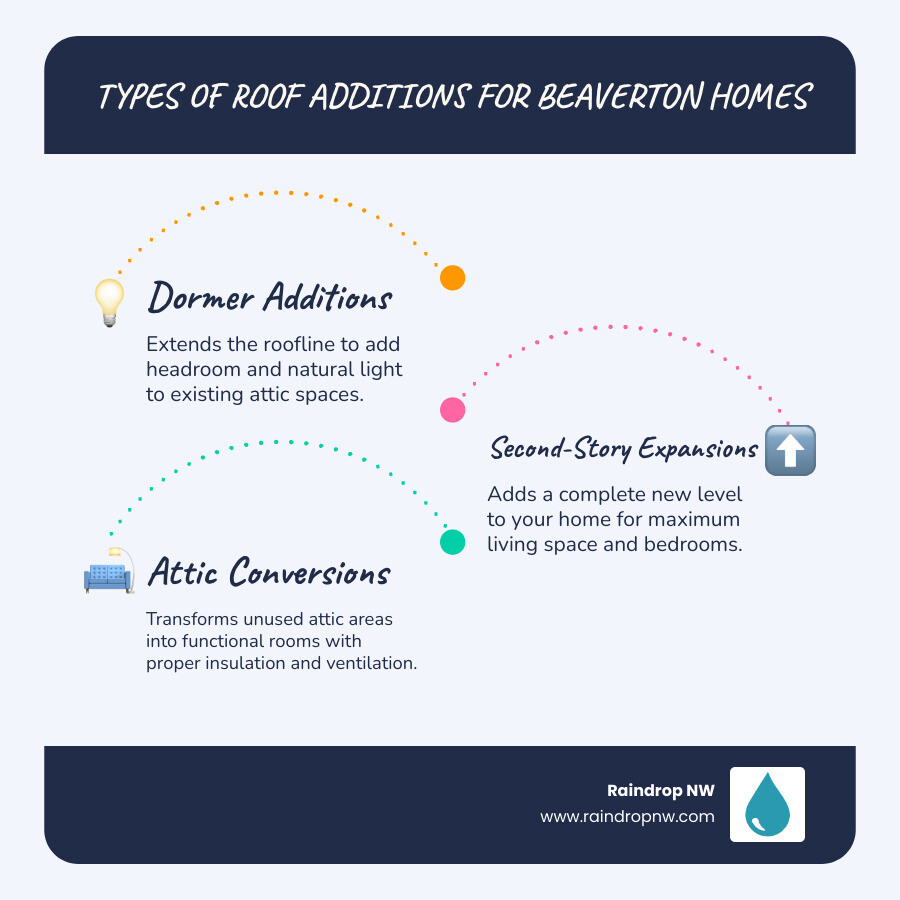
Dormer Additions

Dormers are structural additions that project vertically from the slope of a pitched roof, creating additional usable space and often introducing natural light and ventilation to the floor below. They are an excellent way to expand an attic into a habitable room.

  • Shed Dormers: These have a single-pitched roof that slopes in the same direction as the main roof but at a shallower angle. They typically provide the most interior space and can offer contemporary aesthetics.
  • Gable Dormers: Featuring a small gable roof, these are common and often blend seamlessly with traditional home styles. They add character and light but usually offer less interior space than shed dormers. Converting an attic into a living space, often facilitated by dormer additions, requires careful planning. We need to ensure the existing attic floor and supporting structures are adequate for new live loads and that new spaces meet building codes for ceiling height, egress, and insulation. The City of Portland provides detailed guidelines for Converting Attics, Basements and Garages to Living Space.

Attic Conversions

Beyond just adding dormers, a full attic conversion transforms previously unused space directly under your roof into functional living areas. This can include bedrooms, home offices, or playrooms. This type of addition can significantly increase your home’s square footage without expanding its footprint. Key considerations include structural reinforcement, insulation, and ensuring adequate head height and egress pathways.

Second-Story Additions

For homes that need a significant increase in space, a second-story addition involves building an entirely new level on top of the existing structure. This is a major undertaking that requires extensive structural assessment to ensure the foundation can support the added weight. It offers the most dramatic increase in living space and allows for entirely new floor plans and room configurations.

Rooftop Living Spaces

Changing your roof into an outdoor living area is a growing trend, especially in urban environments like Portland.

  • Decks: A rooftop deck can provide valuable outdoor entertaining space with unique views. This requires significant structural reinforcement, proper waterproofing, and adherence to railing height and safety codes.
  • Patios: Similar to decks, rooftop patios can be designed as extensions of indoor living, offering a serene escape.
  • Ecoroofs: Also known as green roofs, ecoroofs replace conventional roofing with a living, vegetated system. They are not only aesthetically pleasing but also offer significant environmental benefits. Ecoroofs can extend the garden to the roof, insulate the building, cool the air, capture rainwater, and reduce stormwater runoff. They can even create habitat for native species. While conventional roofs typically last about 20 years, a green roof can last 40 years or more. These can be integrated into rooftop decks or stand alone.

Bump-Outs

While not strictly a “roof addition” in the sense of adding an entire new level, bump-outs are smaller additions that extend from the side of a house, often with a dedicated roof structure, to expand a single room. They can provide extra square footage, often adding bay windows, seating nooks, or expanding a kitchen or bathroom.

Each of these options presents unique opportunities and challenges. Our team can help you assess the feasibility of each type of addition for your specific home and property.

Navigating Portland’s Permitting and Regulations for Roof Additions

Undertaking roof additions in portland, or means navigating a specific and detailed permitting landscape. The City of Portland has regulations designed to ensure safety, maintain neighborhood character, and address environmental concerns.

A building permit is always required for an addition to one or two-family dwelling units, especially if you’re making structural changes like adding a dormer, a second floor, or expanding the footprint. Depending on your project, you may also need electrical, mechanical, or plumbing permits. You can start the application process online with DevHub, the city’s permitting portal: Apply for a permit now on DevHub. For a comprehensive overview of what’s required, review the city’s Residential Additions in Portland: Permits and Application Requirements.

One of the most critical regulations to understand is the Major Residential Alteration and Addition (MRAA) Ordinance. This ordinance applies to residential structures with a residential Comprehensive Map Designation. If your project falls under MRAA, it triggers additional requirements, including a mandatory 35-day delay period before a permit can be issued. During this time, neighbors and recognized organizations are notified. You can find more details on these specific requirements at Major Residential Alteration and Addition Permit Requirements. To identify properties that need notification, such as those next to or across the street from your site, you can use www.PortlandMaps.com.

Understanding MRAA Thresholds for roof additions in portland, or

The MRAA ordinance defines specific thresholds that determine if your roof addition project is considered “major.” Understanding these definitions is crucial for planning your project and avoiding unexpected delays.

  • Major Addition Definition: A major addition is defined as adding more than 500 square feet of new interior space and expanding the structure’s footprint or envelope. This means if you’re adding a second story or a large dormer that pushes out the roofline, and it creates over 500 square feet of new interior space, your project will be subject to MRAA rules. The MRAA Brochure provides further clarification.
  • Major Alteration Definition: Even if you’re not expanding your footprint, a project can be deemed a major alteration if it involves removing more than 50% of the exterior walls above the foundation. This applies to linear feet calculations per story.
  • Exemptions: Not all additions fall under MRAA. For example, detached Accessory Dwelling Units (ADUs) are generally exempt. Also, converting existing unfinished basements or attics to living space without altering exterior walls or the structure’s footprint/envelope is not considered a major alteration or addition, even if it adds more than 500 square feet of interior space. This is because the exterior envelope remains unchanged.

The 35-day delay period before a permit can be issued for MRAA projects is a critical factor in your project timeline. During this period, plans can be reviewed, but no work can begin. This notification process ensures transparency and allows neighbors and community organizations to be informed.

Key Code Requirements for Your Project

Beyond MRAA, several other code requirements will impact your roof additions in portland, or project:

  • Energy Efficiency: Portland is committed to energy conservation. For additions that increase the floor area of the house, new windows or doors must meet current code requirements for energy conservation. Specifically, if your addition adds 225 square feet or more of new, heated space, your plans must specify at least one “Additional Measure” energy upgrade. You can visit the Oregon Residential Energy Code for tables on Additional Measures to understand these requirements.
  • Stormwater Management: Portland’s climate means we pay close attention to water runoff. Projects involving additions that add more than 500 square feet of impervious area (like a new roof over an expanded footprint or a large rooftop deck) require specific stormwater management plans. This could involve rain gardens, permeable paving, or other solutions to manage runoff on-site.
  • Zoning and Site-Specific Rules: Your property’s zoning and specific site characteristics will influence what you can build. This includes height restrictions, setbacks from property lines, and impervious surface limits. If your site is in a Flood Hazard Area, additional submittal requirements will apply. You can check flood plain information on the PortlandMaps Flood Hazard gallery and contact Site Development for details. All projects must adhere to the Oregon Residential Specialty Code (ORSC) and Portland City Code Title 33 Zoning Code.
  • Structural Code: The ORSC also dictates structural requirements, including lateral load analysis to ensure your addition can withstand wind and seismic forces, which is particularly important in our region.

Key Considerations for Successful Roof Additions in Portland, OR

A successful roof addition project in Portland requires careful consideration of structural integrity, our unique climate, design aesthetics, energy performance, and project timelines.

Structural Integrity and Portland’s Climate

Any roof additions in portland, or will significantly impact your home’s structural integrity.

  • Structural Load Path: We must ensure the added weight of the new structure is safely transferred through walls and beams down to the foundation. This requires a thorough assessment of your existing foundation and framing. For attic conversions, for example, engineering calculations are crucial to ensure continuity of the load path to the foundation, as beams might be overstressed. Seismic reinforcement, like bolting your house to its foundation, is also recommended, especially when finishing basements. For prescriptive methods of lateral bracing, tools like the APA Wall Bracing Calculator can be used.
  • Weatherproofing: Portland receives an average of 40 inches of rainfall each year, making superior weatherproofing paramount. This includes meticulous flashing around all penetrations and transitions, high-quality underlayments, and robust waterproofing membranes to prevent moisture intrusion. Our expertise in local weather patterns ensures your addition is built to last against the elements.
  • Material Selection: Choosing the right materials is critical for durability, aesthetics, and performance in our climate. Here’s a comparison of common roofing materials for additions:
Material Durability (Lifespan) Maintenance Suitability for Portland
Asphalt Shingles 20-30 years Moderate (regular cleaning, moss control) Good. Most common residential choice. Must be rated for wind and algae resistance. Susceptible to moss growth in damp conditions, which needs to be managed.
Metal Roofing 40-70+ years Low (periodic cleaning) Excellent. Highly durable against rain, wind, and moss. Offers superior longevity and energy efficiency (especially cool metal roofs). Available in various styles to match aesthetics.
Green Roofs 40+ years Moderate (plant care, drainage checks) Excellent for environmental benefits. Captures rainwater, insulates, reduces urban heat island effect. Requires specialized structural support, waterproofing, and plant selection suitable for our climate. Offers unique aesthetic and ecological value, especially for rooftop living spaces.

Other materials like cedar shakes, tile, or TPO/EPDM membranes (often seen on low-slope commercial roofs but applicable to some residential designs) are also options, each with their own benefits and considerations.

Design, Energy Efficiency, and Project Timeline

Thoughtful design and energy performance are integral to any successful roof addition.

  • Architectural Integration: A well-designed addition should seamlessly integrate with your existing home’s architectural style. Whether matching historical details or creating a striking modern contrast, the goal is to improve your home’s overall aesthetics. Incorporating natural light through strategically placed windows and skylights can transform the new space, making it feel open and inviting.
  • Improving Energy Performance: Roof additions offer an opportunity to significantly improve your home’s energy efficiency. This includes ensuring proper insulation R-values in walls, ceilings, and floors (e.g., R-15 for new exposed framing). Adequate ventilation is crucial, especially when adding insulation to roofs, to prevent moisture buildup and maintain indoor air quality. Incorporating cool roof technologies, which reflect more sunlight, can help lower indoor temperatures and improve comfort, even in Portland’s milder summers. New windows and doors in the addition must meet current energy conservation codes.
  • Typical Project Timeline: The timeline for roof additions in portland, or can vary significantly based on complexity, city review times, and contractor availability. Here’s a general breakdown:
    • Design & Engineering: 1-3 months (working with architects and structural engineers)
    • Permitting: 2-4 months (this can be longer if MRAA is triggered, requiring the 35-day notification period)
    • Construction: 3-6+ months (depending on the size and complexity of the addition)
    • Final Inspections: 1-2 weeks (city inspections at various stages and final sign-off)

We strive to keep our clients informed at every stage, providing realistic timelines and transparent communication.

Finding the Right Professional for Your Project

Choosing a qualified and experienced contractor is perhaps the most critical step for a successful roof addition. Our team is dedicated to providing top-notch service and expertise for your project.

What to Look for in a Portland Contractor

  • Licensing and Insurance: Always verify that your contractor is properly licensed and insured. In Oregon, this means checking with the Oregon Construction Contractors Board (CCB). You can visit the CCB website to verify their credentials and ensure they are in good standing. This protects you from liability and ensures quality workmanship.
  • Local Experience: A contractor familiar with Portland’s specific building codes, zoning regulations, and the MRAA ordinance is invaluable. Our team has extensive experience navigating these local requirements, ensuring your project complies with all city and state guidelines. We understand the nuances of MRAA projects and the notification process.
  • Reputation and Reviews: Look for contractors with a strong local reputation. Check online testimonials, review their portfolio of past projects, and ask for references. Our commitment to quality and customer satisfaction is reflected in our long history of serving homeowners in Portland and surrounding areas.

Important Safety and Environmental Considerations for roof additions in portland, or

Safety and environmental compliance are paramount, especially for projects involving older homes.

  • Asbestos and Lead Paint: If your home was built before 1978, there’s a possibility of encountering lead-based paint. If built earlier, or if certain materials were used, asbestos could also be present. Disturbing these materials requires specialized handling and disposal. The Oregon Department of Environmental Quality (DEQ) handles asbestos requirements, and you can call them at 503-229-5982 or email deqnwrasbestos@deq.state.or.us. For lead-based paint, if a contractor is doing the work, they must follow rules set by the Oregon Construction Contractors Board (CCB) (call 503-934-2229 or visit the CCB website). If you, as a homeowner, are doing your own work, the Oregon Health Authority (OHA) provides guidance (call 971-673-0440 or visit the OHA website for lead paint info).
  • Worker Safety: Any construction project involves risks. Ensure your contractor adheres to all worker safety regulations set by the Oregon Occupational Safety & Health (OSHA). You can call them at 503-229-5910 or visit the OR OSHA website for more information. A reputable contractor will prioritize safety for their crew and your property.

Conclusion: Building Up in the Rose City

Roof additions in portland, or are a fantastic way to improve your home, providing much-needed space, improving aesthetics, and potentially boosting energy efficiency. Whether it’s a cozy dormer, a spacious second story, or a vibrant rooftop living area, the benefits can be transformative.

However, as we’ve explored, these projects require meticulous planning, a deep understanding of Portland’s unique regulatory environment—especially the MRAA ordinance—and a commitment to quality craftsmanship. Navigating permits, ensuring structural integrity in our seismic zone, managing stormwater, and adhering to energy codes are all part of the journey.

At Raindrop NW, we believe in building more than just additions; we build lasting relationships and homes that stand the test of time. Our local expertise and unwavering commitment to quality make us the ideal partner for your next roof additions in portland, or project. We’re here to guide you through every step, ensuring a smooth, compliant, and satisfying experience from concept to completion.

Ready to explore your roof addition options? Learn more about our remodeling and addition services.

https://www.raindropnw.com/wp-content/uploads/2026/04/c81ca2cc6b6e42022a071400ab02b2a608013212.jpg 1024 1536 SEO Stats https://www.raindropnw.com/wp-content/uploads/2024/05/logo-raindrop-space-300x92.png SEO Stats2026-04-14 14:32:262026-04-14 14:32:26Portland Roof Additions: What You Need to Know Before You Build

Beaverton Roof Additions: What You Need to Know Before You Build

Residential Roofing

Why Roof Additions Make Sense for Beaverton Homeowners

Roof additions in Beaverton, OR offer a smart way to expand your living space without leaving the neighborhood you love or sacrificing your yard. Whether you’re adding a dormer for natural light, building a second story for extra bedrooms, or converting an unused attic into a home office, roof additions let you grow vertically when building outward isn’t an option.

Here’s what you need to know before starting:

  • Types of Additions: Dormers, second-story expansions, and attic conversions
  • Key Benefits: More living space, increased home value, and preserved yard area
  • Critical Steps: Structural assessment, permits from Beaverton and Washington County, and choosing weather-resistant materials
  • Timeline: Most projects take several months from design to completion
  • Must-Haves: Licensed contractor with Oregon CCB credentials, proper insurance, and local experience with Beaverton’s climate

A well-planned roof addition can be a worthwhile investment that adds significant market value to your home, especially for families who need more space but want to stay put. In Beaverton’s rainy climate with nine months of annual rainfall, choosing the right materials and contractor is essential for long-term durability.

Looking to upgrade your existing roof first? Explore our residential roofing services in Beaverton, or if you’re ready to discuss adding space to your home, contact us for a free consultation.

I’m Torrey Yungeberg, owner of Raindrop Roofing NW, and I’ve spent years helping Oregon homeowners protect their biggest investments through quality roofing work that stands up to our Pacific Northwest weather. When clients ask about roof additions in Beaverton, OR, I guide them through the process with the same attention to detail and local expertise we bring to every project.

Infographic showing three types of roof additions: Dormer additions with angled roofs that extend from the existing roofline to add headroom and light, Second-Story additions that add a full level on top of existing structure for maximum space, and Attic Conversions that transform unused space into livable rooms with proper insulation and ventilation - roof additions in beaverton, or infographic infographic-line-3-steps-blues-accent_colors

Why Build Up? Exploring the Types and Benefits of Roof Additions

Homeowners in Beaverton often find themselves at a crossroads: their family is growing, their needs are changing, but they love their neighborhood and don’t want to move. This is where roof additions in Beaverton, OR become an incredibly attractive solution. The primary reasons we see homeowners consider building up instead of out are diverse and deeply personal. Growing families often need more bedrooms or a dedicated playroom. The rise of remote work has led to a demand for private, functional home office spaces. Some homeowners even look to add an Accessory Dwelling Unit (ADU) for multigenerational living or potential rental income, which is a growing trend in Beaverton.

Beyond personal needs, there’s a significant financial incentive. A well-designed and executed roof addition in Beaverton, OR can substantially increase your home’s value. This means you’re not just gaining space; you’re making a sound investment. Furthermore, with limited lot sizes in many Beaverton neighborhoods, building a second story allows for significant expansion without sacrificing precious yard space. It’s about making the most of your property and staying in the community you cherish.

Common Types of Roof Additions for Beaverton Homes

When we talk about roof additions in Beaverton, OR, we’re usually referring to a few key types, each offering unique benefits:

  • Dormer Additions: These are structural additions that project vertically from the slope of a pitched roof, creating usable space and adding natural light. Dormers can transform a cramped attic into a cozy bedroom, a bright home office, or simply add headroom to an existing attic space. They often involve extending the existing roofline to create a small, new roof section over the dormer itself.
  • Second-Story Additions: This is perhaps the most dramatic way to expand, involving the removal of the existing roof and the construction of an entire new level on top of your home. Second-story additions are a popular solution in Beaverton when lot size is limited, allowing for significant expansion without sacrificing yard space. This type of addition can double your living area, providing space for new bedrooms, bathrooms, a master suite, or even an open-concept living area on the ground floor by relocating existing functions upstairs.
  • Attic Conversions: This involves changing an existing, often unused, attic space into a habitable room. While it may not always require altering the roofline significantly (though dormers are often added), it falls under the umbrella of roof additions because it leverages the existing roof structure to create new living space. Proper insulation, ventilation, and structural reinforcement are key to a successful attic conversion.

Understanding the Benefits of Roof Additions in Beaverton, OR

The advantages of undertaking a roof addition in Beaverton, OR extend far beyond just square footage:

  • Increased Living Area: This is the most obvious benefit. Whether it’s an extra bedroom for a growing family, a dedicated home office, or a spacious primary suite, roof additions provide the much-needed room that makes a home feel comfortable and functional. Additions like new bedrooms, bathrooms, or expanded kitchens are frequently requested by Beaverton homeowners looking to improve livability.
  • Improved Property Resale Value: As mentioned, a well-executed addition can significantly boost your home’s market value. This is especially true for additions that add valuable spaces like extra bedrooms, bathrooms, or expanded kitchens, which are highly sought after by buyers.
  • Improved Home Functionality and Flow: A thoughtful addition can improve how you use your home. Perhaps you need a more private primary suite, or a larger kitchen with better flow for entertaining. These projects allow us to create “better space” custom to your lifestyle, not just “more space.”
  • Maximizing Your Lot Size: In urban and suburban areas like Beaverton, where land is at a premium, building vertically is often the only way to expand without encroaching on your outdoor living areas. Second-story additions are particularly effective in this regard, allowing you to gain significant square footage while preserving your cherished yard.

Planning Your Project: Key Steps for Roof Additions in Beaverton, OR

Starting on a roof addition in Beaverton, OR is an exciting journey, but it requires careful planning to ensure a successful outcome. One of the most critical initial steps involves a thorough structural integrity assessment of your existing home. This includes evaluating the foundation and current load-bearing walls to determine if they can support the additional weight of a new story or dormer. Engineering considerations are paramount here, as professional structural engineers will design the necessary reinforcements to ensure your home remains safe and sound. We often work with skilled engineers to ensure every detail is accounted for, from the ground up.

Navigating Permits and Regulations for Roof Additions in Beaverton, OR

Understanding and complying with local regulations is a non-negotiable step for any roof addition in Beaverton, OR. You’ll need to secure Beaverton building permits, and we’ll also work within Washington County zoning regulations. These regulations cover everything from setback requirements (how far your structure must be from property lines) to height restrictions and the allowable footprint of your home.

The permitting process can be complex, often requiring detailed architectural plans, structural engineering documents, and sometimes even neighborhood review. Our role, as your trusted contractor, is to guide you through this labyrinth. We handle all required city permits, engineering, and inspections to ensure your addition is compliant and stress-free. We understand that compliance isn’t just about avoiding fines; it’s about ensuring your new space is safe, up to code, and a lasting asset to your home.

Optimizing Your Addition for Energy Efficiency

When adding to your home, it’s the perfect opportunity to think about long-term energy savings. Optimizing your roof addition in Beaverton, OR for energy efficiency can significantly impact your utility bills and overall home comfort. This involves implementing modern insulation standards that exceed minimum requirements, installing high-performance windows designed to prevent heat loss in winter and heat gain in summer, and ensuring proper attic ventilation.

Proper attic ventilation, for instance, is crucial in Beaverton’s climate to prevent moisture buildup, rot, and mold, which can compromise both the new and existing structures. We also focus on sealing air leaks throughout the new construction to create a tight building envelope. These measures collectively minimize the impact on your heating and cooling systems, ensuring your new space is comfortable year-round without excessive energy consumption.

Designing for Durability: Materials and Climate Considerations

Beaverton’s climate presents unique challenges that must be considered when planning roof additions in Beaverton, OR. With nine months of annual rainfall and persistent humidity, we experience conditions that can be tough on building materials. Moss and algae growth are common issues, and we also need to account for wind resistance, especially during our occasional winter storms.

Therefore, selecting the right materials isn’t just about aesthetics; it’s about ensuring durability and longevity in the face of the Pacific Northwest weather. We understand these specific climate challenges and recommend materials that are proven to perform here.

Choosing the Right Roofing Materials for Beaverton’s Weather

For the roofing aspect of your addition, we prioritize materials that offer superior weather resistance:

Material Type Durability Weather Resistance (PNW) Maintenance
Architectural Shingles Can last decades, often longer than traditional asphalt shingles. Excellent against heavy rain; algae-resistant options are crucial for moss/algae. Low; requires occasional cleaning for moss/algae if not treated.
Metal Roofing Extremely durable, often lasts 50+ years. Highly resistant to rain, wind, fire, and snow; moisture-resistant. Very low; naturally inhibits moss/algae.
Composite Materials Engineered for longevity, often with warranties up to 50 years. Excellent against moisture, moss, and algae; often made from recycled materials. Low; designed to be moss-resistant and withstand harsh weather.

We often recommend architectural shingles with algae-resistant properties, which are specifically designed to combat the moss and algae growth prevalent in our damp climate. Metal roofing is another excellent, durable option, known for its moisture, fire, and wind resistance, often outlasting asphalt shingles. Composite materials engineered with moss-resistant properties also offer a fantastic balance of aesthetics and performance.

Siding, Windows, and Gutters: Completing the Exterior

A successful roof addition in Beaverton, OR seamlessly integrates with your existing home’s aesthetic. This means carefully matching not just the roofing, but also the siding, windows, and gutters.

For siding, we consider materials that are robust against dampness and moss growth, such as fiber cement siding, composite materials, or even carefully matched wood siding. New windows should be high-performance, weather-resistant models designed to withstand seasonal moisture and heavy tree coverage, improving comfort and energy savings.

Crucially, the importance of functional gutter systems cannot be overstated in Beaverton. They are essential protection for your entire home, efficiently managing water runoff to protect your foundation and roof. We ensure that your new addition’s gutter system integrates perfectly with your existing setup, providing comprehensive water management. We also know that bundling services, such as combining roof and siding projects, can create a more efficient workflow and a cohesive exterior upgrade. For more information on siding, you can refer to general resources like this article on Angi.

From Blueprint to Reality: The Construction Process

Bringing a roof addition in Beaverton, OR from concept to completion is a multi-stage process. While a typical roof replacement might take 1 to 3 days, a comprehensive roof addition project involves a much longer timeline, often several months from the initial design and planning phase through to the final interior and exterior finishing.

The journey begins with detailed architectural and engineering designs, followed by securing the necessary permits. Once approvals are in hand, the physical construction starts. This can involve careful demolition, structural framing of the new space, installing the new roofing system, adding windows and doors, and then moving to interior work like insulation, drywall, flooring, and finishes. Throughout this process, we maintain a clean and organized job site, ensuring safety and minimizing disruption to your daily life as much as possible.

How to Find and Vet a Qualified Beaverton Contractor

Choosing the right contractor for your roof addition in Beaverton, OR is arguably the most critical decision you’ll make. It’s about more than just finding someone who can build; it’s about finding a partner who understands our local climate, regulations, and architectural styles. Here’s how we recommend homeowners find and vet a qualified professional:

  • Verifying Credentials: Always confirm that the contractor holds an active Oregon CCB License through the Construction Contractors Board website. This ensures they are properly registered and bonded. Also, demand proof of both liability and worker’s compensation insurance. This protects you from financial responsibility in case of accidents or damage during the project.
  • The Value of Local Experience: Beaverton’s specific weather patterns, building codes, and common issues like moss and algae growth mean that local experience is invaluable. A contractor with a deep understanding of the area will recommend the best materials and techniques for long-term durability.
  • Evaluating Past Work and Reputation: Don’t just take their word for it. Check online reviews on reputable platforms, review photo galleries of their completed projects, and look at their Better Business Bureau (BBB) ratings. Ask for local references or examples of nearby projects you can see. Pay attention to testimonials that speak to professionalism, communication, and job site cleanliness.

Potential Challenges and How to Prepare

Even with the best planning, undertaking a roof addition in Beaverton, OR can present a few challenges. The Pacific Northwest weather, for instance, can lead to weather delays, especially during our rainy seasons. While we work year-round, we prioritize safety and quality, meaning we may pause work if conditions are unsafe or could compromise the integrity of the project.

Unforeseen structural issues in the existing home can also arise once construction begins, sometimes necessitating design adjustments or additional work. Material availability can occasionally be a factor, impacting project timelines. The key to mitigating these challenges lies in maintaining clear communication with your contractor. We believe in transparent project management, keeping you informed every step of the way, discussing any potential issues promptly, and collaboratively finding solutions. A good contractor will have contingency plans and the expertise to steer these complexities smoothly.

Conclusion: Taking the Next Step on Your Beaverton Home Addition

Undertaking a roof addition in Beaverton, OR is a significant investment that promises to transform your home and improve your lifestyle. From the initial spark of an idea to the final nail, careful consideration of every detail is essential for a successful outcome. We’ve explored the compelling reasons to build up, the various types of additions, the critical planning steps, and the importance of selecting durable materials suited for Beaverton’s unique climate.

The value of thorough planning, navigating permits, optimizing for energy efficiency, and choosing the right materials cannot be overstated. Most importantly, selecting a qualified, local expert for your project ensures that your addition is not only beautiful and functional but also structurally sound and compliant with all local regulations.

At Raindrop NW, we pride ourselves on being a truly local, independently owned company committed to long-term service and accountability. We bring local expertise and a deep understanding of Beaverton’s specific needs to every project, ensuring your roof addition in Beaverton, OR is built to last and exceed your expectations.

Ready to explore how a roof addition can expand your living space and improve your home’s value? Let us be your dedicated partner in protecting and enhancing your home. Learn more about our residential roofing services in Beaverton, OR.

https://www.raindropnw.com/wp-content/uploads/2026/03/d5312ced77298a7b835a5acb307b3018c4156d31.jpg 1024 1536 developer https://www.raindropnw.com/wp-content/uploads/2024/05/logo-raindrop-space-300x92.png developer2026-03-31 06:32:522026-03-31 06:32:52Beaverton Roof Additions: What You Need to Know Before You Build

Elevate Your Home: Professional Roof Additions Near You in Hillsboro

Residential Roofing

Why Homeowners in Hillsboro Are Looking Up for More Space

Local roof additions in Hillsboro, OR offer the perfect solution when you love your neighborhood but need more room. Instead of dealing with the stress and expense of moving, adding a second story or expanding upward lets you stay put while gaining the space your family needs.

Quick Answer: Finding Local Roof Addition Services in Hillsboro

  • What you’ll get: Master suites, bonus rooms, home offices, or lofts that blend seamlessly with your existing home
  • Why add up: Maximize your lot without sacrificing yard space, increase property value, and avoid relocation costs
  • What to expect: Design consultation → permits → construction → final inspection, managed by a single local contractor
  • Key consideration: Choose a local, experienced contractor who understands Hillsboro’s building codes and Pacific Northwest weather

Many Hillsboro families face the same challenge: they’ve outgrown their homes but don’t want to leave their community, schools, or neighbors behind. A roof addition provides functional living space without the hassle of house hunting or the uncertainty of a new neighborhood. Whether you need a private suite for aging parents, a dedicated workspace for remote work, or simply more breathing room for a growing family, building up instead of out makes smart financial sense.

As Torrey Yungeberg, owner of Raindrop Roofing NW, I’ve spent years helping Oregon homeowners steer roofing projects with integrity and precision, and I understand how critical it is to find trustworthy local roof additions in Hillsboro, OR that protect what matters most. My family-owned business is rooted right here in Oregon, and we’re committed to delivering the craftsmanship and accountability you deserve.

Infographic showing three main benefits of roof additions: 1) Increased Living Space - gain functional square footage for bedrooms, offices, or bonus rooms without expanding your lot footprint, 2) Improved Property Value - professionally designed additions can significantly boost home resale value in Hillsboro's competitive market, 3) Customized Design - create spaces tailored to your family's exact needs, from master suites to home gyms, all integrated seamlessly with your existing home's style - local roof additions in hillsboro, or infographic infographic-line-5-steps-elegant_beige

Why Expand Up? The Compelling Benefits of a Roof Addition

While many home additions expand horizontally, expanding upwards with a roof addition is often more practical for Hillsboro homeowners. This strategy maximizes your property’s potential without sacrificing valuable outdoor space, which is ideal for established neighborhoods or smaller lots. It’s about creatively using the space you already have to make your home more expansive and functional.

A primary benefit of a roof addition is the significant increase in usable living area. It’s not just about adding square footage; it’s about creating new environments, like a modern bonus room from attic space or a new floor for bedrooms. This allows your family to spread out and enjoy greater privacy, accommodating growing needs without the hassle of moving.

A well-executed roof addition can also dramatically increase your property’s value. In a competitive market like Hillsboro, adding a second story or other functional space boosts your home’s market appeal and resale value, making it a wise long-term investment. Expanding upwards also means you avoid the hassles of relocating, allowing you to stay in the community you love while enhancing your home’s aesthetic appeal.

Key Benefits of Local Roof Additions in Hillsboro, OR

For Hillsboro homeowners, local roof additions in Hillsboro, OR offer many advantages. The primary benefit is gaining functional space, whether it’s a new bedroom for a growing family, a dedicated home office for remote work, or an expanded living area. These additions are designed to meet specific needs your current home doesn’t fulfill, improving your quality of life. A thoughtfully designed and expertly built roof addition also increases your home’s market value, making it a wise investment in Hillsboro’s vibrant community.

Adapting to Modern Lifestyles

Homes must adapt to our evolving lives, and local roof additions in Hillsboro, OR offer flexible solutions. For multi-generational living, an addition can create a private in-law suite, allowing families to stay close while maintaining independence. We can also build master suites, dedicated home gyms, or hobby rooms, giving everyone their own sanctuary. These additions create flexible living spaces like bonus rooms and lofts that can serve as playrooms, home theaters, or dual-use guest/office combos. These versatile areas ensure your home adapts to your family’s changing needs without extensive future renovations.

The Design-Build Process for Local Roof Additions in Hillsboro, OR

Starting a home addition project can feel daunting, but our clear process makes it an exciting journey. For local roof additions in Hillsboro, OR, we use the design-build approach, which simplifies the experience for homeowners.

The design-build model means we are your single point of contact, managing everything from concept to completion. This streamlines communication and fosters collaboration between our designers and builders from day one, ensuring your vision is practical and efficient to construct. This integrated approach minimizes misunderstandings and speeds up timelines. We handle the entire scope of work, including design, permits, structural work, and final inspections.

From Concept to Completion: A Step-by-Step Guide

Our process for designing and building a home addition is structured to be smooth and transparent.

  1. Initial Consultation: It begins with a consultation to discuss your ideas and needs. We’ll assess your property, explore possibilities for your local roof additions in Hillsboro, OR, and provide a clear plan and timeline.
  2. Design and Layout Planning: Our team designs a layout that maximizes space, meets building codes, and aligns with your home’s style. This phase includes architectural drawings and 3D renderings so you can visualize the new space before construction.
  3. Structural Assessment: A thorough structural assessment is crucial before construction. We evaluate your home’s foundation and structure to ensure it can support the new addition, often involving structural engineers to guarantee safety and compliance.
  4. Material Selection: We guide you in selecting materials, from roofing and siding to interior finishes. We take care to source matching or cohesive materials to ensure the new addition blends seamlessly with your existing home.
  5. Construction Phase: Once designs are approved and permits are secured, our craftsmen begin construction. Project managers oversee every detail, ensuring quality workmanship, adherence to timelines, and consistent communication.
  6. Final Inspections: As construction finishes, we coordinate all final inspections to ensure everything meets Hillsboro’s building codes. After approval, we do a final walkthrough with you to ensure your complete satisfaction.

Navigating Hillsboro’s Building Codes and Permits

Ensuring new additions meet local building codes is paramount, especially for local roof additions in Hillsboro, OR. Navigating permits can be overwhelming, which is why we handle this critical aspect for you.

A building permit from the City of Hillsboro is necessary for home additions. Our team is familiar with the requirements of the City of Hillsboro and Washington County, ensuring all plans comply with guidelines for structural integrity, electrical, plumbing, and energy efficiency. We also work with local HOAs to ensure compliance with their guidelines. Our licensed general contractors manage all documentation and submissions to prevent delays and ensure your project proceeds smoothly and legally, from initial paperwork to final inspections.

Creating Your Perfect Space: Types of Roof Additions

The versatility of local roof additions in Hillsboro, OR means that the possibilities for expanding and enhancing your living space are virtually endless. We can help you envision and create the perfect additional space that meets your family’s unique needs and desires.

One of the most transformative types of roof additions is a second-story addition. This involves adding an entire new floor to your existing single-story home, effectively doubling your living space without increasing your property’s footprint. This is an excellent option for growing families who need multiple new bedrooms, bathrooms, or even a secondary living area.

Another popular choice is a bonus room over the garage. This leverages existing space, often creating a large, flexible room that can serve various purposes. It’s a smart way to add significant square footage without altering the main house’s original structure too drastically.

For those seeking a more open and airy feel, upper-level lofts can be integrated into homes with high ceilings or existing attic space. Lofts offer a unique architectural element, providing a semi-private area that can be used as a reading nook, a small office, or a creative studio.

Finally, master suite expansions are a luxurious and highly sought-after option. This could involve extending an existing master bedroom, adding a private bathroom, or creating a walk-in closet, changing it into a true sanctuary. We build master suite additions with private bathrooms, dedicated home gyms, hobby rooms, and guest spaces that offer both privacy and convenience, providing a personal retreat within your own home.

Integrating Your New Space: A Guide to Local Roof Additions in Hillsboro, OR

The success of any home addition, especially a roof addition, lies in its seamless integration with the existing structure. We believe that an addition should feel like it has always belonged, not like an afterthought. This requires careful planning and execution, focusing on several key considerations.

First, matching the existing style of your home is crucial. This goes beyond simply choosing similar colors. It involves understanding the architectural character of your Hillsboro home, whether it’s a classic Craftsman, a mid-century ranch, or a modern build. Our design team collaborates with you to ensure the new addition complements and improves your home’s inherent charm.

Cohesive design extends to every detail, from the exterior siding and trim to the interior finishes. We take extra care to source matching materials or near-perfect substitutes so your new addition looks completely cohesive with the existing structure. This means ensuring that your new siding and trim blend perfectly with what’s already there, creating a unified look that homeowners and neighbors will appreciate.

Roofline continuity is another critical aspect. A poorly designed roof addition can disrupt the aesthetic balance of your home. Our experts carefully plan the new roofline to flow naturally from the existing one, preserving your home’s curb appeal and structural integrity. This often involves intricate engineering to ensure the new roof section is properly supported and integrated.

Finally, selecting appropriate window styles and ensuring seamless integration of all new elements are vital. We choose windows that match the style and proportion of your existing windows, and we pay close attention to all transitions, both inside and out, so that the addition feels like an organic extension of your home. The goal is to create a layout that works and feels right, improving everyday functionality while complementing your home’s aesthetic.

[LIST] of Flexible Spaces You Can Create

With local roof additions in Hillsboro, OR, your imagination is truly the only limit. We can help you transform underused space into dynamic areas that improve your family’s daily life and adapt to their changing needs. Here are just a few examples of the flexible spaces we can create:

  • Playrooms for children: Give your kids a dedicated space to release their creativity, store toys, and make memories without cluttering common living areas. These spaces can be designed with durable, easy-to-clean surfaces and plenty of natural light.
  • Home theaters or media rooms: Create the ultimate entertainment hub where your family can gather for movie nights, gaming sessions, or watching sporting events. We can incorporate soundproofing, custom lighting, and built-in cabinetry for a truly immersive experience.
  • Craft spaces or art studios: For the creative souls, a dedicated studio offers a quiet, inspiring environment to pursue hobbies. Imagine a space with ample storage, a large workspace, and perfect lighting for all your projects.
  • Dual-use guest room and office combos: In many Hillsboro homes, space is at a premium. We can design a room that functions as a productive home office during the week and comfortably transforms into a welcoming guest room when visitors arrive, perhaps with a cleverly designed Murphy bed or convertible furniture.
  • Private reading nooks or lofts: Sometimes, all you need is a quiet corner to escape with a good book. A cozy reading nook or a small, liftd loft space can provide that perfect retreat, offering a sense of calm and privacy away from the main living areas.

Why a Local, Experienced Contractor is Crucial for Your Hillsboro Project

When considering local roof additions in Hillsboro, OR, choosing the right contractor is perhaps the most critical decision you’ll make. As a truly local, independently owned company, we understand the unique challenges and opportunities that come with building in our community. We are not an out-of-state investment firm; we are your neighbors, committed to long-term service and accountability.

Hillsboro and the wider Pacific Northwest region present specific environmental considerations, primarily our famously wet winters and fluctuating temperatures. This means that understanding Hillsboro’s climate is not just an advantage; it’s a necessity for ensuring the longevity and durability of your addition. We know which materials perform best against moisture, wind, and moss growth, and we design with these elements in mind. Oregon’s challenging weather requires roofing solutions designed to withstand moisture, wind, and moss growth, and Hillsboro’s rainy seasons and transition temperatures necessitate durable roofing.

Sourcing local materials whenever possible is another benefit of working with us. This not only supports our local economy but also often means quicker access to supplies and materials that are specifically suited for our regional climate and architectural styles. Our deep roots in the community mean we have an established reputation for quality and reliability, built on years of successful projects and satisfied homeowners. We believe our community loves us because we love and support it in return. This local presence also translates to greater accountability and long-term support for your project. Should any questions arise years down the line, we’re here, just around the corner.

The Advantage of Local Expertise

Our local expertise goes far beyond just knowing the weather patterns. It encompasses a comprehensive understanding of everything that makes building in Hillsboro unique.

We are intimately familiar with local HOAs and their specific guidelines. Many neighborhoods in Hillsboro have strict architectural or material requirements, and we can help you steer these to ensure your addition complies without compromising your vision. This familiarity saves you time and potential headaches down the road.

We’ve also cultivated established relationships with local suppliers and subcontractors. This network allows us to access high-quality materials and skilled tradespeople efficiently, ensuring your project benefits from the best resources available in the area. We pride ourselves on sourcing materials locally whenever possible.

Furthermore, our team possesses a deep knowledge of regional building styles. Whether your home is a charming historic property in downtown Hillsboro or a newer build in one of the fast-growing neighborhoods, we understand the nuances required to create an addition that seamlessly blends with its surroundings. This ensures that your addition looks like it was always part of the original design, enhancing your home’s curb appeal and value.

Dependable communication is a cornerstone of our service. As a local business, we are always accessible and responsive, providing clear and consistent updates throughout your project. You’ll never be left wondering about the status of your local roof additions in Hillsboro, OR. This commitment to communication, combined with our skilled craftsmanship, ensures a smooth, stress-free building experience and a final product that exceeds your expectations.

Frequently Asked Questions about Hillsboro Roof Additions

We understand that undertaking local roof additions in Hillsboro, OR can bring many questions. Here, we address some of the most common inquiries we receive from homeowners.

How long does a typical roof addition project take?

The timeline for a roof addition project in Hillsboro can vary significantly depending on several factors, as each project is unique. The overall duration is heavily dependent on the project scope, meaning whether you’re adding a small dormer or an entire second story will greatly impact the schedule.

The process typically begins with a design phase, which can take several weeks as we collaborate to finalize plans and architectural drawings. Following this, the permitting timeline is a critical factor. Obtaining the necessary building permits from the City of Hillsboro can take anywhere from a few weeks to a couple of months, depending on the complexity of the project and the city’s current workload. We handle all the permit applications to ensure this process is as efficient as possible.

Once permits are secured, the actual construction duration can range from three to six months or even longer for larger, more complex additions. Weather considerations, particularly our rainy seasons in Hillsboro, can also play a role in extending timelines, as certain exterior work may need to be paused during inclement weather. We always emphasize the importance of a clear project plan from the outset, providing you with realistic expectations for each phase of your local roof additions in Hillsboro, OR project.

Can you match the materials of my existing home?

Absolutely, matching the materials of your existing home is one of our top priorities and a key component of a successful and cohesive roof addition. We take extra care to source matching materials or near-perfect substitutes so your new addition looks completely cohesive with the existing structure.

Our material sourcing process involves a thorough assessment of your current home’s exterior, including siding, roofing, and trim. For example, if your home has a specific type of asphalt shingle, we’ll work to find an exact match or the closest available equivalent in terms of color, texture, and style. The same meticulous approach applies to siding, ensuring that the new addition blends seamlessly.

We also pay close attention to trim and paint continuity, making sure that all new elements are painted or stained to match your home’s current aesthetic. Our professional assessment ensures that every detail contributes to achieving a cohesive look, making it appear as though the addition was always part of the original design. This commitment to detail ensures your local roof additions in Hillsboro, OR improve your home’s beauty and value without looking like an obvious add-on.

What is the first step to starting a home addition project?

The first step to starting any home addition project, especially local roof additions in Hillsboro, OR, is simple: reach out to us for an initial consultation. This is a crucial starting point where we can begin to turn your dreams into a tangible plan.

During this initial meeting, we’ll discuss your ideas, your family’s needs, and your long-term goals for your home. We’ll perform a property assessment to understand the existing structure, potential challenges, and opportunities for expansion. This helps us define your goals more clearly and explore the feasibility of different types of roof additions.

Understanding the process is also a key part of this first step. We’ll walk you through our design-build approach, explain what to expect at each stage, and answer any questions you may have. This allows us to create a preliminary plan custom to your specific project, setting the foundation for a successful and stress-free building experience. We believe in transparency and guidance from the very beginning, ensuring you feel confident and informed as you start on this exciting journey to expand your Hillsboro home.

Transform Your Hillsboro Home with a Custom Roof Addition

Choosing to invest in local roof additions in Hillsboro, OR is more than just a renovation; it’s an investment in your family’s future, comfort, and the lasting value of your home. We’ve explored how these additions offer increased living space, allowing you to accommodate growing families, create dedicated home offices, or build flexible bonus rooms that adapt to your evolving lifestyle. We’ve also highlighted how they significantly increase your property’s value in the vibrant Hillsboro market, making it a wise financial decision that pays dividends for years to come.

With our design-build approach, we ensure a seamless and stress-free process from concept to completion, handling everything from intricate designs to navigating Hillsboro’s specific building codes and permits. Our commitment to integrating your new space flawlessly, matching existing styles, and ensuring roofline continuity means your addition will feel like it was always meant to be there.

As your trusted local experts, we bring a deep understanding of Hillsboro’s unique climate and community needs. We are here to provide the quality craftsmanship, dependable communication, and accountability you deserve. We’re not just building additions; we’re helping you craft the home of your dreams.

Contact us to start planning your Hillsboro roof addition.

https://www.raindropnw.com/wp-content/uploads/2026/03/elevate-your-home-professional-roof-additions-near-you-in-hillsboro-image.jpg 1024 1536 developer https://www.raindropnw.com/wp-content/uploads/2024/05/logo-raindrop-space-300x92.png developer2026-03-26 02:34:272026-03-26 02:34:39Elevate Your Home: Professional Roof Additions Near You in Hillsboro

Emergency Residential Roofing in Forest Grove: Don’t Let the Rain In

Residential Roofing

When Your Roof Can’t Wait: Emergency Residential Roofing in Forest Grove, OR

Emergency residential roofing in Forest Grove, OR is something no homeowner wants to need — but when a storm rolls in off the Coast Range and water starts dripping through your ceiling at midnight, you need answers fast.

Here’s what to do right now if your roof is failing:

  1. Stay safe — move people and pets away from the affected area
  2. Contain the water — place buckets and lay down towels to protect floors and belongings
  3. Document everything — take photos and video of all visible damage before touching anything
  4. Call a local emergency roofer — look for 24/7 availability and local accountability
  5. Notify your insurance company — report the damage as soon as possible to start your claim

Forest Grove’s weather is no joke. Sudden downpours, gusty winds, long wet winters, and the occasional summer storm all put real stress on residential roofs. A slow drip or a few missing shingles can turn into a major structural problem within hours if left unaddressed. The difference between a manageable repair and a full interior gut job often comes down to how quickly you act.

I’m Torrey Yungeberg, owner of Raindrop Roofing NW, and I’ve spent years helping Oregon homeowners navigate the chaos of emergency residential roofing in Forest Grove, OR and across the region — following in my father’s footsteps in the trades and building a business on honesty, craftsmanship, and showing up when it matters most. Read on and I’ll walk you through exactly what to do, step by step.

Infographic showing 5 steps of emergency roof response in Forest Grove OR: Step 1 - Ensure household safety and evacuate affected rooms; Step 2 - Contain interior water with buckets and towels; Step 3 - Document all damage with photos and video for insurance; Step 4 - Call a licensed local emergency roofer for 24/7 tarping and leak sealing; Step 5 - Notify your insurance provider and begin the claims process — with icons for each step and a background showing a rainy Oregon residential neighborhood - emergency residential roofing in forest grove, or infographic infographic-line-5-steps-colors

Identifying a Roofing Emergency in Forest Grove, OR

Not every missing shingle is an “emergency,” but in the Pacific Northwest, the line between a maintenance task and a crisis is often quite thin. In Forest Grove, our specific climate—characterized by heavy seasonal rains and high winds—dictates what constitutes an urgent situation.

Active Leaks and Interior Damage

If water is actively entering your living space, it is an emergency. Period. Water doesn’t just damage your ceiling paint; it saturates insulation, weakens drywall, and creates a breeding ground for mold within 24 to 48 hours. If you see a “bubble” forming in your ceiling paint or water dripping around light fixtures, you need to call for residential roofing services immediately.

Fallen Tree Limbs and Structural Impact

Forest Grove is known for its beautiful, mature trees, but during a windstorm, those trees become liabilities. If a large limb or an entire tree has fallen onto your roof, the structural integrity of your home may be compromised. Even if you don’t see water yet, the impact can crack rafters or puncture the roof deck. This requires professional storm damage repair to stabilize the building.

Wind-Torn Shingles and Exposed Underlayment

Our local gusty winds can peel back asphalt shingles like the lid of a tin can. If you can see the dark felt paper (underlayment) or the wood of the roof deck from the ground, your home’s primary defense is gone. Without shingles, the underlayment will only hold back Oregon rain for a very short time before it fails.

Hail Impact and Sagging

While less common than rain, hail storms in Washington County can bruise shingles, knocking off the protective granules that shield the asphalt from UV rays and water. Furthermore, if you notice a section of your roofline sagging, this is a sign of a major structural failure—often caused by long-term water saturation or heavy snow/ice loads—and requires an immediate evacuation of that part of the home.

Immediate Steps to Take During a Roof Failure

When the “big one” hits—whether it’s a tree or a torrential downpour—your first instinct might be to panic. Take a deep breath. Following a set protocol will save you money and stress.

Safety First

Never, under any circumstances, get on your roof during a storm. A wet roof is incredibly slippery, and high winds can easily knock a person off a ladder. If the damage is structural (like a tree through the roof), evacuate the home until a professional can verify it is safe.

Interior Water Collection

While waiting for a roofer, focus on the inside. Place buckets under leaks. If water is pooling behind ceiling paint, you might actually need to poke a small hole in the center of the bulge with a screwdriver to drain the water into a bucket. This prevents the weight of the water from causing the entire ceiling to collapse.

Photo Documentation and Tarping

Before we arrive to perform a temporary fix, take as many photos as possible from the ground and from inside your attic or living room. This documentation is vital for your insurance claim. Once we arrive, the first step is often emergency tarping. This involves securing heavy-duty, waterproof covers over the damaged area to stop the ingress of water. You can find more detail on this in our emergency roof repair guide.

Clear What You Can

If it is safe to do so, clear debris from around your home’s foundation so our crews can access the perimeter. However, leave the roof debris to us. We have the safety gear to handle fallen branches and sharp shingle edges. For more DIY-friendly advice, check out our essential repair tips for homeowners.

Essential Services for Emergency Residential Roofing in Forest Grove, OR

When you call for emergency residential roofing in Forest Grove, OR, you aren’t just looking for a guy with a ladder; you need a specialized set of services designed to stabilize your home under duress.

24/7 Dispatch and Rapid Response

True emergency services don’t stop at 5:00 PM. We maintain a dispatch system that ensures a crew can get to Forest Grove quickly, regardless of the hour. Minutes matter when water is flowing into an attic. Our specialty emergency repairs are focused on “stopping the bleed” first.

Tarping vs. Permanent Repairs

It is important to understand the difference between a temporary “stop-gap” and a final fix.

Feature Emergency Tarping Permanent Repair
Purpose Immediate water diversion Restoring roof life and aesthetics
Duration 30–90 days (temporary) 20–50 years (depending on material)
Materials Poly tarps, sandbags, furring strips Shingles, flashing, underlayment
Appearance Bright blue or black plastic Matches existing roof
Cost Usually covered by “Loss Mitigation” Subject to deductible/policy limits

Moisture Mapping and Leak Sealing

We don’t just guess where the leak is. Using moisture mapping tools and attic inspections, we trace the water back to its entry point. Often, a leak appears in the ceiling ten feet away from where the hole actually is on the roof because water travels along rafters. Our roof repair services utilize high-grade sealants and “shrink-wrapping” techniques for flat roofs to ensure no more moisture gets in while we wait for the weather to clear for a permanent fix.

Navigating Insurance and Long-Term Restoration

Once the immediate danger has passed and your home is “dried in” with a tarp, the real work of restoration begins. This is where many homeowners feel overwhelmed, but we are here to help you navigate the paperwork.

Adjuster Coordination

Your insurance company will send an adjuster to look at the damage. It is incredibly helpful to have your roofing contractor present during this meeting. We speak the same language as the adjuster and can point out hidden damage—like compromised decking or cracked flashing—that they might miss.

Insurance-Ready Documentation

We provide a comprehensive “scope of work” that includes photos, moisture readings, and detailed descriptions of the damage. This documentation is essential for a smooth claims process. Whether you need a simple patch or are looking at roof replacement options, having a professional paper trail ensures you get the coverage you’re entitled to.

Policy Coverage and Supplements

Most standard homeowners policies in Oregon cover “sudden and accidental” damage, such as wind or fallen trees. However, they may not cover damage caused by “neglect” (like a leak that has been dripping for three years). We help you understand your policy limits and can file “supplements” if we find more damage once the old shingles are removed. For those considering a full upgrade after a disaster, check out our guide on getting a new roof in Forest Grove.

Preventing Future Roofing Emergencies

The best emergency is the one that never happens. While you can’t control the wind, you can control how prepared your roof is to handle it.

Seasonal Maintenance and Gutter Cleaning

In Forest Grove, the biggest threat to your roof is often its own drainage system. Clogged gutters cause water to back up under the shingles at the eaves (the “ice dam” effect, even without ice). This rots the fascia boards and the edge of the roof deck. Regular repairs and maintenance services are the cheapest insurance policy you can buy.

Attic Ventilation and Moss Treatment

A roof that “breathes” lasts longer. Proper attic ventilation prevents heat buildup that can bake shingles from the inside out. Additionally, Forest Grove’s damp climate is perfect for moss. Moss acts like a sponge, holding water against your shingles and eventually lifting them up, allowing wind to catch them.

Tree Trimming and Flashing Inspections

Keep those beautiful Douglas firs and maples trimmed back at least 10 feet from your roofline. This prevents branches from rubbing against shingles and reduces the amount of debris in your gutters. Also, have your flashing—the metal bits around chimneys and vents—inspected every few years. Flashing failure is the #1 cause of “surprise” leaks. If you’ve recently suffered a hit, read more about repairing your roof after a storm.

Frequently Asked Questions about Emergency Residential Roofing in Forest Grove, OR

How quickly should I respond to a leak?

You should respond immediately. Even a small “nuisance” leak can saturate your attic insulation, rendering it useless and significantly increasing your heating bills. More importantly, moisture trapped in the dark, warm environment of an Oregon attic will lead to mold growth in as little as 24 hours. Structural rot in the rafters follows shortly after, turning a simple shingle fix into a major carpentry project.

Does insurance cover emergency residential roofing in Forest Grove, OR?

In most cases, yes—provided the damage was caused by a specific event like a windstorm, hail, or a fallen tree. Your insurance company also expects you to take “reasonable steps” to prevent further damage, which is why they usually cover the cost of emergency tarping. Always check your specific deductible; if the repair cost is only slightly higher than your deductible, it might be worth paying out of pocket to keep your claims history clean.

How to choose a contractor for emergency residential roofing in Forest Grove, OR?

Look for three things: local licensing (check the Oregon CCB), 24/7 availability, and a physical presence in the community. Many “storm chasers” come into town after a big wind event, take insurance checks, and disappear. Choosing a truly local company ensures that if there’s a problem with the repair a year from now, you know exactly where to find us. Accountability is everything in the roofing business.

Conclusion: Your Local Partner in the Storm

When you are facing a roofing crisis, you don’t need a corporate call center in another state. You need a neighbor who knows exactly how the wind whips through the Tualatin Valley and how the rain settles over Forest Grove. At Raindrop NW, we are a truly local, independently owned company. We aren’t owned by a distant investment firm; we are owned by people who live and work right here in the community.

We believe in long-term service and accountability. Whether it’s a midnight tarping job or a full restoration after a major storm, we treat your home like it’s our own. Don’t let the rain in—reach out to our Forest Grove roofing experts today and let us help you keep your lid on.

Privacy Policy | Do Not Share My Information | Conditions of Use | Notice and Take Down Policy | Website Accessibility Policy

https://www.raindropnw.com/wp-content/uploads/2026/03/emergency-residential-roofing-in-forest-grove-dont-let-the-rain-in-image.jpeg 627 940 developer https://www.raindropnw.com/wp-content/uploads/2024/05/logo-raindrop-space-300x92.png developer2026-03-25 02:39:442026-03-25 02:39:58Emergency Residential Roofing in Forest Grove: Don’t Let the Rain In

Same Day Residential Roofing in Tigard OR for Storm Damage

Residential Roofing

When Your Roof Can’t Wait: Emergency Residential Roofing in Tigard, OR

Emergency residential roofing in Tigard, OR is something no homeowner wants to think about — until water is dripping through the ceiling at midnight during a winter storm. With nearly 40 inches of rain falling on Tigard each year, plus gusty Columbia Gorge outflow winds that can peel shingles without warning, roof damage here isn’t a matter of if — it’s when.

When that moment hits, here’s what you need to know right away:

If you have an active roof emergency in Tigard, OR:

  1. Get to safety — stay away from sagging ceilings or areas with active water intrusion
  2. Stop interior damage — place buckets, move valuables, and lay down towels
  3. Document everything — take photos and video of all visible damage for your insurance claim
  4. Call a local roofing professional — look for same-day or 24/7 emergency response in your area
  5. Request emergency roof tarping — a temporary tarp buys critical time until full repairs can begin

The difference between a small repair and a major structural replacement often comes down to how fast you act. In Tigard’s wet climate, an unaddressed leak can go from a nuisance to a mold problem in just 24 to 48 hours.

I’m Torrey Yungeberg, owner of Raindrop Roofing NW, a family-owned business rooted in Oregon — and I’ve seen how quickly storm damage can escalate when emergency residential roofing in Tigard, OR isn’t addressed by someone who truly knows this region. Read on for everything you need to know to protect your home, your family, and your investment when a roofing emergency strikes.

Infographic showing 5-step emergency residential roofing response process for Tigard OR homeowners: Step 1 - Ensure personal safety and avoid hazardous areas; Step 2 - Protect interior with buckets and moved belongings; Step 3 - Document damage with photos and video for insurance; Step 4 - Call a local Tigard emergency roofer for same-day or 24/7 service; Step 5 - Get emergency roof tarping applied as a temporary moisture barrier while repairs are scheduled — with a note that water damage can begin within 24-48 hours in the Pacific Northwest - emergency residential roofing in tigard, or infographic step-infographic-4-steps

Identifying an Emergency Residential Roofing Situation in Tigard, OR

Living in the Pacific Northwest means our homes are constantly tested by the elements. Tigard, in particular, faces a unique “stress test” for roofs: a combination of heavy annual rainfall and those notorious gusty winds blowing through the Columbia River Gorge. But how do you know if that rhythmic “drip-drip-drip” is a minor maintenance issue or a full-blown emergency?

In our experience, an emergency is any situation where the structural integrity of your home is compromised or where water is actively entering the living space. If you are unsure, our Emergency Roof Repair Beaverton OR Guide provides further context on regional damage patterns. Most Residential Roofing/Roof Repair Beaverton OR needs can be scheduled, but when the barrier between you and the Oregon sky is broken, you need to move fast.

Signs You Need Emergency Residential Roofing in Tigard, OR

Not all roof damage is obvious from the curb. While a fallen Douglas fir resting on your ridgepole is a clear sign of trouble, other indicators are more subtle. Here are the red flags that require immediate professional intervention:

  • Active Interior Leaks: If water is visible on your ceiling, running down walls, or dripping from light fixtures, the “envelope” of your home has been breached.
  • Structural Sagging: A roofline that looks dipped or “wavy” suggests that the decking or support beams are saturated or failing.
  • Large Sections of Missing Shingles: Losing one shingle is a repair; losing a 4×4 foot patch during a windstorm is an emergency that leaves the underlayment vulnerable.
  • Fallen Debris: Large branches or trees can cause “impact damage” that creates hairline fractures in the roofing material, even if a hole isn’t immediately visible.
Feature Minor Wear (Schedule Later) Emergency Damage (Call Now)
Shingle Condition Granule loss in gutters Large patches of shingles missing
Water Entry Damp spot in attic only Water dripping into living areas
Roof Deck Aged but straight Visible sagging or soft spots
External Impact Small twigs/moss growth Fallen trees or heavy branches
Flashing Slight lifting around chimney Flashing completely torn away

Why Prompt Action is Critical in the Pacific Northwest

In Tigard, we don’t just get “rain”; we get sustained moisture. With nearly 40 inches of annual rainfall, any opening in your roof acts like a funnel. Water doesn’t just stay on the surface; it travels along rafters, soaks into fiberglass insulation, and pools on top of your ceiling drywall.

If you wait even a few days to address emergency residential roofing in Tigard, OR, you aren’t just looking at a roof repair—you’re looking at mold remediation and structural drying. Prompt Residential Roofing/Services/Repairs and Maintenance is the only way to “stop the bleed” and prevent extensive interior restoration.

Immediate Steps for Homeowners After Storm Damage

When the wind dies down and you realize your roof has taken a hit, your first instinct might be to grab a ladder. Don’t. Roofs are incredibly slippery when wet, and storm-damaged structures can be unstable. Your job is to manage the situation from the ground and inside the house while the professionals head your way.

If the damage is extensive, you may eventually need to look into an Emergency Roof Replacement in Portland OR, but for now, focus on stabilization. Our team specializes in Specialty Roofing/Storm Damage Repair Beaverton OR and can help you navigate these first chaotic hours.

The Importance of Professional Emergency Roof Tarping

The gold standard for temporary protection is professional tarping. This isn’t just throwing a blue tarp over a hole and weighing it down with bricks. Professional tarping involves:

  1. Proper Sizing: Ensuring the tarp extends over the ridge to prevent water from running under the top edge.
  2. Secure Fastening: Using “furring strips” (wooden slats) to nail the tarp down so it doesn’t blow away in the next gust of wind.
  3. Moisture Barrier: Creating a tight seal that acts as a temporary roof, allowing the interior of your home to begin drying out.

This service is a critical part of Residential Roofing because it buys you time to wait for a clear weather window or for your insurance adjuster to arrive.

Assessing Secondary Damage

Once the tarp is secure, turn your attention inside. Secondary damage is often more severe than the roof repair itself. Check your attic for:

  • Saturated Insulation: Wet insulation loses its R-value and becomes a breeding ground for mold.
  • Ceiling Stains: Look for “tea-colored” rings on your ceiling.
  • Drywall Softness: Use a non-contact moisture meter or gently press on the ceiling to see if the drywall has become “mushy.”

Navigating the Emergency Repair and Insurance Process

Dealing with insurance companies after a storm can feel like a second disaster. However, most homeowners’ policies in Oregon cover “sudden and accidental” damage, such as wind-blown shingles or fallen trees. The key is documentation and a thorough professional assessment.

If you are considering more than just a repair, our Emergency Roof Remodels Portland OR Guide can help you decide if it’s time to upgrade your materials during the restoration. For immediate help, our Specialty Roofing/Emergency Roof Repair Beaverton OR services include detailed reporting that your insurance company will require.

What to Expect During an Emergency Residential Roofing Inspection in Tigard, OR

When we arrive at your home in the Locations/Tigard OR area, we don’t just look at the hole. We perform a comprehensive assessment to ensure no hidden damage is missed. This includes:

  • Drone Scans: Using AI-assisted drone technology to see angles that are dangerous for a human to traverse during a storm.
  • 25-Point Inspection: Checking the flashing, valley metal, chimney seals, and pipe boots.
  • Gutter Evaluation: Ensuring that the weight of the storm debris hasn’t pulled your gutters away from the fascia.

Financing and Warranty Considerations

A roofing emergency is rarely a planned event. That’s why we offer financing options to help bridge the gap while you wait for insurance payouts. Furthermore, any repair or replacement should come with peace of mind. In Tigard, where the weather is harsh, look for:

  • Craftsmanship Warranties: We stand by our work with long-term guarantees (often up to 15 years on labor).
  • Material Guarantees: High-quality asphalt shingles or metal roofing often come with 20 to 50-year manufacturer warranties.
  • Claim Assistance: We can work directly with your adjuster, providing the photos and technical data they need to process your claim accurately.

Preventing Future Roofing Emergencies in Tigard

The best way to handle emergency residential roofing in Tigard, OR is to prevent it from becoming an emergency in the first place. Tigard homes are often nestled under beautiful, dense evergreen canopies. While scenic, these trees drop needles and debris that trap moisture and encourage moss growth.

Regular maintenance is your best defense. Our Roof Repair in Beaverton OR Guide highlights how small proactive steps can prevent major damage later.

The Role of Gutters and Moss Control

In Oregon, moss isn’t just an aesthetic issue; it’s a roof-killer. Moss acts like a sponge, holding water against your shingles and causing them to rot from the underside.

  • Zinc Treatments: Applying zinc strips or powder annually can retard moss and fungi growth.
  • Gutter Maintenance: Clogged gutters cause water to “back up” under the first row of shingles (the eave), leading to dry rot in your fascia and soffits.
  • Debris Removal: Clearing “valleys” where leaves and needles collect ensures water flows off the roof as intended.

If you are adding on to your home, check our Emergency Roof Additions Hillsboro OR Guide for tips on how to integrate new rooflines without creating new leak points.

Seasonal Maintenance Checklists

Before the winter storms hit, we recommend a simple “Fall Checkup”:

  1. Trim the Trees: Ensure no branches are touching or overhanging the roof.
  2. Inspect Flashing: Check the metal “collars” around your chimney and vents for cracks.
  3. Secure Shingles: Look for any shingles that are curling or “lifting” at the edges.
  4. Clear the Vents: Ensure your attic ventilation is clear so moisture doesn’t build up inside.

Frequently Asked Questions about Emergency Roofing

How quickly can a roofer respond to a leak in Tigard?

Response times vary based on storm severity, but local experts typically offer same-day service or 24/7 emergency response for active leaks. During major weather events, a “tarp-first” approach is common to secure the home until a full repair can be safely performed.

Does insurance cover roof damage from fallen trees?

Generally, yes. Most standard homeowners’ insurance policies cover damage caused by “perils” like wind and falling objects. It is vital to document the damage immediately and call a professional roofer who can provide a “scope of work” for your adjuster.

Can a flat roof be repaired during a rainstorm?

It is difficult but possible. Traditional shingles cannot be easily replaced in the pouring rain, but flat roofs using PVC membranes can often be patched with specialized emergency sealants or temporary coatings that “cure” even in damp conditions.

Conclusion

When it comes to emergency residential roofing in Tigard, OR, you need more than just a contractor — you need a neighbor who understands the local climate. At Raindrop NW, we are a truly local, independently owned company. We live and work right here in the community. Our commitment is to long-term service and accountability, ensuring that when the clouds clear, your home is stronger than ever.

Don’t let a small leak turn into a major disaster. Contact our Tigard roofing experts today for a professional inspection and the peace of mind you deserve.

https://www.raindropnw.com/wp-content/uploads/2026/03/same-day-residential-roofing-in-tigard-or-for-storm-damage-image.jpg 720 1080 developer https://www.raindropnw.com/wp-content/uploads/2024/05/logo-raindrop-space-300x92.png developer2026-03-24 02:49:442026-03-24 02:49:59Same Day Residential Roofing in Tigard OR for Storm Damage
Page 2 of 9‹1234›»
Search Search
  • Modern Single EntryJuly 15, 2015 - 3:48 pm
  • Classic Single EntryJuly 15, 2015 - 3:48 pm
  • Classic Single Entry #2July 15, 2015 - 3:46 pm
  • MacBook PRO & SSDJuly 15, 2015 - 3:41 pm

Categories

  • Chimneys
  • Gutter Cleaning
  • Gutter Maintenance
  • Gutters
  • Low Slope Roofing
  • News
  • Personal
  • Residential Roofing
  • Roof Inspections
  • Roof Leak Repair
  • Roof Maintenance
  • Roof Replacement
  • Roofing
  • Roofing Services
  • Shingle Roofing

CLICK FOR A FREE ESTIMATE

CLICK NOW

Phone: (503)526-3887
Email:
info@raindropnw.com

Mon–Fri: 9:00am – 5:00pm
8305 SW Cirrus Dr.
Beaverton, OR 97008

Raindrop Roofing NW LLC BBB Business Review

 
Previous Previous Previous Next Next Next

©2026 Copyright - RAINDROP ROOFING NW | PORTLAND, OR
  • Link to X
  • Link to Instagram
  • Link to Youtube
  • Link to Facebook
  • Link to WhatsApp
Scroll to top Scroll to top Scroll to top