Flat Deck Fantastic: Picking the Perfect Material for Your Outdoor Oasis

Why Choosing the Right Waterproofing Material Matters for Your Deck
EPDM balconies, patios, and flat decks in first addition or remodel projects demand careful material selection to protect your home. In Oregon, the waterproofing membrane you choose determines your deck’s lifespan, its resistance to water damage, and future maintenance needs.
Quick Answer: Top Material Options for Waterproofing Flat Decks
- EPDM (Rubber Membrane): A durable synthetic rubber with a 20-35+ year lifespan, excellent cold-weather flexibility, and resistance to UV and ponding water.
- TPO (Thermoplastic Polyolefin): Features heat-welded seams and good UV resistance.
- PVC (Polyvinyl Chloride): Offers strong chemical resistance and a 20+ year lifespan.
- Liquid-Applied Polyurethane: A seamless option ideal for complex shapes.
- Modified Bitumen: A traditional material less suitable for walking surfaces.
EPDM is a standout for Pacific Northwest climates due to its exceptional performance in freeze-thaw cycles and its ability to handle our wet winters without degrading. A proper waterproofing membrane creates a barrier that protects the structure underneath from rot, mold, and costly water damage.
I’m Torrey Yungeberg, owner of Raindrop Roofing NW. For years, I’ve helped Oregon homeowners protect their outdoor living spaces with proper waterproofing solutions, including EPDM balconies, patios, and flat decks in first addition or renovation projects. Our family-owned business focuses on getting every detail right, ensuring your deck performs reliably for decades.
Learn more about our complete range of residential roofing services or get expert help with your waterproof deck project today.
Why Waterproofing Your Outdoor Space is a Smart Investment
In the Pacific Northwest, our outdoor living spaces face a constant battle against the elements. Without proper waterproofing, a beautiful deck or balcony can quickly become a liability. Rain, freeze-thaw cycles, and even morning dew create opportunities for water to penetrate your home’s structure, leading to damage that compounds over time.
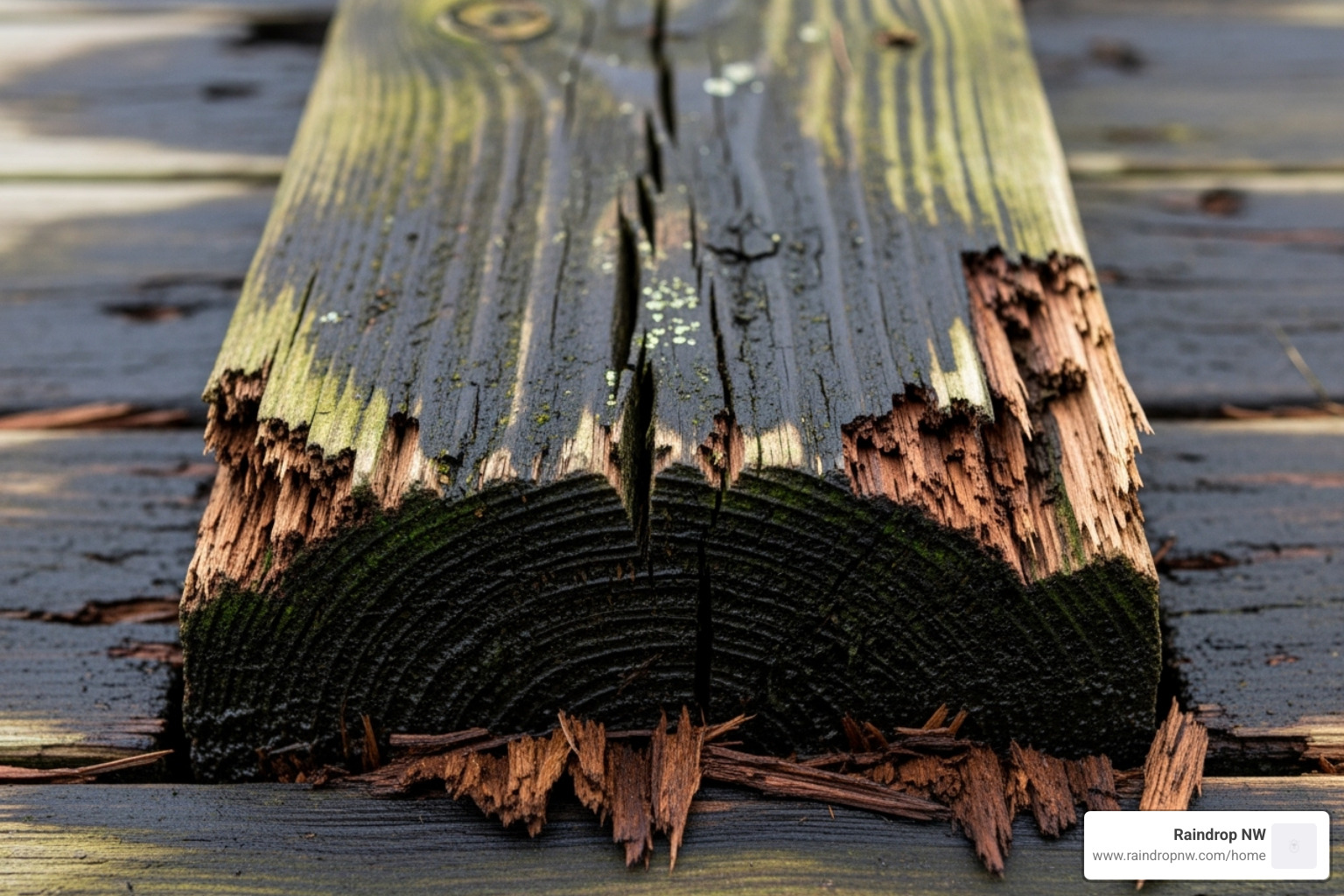
Waterproofing isn’t just about keeping the surface dry; it’s about protecting everything underneath. When you invest in quality waterproofing for your EPDM balconies, patios, and flat decks in first addition or renovation, you’re safeguarding your home’s structural integrity. We’ve seen what happens when this step is skipped: wood joists rot, support beams weaken, and water finds its way into rooms below, causing ceiling stains and insulation damage. What starts as a small issue can become a major repair project.
Traditional wood and composite decking materials are not waterproof and allow moisture to reach the structure beneath. A dedicated waterproofing membrane is essential to create a complete barrier. Proper waterproofing extends the life of your outdoor area, prevents safety hazards from weakened supports, and protects the living spaces below from water intrusion.
More info about our waterproofing services.
The Primary Benefits of EPDM Waterproofing
For EPDM balconies, patios, and flat decks in first addition or remodels, EPDM (Ethylene Propylene Diene Monomer) rubber membrane consistently outperforms other options in our climate. This tough synthetic rubber has been a top choice for flat roofing for decades, and its benefits translate perfectly to outdoor living spaces.
- Durability: A properly installed EPDM membrane can last 20 to 35 years or more, offering decades of reliable protection.
- Flexibility: EPDM remains flexible in extreme temperatures, moving with your home’s expansion and contraction without cracking or splitting. This is crucial during our region’s freeze-thaw cycles.
- Weather Resistance: It stands up to UV radiation, ozone, and the persistent moisture of Oregon weather without breaking down.
- Ponding Water Resistance: EPDM handles standing water without deteriorating, a key advantage for flat surfaces where perfect drainage isn’t always possible.
- Lightweight: The material adds protection without significant weight, typically eliminating the need for structural reinforcement.
- Fewer Seams: EPDM comes in large sheets, minimizing seams which are potential weak points in any waterproofing system.
Protecting Your Home’s Structure
Your deck’s ledger board, which connects it to your house, is highly vulnerable to moisture and rot. When this critical connection fails, the deck can sag or pull away, requiring major structural repairs. Support posts and joists face the same threat, as damp wood loses strength and creates safety concerns.
An EPDM waterproofing system stops this process by creating an impervious barrier that keeps water away from these critical structural elements. For second-story applications, this protection extends to the living spaces below, preventing interior damage. Effective waterproofing also directs water away from your home’s foundation, protecting your investment from top to bottom. Investing in quality EPDM waterproofing is preventive maintenance that protects your home’s value for decades.
Why EPDM is the Top Choice for Balconies, Patios, and Flat Decks
When waterproofing outdoor living spaces in Oregon, EPDM’s unique properties make it exceptionally well-suited for EPDM balconies, patios, and flat decks in first addition or renovation projects that require long-term performance.
Here’s how EPDM compares to other common single-ply membranes:
| Feature | EPDM | TPO | PVC |
|---|---|---|---|
| Composition | Synthetic rubber (Ethylene Propylene Diene Monomer) | Thermoplastic Polyolefin (blend of polypropylene & ethylene-propylene rubber) | Polyvinyl Chloride (thermoplastic) |
| Flexibility | Excellent, especially in cold temperatures | Good, can become less flexible in extreme cold | Good, but can become brittle in very cold climates |
| Seam Strength | Adhesively seamed, strong with proper technique | Heat-welded, very strong, requires skilled labor | Heat-welded, strongest seams, requires skilled labor |
| UV Resistance | Excellent, maintains properties over time | Good, can vary with formulation | Excellent, highly stable |
| Puncture Resistance | Good, but requires protective layer for foot traffic | Good, but variability in formulations | Excellent, very strong (350+ psi) |
| Lifespan | 20-35+ years | 10-20 years (variability noted) | 20+ years |
| Cost | Generally lowest per square foot | Mid-range | Higher |
| Installation | Adhered (fully or mechanically) | Heat-welded, mechanically fastened | Heat-welded, mechanically fastened |
| Recyclability | Limited | Recyclable | Recyclable |
EPDM’s superior flexibility in cold weather is what truly sets it apart for the Pacific Northwest climate. It handles our frequent freeze-thaw cycles without cracking or splitting, a common failure point for more rigid materials.
EPDM (Ethylene Propylene Diene Monomer)
EPDM is a synthetic rubber membrane known for its elasticity and decades of proven performance. This flexibility allows it to move with a building’s natural expansion and contraction, maintaining a continuous waterproof barrier that doesn’t crack or pull apart. Its long track record provides confidence in its durability. The seam adhesive technology has been refined over years, creating bonds as strong as the membrane itself when applied by a professional.
Key Features for Outdoor Living Spaces
EPDM offers several key advantages for EPDM balconies, patios, and flat decks in first addition or other residential projects:
- Seamless Waterproofing: EPDM is available in large sheets, allowing for installations with minimal seams. Fewer seams mean fewer potential weak points and a more reliable waterproof barrier.
- Puncture Resistance: While not meant for direct foot traffic, EPDM provides a robust barrier under a protective surface (like deck boards or pavers) that resists tears and punctures.
- UV Stability: EPDM is formulated to withstand prolonged sun exposure without becoming brittle or degrading, which is why it can last 20-35+ years.
- Performance in Cold Climates: EPDM stays flexible in freezing weather, which is crucial during our freeze-thaw cycles. It flexes with temperature changes, maintaining its seal and protecting your deck structure year-round.
- Color Options: While traditional black EPDM is ideal under deck boards, white EPDM is available for exposed applications to minimize heat absorption.
Learn more about our waterproof deck surface services and how we can protect your outdoor living space with professional EPDM installation.
The Anatomy of a Bulletproof EPDM Deck System
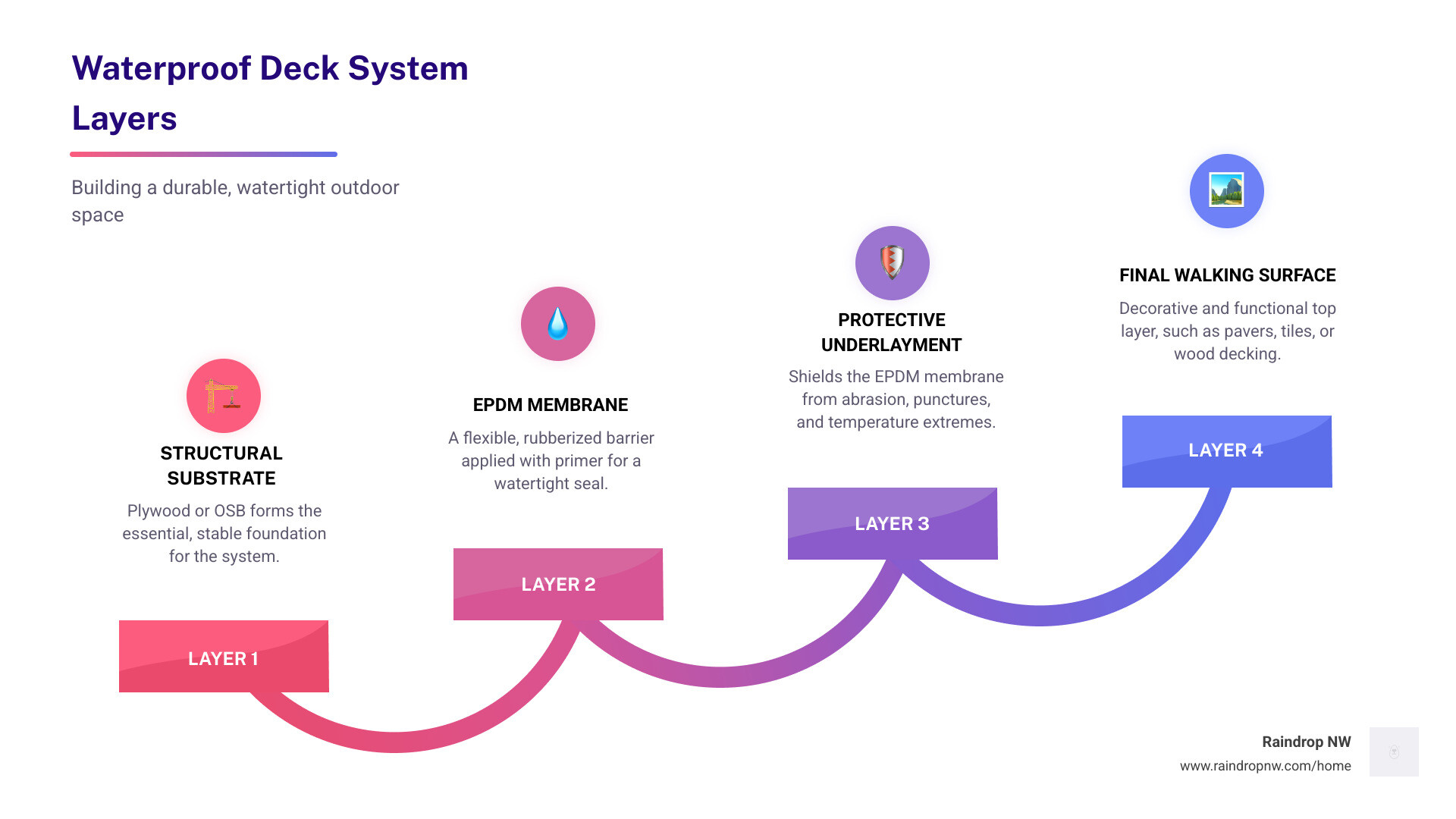
Creating a waterproof deck with EPDM is a systematic process where each component is vital. When we install EPDM balconies, patios, and flat decks in first addition or remodel projects, we focus on every layer to ensure the system is impenetrable.
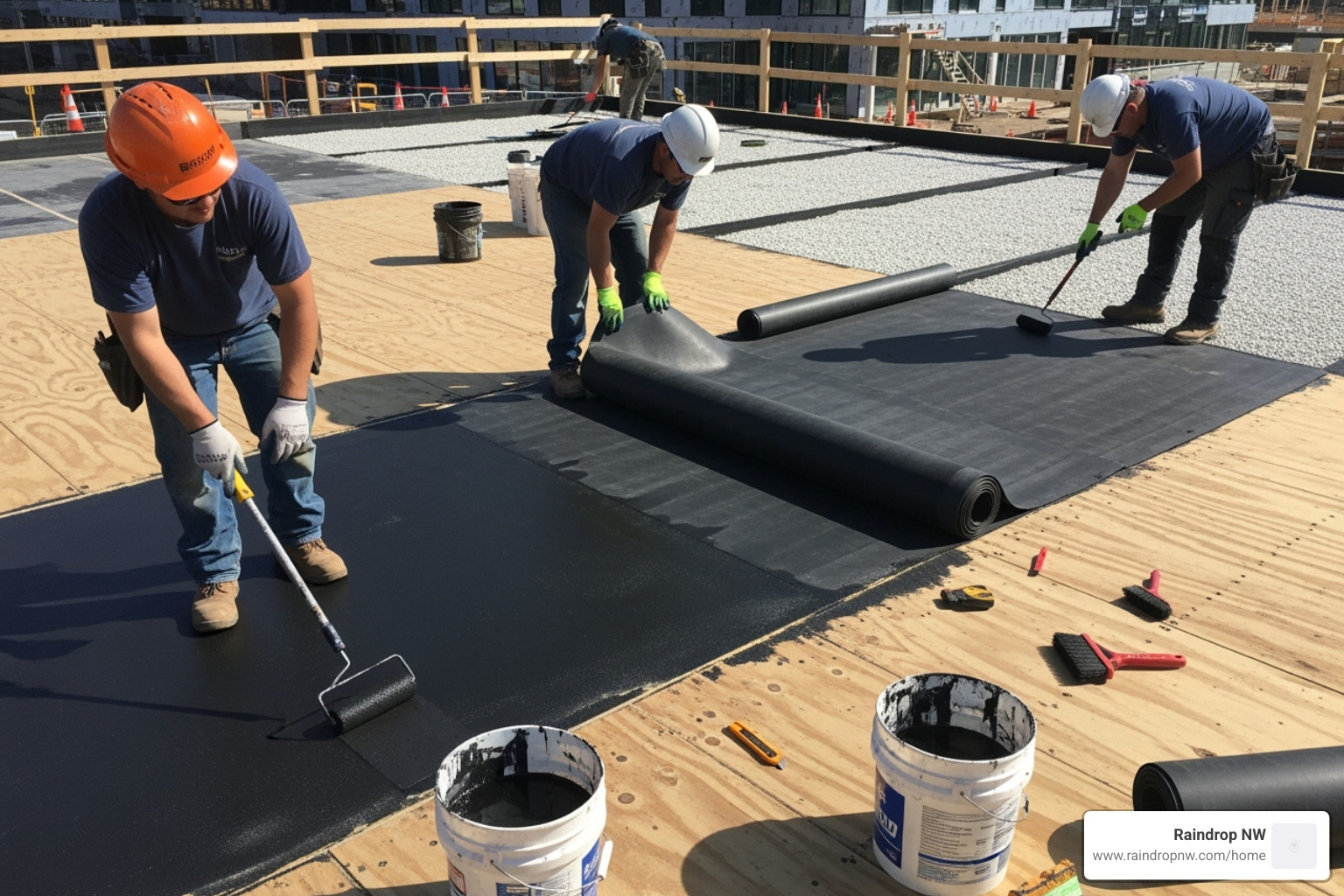
An EPDM deck system is like a multi-layered shield. It starts with preparing the substrate, followed by primers, adhesives, the EPDM membrane, and a protective walking surface. Professional installation is key, as getting each layer right is what ensures a deck will last for decades.
Learn more about our EPDM waterproofing services.
Essential System Components
A durable EPDM deck system relies on these key materials:
- Clean, Prepared Substrate: The foundation (plywood, OSB, or concrete) must be clean, dry, and smooth for the adhesive to bond correctly.
- Bonding Adhesive: This specialized glue creates a permanent bond between the substrate and the EPDM membrane, preventing water from migrating underneath.
- EPDM Rubber Membrane: The primary waterproof barrier, available in different thicknesses (e.g., 60-mil or 90-mil) depending on the deck’s expected use.
- Seam Tape and Primer: These products create strong, watertight bonds where EPDM sheets meet, making the seams as durable as the membrane itself.
- Flashing: Used to seal perimeters and penetrations (like posts), preventing water entry at vulnerable transition points.
- Termination Bars and Mastic: These components secure the EPDM membrane at vertical terminations (like up a wall) and create a final watertight seal.
How the Layers Work Together
When integrated, these components form a single, monolithic barrier. The EPDM membrane is fully adhered to the prepared substrate, creating a second skin for your deck. Seams are chemically welded with primer and tape, eliminating weak points. This seamless approach is why EPDM is so effective for EPDM balconies, patios, and flat decks in first addition or renovations.
Adhesion prevents water from traveling underneath the membrane, so any potential breach remains localized. Penetrations for posts or pipes are carefully sealed with custom flashing. Finally, we incorporate a slight slope (at least 1/4 inch per foot) to ensure positive drainage, directing water efficiently off the surface. This multi-layered, integrated system provides comprehensive, long-lasting protection.
Best Practices for EPDM Balconies, Patios, and Flat Decks in First Addition OR
Installing an EPDM membrane in Oregon requires following proven techniques to ensure flawless performance for decades. Getting the details right is what separates a protective deck from a future problem.
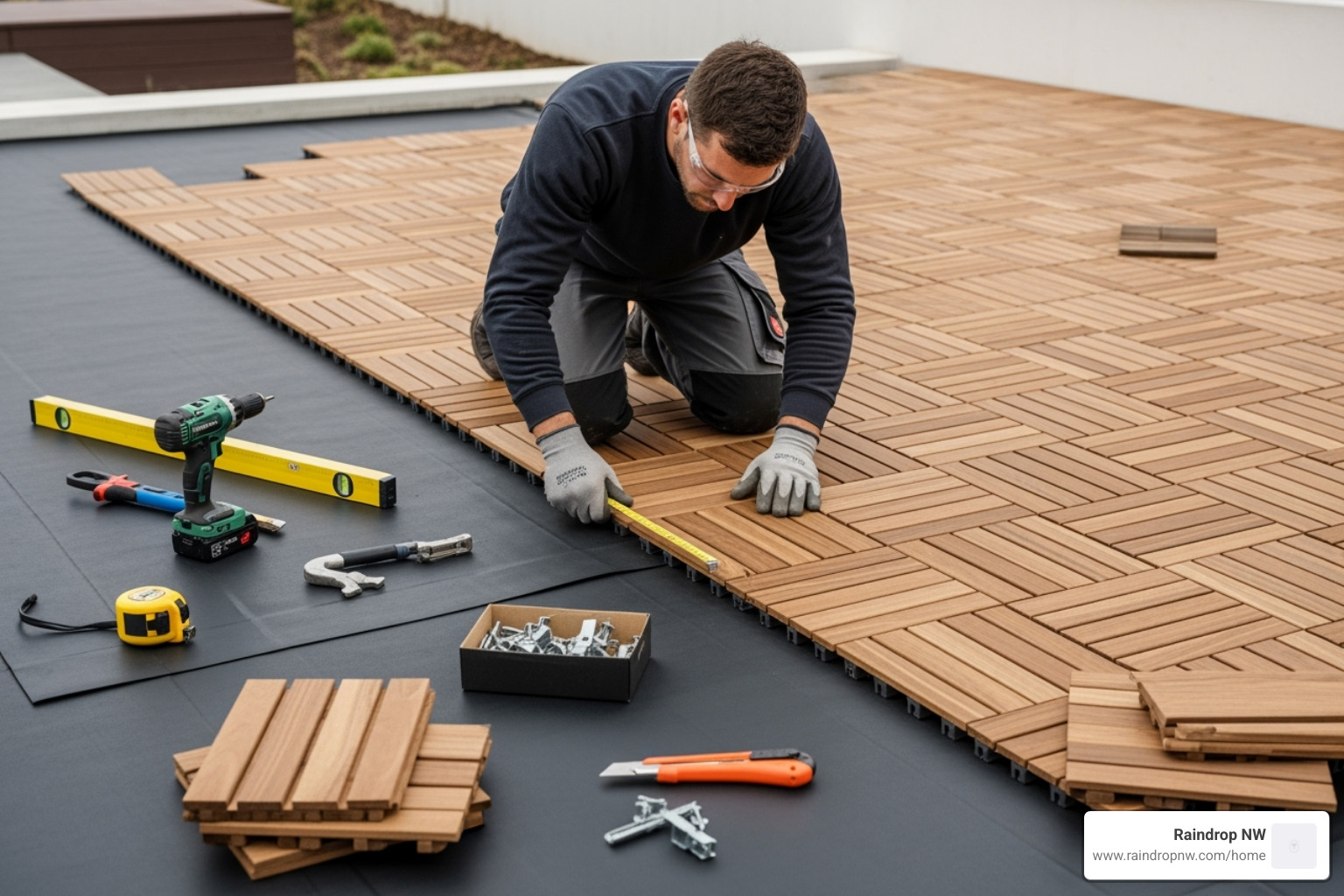
The foundation of a successful installation is proper slope and drainage. “Flat” decks should always have a minimum slope of 1/4 inch per foot to ensure water flows away efficiently. Flashing details are also critical, creating watertight barriers where the deck meets a wall or wraps around a post.
How to Frame a Deck Over an EPDM Roof | Part 1 – YouTube
More info about new roof replacements.
Proper Installation for Maximum Longevity
The lifespan of your EPDM membrane depends entirely on the quality of the installation. For EPDM balconies, patios, and flat decks in first addition or projects, proper installation involves:
- Surface Preparation: The substrate must be perfectly clean, dry, and smooth. Any debris or sharp edges can compromise the membrane.
- Allowing the Membrane to Relax: EPDM is unrolled and left to acclimate for at least 30 minutes to prevent wrinkles and tension.
- Correct Adhesive Application: Bonding adhesive is applied evenly to both the substrate and the membrane, then allowed to “flash off” until tacky before bonding.
- Removing Air Bubbles: A broom or roller is used to apply firm pressure, ensuring full contact and a strong, uniform bond.
- Ensuring Seam Integrity: Seams are cleaned, primed, and sealed with specialized tape under firm pressure to create a bond as strong as the membrane itself.
Installing Decking Over An EPDM Membrane | Rubber4Roofs.
Mitigating Challenges When Installing Decking Over EPDM Balconies, Patios, and Flat Decks in First Addition OR
Installing a walking surface over EPDM requires care to avoid damaging the waterproofing. The primary challenge is abrasion protection. Deck supports rubbing against the EPDM can cause wear over time. We prevent this by placing a protective barrier, like rubber pads or extra EPDM strips, between the membrane and any decking components.
- Floating Deck Systems: The deck structure rests on the EPDM without any fasteners penetrating the membrane, keeping the waterproofing intact.
- Pedestal Systems: Adjustable pedestals support joists or pavers, allowing for excellent drainage and air circulation underneath while making it easy to level the surface.
- Sleeper Systems: Wood sleepers must be properly spaced and protected on their undersides to prevent friction and allow for ventilation.
Choosing the Right EPDM for High-Traffic vs. Low-Traffic Decks
We match the EPDM membrane to your specific needs for EPDM balconies, patios, and flat decks in first addition or homes.
- 60-mil EPDM: Provides excellent durability for most residential decks with typical foot traffic.
- 90-mil EPDM: A thicker membrane offering improved puncture resistance, ideal for high-traffic areas or commercial applications.
- Fleece-backed EPDM: Features a fleece underside for increased puncture resistance and improved adhesion, making it a great option for added durability.
Long-Term Performance and Maintenance of Your EPDM Deck
One of the best reasons to choose EPDM for your EPDM balconies, patios, and flat decks in first addition or remodel is its exceptional long-term performance. A properly installed EPDM system has a lifespan of 20-35 years, making it a true set-it-and-forget-it solution.
This longevity is invaluable in Oregon’s climate. EPDM’s flexibility allows it to endure freeze-thaw cycles without cracking, while its UV resistance prevents it from degrading under the sun. It performs reliably year after year, providing peace of mind and significant long-term savings by avoiding frequent repairs or premature replacement.
More info about roof repairs and maintenance.
Simple Maintenance for Decades of Use
While EPDM is incredibly durable, simple routine care will maximize its lifespan.
- Regular Cleaning: Periodically sweep or rinse off leaves, dirt, and other debris to prevent organic matter from holding moisture against the membrane.
- Debris Removal: After storms, remove any large branches or objects that could puncture or abrade the surface.
- Annual Inspections: Once a year, visually inspect exposed seams and flashing for any signs of lifting or damage.
- Check for Punctures: If you have a deck surface installed over the EPDM, occasionally check for damage from sharp objects.
- Look for Signs of Wear: Keep an eye out for excessive chalking or thinning. If you notice soft or spongy areas on your deck, it indicates a need for immediate professional inspection.
Environmental and Sustainability Aspects
EPDM offers several sustainability advantages. Its manufacturing process requires relatively low energy, and the material itself is recyclable, reducing landfill waste.
Most importantly, EPDM’s long service life reduces waste. A membrane that lasts 20-35+ years means fewer replacements, less material consumption, and less construction waste over the long term. For exposed applications, white EPDM membranes can reflect sunlight, reducing cooling costs and mitigating the urban heat island effect. Choosing EPDM for your EPDM balconies, patios, and flat decks in first addition or project is a practical and responsible choice that combines durability with sustainability.
Frequently Asked Questions about EPDM Decks
When considering waterproofing for EPDM balconies, patios, and flat decks in first addition or remodel projects, homeowners often have questions. Here are straightforward answers to the most common ones.
How long does an EPDM membrane last on a balcony or patio?
A properly installed EPDM membrane can be expected to last 20 to 35+ years. Longevity depends on the quality of the installation, the materials used, and simple routine maintenance. Its excellent UV resistance allows it to hold up for decades, and most manufacturers provide substantial warranties for added peace of mind.
Can you walk directly on an EPDM membrane?
No, EPDM is not designed to be a direct walking surface. While tough, regular foot traffic, sharp objects, or dragging furniture can cause abrasion or punctures over time. EPDM should always be installed as an underlayment protected by an overlay. This protective layer can be wood decking on sleepers, pavers on pedestals, or composite deck tiles, which provide a durable and attractive surface for daily use.
How does EPDM compare in value to traditional wood decking?
It’s best to think of EPDM and wood decking as serving two different functions. Traditional wood decking is a surface, whereas EPDM is a waterproofing system that offers exceptional long-term value.
- Lifespan: An EPDM membrane will last 20-35+ years, often outliving the wood or composite decking installed over it. A wood deck alone may need replacement in 10-15 years.
- Maintenance: Wood decks require constant staining and sealing. The EPDM layer beneath is virtually maintenance-free.
- Protection: This is the key difference. Wood decking is not waterproof and allows water to reach the structure below. EPDM creates an impermeable barrier, protecting your home’s joists, ledger board, and the rooms below from costly water damage.
While there is an upfront cost to including EPDM, it’s a cost-effective investment that prevents expensive structural repairs and extends the life of your entire outdoor living area.
Secure Your Outdoor Oasis for Years to Come
It’s clear that choosing EPDM for EPDM balconies, patios, and flat decks in first addition or any outdoor living space is a smart investment in your home. EPDM is a proven shield against the relentless Pacific Northwest weather, offering exceptional durability, flexibility, and weather resistance.
However, even the best material requires professional installation to perform correctly. Every detail, from substrate preparation to seam sealing, is critical for ensuring a 30+ year lifespan. This is the difference between long-term peace of mind and future headaches.
At Raindrop NW, we are your neighbors in Beaverton, Portland, and the surrounding areas. We are a truly local, independently owned company, not an out-of-state investment firm. We are committed to building relationships that last as long as the decks we install.
When you work with us, you get a team that cares about protecting your home. We take pride in getting every detail right, from proper drainage to meticulous flashing. Your outdoor space should be for relaxation, not a source of worry about water damage.
With a professionally installed EPDM system, you can enjoy your deck, patio, or balcony without wondering what’s happening underneath. We’ve seen how the right waterproofing solution transforms how families enjoy their homes, and we want to bring that same impact to your project.
Ready to protect your outdoor oasis the right way? Learn more about our residential roofing solutions and find out how we can create a waterproof deck system that performs beautifully for decades.