
The Definitive Guide to Choosing a Truly Local Roofing Contractor
Why So Many Oregon Homeowners Are Rethinking Who They Hire for Their Roof
Choosing a truly local roofing contractor in Beaverton and the greater Portland metro has never felt more urgent — or more complicated. In recent years, roofing companies across the country have been quietly acquired by private equity firms and national chains, leaving homeowners with a contractor whose name says “local” but whose ownership, accountability, and warranty support are anything but. After a storm rolls through, the stakes get even higher. Door-knocking crews with out-of-state plates flood neighborhoods, offer fast quotes, then disappear before the ink on the warranty is dry.
Here’s a quick look at how to tell the difference between a truly local roofing contractor and one that just markets itself that way:
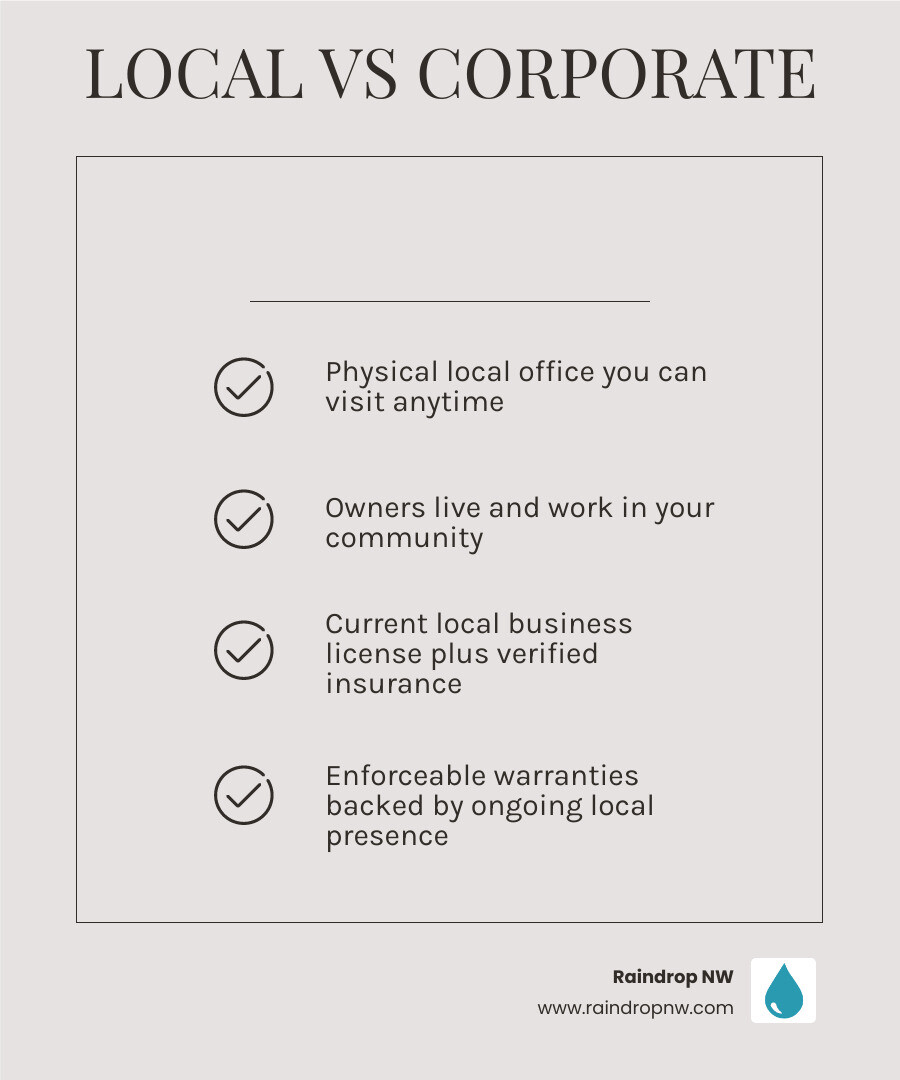
- They have a verifiable physical office in your community — not just a P.O. box or a shared coworking address.
- The owners live and work locally — they’re your neighbors, not regional managers reporting to a corporate headquarters.
- They hold a current Oregon business license and carry general liability and workers’ compensation insurance you can verify.
- They have a real track record in your area — references from homeowners in Beaverton, Portland, or surrounding communities.
- They understand local building codes and weather patterns — including Oregon’s wet winters, wind-driven rain, and moss-prone rooflines.
- Their warranties are enforceable — because they’ll still be in business next year, and the year after that.
- They’re involved in the community — through local trade associations, volunteer work, or neighborhood projects that go beyond a logo on a truck.
The uncomfortable truth is that many homeowners don’t discover a contractor wasn’t truly local until something goes wrong — a leak returns, a warranty claim goes unanswered, or the company’s phone number is suddenly disconnected. By then, the cost of that mistake falls entirely on you.
This guide walks you through exactly what to look for, what to ask, and what to watch out for when hiring a roofing contractor in the Portland metro area — so you can protect your home, your investment, and your peace of mind.
I’m Torrey Yungeberg, owner of Raindrop Roofing NW, a family-owned business rooted right here in Oregon, and choosing a truly local roofing contractor is something I’ve spent years helping homeowners understand — because I’ve seen what happens when that decision goes wrong. As Secretary of both the Oregon Chapter of National Women in Roofing and the Associated Roofing Contractors of Oregon and Southwest Washington, I bring not just field experience but a deep commitment to raising the standard of accountability in our industry.
Why Locality Matters: The Benefits of Choosing a Truly Local Roofing Contractor
When you invest in a new roof or a major repair, you are not just purchasing shingles and nails; you are purchasing a promise of long-term protection. This is where the difference between national corporate chains and independent local roofers becomes incredibly clear.
Keeping Your Dollars in the Pacific Northwest
When you hire a business that is genuinely rooted in our community, your investment has a powerful ripple effect. Research shows that local businesses return $0.68 of every dollar spent back into the local economy, compared to just $0.43 for national chains. Those dollars help fund our local schools, support neighborhood programs, and create stable, family-wage jobs right here in Beaverton, Tigard, Hillsboro, and Portland.
By contrast, national chains and private-equity-backed corporations funnel their profits out of Oregon to out-of-state headquarters or investor groups. They also tend to spend up to three times more on aggressive national marketing campaigns. Those massive advertising budgets do not improve the quality of your roof—but they do increase the overhead costs that are ultimately passed on to you.
Unmatched Response Times and Accountability
If a severe windstorm hits the Willamette Valley or an unexpected leak develops in the middle of a wet November night, you cannot afford to wait for a corporate call center to route your request. Homeowners who hire local contractors report 25% faster response times for repairs and warranty claims compared to national companies.
Because we work, live, and raise our families in the same neighborhoods we serve, our reputation is on the line with every single job. This community presence creates a level of personal accountability that a distant corporation simply cannot replicate. Over 70% of homeowners state they prefer hiring local contractors due to this superior accountability and community reputation. To learn more about how independent operations differ from corporate networks, read about the Benefits of Choosing a Truly Local Independent Roofer.
Climate-Specific Expertise
A roofing system that works perfectly in the dry heat of Arizona or the mild climate of Southern California will quickly fail under the constant moisture and seasonal freeze-thaw cycles of Western Oregon. Truly local contractors possess deep, knowledge of how regional weather patterns affect different materials. We know how to design ventilation systems that prevent attic moisture buildup during our damp winters, how to install robust ice and water barriers to protect valleys, and which materials resist the moss and algae growth common to shaded properties in Lake Oswego, West Linn, and Sherwood.
Long-Term Warranty Protection
A warranty is only as reliable as the company standing behind it. Local roofing companies are 40% more likely to honor long-term warranties because they remain in the community year after year. If an issue arises five or ten years down the road, you can walk right into our office or call a local number to get it resolved.
| Feature | Truly Local Independent Contractor | National Chain / PE-Backed Firm |
|---|---|---|
| Primary Focus | Quality craftsmanship & community reputation | Volume, rapid growth, and profit margins |
| Economic Impact | Returns $0.68 of every dollar to the local economy | Returns only $0.43 of every dollar locally |
| Warranty Reliability | 40% more likely to honor long-term warranties | High risk of unfulfilled claims if local branch closes |
| Response Times | 25% faster response for emergencies & repairs | Delayed by out-of-state corporate scheduling |
| Marketing Overhead | Low to moderate (relies heavily on local referrals) | Up to 3x higher (costs passed to the homeowner) |
| Local Knowledge | Expert in NW rain, moss prevention, and CCB codes | Standardized national practices |
How to Verify a Contractor’s Local Presence and Legitimacy
With so many companies using clever digital marketing to appear “local,” homeowners must take active steps to verify a contractor’s physical and legal presence before signing any agreement.

1. Verify a Physical Commercial Address
A legitimate local contractor will have a physical office, warehouse, or showroom in the area. Be wary of companies that list a P.O. Box, a UPS Store address, or a virtual coworking space as their primary location. Take a moment to search the address on Google Maps. Is it a real commercial building with company signage and service vehicles, or is it a residential home or a shared mailbox center?
2. Check the Oregon Construction Contractors Board (CCB) License
In Oregon, every professional residential and commercial roofing contractor must be licensed with the Construction Contractors Board (CCB). This is one of your strongest consumer protection tools.
- Go to the Oregon CCB website and search the contractor’s business name or license number.
- Confirm that the license status is “Active.”
- Check the “LBL” (Licensed Business License) history. A truly local company will have a consistent, long-standing license history under the same name.
- Verify that the company’s listed address on the CCB matches their marketing materials.
Reviewing a contractor’s licensing history can tell you a lot about their stability and business practices. For a detailed breakdown of why this matters, read How Consistent Licensing Protects Past and Future Customers.
3. Verify a Local Phone Number and Tax ID
A truly local contractor will have a local area code (such as 503 or 971) and a local business registry with the state of Oregon. If the only way to contact a company is through an 800-number or an online chat system managed by a third party, it is highly likely you are dealing with a national broker or a regional corporate entity rather than a local business owner.
Red Flags When Choosing a Truly Local Roofing Contractor
Vetting a contractor also means knowing what warning signs to watch out for. When choosing a truly local roofing contractor, keep an eye out for these common red flags:
- The Post-Storm Influx (Storm Chasers): After a severe windstorm or hailstorm in the Portland metro area, out-of-state roofing companies often flood the market. They use temporary local addresses, hire untrained local subcontractors, and use high-pressure sales tactics to sign up as many homeowners as possible. Once the storm season passes, they pack up and move to the next state, leaving you with no way to enforce your workmanship warranty.
- High-Pressure Sales Tactics: Avoid sales representatives who push you to sign a contract immediately, demand a large cash deposit on the spot, or claim that a special discount is only available if you sign today. A reputable local contractor will provide a detailed, written proposal and give you the time you need to review it.
- Vague or Incomplete Proposals: A professional contract should never fit on a single, vague page. It must clearly outline the exact materials to be used (including brand and type), the scope of work (such as decking replacement, underlayment, flashing, and ventilation), the project timeline, cleanup practices, and payment terms.
- Lack of Local References: If a contractor cannot provide a list of recently completed projects and references from homeowners in your immediate area—whether that is Beaverton, Tigard, Hillsboro, or Portland—they likely do not have deep roots in the community.
If you want to protect your investment and avoid common industry traps, take a look at our guide on how to Don’t Get Ripped Off: How to Find Top Rated Roof Replacement in Beaverton.
Key Credentials and Standards to Evaluate Before Hiring
To ensure your home is in safe hands, always request and verify the following credentials before any work begins on your property.
Active Liability and Workers’ Compensation Insurance
Roofing is inherently high-risk work that involves heights, heavy materials, and specialized power tools. If an uninsured worker is injured on your property, or if your home suffers structural water damage during a roof tear-off, you could be held financially liable.
- General Liability Insurance: Protects your property from damage caused by the contractor’s work.
- Workers’ Compensation Insurance: Covers medical expenses and lost wages for crew members if they are injured on the job.
Do not simply take a contractor’s word that they are insured. Request a copy of their Certificate of Insurance (COI) and call the insurance agency listed on the certificate to confirm that the policy is active and covers roofing operations. To understand how these credentials protect your property, see How to Choose the Right Roofing Contractor.
Manufacturer Certifications
The highest-quality roofing materials in the world can still fail if they are installed incorrectly. Leading manufacturers—such as GAF, Owens Corning, and CertainTeed—only grant certified status to a small percentage of contractors who meet strict standards for ongoing training, financial stability, and installation quality.
Hiring a certified contractor ensures your roof is installed according to strict manufacturer specifications, which also allows you to access extended, non-prorated manufacturer warranties that cover both materials and labor.
Essential Questions for Choosing a Truly Local Roofing Contractor
Before making your final hiring decision, schedule a consultation and ask these critical questions to gauge a contractor’s professionalism, quality control, and long-term commitment:
- Who will supervise my project on-site every day?
- What to look for: A reputable contractor will assign a dedicated, English-speaking job site supervisor or project manager to monitor quality control, manage the crew, and answer your questions throughout the installation process.
- What steps will you take to protect my property and landscaping?
- What to look for: The contractor should explain how they will protect your gutters, siding, windows, and landscaping using tarps, plywood, and specialized debris-containment systems, as well as how they will sweep your yard with magnetic nails sweeps after completion.
- What is covered under your workmanship warranty, and how long does it last?
- What to look for: A manufacturer’s warranty only covers material defects. You need a written workmanship warranty from the contractor that covers installation errors. Ensure this warranty is clearly documented in your contract.
- Who owns your company, and where do they live?
- What to look for: Ensure the business is independently owned by individuals who live and work in the local community, rather than being owned by an out-of-state investment firm or national conglomerate. For more context on why independent ownership matters for your warranty support, read Choosing a Roofing Company That Won’t Sell Out.
Frequently Asked Questions About Local Roofers
How do I verify if a roofing company is actually local to Beaverton?
To confirm a company is genuinely local, check their physical commercial address on Google Maps to ensure it is a real local office or warehouse rather than a virtual address or P.O. Box. Verify their business registry and active license status on the Oregon Construction Contractors Board (CCB) website, ensuring their listed address matches their local marketing. Finally, look for evidence of deep community roots, such as local sponsorships, membership in regional trade associations, and a long list of local references.
What is the difference between a manufacturer warranty and a workmanship warranty?
A manufacturer warranty covers defects in the physical roofing materials (such as shingles cracking or degrading prematurely), but it does not cover installation mistakes. A workmanship warranty is provided directly by your local contractor and covers installation-related issues (such as leaks caused by improper flashing, poor ventilation, or incorrect fastening). To get complete protection, you need both a strong manufacturer warranty and a written workmanship warranty from a stable, local contractor.
Why do storm-chasing roofing companies disappear after a major storm?
Storm-chasing companies operate on a high-volume, rapid-migration business model. They travel across the country following severe weather patterns, setting up temporary local operations to sign up as many insurance claims as possible. Because they rely on temporary, outsourced crews and prioritize speed over quality, their installations often suffer from major defects. Once local demand drops off, they close their temporary offices and move to the next storm zone, leaving homeowners with no local contact to address leaks or honor workmanship warranties.
Conclusion
Choosing a roofing contractor is one of the most significant investments you will make in your home’s structural integrity, safety, and long-term market value. While national chains and private-equity-backed firms may have massive marketing budgets, they simply cannot match the personal accountability, climate-specific expertise, and long-term community commitment of a truly local, independent contractor.
At Raindrop NW, we are proud to be a multi-generational, family-owned roofing company based right here in Beaverton, Oregon. We serve our neighbors throughout Portland, Tigard, Hillsboro, Lake Oswego, and the surrounding communities with a commitment to honest communication, certified craftsmanship, and reliable, long-term service. We live in the communities we serve, and we stand behind every roof we install.
If you are ready to experience the peace of mind that comes with working with a truly local, independent roofing partner, we invite you to reach out to our team today.




Trackbacks & Pingbacks
[…] in How to Verify a Roofer’s License and Insurance and understand why local matters in Choosing a Truly Local Roofing Contractor. You can also compare your options in Local Independent Roofer vs Corporate Chain Comparison, Why […]
Leave a Reply
Want to join the discussion?Feel free to contribute!