
The Independent Edge: What It Means to Say No to Investor Buyouts
Why Your Roofer’s Ownership Structure Is the First Thing to Check
Choosing a roofing company that won’t sell out is one of the most important decisions you’ll make as a homeowner — and in 2026, it’s more complicated than it used to be.
Here’s a quick answer if you need it now:
- Verify local, independent ownership — look for a physical address and community ties
- Check for 5+ years of local experience and familiarity with Oregon building codes
- Confirm licensing, general liability, and workers’ compensation insurance
- Look for manufacturer credentials (such as GAF credentials, held by only 2% of roofers)
- Read recent reviews on Google and BBB — patterns matter more than averages
- Get at least three written, line-item proposals before committing
- Avoid companies with high-pressure tactics, no physical address, or vague contracts
Too many Oregon homeowners have been through this: they hire a roofing company that seemed solid, only to find out months later that the business was bought out by an out-of-state investment firm. The crew changes. The warranty becomes impossible to claim. The local contact number stops working. The roofing industry is, as one industry guide put it, “one of the most complained-about home improvement trades” — and corporate consolidation is making that problem worse, not better.
This isn’t just about customer service. It’s about what happens when a significant investment in your home — your roof — is backed by a company that has no real stake in your community, your neighborhood, or your long-term satisfaction.
I’m Torrey Yungeberg, owner of Raindrop Roofing NW, a family-owned business based in Beaverton, Oregon, and I’ve built this company around the belief that choosing a roofing company that won’t sell out starts with choosing one that was never for sale in the first place. In this guide, I’ll walk you through exactly what to look for, what to avoid, and how to protect your home investment for the long haul.
Why choosing a roofing company that wont sell out Matters in 2026
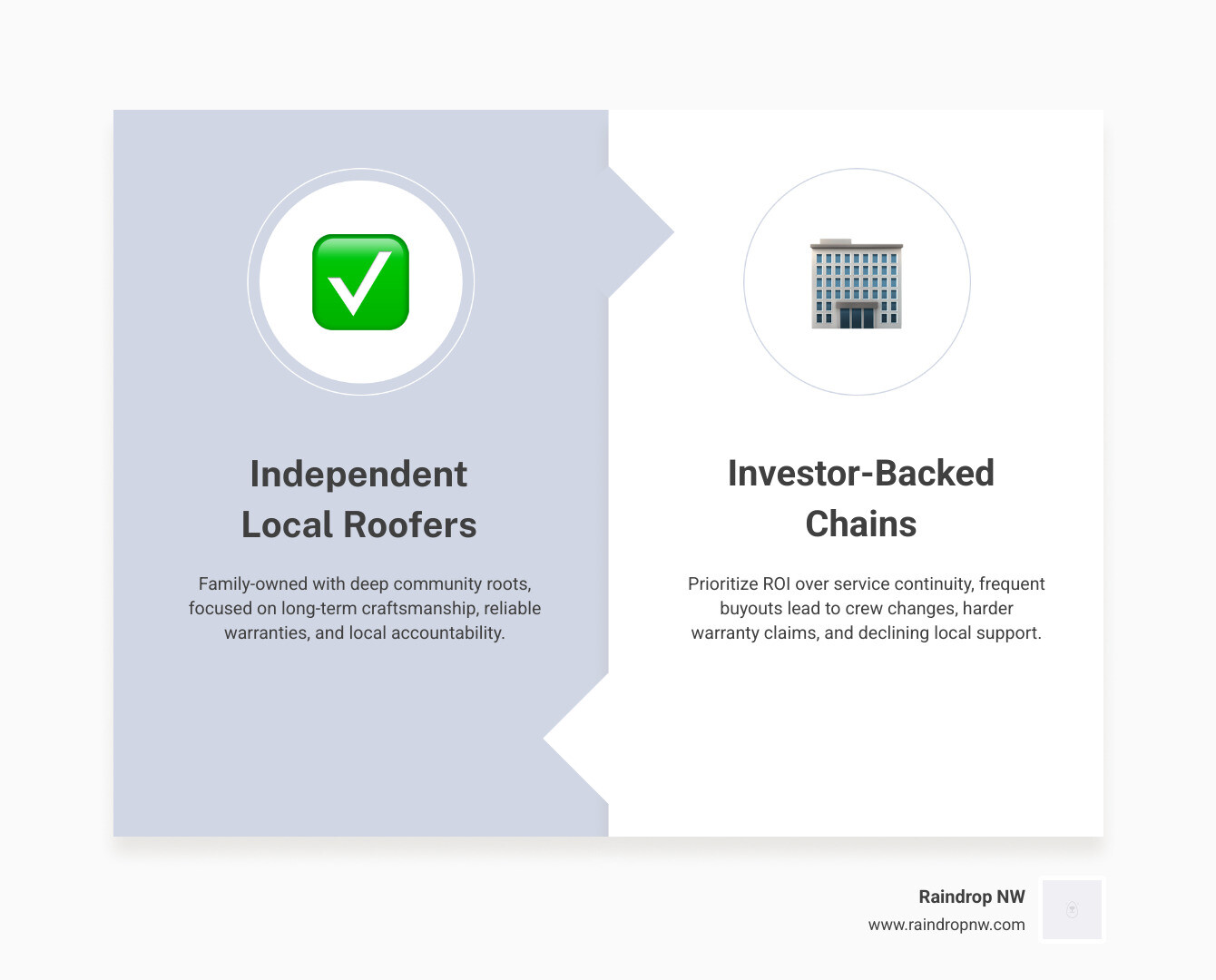
As we move through April 2026, the roofing landscape in the Pacific Northwest has shifted. Private equity firms and out-of-state investment groups are buying up local contractors at a record pace. While this might look like “growth” on a balance sheet, for you as a homeowner in Beaverton or Portland, it often means a decline in service continuity.
When a local company sells out, the primary goal shifts from craftsmanship to “Return on Investment” (ROI). The multi-generational expertise that built the brand is often replaced by standardized corporate processes designed to maximize profit. This matters because a roof isn’t just a product; it’s a long-term commitment. If your contractor is sold to a firm in another state, who is accountable when a leak appears three years from now?
Independent companies maintain a deep community commitment. We live where we work. Our reputation isn’t managed by a corporate PR team in a different time zone; it’s built at the local grocery store and through word-of-mouth in our neighborhoods. Choosing an independent roofer ensures that the person who stands behind the warranty today will still be there to honor it tomorrow.
More info about residential roofing services
Spotting the Red Flags of Corporate-Owned Roofing Chains
Identifying a corporate-owned chain isn’t always easy—they often keep the original local name to maintain a “hometown” feel. However, their internal culture usually gives them away through high-pressure sales and aggressive closing techniques.
If a salesperson sits at your kitchen table and refuses to leave without a signed contract, or offers a “today-only” discount that expires the moment they walk out the door, you are likely dealing with a corporate entity focused on volume over value. These companies often use commission-based sales reps who may not have any actual roofing experience. Their job is to sell, not to solve your roof’s specific problems.
Another red flag is the “vague proposal.” A corporate chain might give you a lump-sum price with very few details. This lack of transparency is often intentional, allowing them to swap in cheaper materials or skip critical steps like replacing old flashing to protect their profit margins.
More info about new roof replacement
Common Corporate Upselling Tactics
- The “Free” Upgrade Myth: Offering a “free” upgrade to a specific brand of underlayment that actually costs the company very little, while ignoring more expensive needs like attic ventilation.
- Minimizing Real Issues: Downplaying signs of attic mold or structural rot because addressing them would slow down their high-speed installation schedule.
- Brand Obsession: Pushing one specific manufacturer’s shingle without explaining why it’s right for the NW Oregon climate, usually because they get a corporate kickback for high-volume orders.
- The Deductible Waiver: Claiming they can “waive” or “absorb” your insurance deductible. This is not only a red flag for fraud but can also jeopardize your entire insurance claim.
Red Flags When choosing a roofing company that wont sell out

When you are choosing a roofing company that won’t sell out, keep a sharp eye out for these structural red flags:
- No Physical Address: If the company only lists a P.O. Box or a virtual office, they lack the local roots required for accountability. A legitimate roofer has a yard, a warehouse, and a local office you can visit.
- Lack of Local References: A company that has “sold out” might have thousands of generic online reviews, but can they give you the addresses of three roofs they replaced in Beaverton or Hillsboro in the last six months?
- Subcontracting Risks: Many national chains sell the job and then “flip” it to the lowest-bidding subcontractor. This creates a massive gap in quality control. You want a company that uses consistent, vetted crews who follow the same high standards on every job.
- The “Storm Chaser” Profile: These are companies that move into an area after a major Oregon wind or hail storm, use aggressive sales tactics to grab insurance checks, and disappear before the first rainy season hits.
The Benefits of Local, Independent Craftsmanship in NW Oregon
In the Pacific Northwest, roofing is a specialized craft. Our weather—ranging from relentless winter rain to scorching summer sun—requires a specific approach to ventilation and moisture barriers. A corporate office in the Midwest might use the same “standard” installation manual for a house in Portland as they do for one in Phoenix. That is a recipe for disaster.
Local, independent roofers in Beaverton and the Portland-Metro area understand regional building codes and weather challenges intimately. We know that in our climate, underlayment and ventilation are actually more critical to your roof’s lifespan than the shingles themselves.
Multi-generational expertise means we’ve seen how different materials perform over 20 or 30 years in this specific environment. We aren’t just following a corporate script; we are applying decades of local knowledge to ensure your home stays dry.
More info about roof types and products
How to Verify Legitimacy and Protect Your Investment
Don’t take a salesperson’s word for it. Protecting your investment requires active verification. In the roofing industry—which can be unfortunately scam-heavy—due diligence is your best defense.
Start with the basics: Licensing and Insurance. A reputable contractor must carry general liability insurance and workers’ compensation. Without these, you as the homeowner could be held liable for injuries that happen on your property. Don’t just look at a piece of paper; call the insurance provider directly to verify the policy is active and has adequate coverage (typically at least $1 million).
Next, look for manufacturer certifications. For example, only 2% of roofers nationwide qualify for GAF’s top-tier certifications. These credentials aren’t just badges; they indicate the company has undergone rigorous training and can offer enhanced warranties that non-certified installers simply cannot provide.
More info about roof inspections and certifications
Verification Steps for choosing a roofing company that wont sell out
- State License Lookup: Visit the Oregon Construction Contractors Board (CCB) website and enter the contractor’s license number. Ensure it is active and check for any history of complaints or legal actions.
- Verify the “Local” in Local: Google the physical address. Is it a real office/warehouse or a UPS Store?
- Check Recent Patterns: When reading reviews, don’t just look at the star rating. Look at the last six months. If you see a sudden shift in tone—complaints about “lack of communication” or “different crews than promised”—it may be a sign the company has recently changed ownership.
- Ask About the Crew: Ask point-blank: “Will the people on my roof be employees of your company or subcontractors?” An independent company is much more likely to have long-term, loyal employees.
Essential Components of a Transparent Roofing Proposal
A proposal should be a roadmap, not a mystery. If a contractor hands you a one-page document with a single price at the bottom, walk away. A transparent proposal from an independent roofer should be a detailed, line-item breakdown.
This transparency ensures you know exactly what you are paying for and prevents “hidden costs” from surfacing halfway through the project. It also serves as a quality control document. If the proposal specifies that they will replace all lead jacks and flashing, you can verify that work was actually done before you make the final payment.
More info about roof repairs and maintenance
Comparing Independent vs. Corporate Proposals
| Feature | Independent Local Proposal | Corporate Chain Proposal |
|---|---|---|
| Material Detail | Specific brands/grades for every layer | Generic “architectural shingle” |
| Ventilation Plan | Custom plan based on your attic’s needs | Standard “one size fits all” |
| Flashing | Line-item for full replacement | Often “inspect and reuse” (to save cost) |
| Cleanup | Detailed daily and final cleanup plan | Vague “site will be cleared” |
| Payment Terms | Reasonable deposit (e.g., 30%) with final payment after inspection | Often demands high upfront or full payment |
| Accountability | Direct access to the owner or local manager | Call center or regional manager |
Frequently Asked Questions about Independent Roofers
How many proposals should I compare?
We always recommend getting at least three written proposals. This isn’t just about finding the lowest price—in fact, the lowest bid is often a red flag for skipped steps or uninsured labor. Comparing three bids allows you to see the “average” market price and identify which contractors are being the most thorough in their inspections.
Why are local workmanship warranties more reliable?
A manufacturer warranty covers the shingles, but a workmanship warranty covers the installation. If a national company goes bankrupt or closes its local branch, that workmanship warranty often vanishes. A local, independent company with 10+ years in the community relies on their reputation, making them much more likely to return and fix a minor issue quickly.
How do I identify a storm chaser?
Storm chasers usually appear right after a weather event. They often have out-of-state license plates, use high-pressure “sign now” tactics, and offer to “pay your deductible.” They rarely have a local office and often use inexperienced subcontractors to maximize speed. If they can’t show you a local address they’ve occupied for at least five years, be extremely cautious.
Conclusion
At the end of the day, your roof is the most important protector of your home’s value and your family’s safety. Choosing a roofing company that won’t sell out means choosing a partner who views your home as a part of their own community.
At Raindrop NW, we take pride in our “Independent Edge.” We aren’t answering to a board of directors or an out-of-state investment firm. We answer to you—our neighbors in Beaverton, Portland, Hillsboro, and across the metro area. Our family-owned values mean that we prioritize craftsmanship over volume and accountability over quick profits.
When you work with a truly local team, you get more than just a new roof; you get the peace of mind that comes from knowing exactly who is standing behind the work. We’ve been here for years, and we’ll be here for many more.


Leave a Reply
Want to join the discussion?Feel free to contribute!