
A Business Owner’s Guide to Commercial Roofing Materials and Expectations

What Are Your Commercial Roofing Options and What to Expect?
Commercial roofing options and what to expect depend largely on your building type, climate, and budget — but most commercial buildings use one of six main systems:
| Roofing System | Best For | Typical Lifespan |
|---|---|---|
| TPO (Thermoplastic Polyolefin) | Energy efficiency, large flat roofs | 20-30 years |
| EPDM (Rubber) | Cold climates, simple low-slope roofs | 25-30 years |
| PVC | Chemical/grease exposure (restaurants, labs) | 20-35 years |
| Metal Roofing | Long-term value, sloped or low-slope | 40-60+ years |
| Modified Bitumen | High-traffic roofs, layered waterproofing | 20-25 years |
| Built-Up Roofing (BUR) | Heavy-duty flat roofs, puncture resistance | 25-30 years |
Each system has real trade-offs in cost, maintenance, and performance. The right choice protects your building for decades — the wrong one costs you far more in repairs and downtime than you ever saved upfront.
Commercial roofs are fundamentally different from residential roofs. They’re almost always flat or low-slope, they carry rooftop HVAC equipment, they handle foot traffic from service crews, and they must drain properly despite having little to no visible pitch. Even a small misstep in material selection or installation can quietly create serious risk overhead — water damage, failed insulation, and disrupted operations — long before you notice anything from the parking lot.
That’s why this guide walks through every major material option, what each one is suited for, and what the full process looks like from installation to long-term maintenance.
I’m Torrey Yungeberg, owner of Raindrop Roofing NW, and I’ve spent my career helping Oregon and Southwest Washington business owners navigate exactly these decisions — from understanding commercial roofing options and what to expect during installation to knowing when a repair is enough and when it’s time to replace. Let’s break it all down so you can move forward with confidence.
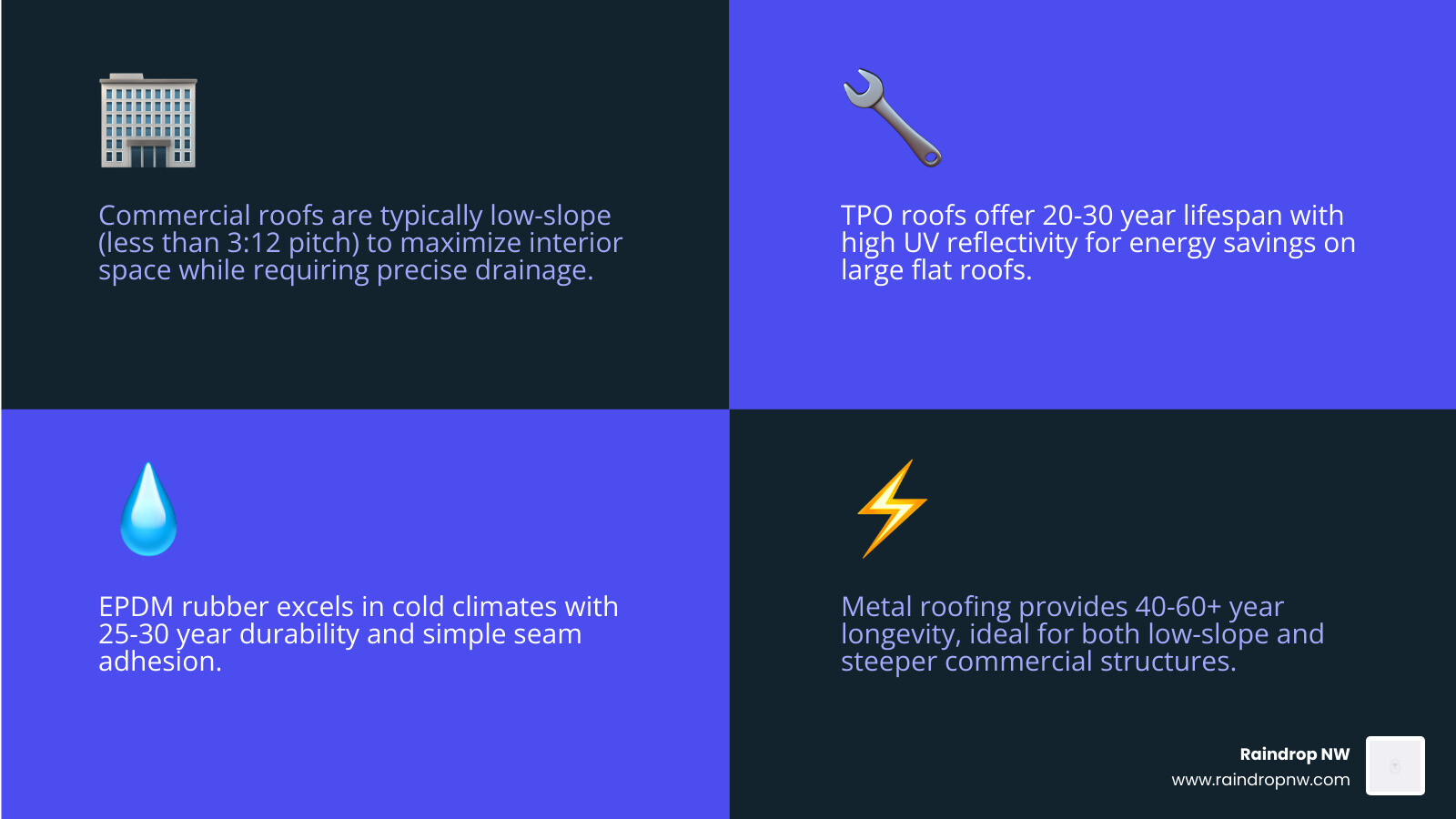
Understanding Commercial Roofing Options and What to Expect
When we talk about commercial roofing, we are usually discussing “low-slope” systems. While a residential home typically has a steep pitch to shed water quickly, commercial buildings like warehouses and retail centers in Beaverton or Portland are often designed with large, flat surfaces. However, “flat” is a bit of a misnomer. To prevent ponding water—which can lead to structural failure—even a flat roof must have a slight slope, usually at least 1/4 inch per foot, to guide water toward drains and scuppers.

The structural integrity of a commercial roof is also under more pressure than a typical home. It doesn’t just keep the rain out; it often supports massive HVAC units, refrigeration equipment, and exhaust fans. This means the material you choose must be able to handle “dead loads” (the weight of the equipment) and “live loads” (the weight of technicians walking on the surface to service that equipment).
Water management is the single most important job of these systems. Unlike a sloped roof where gravity does most of the work, a low-slope system relies on watertight seams and high-performance membranes to keep the interior bone-dry. For more detail on specific products, you can check out more info about commercial roof types.
Comparing Commercial Roofing Options and What to Expect by Material
Choosing a material isn’t just about the initial purchase; it’s about the lifecycle. In April 2026, we are seeing a massive shift toward materials that prioritize energy reflectivity and long-term durability. Here is how the heavy hitters stack up:
- TPO (Thermoplastic Polyolefin): Currently holding about 40% of the market share for new construction, TPO is a single-ply reflective membrane. It’s popular because it combines the best traits of EPDM and PVC but often at a more accessible entry point.
- EPDM (Ethylene Propylene Diene Monomer): This is the classic “rubber roof.” It’s incredibly durable and handles the freeze-thaw cycles of the Pacific Northwest exceptionally well. It captures about 22% of the new construction market.
- PVC (Polyvinyl Chloride): The gold standard for restaurants and industrial facilities. It is highly resistant to chemicals, grease, and fire.
- Metal Roofing: While the upfront investment is higher, metal can last 40 to 60 years. It’s often used on sloped commercial facades or for high-end retail spaces where aesthetics and longevity are paramount.
- Modified Bitumen & BUR: These are “multi-ply” systems. Instead of one thick membrane, they use multiple layers of asphalt-soaked fabrics. They are incredibly tough against foot traffic and punctures.
Single-Ply Membrane Performance
Single-ply membranes (TPO, EPDM, and PVC) have revolutionized the industry because they are manufactured with precise quality control. Unlike older systems that were built layer-by-layer on your roof, these arrive in large rolls, meaning fewer seams and a more consistent finish.
One of the biggest advantages of thermoplastic membranes (TPO and PVC) is that their seams are heat-welded. This creates a physical bond that is actually stronger than the membrane itself, making them highly resistant to leaks at the most vulnerable points. EPDM, being a “thermoset” rubber, typically uses adhesive or tape for seams. While EPDM is famous for its weathering resistance, TPO and PVC are the champions of UV reflectivity, often reflecting up to 85% of solar heat. This can cut cooling costs by 20-30% during our increasingly hot Oregon summers.
Choosing the Right System for Your Building Type
The “best” roof doesn’t exist in a vacuum; it depends on what happens inside and on top of your building.
- Warehouses: These buildings usually have massive surface areas. TPO is often the go-to here because it is cost-effective and provides the energy efficiency needed to keep large open spaces cool.
- Retail Centers: Curb appeal and HVAC access are the priorities. Since retail roofs often see a lot of foot traffic from maintenance crews, a thicker membrane or a multi-ply system like Modified Bitumen is a smart play.
- Office Buildings: Noise reduction and HVAC integration are key. PVC and TPO are excellent because they allow for easy detailing around the many vents and units found on office roofs.
- Healthcare Facilities: Reliability is non-negotiable. Many hospitals opt for PVC or Modified Bitumen because they offer superior chemical resistance and redundancy. A leak in a surgical suite isn’t just an inconvenience; it’s a crisis.
- Restaurants: If you have kitchen exhaust fans, you need PVC. Grease will eventually eat through TPO and EPDM, but PVC is designed to withstand it.
Before making a final call, it’s essential to have a professional assessment of your current deck and insulation. You can find more info about commercial inspections to see what we look for during a site visit.
Climate and Energy Efficiency Considerations
In the Pacific Northwest, we deal with a unique mix of heavy rain, moss growth, and intense summer sun. This makes cool roofs a major trend in 2026. A white or light-colored TPO membrane can significantly reduce the “Urban Heat Island” effect, keeping your building cooler and reducing the strain on your HVAC system.
Beyond the membrane, the R-value (insulation thickness) is critical. Modern building codes in Oregon and Washington have become much stricter regarding thermal insulation. Proper insulation doesn’t just keep you warm in the winter; it can reduce your annual energy expenses by 10-15%. We often recommend using polyisocyanurate (polyiso) board, which offers high thermal resistance and a solid substrate for the roofing membrane.
The Commercial Roofing Installation Process and Timeline
We know that for a business owner, “roofing project” often sounds like “business disruption.” Our goal is always to minimize that. For a standard 20,000 sq. ft. commercial project, the installation typically spans 5 to 10 days, depending on the complexity and weather.
The process generally follows these steps:
- Site Preparation & Safety: We set up safety barriers and staging areas. Because we are a local, independently owned company, we take extra care to ensure our equipment doesn’t block your customers or tenants.
- Tear-Off (if needed): We remove the old roofing material down to the deck. We also perform a moisture scan to ensure no trapped water remains in the substrate.
- Insulation & Cover Board: We lay down the thermal layers and a cover board to provide a smooth, impact-resistant surface.
- Membrane Installation: The rolls are laid out, fastened or adhered, and the seams are welded or taped.
- Detailing: This is where the skill shows. We flash all penetrations (pipes, vents, HVAC curbs) to ensure they are watertight.
- Final Inspection: A thorough walkthrough to ensure everything meets manufacturer specifications and local codes.
For more on what a full replacement looks like, see more info about new commercial roofs.
Minimizing Operational Downtime
We understand that you can’t just close your doors because the roof is being worked on. We use a staged installation approach, meaning we only tear off what we can replace in the same day. This keeps your building “dry-in” at all times.
Communication is our best tool for minimizing disruption. We provide clear schedules so you know when to expect noise or when a certain part of the parking lot will be used for material staging. By managing debris daily and maintaining strict safety compliance, we ensure your employees and customers stay safe while we work overhead.
Maintenance and Longevity: What to Expect Post-Installation
A commercial roof is an asset that requires management. “Out of sight, out of mind” is the leading cause of premature roof failure. Most single-ply systems are designed to last 20 to 30 years, but only if they are cared for.
Routine maintenance should include:
- Twice-Yearly Inspections: Ideally in the spring and fall, plus after any major wind or hail storms.
- Drain and Gutter Cleaning: Clogged drains lead to ponding water, which adds thousands of pounds of stress to your building’s structure.
- Seam and Flashing Checks: We look for any signs of “bridging” or splitting where the membrane meets walls or pipes.
- Puncture Repair: Rooftop equipment service often leads to dropped tools or screws. Finding these early prevents them from becoming leaks.
Warranties are a big part of the protection package. There are two main types: the manufacturer’s warranty (covering the material) and the contractor’s workmanship warranty. For a deep dive into what is covered, read more info about commercial warranties.
When to Repair vs. Replace
This is the most common question we get. As a general rule, we use the 25-30% rule: if more than 25-30% of the roof is damaged or the insulation is widespread with moisture, a full replacement is usually more cost-effective than constant patching.
However, if the issues are localized—like a few failed seams or a single leaking HVAC curb—a repair is the way to go. In some cases, if the existing roof is structurally sound but aging, we can apply restoration coatings. This can extend the life of your roof by 10-15 years and improve energy reflectivity without the cost of a full tear-off. It’s all about analyzing the total lifecycle cost rather than just looking at the immediate price tag.
Frequently Asked Questions about Commercial Roofing
What are the most common commercial roofing options and what to expect regarding lifespan?
The most common options are TPO, EPDM, PVC, and Metal. You can generally expect 20-30 years for single-ply membranes (TPO/EPDM/PVC) and 40-60+ years for metal systems. Factors like maintenance frequency and the quality of the initial installation significantly impact whether you hit the high or low end of those ranges.
How do energy-efficient cool roofs benefit commercial properties in 2026?
Cool roofs use highly reflective surfaces (like white TPO or PVC) to bounce solar energy away from the building. In 2026, with rising energy costs and stricter environmental regulations in the Pacific Northwest, these roofs are essential. They can reduce peak cooling demand by up to 15%, lower your energy bills, and extend the life of your HVAC equipment by reducing its workload.
What should I look for in a commercial roofing warranty?
Look for an NDL (No Dollar Limit) warranty from a reputable manufacturer. This means if there is a failure covered by the warranty, the manufacturer will pay the full cost of the repair, regardless of the original price of the roof. Also, ensure your contractor provides a separate workmanship warranty. At Raindrop NW, we pride ourselves on long-term accountability—we’re local, so if you have a problem, you know exactly where to find us.
Conclusion
Navigating commercial roofing options and what to expect doesn’t have to be overwhelming. Whether you are managing a retail strip in Tigard or a warehouse in Hillsboro, the goal is the same: a reliable, energy-efficient system that lets you focus on your business instead of the weather forecast.
At Raindrop NW, we do things differently. While many local roofing companies have been bought out by large, out-of-state investment firms, we remain a truly local, independently owned company based right here in Beaverton. We live in the communities we serve—from Vancouver and Camas down to Lake Oswego and Oregon City. This means our reputation is on the line with every seam we weld and every drain we clear. We aren’t looking for a quick transaction; we are looking to be your roofing partner for the next thirty years.
If you’re ready to discuss your building’s needs or need a professional eye to evaluate your current system, we’re here to help. Learn more about our commercial roofing services and let’s build a plan that protects your investment for the long haul.




Leave a Reply
Want to join the discussion?Feel free to contribute!